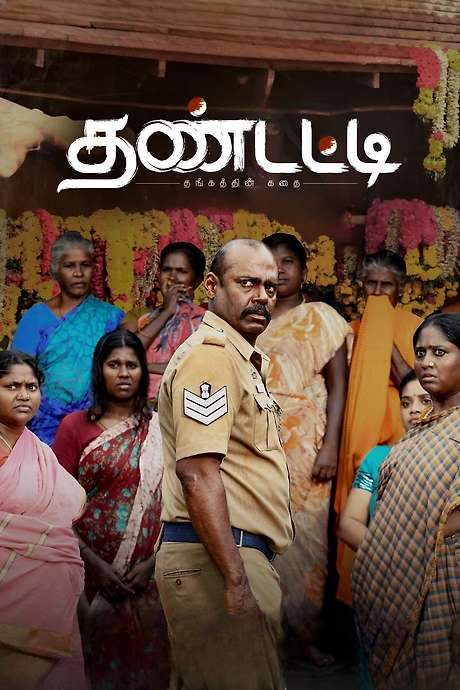
Constable Subramani is introduced as a police officer renowned for his quick, impulsive decisions. In a tense scene, he shoots a criminal who tries to flee, earning the wrath of his superiors and setting a controversial tone for his character.
One day, a disheveled young man named Selvarasu arrives at the station from Kidaripatti, begging for help to locate his grandmother, Thangaponnu. The other officers are wary of getting involved with villagers who have a history of trouble, but Subramani volunteers to take the case. As the search unfolds, Selvarasu reflects on fond memories of his grandmother and the way her daughters have quietly siphoned away her wealth, property, and jewelry. The one thing she clings to is her solid gold ear piece, the thandatti, a priceless heirloom that carries deep emotional weight. In flashback, we learn that in her youth, Thangaponnu eloped with a man named Veera from a different community, and Veera gifted her the thandatti. That act triggers a family calamity: Thangaponnu’s brother arrives with his men, Veera is killed, and Thangaponnu is forcibly married to another man. She clings to Veera’s memory and to the thandatti for years.
In the present, Subramani eventually locates a frail Thangaponnu by the roadside and admits her to a hospital, where she passes away. Selvarasu is crushed, and he pleads with Subramani to accompany him back to the village so the family can mourn without further disruptiveness. At the village, Subramani discovers that Thangaponnu’s daughters and her alcoholic son are more interested in grabbing the last piece of her legacy than in honoring her memory. While the funeral is being prepared, the thandatti goes missing overnight, sparking a heated dispute among the grieving family, each side accusing the other of theft. Subramani is left to untangle the tangled web of rumors and chase down any clue that could explain the disappearance.
A glimmer of hope arrives in the form of an officer from a life insurance company who reveals that Thangaponnu’s policy has matured, releasing a large sum of money to be shared among her children. The family momentarily forgets the missing thandatti in the face of this financial windfall, a development that leaves Subramani feeling disillusioned by their priorities. Just as the mourners prepare to proceed with the cremation, a casteist man—proud of his village’s long, brutal history of honor killings—threatens to disrupt the funeral procession because Thangaponnu helped his daughter elope with a man from a different community. Subramani confronts him and his associates, delivering a decisive victory that earns the respect of the entire village, who had previously seen him as quiet and unassuming.
With the crowd behind him, Subramani leads the funeral procession to a peaceful cremation for Thangaponnu. When the village disperses, Subramani stands alone by the funeral pyre. It is revealed that the missing thandatti had been in his possession all along. In a quiet exchange just before her death, Thangaponnu recognizes Subramani as her long-lost love Veera, a bond that had been presumed dead. They reminisce about their past and the choices that led to their current lives. Thangaponnu’s life has been marked by clandestine support for couples fleeing oppressive circumstances, a measure to spare others from the fate she and Subramani endured. Subramani, who never remarried, reveals that he has lived with nothing but memories. He fulfills Thangaponnu’s last wish by returning the thandatti to the fire and letting it burn away with her, a symbolic culmination of their shared history.




![Investigation of a Citizen Above Suspicion [re-release] movie poster](https://whats-after-the-movie-ti152.sevalla.storage/movies/investigation-of-a-citizen-above-suspicion.jpg)