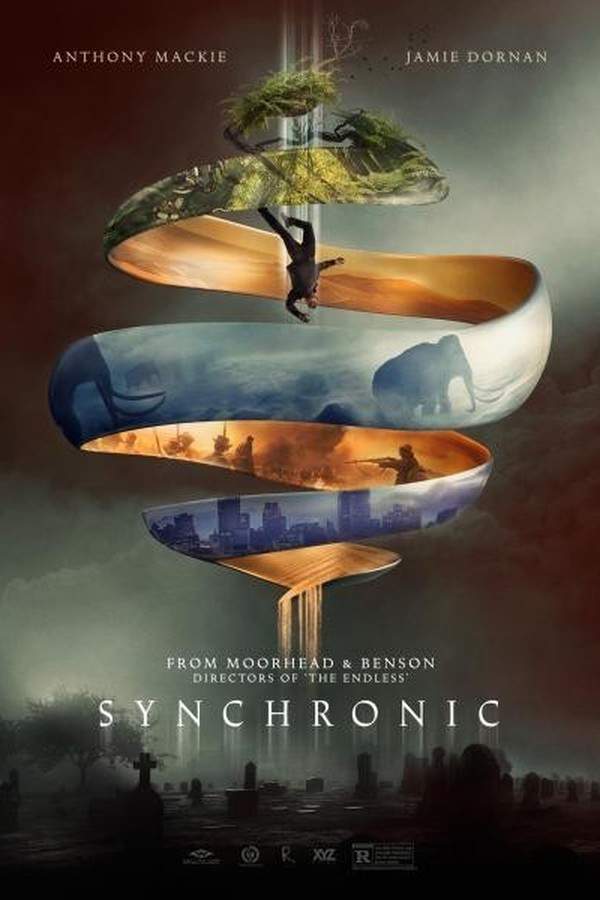
In Synchronic, Steve, a womanizing New Orleans paramedic, teams up with his devoted partner, Dennis, to tackle a pall of deaths linked to a mysterious designer drug called Synchronic. When Steve is accidentally pricked by a contaminated needle during a call, doctors uncover not only a possible infection but also an aggressive cancer lodged in his underdeveloped pineal gland, a diagnosis that frames the race against time from the very start.
Driven to uncover the truth about Synchronic, Steve traces the drug to its creator and learns a startling secret: the substance warps the pineal gland’s perception of time, hurling users backward through history. The effects are stark and surreal—children experience full time travel, while adults drift through the past as ghost-like echoes. This is not merely a mind game; it reshapes lives as it pulls people toward eras they cannot fully belong to.
Meanwhile, Dennis’s teenage daughter, Brianna, disappears, placing immense strain on his marriage and testing the trust between the men. Dennis misreads Steve’s illness and the painkiller use as addiction, and their frictions explode into a physical confrontation that underscores how fear and suspicion can fracture even close partnerships.
Fueled by his diagnosis and the urgent need to find Brianna, Steve experiments with Synchronic, venturing through Louisiana’s layered past. He brushes against history in dramatic vignettes—confrontations with a conquistador and, later, the Ku Klux Klan—while his loyal dog Hawking stays by his side until the 1920s, when the animal is lost to the time drift. Steve also discovers a crucial rule: the location where the pill is taken dictates the destination year.
As the time-travel mystery deepens, Steve realizes that physical contact with objects can act as an anchor, locking a traveler to a specific moment. He returns to the park where Brianna disappeared, briefly meeting prehistoric tribesmen, and learns that Brianna may have wandered off before she ever took Synchronic.
Reconciliation comes with honesty: Steve reveals his cancer and shares the time-travel footage with Dennis. They examine the footage, then journey to the cemetery where Steve’s family lies, before heading back to the park to resume the search.
Amid the chaos of the Battle of New Orleans, Steve finally locates a frightened Brianna. A threatening looter mistakes Steve for a runaway slave, and Steve sacrifice himself as a distraction so Brianna can use his last pill to return to the present. Fatally wounded and with the looter killed by a landmine, Steve carves the word “ALLWAYS” into a boulder, a symbolic tattoo of his origin in the modern era.
Dennis embraces Brianna as Steve’s spectral presence lingers, and the two men acknowledge each other in a final, quiet moment. The film closes on a close-up of their hands clasped together, signaling a fragile reconciliation between past and present and leaving a poignant note on memory, loss, and the enduring bonds of family.