















Plot Explained Spoilers guaranteed!
Plot Explained

Browse by genre

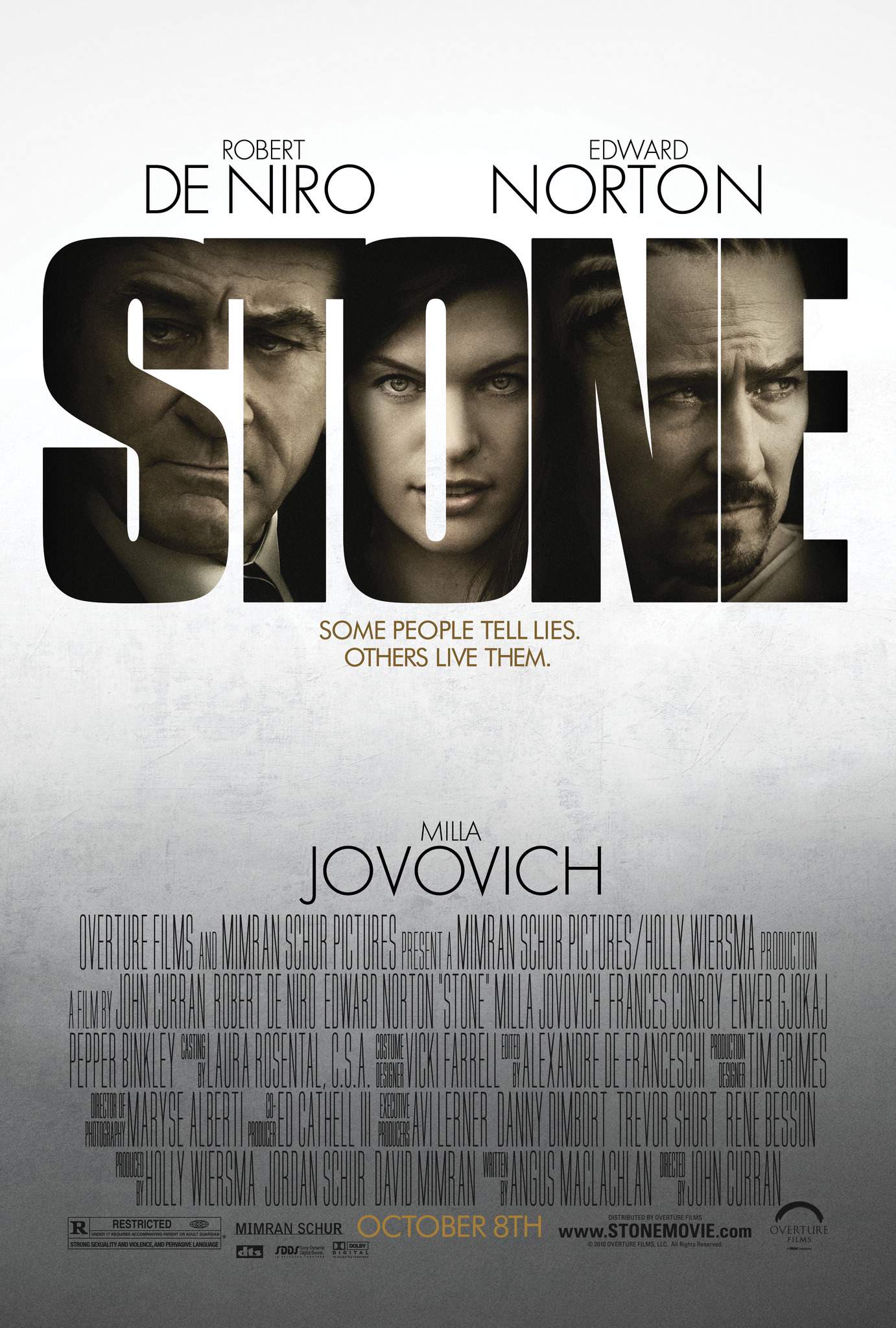
Stone (2010) movie poster

Timeline

Stone (2010) Timeline Explained – Every Event in Order

Release, runtime and language
2010 · 105 min · English
JustWatch #9,470 7
Directed by
John Curran
Starring
Robert De Niro, Edward Norton, Milla Jovovich
Budget
$22M

A seasoned detective, burdened by personal struggles, unexpectedly teams up with an enigmatic young woman. Together, they face danger while uncovering a conspiracy involving a powerful and secretive government agency. He must confront not only external threats but also his own inner demons as they navigate a complex and perilous situation, revealing hidden agendas and long-held secrets.

On this page (6)
  1. 1 Where to watch
  2. 2 Events in order (15)
  3. 3 Timeline questions answered
  4. 4 Movie threads
  5. 5 Movies like Stone
  6. 6 Every angle

Where to watch

Where to Watch Stone (2010)

Where can you watch Stone? Stream, rent or buy it in the US, including on Philo, Starz and Fawesome: current JustWatch availability with up-to-date prices.

Streaming availability powered by JustWatch

15 events in order · contains spoilers

Stone Timeline: Events in Chronological Order

Every key event of Stone (2010) in order, scene by scene, with when and where it takes place. Use it to untangle flashbacks, time jumps and parallel storylines, to refresh your memory before the sequel or to find the exact scene you are thinking of.

  1. Madylyn Puts Her Daughter to Bed

    Young mother Madylyn Mabry tenderly puts her daughter to sleep, ensuring her comfort and safety. Meanwhile, her husband Jack is absorbed in a ball game on television, indicating a disconnect in their relationship.

  2. Jack’s Disturbing Threat

    In a desperate attempt to halt Madylyn from leaving, Jack holds their daughter out the window and threatens to drop her. This shocking act forces Madylyn to reconsider her decision, showcasing the extreme dynamics of their tumultuous marriage.

  3. Jack and Madylyn's Routine

    Years pass, and Jack and Madylyn return home from church, settling into their habitual lifestyle. Jack resumes his routine of watching TV and drinking, while Madylyn engages in puzzles, reflecting their mundane, yet strained existence.

  4. Bobby's Funeral

    Late one night, Jack receives a distressing phone call that leads him to attend his brother Bobby's funeral the next day. The event marks a poignant moment as Jack grapples with grief and unprocessed emotions from his past.

  5. Jack's Shift at the Prison

    As a parole officer, Jack arrives at the prison while listening to Christian radio, providing insight into his internal struggles. He conducts meetings with inmates but is increasingly burdened by the pressures of his upcoming retirement.

    Where
    Prison
  6. Meeting Gerald Creeson

    Jack meets a new inmate named Gerald Creeson, also known as Stone. Stone is straightforward in his desire for an early release, presenting Jack with a challenge that tests Jack’s professional boundaries and personal beliefs.

    Where
    Prison
  7. Jack Confronts Stone

    Tensions escalate during their interaction when Jack angrily demands Stone to sit down. Their contrasting personalities clash, as Jack tries to establish rapport while dealing with Stone's brash demeanor and inappropriate comments about his wife.

    Where
    Prison
  8. Jack and Madylyn's Distanced Relationship

    That night, Jack shares drinks with Madylyn as they listen to a program on predestination. Despite her attempts to connect, Jack remains detached, reflecting the growing rift between them.

  9. Lucetta's Warm Nature

    In a contrasting sequence, Lucetta is shown joyfully working with preschoolers, revealing her vibrant personality. This juxtaposition highlights the stark differences between her life and Stone's troubled past.

  10. Lunch Discussions with Lucetta

    Jack's interactions with Lucetta during lunch become laden with tension as they reveal their vulnerabilities. Their dialogues explore deeper emotional connections, blurring the lines between their respective lives.

  11. Jack's Internal Struggles

    As Jack continues to navigate his life, he spirals into a state of turmoil influenced by his interactions with Stone and Lucetta. The emotional strain reveals the complexities of love, betrayal, and moral dilemmas he faces.

  12. Confrontation with Stone

    Jack's ultimate meeting with Stone reveals philosophical discussions on guilt and redemption. Their dialogue pushes Jack to confront his beliefs and unveil the deeper consequences of their interactions.

    Where
    Prison
  13. The Haunting Fire

    As the climax approaches, a haunting fire symbolizes destruction and rebirth. Jack faces a downward spiral, confronting a pivotal moment that forces him to reevaluate his past decisions and their impact on his life.

  14. Jack's Metamorphosis

    Through his journey, Jack undergoes a significant transformation as he grapples with his faith, morality, and human relationships. His encounter with the remnants of chaos leads him to a crossroads that will redefine his identity.

  15. Confronting Existence

    In the film's closing moments, Jack must confront the intertwining actions of himself with those of Stone and Lucetta. This confrontation forces Jack to face the complexities surrounding love, hate, life, and death.

Last updated: October 31, 2024 at 15:00

Was this helpful?

Timeline questions answered

Stone Timeline Explained: Your Questions Answered

When does it happen, and why in that order? The questions people ask about the chronology of Stone (2010): time jumps, flashbacks, cause and effect between scenes and the correct order of events, each answered with spoilers.

Q1

Why does Jack threaten to drop his daughter out the window?

Jack threatens his daughter because Madylyn announces she wants to leave him. In a desperate and violent response, Jack grabs their child and holds her out the window, demanding she stay. This extreme act reveals Jack's controlling nature and the toxic dynamics of their marriage, forcing Madylyn to comply against her will.

Foreshadowing: The opening scene establishes Jack's capacity for desperate violence when he feels his control slipping, setting up his later moral breakdown.

  • jack mabry
  • daughter
  • threatening
  • madylyn
  • domestic violence
Q2

Who is Betsy and why does the phone call upset Jack?

Betsy is Jack's brother Bobby's widow, who calls to inform Jack of Bobby's death. The phone call late at night disturbs Jack and Madylyn's peace, leading Jack to attend Bobby's funeral the next day. This suggests Jack has unresolved grief and potentially complicated feelings about his brother.

Foreshadowing: Bobby's death haunts Jack throughout the film, contributing to his psychological turmoil and questioning of faith.

  • bobby
  • beth
  • phone call
  • funeral
  • death
Q3

What is Stone's crime and why is he in prison?

Stone (Gerald Creeson) is incarcerated for arson. He set a fire that killed his grandparents, though the full details of the crime are revealed gradually through his conversations with Jack. Stone shows little remorse for this act, which forms the basis of his philosophical discussions with Jack about guilt and morality.

  • stone
  • gerald creeson
  • arson
  • grandparents
  • prison
Q4

Why does Jack meet with Lucetta despite her being Stone's wife?

Lucetta reaches out to Jack, and they begin having lunch discussions. During these meetings, Jack and Lucetta slowly reveal their vulnerabilities to each other. Jack is drawn to her warmth and brightness, which contrasts sharply with the darkness of his own life and his job dealing with criminals. Their relationship becomes a source of emotional connection for both isolated individuals.

Foreshadowing: Lucetta's warm nature, shown in her work with preschoolers, hints at her capacity for genuine connection despite her troubled marriage to Stone.

  • lucetta
  • milla jovovich
  • lunch
  • connection
  • stone's wife
Q5

What happens during the fire at the end of the film?

As the climax approaches, a fire breaks out that serves as a symbolic and literal destruction. Jack faces a downward spiral during this fire, confronting the consequences of his decisions. The fire represents destruction, loss, and potential rebirth, though the exact circumstances and responsibility for the fire remain ambiguously tied to the chaos of the narrative.

  • fire
  • climax
  • destruction
  • burning
  • climax
Q6

What is the significance of the predestination discussions on the radio?

Jack frequently listens to Christian radio programs discussing predestination, which reflects his internal struggle with faith, fate, and moral responsibility. These programs play during pivotal moments in Jack's life, symbolizing his search for meaning and his questioning of whether his actions and suffering are predetermined or within his control.

Foreshadowing: The recurring radio discussions plant themes of fate versus free will that later emerge in Jack's philosophical debates with Stone.

  • predestination
  • radio
  • faith
  • Christian
  • fate
Q7

Why does Jack's life start to unravel?

Jack's life spirals due to multiple factors converging: the stress of his upcoming retirement, his meetings with the manipulative Stone, his growing emotional involvement with Lucetta, and the unresolved trauma from his brother's death. These pressures clash with his repressed guilt over his marriage, his threatening of his daughter, and his crisis of faith, causing his mental state to deteriorate.

  • jack mabry
  • breakdown
  • stress
  • retirement
  • turmoil
Q8

What does Jack discuss with Stone about guilt and redemption?

Jack and Stone engage in deep philosophical conversations about guilt, morality, and redemption. Stone challenges Jack's beliefs about sin and forgiveness, pushing him to confront his own moral compromises. These dialogues explore whether true redemption is possible and whether guilt can ever be washed away, themes that become increasingly personal for Jack as the film progresses.

  • stone
  • jack
  • philosophy
  • guilt
  • redemption
  • morality
Q9

What happens to Jack at the end of the film?

Jack undergoes a metamorphosis as he confronts the core of his existence. The ending is ambiguous, suggesting Jack reaches a crossroads that fundamentally changes who he is. He must face the consequences of his actions and decisions, though the exact outcome remains open to interpretation, leaving questions about whether he finds redemption, destruction, or transformation.

  • jack mabry
  • ending
  • transformation
  • metamorphosis
  • fate
Q10

Why does Madylyn agree to stay with Jack after the threat?

Madylyn agrees to stay because Jack threatens to drop their daughter if she leaves. This traumatic event forces her to abandon her plan to leave, though it establishes a relationship built on coercion and fear rather than love or mutual respect. Years later, their marriage remains strained and empty, with Madylyn finding solace in puzzles while Jack immerses himself in television and drinking.

  • madylyn
  • jack
  • marriage
  • stay
  • threatened
  • daughter
Q11

How does Stone describe Lucetta to Jack?

Stone describes Lucetta to Jack in offensive terms, calling her an "alien" and a "dime" (referring to her as inexpensive). He graphically illustrates her wild sexuality and warns Jack to "watch out" during their conversations, revealing Stone's objectifying and dismissive attitude toward his wife. This contrasts sharply with the warm, nurturing image of Lucetta that emerges elsewhere in the film.

  • stone
  • lucetta
  • wife
  • alien
  • dime
  • relationship
Q12

Why is Jack unhappy in his marriage to Madylyn?

Jack's marriage to Madylyn is unhappy because their relationship was built on coercion, Maddylyn only stayed after Jack threatened their daughter. Years later, Jack continues his routine of watching TV and drinking while Madylyn engages in solitary activities like puzzles. They are emotionally distant, with Jack appearing detached and lost in his thoughts, unable to truly connect with his wife despite living together.

  • jack
  • madylyn
  • marriage
  • unhappy
  • distant
  • routine

Movie threads

More Movies Like Stone, by Mood & Story

Curated lists built around what makes Stone tick: the same mood, the same kind of story or the same emotional payoff. Each list explains why these movies belong together.

Movies with slow burn psychological unease like Stone

Stories where simmering dialogue and internal tension create a suffocating atmosphere. If you liked the oppressive, dialogue-heavy tension of Stone, explore more movies that build dread through psychological manipulation and moral decay. These similarly-paced dramas and thrillers feature ambiguous characters and a focus on internal turmoil over fast-paced plots.

  • slow burn
  • psychological
  • unsettling
  • claustrophobic
  • oppressive
  • uneasy
  • Tone: dark, unsettling, oppressive
  • Pacing: slow, deliberate, simmering
Why these movies?

The story pattern: Narratives in this thread unfold slowly, often centered on intense, manipulative relationships that erode the characters' sanity and morals. The plot progression is secondary to the psychological unraveling, leading to ambiguous or bleak conclusions that reflect the internal damage inflicted.

Why they belong together: Movies are grouped here for their shared commitment to a slow, deliberate pacing that amplifies psychological tension. They feature heavy emotional weight, dark tones, and a focus on the unsettling dynamics between characters, creating a consistently oppressive and thought-provoking viewing experience.

Movies about moral collapse and questioned redemption like Stone

Character studies where flawed individuals confront their own ethical decay. Fans of Stone's exploration of spiritual crisis and moral decay will find similar themes here. These films feature protagonists grappling with their own darkness, set against gritty backdrops, and often end on ambiguous notes about the possibility of change.

  • philosophical
  • gritty
  • melancholic
  • moral ambiguity
  • existential
  • heavy
  • Tone: dark, philosophical, gritty
  • Pacing: slow, character-driven
Why these movies?

The story pattern: The narrative pattern involves a world-weary protagonist, burdened by personal failings, whose beliefs are challenged by a catalyst character or event. The story is a philosophical battleground, exploring themes of deception, betrayal, and the fragile nature of morality, without offering easy answers.

Why they belong together: These films are connected by their heavy emotional weight, dark tone, and focus on themes of moral decay, spiritual crisis, and redemption. They feature complex character arcs where existential doubt is central, and the endings often leave the character's transformation open to interpretation.

If you liked this

Movies Like Stone

Similar movies to Stone: the same genre, themes or kind of story. Each one comes with its own plot summary, timeline and ending explained.

Browse all movie summaries

Every angle

Stone (2010) Explained: Plot, Timeline & Characters

Everything about Stone in one place: what happens in the plot summary, the timeline in chronological order, the characters and meaning and a spoiler-free summary. What's After the Movie adds the cast, box office and post-credit scenes.

Coming soon on iOS and Android

The Plot Explained Movie Summary App

Plot summaries, endings explained and timelines on your phone. Catch up on any movie in minutes, save your favorites and never miss a twist again.

Be the first to know when we launch. Your email stays private, always.

Learn more about the app