Plot Explained Spoilers guaranteed!
Plot Explained

Browse by genre

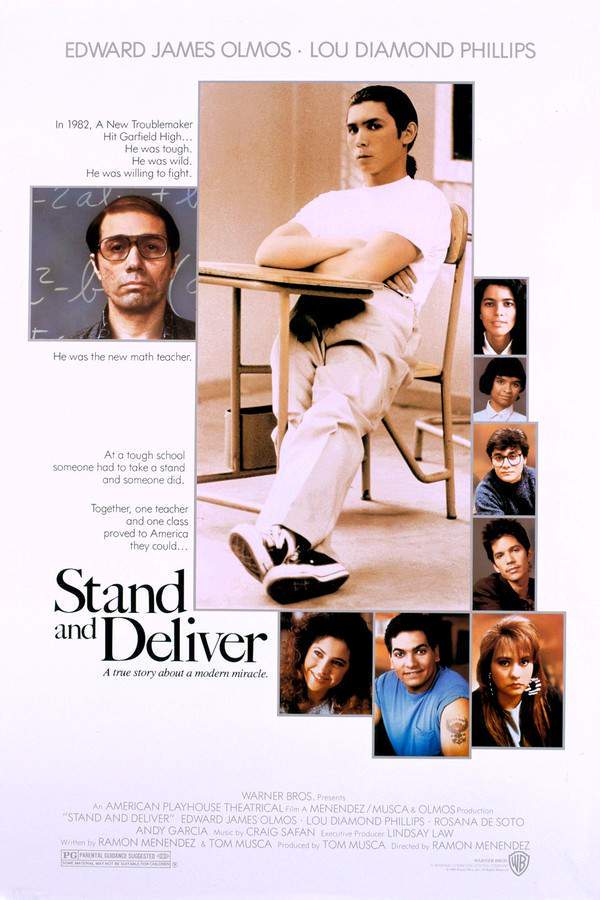
Stand and Deliver (1988) movie poster

Plot Summary

Stand and Deliver (1988) Plot Summary Explained

Release, runtime and language
1988 · 103 min · English
Loading streaming availability…
Directed by
Ramón Menéndez
Starring
Estelle Harris, Edward James Olmos, Adelaida Alvarez, Carmen Argenziano, Eliot, Ingrid Oliu

A dedicated high school math teacher, Jaime Escalante, inspires a class of predominantly Latino students in Los Angeles to pursue calculus. Facing prejudice, systemic challenges, and skepticism from the school administration, he pushes them to achieve remarkable success. Their accomplishments are met with accusations of cheating, forcing Escalante and his students to fight to prove their abilities and defend their hard-earned victory.

On this page (6)
  1. 1 Where to watch
  2. 2 What happens: full plot
  3. 3 Plot questions answered
  4. 4 Movie threads
  5. 5 Movies like Stand and Deliver
  6. 6 Every angle
Loading streaming availability…

Full plot summary · contains spoilers

What Happens in Stand and Deliver: Full Plot Summary

The whole story of Stand and Deliver (1988) explained, from the opening scene to the final frame: every key event, every twist and what it all adds up to. Read it as a quick recap before the sequel, to check a scene you missed, or to finally understand what really happened.

Based on a true story, this poignant and low-budget theatrical masterpiece unfolds in the backdrop of Eastern LA. In a community that prioritizes quick fixes over education, Jaime A. Escalante, played by Edward James Olmos, steps in as a new teacher at James A. Garfield High School. His mission is ambitious—to transform the educational landscape and inspire students to achieve higher levels of excellence. Initially taking a drastic pay cut to leave his steady job, Escalante finds himself in a challenging environment where students are more familiar with rebellion than respect for academics.

At first, his approach is met with hostility; students subject him to taunts and threats, perceiving him as stubborn, particularly when their personal struggles become evident. However, as time goes on, Escalante's innovative teaching methods begin to break through. He employs props, humor, and real-life applications of mathematics to engage his students, demonstrating that math is a vital part of everyday life. Through his efforts, he helps even the most troubled teens evolve into diligent learners eager to grasp complex concepts.

While teaching Math 1A, Escalante quickly realizes that his students possess potential far beyond what the school board anticipates. Despite the skepticism of other educators who argue that "you can't teach logarithms to illiterates," he develops a rigorous curriculum that empowers his students to tackle AP Calculus by their senior year, enabling them to earn college credits. This demanding program requires students to attend summer classes and Saturday sessions, lasting from 7 AM to noon—no small feat, especially when peers engage in less academic pursuits.

As these students grapple with the stark differences between their home lives and the academic ambitions Escalante instills, they begin to find their voices and rise above the low expectations imposed on them. Under Escalante's nurturing guidance, they find the strength to pursue their personal goals, striving for success rather than succumbing to societal pressure.

When the spring of senior year arrives, the students take their AP Calculus exam, experiencing relief and joy upon completing a challenging year. Their euphoria is short-lived, however, as a shocking accusation arises: the Educational Testing Service questions the validity of their scores after noticing patterns in errors that seem improbable. Outraged and feeling the weight of racial and economic prejudices, Escalante confronts the investigating professors, acknowledging his unintentional role in their scoring similarities.

Determined to validate his students’ abilities and prove their worth to both the school and the nation, they agree to retake the test by summer's end. With only one day to prepare, the pressure is enormous, but they prepare to show they are capable of success. When the results arrive and they pass once again, Escalante retains his composure, calmly stating that he demands the reinstatement of their original scores, solidifying their accomplishments as the true fruits of their labor.

In the end, it’s a powerful tale of resilience and vision—The Numerators.
Last updated: November 07, 2024 at 23:22

Was this helpful?

Plot questions answered

Stand and Deliver Plot Explained: Your Questions Answered

The questions people ask most about Stand and Deliver (1988): what happens in the confusing scenes, why the characters do what they do, the twists, hidden details and what the ending means. Each answer contains spoilers.

Q1

Why was Escalante willing to take a pay cut to teach at Garfield High?

Escalante left his steady job to teach at James A. Garfield High School because he had an ambitious mission to transform the educational landscape in a community that prioritizes quick fixes over education. He believed his students possessed untapped potential far beyond what school authorities expected, and he was determined to inspire them to achieve higher levels of excellence.

Foreshadowing: Earlier scenes establish that Escalante's decision is driven by personal conviction rather than financial gain, as he takes a significant pay cut to pursue teaching.

  • jaime escalante
  • garfield high school
  • teacher motivation
  • pay cut
  • education reform
Q2

How did Escalante gain his students' trust after initial hostility?

Escalante broke through the students' hostility by employing innovative teaching methods using props, humor, and real-life applications of mathematics. He demonstrated that math is a vital part of everyday life, which helped students see the relevance of education. Over time, his charismatic approach and genuine belief in their potential slowly broke down the barriers of apathy and rebellion.

Foreshadowing: The timeline shows that Escalante's teaching methods gradually transform students from hostile to diligent learners eager to grasp complex concepts.

  • escalante teaching methods
  • student trust
  • math education
  • classroom engagement
Q3

Why were the Garfield High students accused of cheating on the AP Calculus exam?

The Educational Testing Service questioned the validity of the students' scores after noticing patterns in their errors that seemed improbable. The investigators suspected that the scoring similarities indicated cheating, rather than acknowledging that the students genuinely understood the material. This accusation reflected racial and economic prejudices, as the testers couldn't believe predominantly Latino students from a low-income area could achieve such high scores legitimately.

Foreshadowing: The AP exam results showing uniformly high scores raised suspicion among testing officials who expected lower performance from this student population.

  • ap calculus exam
  • cheating accusation
  • educational testing service
  • garfield high students
  • racial prejudice
Q4

What made the Garfield High calculus program unusual?

The program was unprecedented because Escalante pushed his predominantly Latino students to tackle AP Calculus by their senior year, enabling them to earn college credits. Other educators believed "you can't teach logarithms to illiterates," but Escalante's rigorous curriculum required summer classes and Saturday sessions from 7 AM to noon, a demanding schedule that pushed students outside their comfort zone while balancing challenging home lives.

Foreshadowing: The skepticism from other educators early in the film establishes that this academic achievement was considered impossible for students like those at Garfield High.

  • ap calculus
  • garfield high
  • advanced placement
  • calculus program
  • college credits
Q5

Why did Escalante acknowledge unintentional scoring similarities?

Escalante confronted the investigating professors and acknowledged his unintentional role in their scoring similarities. He recognized that his teaching methods, while effective, may have led students to solve problems in similar ways, using identical approaches and making the same types of mistakes. Rather than deny any responsibility, he focused on proving his students' actual abilities through the retake exam.

Foreshadowing: The investigation scene reveals Escalante's integrity and willingness to take accountability while fighting for his students' reputation.

  • escalante confrontation
  • scoring patterns
  • investigation
  • ap exam retake
Q6

How did students prepare for the AP retake exam with only one day?

Despite having only one day to prepare for the retake exam at the end of summer, the students demonstrated remarkable determination and resilience. The intense pressure from the cheating accusation, combined with Escalante's unwavering belief in their abilities, motivated them to showcase their true mathematical capabilities. Their success on the retake proved that their original scores were legitimate achievements earned through hard work.

Foreshadowing: The one-day preparation timeframe creates enormous tension, emphasizing the high stakes and the students' resolve to prove themselves.

  • ap exam retake
  • one day preparation
  • summer
  • garfield students
  • second exam
Q7

What does The Numerators mean at the end of the movie?

The Numerators refers to the students' accomplishments as the true fruits of their labor. After successfully passing the AP Calculus exam twice, Escalante demands the reinstatement of their original scores, asserting that their achievements are legitimate. The term symbolizes mathematical achievement while representing the students' journey from being undervalued to proving their intellectual worth.

Foreshadowing: Escalante's calm demand for score reinstatement following their successful retake validates the students' entire academic journey.

  • the numerators
  • ending
  • score reinstatement
  • vindication
  • achievement
Q8

Why did the school board and other teachers believe these students couldn't learn calculus?

The school board and other educators held deeply ingrained biases about what students from predominantly Latino communities in Eastern LA could achieve academically. They argued that "you can't teach logarithms to illiterates," reflecting systemic skepticism toward students who faced low expectations. This prejudice stemmed from racial and economic assumptions about the students' capabilities, ignoring their untapped potential that Escalante recognized.

Foreshadowing: Early scenes establish the institutional skepticism that Escalante must overcome to implement his ambitious curriculum.

  • school board skepticism
  • low expectations
  • racial prejudice
  • educational system
  • teachers
Q9

Why did the calculus program require such demanding summer and Saturday classes?

Escalante's rigorous curriculum required students to attend summer classes and Saturday sessions from 7 AM to noon because tackling AP Calculus by senior year demanded extensive preparation beyond normal school hours. This demanding schedule pushed students who faced peer pressure to engage in less academic pursuits to commit to their education. The intensive program was essential for covering college-level material while helping students balance their challenging home lives.

Foreshadowing: The timeline shows that this rigorous schedule was a key component of the program's success, pushing students outside their comfort zone.

  • summer classes
  • saturday sessions
  • ap calculus
  • rigorous curriculum
  • time commitment
Q10

How did students balance their home lives with Escalante's academic ambitions?

As students engaged in the rigorous academic pursuits, they grappled with conflicting pressures between their home lives and school ambitions. Many came from environments where education wasn't prioritized, and peers often engaged in less academic pursuits. Escalante's mentorship helped them find their voices and the strength to pursue personal goals rather than succumbing to societal pressure. Their journey represents overcoming both external obstacles and internal doubts.

Foreshadowing: The tension between home life and academic ambition is established early as students face challenges balancing their personal circumstances with educational goals.

  • home life conflict
  • family pressure
  • peer influence
  • student motivation
  • personal goals
Q11

What specific patterns in the exam answers made the testing service suspicious?

The Educational Testing Service noticed improbable patterns in the students' answer errors that seemed too consistent to be legitimate. They believed that genuine independent test-takers would not make the same types of mistakes in such uniform ways. This suspicion led to the accusation that the students had cheated, rather than considering that Escalante's consistent teaching methods might have produced uniformly well-prepared students who approached problems similarly.

Foreshadowing: The investigation focuses on statistical anomalies in error patterns rather than direct evidence of cheating.

  • ets
  • exam patterns
  • error analysis
  • suspicious scores
  • testing service
Q12

How did the cheating accusation reflect broader prejudice against the students?

The cheating accusation highlighted the racial and economic prejudices embedded in the educational system. The testing service's inability to believe that predominantly Latino students from a low-income high school could legitimately achieve high AP Calculus scores led to their investigation. Escalante confronted the investigators about this bias, and the entire controversy revealed the institutional barriers students from marginalized communities face when achieving academic success that defies stereotypes.

Foreshadowing: The confrontation scene explicitly addresses how racial and economic prejudices shaped the investigation.

  • racial prejudice
  • institutional bias
  • educational inequality
  • discrimination
  • academic stereotyping

Movie threads

More Movies Like Stand and Deliver, by Mood & Story

Curated lists built around what makes Stand and Deliver tick: the same mood, the same kind of story or the same emotional payoff. Each list explains why these movies belong together.

Inspiring teacher movies like Stand and Deliver

Dedicated mentors who defy the system to unlock student potential. Discover movies like Stand and Deliver that focus on dedicated teachers and transformative classrooms. If you enjoyed the story of Jaime Escalante, you'll find similar films about educators who inspire underdog students to overcome adversity and achieve academic success against the odds.

  • inspiring
  • uplifting
  • determined
  • frustrating
  • triumphant
  • hopeful
  • Tone: hopeful, determined
  • Pacing: steady, linear progression
Why these movies?

The story pattern: Stories in this thread typically follow a determined teacher who enters a challenging educational environment. They face skepticism from both the system and their students, but through unorthodox methods and sheer dedication, they break through barriers. The narrative builds steadily towards a climactic achievement, often challenged by outside forces, leading to a final validation of the students' hard work and the teacher's belief.

Why they belong together: These films are grouped by their shared focus on the teacher-student dynamic as a catalyst for change. They combine a hopeful, determined tone with a steady pace, creating an uplifting emotional arc centered on academic and personal triumph over systemic obstacles.

Movies about overcoming prejudice like Stand and Deliver

Stories of marginalized groups proving their worth against institutional doubt. Explore films similar to Stand and Deliver where characters must overcome systemic barriers and prejudice. These stories feature underdogs fighting for validation, often facing accusations and skepticism even after achieving success, leading to a triumphant and socially resonant conclusion.

  • frustrating
  • triumphant
  • determined
  • inspiring
  • social justice
  • underdog
  • Tone: frustrating, triumphant
  • Pacing: steady, building to a crisis
Why these movies?

The story pattern: The narrative pattern involves a group or individual from a marginalized background striving for a significant goal. Their initial success is met not with celebration, but with suspicion and accusations of fraud or incompetence. The second half of the story becomes a battle for legitimacy, where proving their inherent capability is as important as the achievement itself, resulting in a deeply satisfying vindication.

Why they belong together: Movies are grouped here by their shared thematic focus on challenging systemic injustice. They blend medium emotional weight with a straightforward, earnest structure, creating a powerful arc that moves from frustration to a hard-earned triumph that feels like a collective win.

If you liked this

Movies Like Stand and Deliver

Similar movies to Stand and Deliver: the same genre, themes or kind of story. Each one comes with its own plot summary, timeline and ending explained.

Browse all movie summaries

Every angle

Stand and Deliver (1988) Explained: Plot, Timeline & Characters

Everything about Stand and Deliver in one place: what happens in the plot summary, the timeline in chronological order, the characters and meaning and a spoiler-free summary. What's After the Movie adds the cast, box office and post-credit scenes.

Coming soon on iOS and Android

The Plot Explained Movie Summary App

Plot summaries, endings explained and timelines on your phone. Catch up on any movie in minutes, save your favorites and never miss a twist again.

Be the first to know when we launch. Your email stays private, always.

Learn more about the app