Plot Explained Spoilers guaranteed!
Plot Explained

Browse by genre

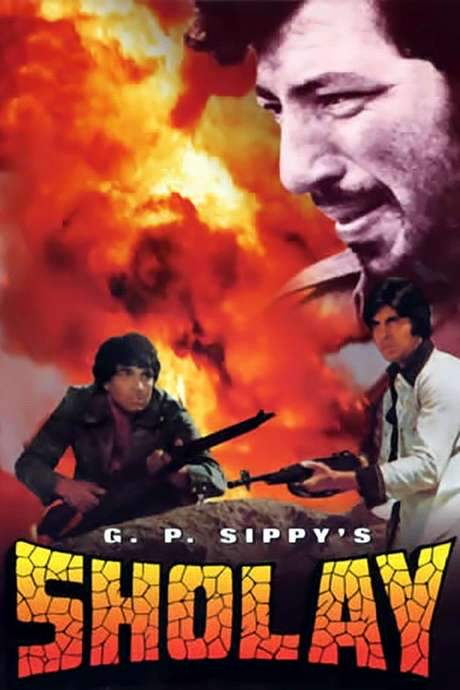
Sholay (1975) movie poster

Plot Summary

Sholay (1975) Plot Summary Explained

Release, runtime and language
1975 · 210 mins · Hindi
Directed by
Ramesh Sippy
Starring
Amitabh Bachchan, Dharmendra, Viju Khote, Jaya Bachchan, Hema Malini, Govardhan Asrani

Featuring an iconic ensemble, the film follows a former police officer who, after his family is slain by the dreaded bandit Gabbar Singh, hires two seasoned outlaws to capture the villain and exact revenge. The narrative builds tension as the trio confronts the ruthless gangster, delivering a timeless tale of justice and retribution.

On this page (5)
  1. 1 Where to watch
  2. 2 What happens: full plot
  3. 3 Plot questions answered
  4. 4 Movie threads
  5. 5 Every angle

Where to watch

Where to Watch Sholay (1975)

Where can you watch Sholay? Stream, rent or buy it in the US, including on Tubi TV, Amazon Video and Apple TV Store: current JustWatch availability with up-to-date prices.

Streaming availability powered by JustWatch

Full plot summary · contains spoilers

What Happens in Sholay: Full Plot Summary

The whole story of Sholay (1975) explained, from the opening scene to the final frame: every key event, every twist and what it all adds up to. Read it as a quick recap before the sequel, to check a scene you missed, or to finally understand what really happened.

Jai and Veeru are small-time crooks who are released from prison and immediately drawn into a high-stakes assignment by the retired inspector Thakur Baldev Singh. Thakur tells them about the notorious dacoit Gabbar Singh, a ruthless figure whose reign of terror has left the village rattled and the villagers living in fear. The reward is substantial:Gabbar Singh is wanted for ₹50,000, and the duo are promised an additional ₹20,000 if they manage to bring him in alive, a condition that gives the mission a personal edge for both men.

When Jai and Veeru reach Ramgarh, Gabbar’s domain, the two quickly become entwined with the people and the rhythms of village life. Veeru’s eyes are drawn to Basanti, a lively and sharp-tongued horse-cart driver who refuses to back down from a challenge, while Jai finds himself drawn to Radha, Thakur’s widowed daughter-in-law, whose quiet strength and warmth slowly spark a blossoming affection. The two pairs—fighters on opposite sides of danger—begin to undermine Gabbar’s extortion schemes, quietly building trust with the villagers and testing Gabbar’s grip on the region.

The tension intensifies during a festival of Holi, when Gabbar’s gang launches a brazen assault on the village. Jai and Veeru stand firm, defending the civilians and pushing back the assault, even as the memories of Thakur’s costly past haunt the air. It’s revealed, in stark detail, that years earlier Gabbar killed Thakur’s family and left him with his arms disfigured, a wound that Thakur hides beneath a shawl and that has shaped his decisions and fears. The revelation deepens the resolve of Jai and Veeru, who vow to capture Gabbar alive as a tribute to the man who once saved them and now bears a heavy personal burden.

In the wake of the tragedy, the villagers rally behind the two young men, and the mission takes on a new moral weight. The cat-and-mouse chase leads to a brutal confrontation in Gabbar’s hideout, where Gabbar’s men capture Ahmed, the son of Imaam Saheb, a moment that galvanizes the community and underscored the stakes of their vow. Jai and Veeru fight with renewed purpose, sustaining injuries and hunger as they press forward against overwhelming odds.

The turning point comes when Jai sacrifices himself in a dramatic act of courage: he uses his last bullet to ignite dynamite on a bridge, collapsing a critical crossing and buying time for Veeru and Basanti to escape. Jai’s death leaves Veeru and the others bruised but unbroken, and Veeru channels his grief into a relentless assault on Gabbar’s den. He slaughter the remaining henchmen and seizes the chance to confront Gabbar directly, a confrontation that ends with Thakur entering the scene and enforcing the vow to deliver Gabbar alive. Thakur’s measured punishment—applied with spike-soled shoes and a final, decisive restraint—caps the long arc of vengeance and justice that has threaded through the village’s ordeal.

As the dust settles, the police arrive and take Gabbar into custody, ending his violent reign for the time being. The aftermath is quiet but heavy with memory: Jai’s funeral is observed with solemn respect, and Veeru, haunted by loss yet restless to seek a future, chooses to leave Ramgarh. His journey, however, circles back to Basanti, who stands waiting for him on the train, signaling a new chapter that begins where the old one ended.

Last updated: October 09, 2025 at 11:19

Was this helpful?

Plot questions answered

Sholay Plot Explained: Your Questions Answered

The questions people ask most about Sholay (1975): what happens in the confusing scenes, why the characters do what they do, the twists, hidden details and what the ending means. Each answer contains spoilers.

Q1

Why did Thakur hire Jai and Veeru to catch Gabbar Singh?

Thakur hired Jai and Veeru because he was a retired inspector who could not capture Gabbar Singh himself. Years earlier, Gabbar had killed Thakur's entire family and severed his arms, leaving him physically unable to fight. Thakur offered a substantial reward, ₹50,000 for capturing Gabbar plus ₹20,000 extra for bringing him alive, to motivate the two seasoned outlaws to undertake this dangerous mission.

Foreshadowing: Earlier in the film, Thakur is seen wearing a shawl to conceal his disfigured arms, hinting at his past trauma.

  • thakur
  • jai
  • veeru
  • gabbar
  • reward
  • ₹50000
  • ₹20000
Q2

Why did Jai sacrifice himself on the bridge?

Jai sacrificed himself because Veeru and Basanti were being chased by Gabbar's men with no escape route remaining. Using his last bullet, Jai ignited dynamite placed on the bridge, collapsing it and wiping out Gabbar's pursuing henchmen at close range. This act bought crucial time for Veeru and Basanti to escape, though Jai died from his wounds sustained during the battle.

Foreshadowing: Earlier in the conflict, Jai and Veeru had already sustained multiple injuries while fighting Gabbar's larger gang.

  • jai
  • death
  • dynamite
  • bridge
  • sacrifice
  • explosion
  • veeru
  • basanti
Q3

Why did Thakur insist on capturing Gabbar alive instead of letting Veeru kill him?

Thakur insisted on capturing Gabbar alive because of the personal vow Jai and Veeru had made after learning about his tragic past. When Thakur revealed that Gabbar had murdered his family and cut off his arms years earlier, Jai and Veeru pledged to bring Gabbar to justice through proper legal channels. Thakur wanted Gabbar to face the courts and be arrested publicly, denying him the heroic death of a dacoit killed in battle.

Foreshadowing: After Thakur's revelation about his family's massacre, Jai and Veeru explicitly took an oath to capture Gabbar alive.

  • thakur
  • gabbar alive
  • vow
  • justice
  • arrest
  • veeru
  • jai
Q4

Why did Gabbar murder Ahmed, the Imam's son?

Gabbar killed Ahmed to terrorize the villagers into submission and force them to stop supporting Jai and Veeru. By taking the son of Imam Saheb (a respected community figure), Gabbar aimed to break the villagers' resolve and show them the consequences of defiance. Instead, the murder galvanized the villagers to demand that Jai and Veeru eliminate Gabbar's remaining henchmen.

Foreshadowing: Gabbar had been extorting the village for years, and his earlier attacks during Holi showed his willingness to use violence against civilians.

  • gabbar
  • ahmed
  • imam
  • death
  • threat
  • intimidation
  • villagers
Q5

How was Jai able to blow up the bridge with his last bullet?

Jai had placed dynamite on the bridge earlier during the assault on Gabbar's hideout. When Gabbar's men chased Veeru and Basanti across the bridge with no means of escape, Jai used his final bullet to shoot the dynamite's fuse from his position. The explosion destroyed the bridge and killed the pursuing dacoits, though the blast also claimed Jai's life.

Foreshadowing: During the assault on Gabbar's den, Jai and Veeru had strategically placed explosives, showing their preparation for a desperate escape.

  • jai
  • dynamite
  • bridge
  • bullet
  • explosion
  • escape
  • veeru
Q6

Why did Thakur hide his arms beneath a shawl?

Thakur concealed his arms with a shawl because Gabbar Singh had dismembered them years earlier when he killed Thakur's family. The brutal attack left Thakur physically disabled and emotionally traumatized. He wore the shawl to hide this visible reminder of his tragedy and because he was ashamed of being unable to fight the man who destroyed his life.

Foreshadowing: Early scenes show Thakur consistently wrapped in a shawl, and he refrains from physical activity that would reveal his injuries.

  • thakur
  • arms
  • shawl
  • injury
  • dismembered
  • gabbar
  • family killed
Q7

Why did Thakur use spike-soled shoes to punish Gabbar?

After Veeru had cornered Gabbar and was ready to kill him, Thakur stopped the execution to ensure Gabbar would be arrested alive. Instead of letting Gabbar die quickly, Thakur applied his own form of brutal justice by making Gabbar wear shoes with spike soles. As Gabbar walked, the spikes drove into his feet, inflicting severe pain while keeping him alive enough to be taken into police custody. This was Thakur's personal revenge for the destruction of his family.

Foreshadowing: Thakur's calm demeanor when stopping Veeru from killing Gabbar showed he had planned this punishment long before.

  • thakur
  • gabbar
  • spike shoes
  • punishment
  • revenge
  • arrest
  • feet
Q8

What was the vow Jai and Veeru made after learning about Thakur's past?

After Thakur revealed that Gabbar had killed his family and severed his arms, Jai and Veeru made a solemn oath to capture Gabbar Singh alive and deliver him to proper justice. They promised not to kill Gabbar in battle but to bring him back to Ramgarh to face the legal system, honoring Thakur's suffering and the village's need for closure.

Foreshadowing: This vow was made immediately after the Holi attack when tensions between the villagers and Gabbar's gang were at their peak.

  • vow
  • jai
  • veeru
  • gabbar alive
  • capture
  • justice
  • thakur
Q9

Why did Veeru leave Ramgarh after Jai's funeral?

Veeru left Ramgarh after Jai's funeral because he was haunted by the loss of his closest friend and partner. The intense grief and restless energy from Jai's sacrifice drove Veeru to leave the village, though his journey ultimately brought him back to Basanti, who was waiting for him on the train, a signal that their story was not over.

Foreshadowing: Throughout the film, Veeru and Jai's friendship is shown as the defining bond of the narrative, making his departure after Jai's death emotionally inevitable.

  • veeru
  • leave
  • ramgarh
  • jai funeral
  • basanti
  • departure
  • grief
Q10

Why was Basanti waiting for Veeru on the train at the end?

Basanti waited for Veeru on the train because their love story, which had developed throughout the film despite Veeru's dangerous mission, was not over. After Jai's death and Veeru's departure from Ramgarh, Basanti chose to pursue their relationship rather than wait passively. Her presence on the train signals hope and a new beginning, ending the film on a bittersweet note of possible renewal.

Foreshadowing: Veeru and Basanti's romance began with their first meeting when Veeru admired her fiery spirit as a horse-cart driver.

  • basanti
  • veeru
  • train
  • ending
  • love
  • waiting
  • future
Q11

Why did Gabbar attack the village during the Holi festival?

Gabbar attacked during Holi because the festival provided cover for his gang to move through the village unnoticed and catch the residents off guard. His dacoits launched a brazen assault to extort money and assert dominance over Ramgarh. The timing also demonstrated Gabbar's ruthlessness, he had no regard for sacred occasions or civilian safety.

Foreshadowing: Earlier scenes established Gabbar's pattern of regular extortion visits to the village, making the Holi attack an escalation of his typical tactics.

  • gabbar
  • holi
  • attack
  • village
  • festival
  • extortion
  • dacoits
Q12

Why did Veeru slaughter Gabbar's henchmen but spare Gabbar himself?

Veeru killed all of Gabbar's remaining henchmen in his fury after Jai's death, but when he finally confronted Gabbar, he was stopped by Thakur. Thakur reminded Veeru of their vow to capture Gabbar alive, and since Thakur himself wanted the satisfaction of dealing with Gabbar, Veeru reluctantly complied. The vow took precedence over Veeru's personal desire for revenge.

Foreshadowing: The oath to capture Gabbar alive was made public after Thakur's revelation about his family's murder.

  • veeru
  • gabbar
  • henchmen
  • kill
  • alive
  • vow
  • thakur
  • revenge

Movie threads

More Movies Like Sholay, by Mood & Story

Curated lists built around what makes Sholay tick: the same mood, the same kind of story or the same emotional payoff. Each list explains why these movies belong together.

Rural Revenge Epics like Sholay

Stories where a community rises against a brutal oppressor to reclaim their honor. If you enjoyed Sholay's tale of vengeance against a rural tyrant, you'll find similar stories here. These movies feature communities standing up to oppression, heroic figures fighting for justice, and emotionally charged narratives of retribution and resilience.

  • vengeful
  • grim
  • heroic
  • tense
  • resilient
  • oppressive
  • Tone: tense, grim, resolute
  • Pacing: variable, building to climax
Why these movies?

The story pattern: The narrative typically begins with a heinous act that shatters the peace of a rural setting. A hero, often an outsider or a deeply wronged local, is compelled to seek justice, galvanizing the community against a formidable and cruel antagonist. The journey is fraught with tension, leading to a climactic confrontation where the cost of victory is often high.

Why they belong together: These films are grouped by their central theme of fighting oppression in a rural landscape. They share a tense, grim tone, high emotional stakes, and a focus on justice achieved through collective resilience and personal sacrifice, creating a powerful, cathartic experience.

Movies with Bittersweet Endings like Sholay

Epic stories where justice is won, but at a profound personal cost. For viewers who appreciated the poignant, bittersweet conclusion of Sholay. This collection features films where the heroes achieve their goal, but not without enduring significant tragedy and loss, creating a deeply resonant and emotionally heavy viewing experience.

  • bittersweet
  • tragic
  • heroic
  • melancholic
  • gripping
  • sacrifice
  • Tone: bittersweet, tragic, heroic
  • Pacing: variable, emotionally driven
Why these movies?

The story pattern: The story builds towards a crucial victory over evil or adversity. However, the path to success is paved with hardship and sacrifice, often involving the death of a key character. The ending acknowledges the win but is deeply colored by the grief and memory of what was lost, resulting in a bittersweet feeling.

Why they belong together: They are united by their emotional payoff: a satisfying yet sorrowful conclusion. The mix of heavy emotional weight, themes of sacrifice, and a bittersweet ending feel creates a specific, powerful vibe that resonates with audiences seeking depth in their resolutions.

Every angle

Sholay (1975) Explained: Plot, Timeline & Characters

Everything about Sholay in one place: what happens in the plot summary, the timeline in chronological order, the characters and meaning and a spoiler-free summary. What's After the Movie adds the cast, box office and post-credit scenes.

Coming soon on iOS and Android

The Plot Explained Movie Summary App

Plot summaries, endings explained and timelines on your phone. Catch up on any movie in minutes, save your favorites and never miss a twist again.

Be the first to know when we launch. Your email stays private, always.

Learn more about the app