






Plot Explained Spoilers guaranteed!
Plot Explained

Browse by genre

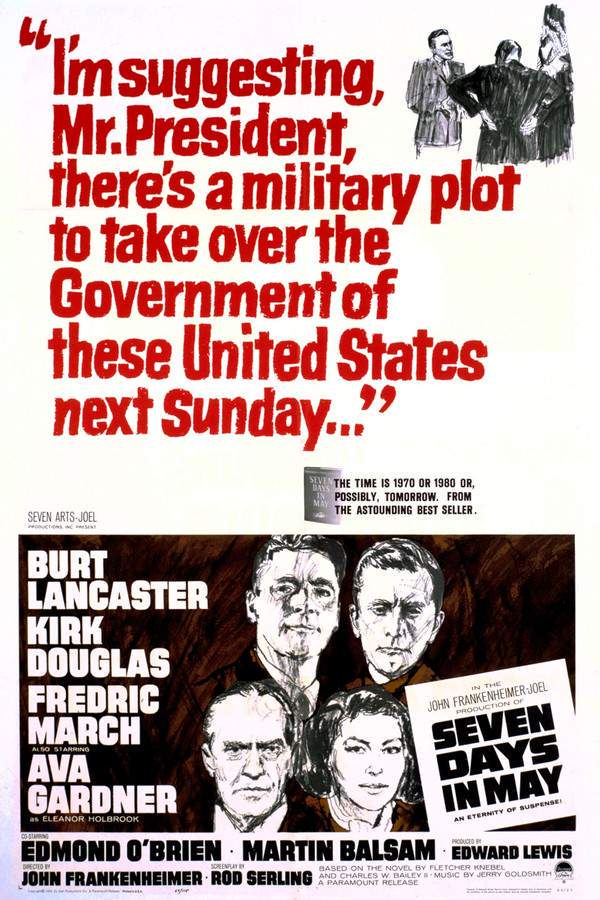
Seven Days in May (1964) movie poster

Timeline

Seven Days in May (1964) Timeline Explained – Every Event in Order

Release, runtime and language
1964 · 118 min · English
Directed by
John Frankenheimer
Starring
Burt Lancaster, Martin Balsam, Ava Gardner, Edmond O'Brien, Whit Bissell, Fredric March

With nuclear disarmament on the table, President Jordan Lyman's policies face opposition from General James Scott, who leads the Joint Chiefs of Staff. A dedicated presidential aide discovers a plot to overthrow the government, triggering a tense race against time. Loyalties are tested as those involved must navigate a dangerous situation to prevent a military coup and protect the country from devastating repercussions.

On this page (6)
  1. 1 Where to watch
  2. 2 Events in order (15)
  3. 3 Timeline questions answered
  4. 4 Movie threads
  5. 5 Movies like Seven Days in May
  6. 6 Every angle

Where to watch

Where to Watch Seven Days in May (1964)

Where can you watch Seven Days in May? Stream, rent or buy it in the US, including on YouTube Free, Amazon Video and Apple TV Store: current JustWatch availability with up-to-date prices.

Streaming availability powered by JustWatch

15 events in order · contains spoilers

Seven Days in May Timeline: Events in Chronological Order

Every key event of Seven Days in May (1964) in order, scene by scene, with when and where it takes place. Use it to untangle flashbacks, time jumps and parallel storylines, to refresh your memory before the sequel or to find the exact scene you are thinking of.

  1. Morning of May 12

    The film opens on Monday, May 12, amidst rising tensions across the United States. Strikes threaten to cripple the coal industry, foreshadowing a chaotic environment.

    When
    Morning
    Where
    Washington D.C.
  2. Demonstrators Gather

    Outside the White House, two distinct groups of demonstrators form, showcasing the nation's divided sentiments. One group expresses gratitude towards President Lyman for a nuclear disarmament treaty with the Soviet Union, while the other vehemently condemns him and promotes General Scott.

    When
    Afternoon
    Where
    Pennsylvania Avenue
  3. Chaos Erupts

    Tensions escalate when a supporter of General Scott disrupts a peaceful protest by cutting down a banner. The Capitol Police quickly respond to regain control of the situation, marking the day's growing unrest.

    When
    Afternoon
    Where
    Pennsylvania Avenue
  4. Lyman's Stress

    Inside the White House, President Lyman's physician raises concerns about the stress affecting his health. With blood pressure rising due to mounting criticisms, Lyman is advised to take a break but decides instead to go for a swim.

    When
    Late Afternoon
    Where
    White House
  5. Discussion with Senator Clark

    During a swim, Lyman meets Senator Raymond Clark, where he discusses the rationale behind his nuclear treaty. Lyman warns Clark about the risks of a deranged officer initiating a nuclear war, while also advising him to stay sober.

    When
    Late Afternoon
    Where
    White House Pool
  6. Senate Armed Services Meeting

    Senator Clark attends a Senate Committee meeting where General Scott challenges Lyman’s treaty. Scott is well-received by certain senators, indicating a split in support for the treaty, and Clark expresses his mockery of the proceedings.

    When
    Evening
    Where
    Senate Building
  7. Secrets in the Joint Chiefs

    Colonel Martin Casey learns about a secret operations unit, EComCon, that is being trained for offensive strategies. Rumors swirl around General Scott's behavior, hinting at unsettling developments within the military hierarchy.

    When
    Subsequent Days
    Where
    Joint Chiefs’ Office
  8. Intensifying Suspicion

    As Casey investigates further, he becomes convinced that Scott is orchestrating a military coup against Lyman. This suspicion is fueled by a tense social event and his interactions with Scott’s former lover, Eleanor Holbrook.

    When
    Subsequent Days
    Where
    Various Locations
  9. Emergency Meeting

    On Tuesday, May 13, Lyman calls for an urgent meeting to address the potential coup after Casey presents his findings. Despite skepticism from his aides, Lyman insists on forming a task force to investigate Scott's activities.

    When
    Tuesday, May 13
    Where
    White House
  10. Gathering Evidence

    Throughout the week, Casey intensifies his search for incriminating evidence against Scott. He gathers letters and documents, fearing the implications of Scott's relationships and manipulative tactics within the Senate.

    When
    Mid-week
    Where
    Various Locations
  11. Confronting the Threat

    By Friday, May 16, Casey believes he has enough evidence to confront General Scott about his schemes. Lyman is caught in a delicate balance of power between civilian governance and military allegiance.

    When
    Friday, May 16
    Where
    White House
  12. Preparing for the Press Conference

    As the situation escalates, Lyman prepares for an emergency press conference scheduled for Sunday, May 18. This critical moment comes as Lyman weighs the implications of revealing the truth about Scott's plans to the public.

    When
    Days leading to May 18
    Where
    White House
  13. Culmination of Tensions

    The climax builds as Lyman reflects on his options, knowing that his next steps could define the future of the nation. He resolves to uphold democratic principles and the importance of peaceful negotiations.

    When
    Sunday, May 18
    Where
    White House
  14. Defending Democracy

    In a decisive moment, Lyman publicly counters Scott's coup attempt, emphasizing the strength found in democratic processes. His unwavering commitment to peace resonates with the core message of the film, demonstrating the power of dialogue over force.

    When
    Sunday, May 18
    Where
    Press Conference
  15. Final Reflections

    The film concludes with Lyman denouncing the notion that military strength is the ultimate solution, reinforcing his belief in peaceful negotiation as the cornerstone of the nation's authority. His stance reiterates the theme of constitutional values against the backdrop of military ambition.

    When
    End of Film
    Where
    White House

Last updated: November 04, 2024 at 00:28

Was this helpful?

Timeline questions answered

Seven Days in May Timeline Explained: Your Questions Answered

When does it happen, and why in that order? The questions people ask about the chronology of Seven Days in May (1964): time jumps, flashbacks, cause and effect between scenes and the correct order of events, each answered with spoilers.

Q1

Why does General Scott plan a coup against President Lyman?

General Scott believes the nuclear disarmament treaty with the Soviet Union weakens America's security and embitters the Soviet Union. As Chairman of the Joint Chiefs of Staff, he views the treaty as either naive or deliberately negligent, arguing it leaves the nation vulnerable to nuclear attack. Scott sees a military takeover as necessary to protect what he believes is the country's true interests, though his ambitions also appear driven by personal ambition and resentment toward civilian leadership.

Foreshadowing: Early scenes show Scott's public criticism of the treaty at the Senate Armed Services Committee, establishing his strong opposition.

  • general scott
  • coup
  • joint chiefs
  • nuclear treaty
  • military takeover
Q2

What is EComCon and why is it significant?

EComCon is a secret military unit located in El Paso, Texas, that has been training for offensive operations rather than defensive purposes. This is significant because it reveals that General Scott has been secretly building a combat force outside normal military channels. The discovery of EComCon provides concrete evidence that Scott is preparing for aggressive action beyond standard military operations, supporting Casey's theory that a coup is being organized.

Foreshadowing: Colonel Henderson reveals EComCon to Casey during their meeting, warning that the unit operates without proper oversight.

  • ecomcon
  • el paso
  • secret unit
  • military training
  • offensive operations
Q3

How does Colonel Casey discover the coup plot?

Casey first becomes suspicious when he's instructed to keep a planned alert hidden from the President. His suspicion grows during a tense social event where he interacts with Eleanor Holbrook, Scott's former lover, who hints at troubling aspects of Scott's behavior. As he investigates further, he encounters rumors about Scott's erratic behavior and discovers the existence of EComCon. His investigation culminates when he obtains incriminating letters from Eleanor Holbrook that expose Scott's manipulative ties with Senator Prentice.

Foreshadowing: Scott's aide Colonel Murdock warns Casey against prying into Scott's operations, which itself signals something is being concealed.

  • colonel casey
  • investigation
  • evidence
  • eleanor holbrook
  • senator prentice
Q4

Why is the nuclear disarmament treaty so controversial in the film?

The treaty is controversial because many military leaders, led by General Scott, believe it leaves America vulnerable to Soviet attack. President Lyman argues that without the treaty, the precarious nuclear balance could lead to uncontrollable war if a deranged officer initiates a launch. The film's political divide is visualized through the opposing demonstrators outside the White House, with one side supporting Lyman's peace efforts and the other promoting Scott as a potential presidential candidate who would reverse the treaty.

Foreshadowing: The opening scene establishes the divide through the two groups of demonstrators clashing on Pennsylvania Avenue.

  • nuclear treaty
  • disarmament
  • soviet union
  • president lyman
  • general scott
Q5

Why does President Lyman decide to hold an emergency press conference?

Lyman decides to hold the press conference because he has gathered enough evidence through Casey's investigation to publicly expose Scott's coup plot. By Sunday, May 18, with the evidence in hand, Lyman faces a critical choice: keep the information classified and risk the conspiracy continuing, or go public and risk destabilizing the nation. He ultimately chooses to address the American people directly, believing that revealing the truth is essential to stopping the coup and preserving democratic processes.

Foreshadowing: The timeline builds toward this moment throughout the week, with Lyman repeatedly weighing his options for a public reveal.

  • press conference
  • public reveal
  • democracy
  • coup prevention
  • sunday may 18
Q6

What role does Senator Prentice play in General Scott's plans?

Senator Frederick Prentice appears sympathetic to General Scott's views and serves as an important political ally within the Senate. During the Armed Services Committee hearings, Prentice throws soft questions to Scott, appearing to support his position against the treaty. Casey discovers that Scott has manipulative ties to Prentice, using this relationship to gain political cover for his coup plans. Prentice's support gives Scott a veneer of civilian legitimacy and helps explain how the General hoped to execute his takeover without immediate resistance.

Foreshadowing: Prentice's biased questioning during the Senate committee meeting hints at his alignment with Scott's agenda.

  • senator prentice
  • senate
  • political ally
  • general scott
  • manipulation
Q7

What prevents the military coup from succeeding?

The coup fails primarily because President Lyman chooses to expose the plot publicly rather than be silenced. Casey's thorough investigation provides the evidence needed to confront Scott, and Lyman's decision to hold the emergency press conference on May 18 forces Scott's hand. When Lyman publicly denounces the coup attempt and asserts that the nation's strength lies in peaceful negotiation rather than military force, Scott's plan collapses. The film suggests that democratic institutions and the President's willingness to confront the conspiracy directly are what save the country.

Foreshadowing: Throughout the film, Lyman consistently chooses to pursue evidence and transparency rather than compromise with Scott's demands.

  • coup prevention
  • democracy
  • president ly]!d~[f0f0f0f0
  • general scott
  • press conference
Q8

What motivates Colonel Casey to investigate General Scott?

Casey's motivation stems from his professional integrity and growing unease about Scott's behavior. When instructed to keep the alert secret, Casey begins paying closer attention to Scott's activities. His investigation is driven by a combination of duty to the constitution and his interactions with Eleanor Holbrook, who provides him with crucial information. Despite warnings from Scott's aide and skepticism from other officials, Casey persists because he believes a military coup would destroy democratic principles and potentially lead to nuclear war.

Foreshadowing: The moment Casey is told to keep the alert hidden marks the beginning of his suspicion.

  • colonel casey
  • loyalty
  • constitution
  • investigation
  • patriotism
Q9

Why does the film take place over exactly seven days?

The seven-day structure from Monday, May 12 to Sunday, May 18 creates intense pacing and urgency appropriate to the crisis. Each day advances the investigation, reveals new evidence, and brings the confrontation closer. The compressed timeframe reflects the real-time pressure facing the President, who must act before the coup can be executed. The specific dates also anchor the political reality of the story, making the conspiracy feel plausible and immediate.

Foreshadowing: The film's title explicitly announces this seven-day countdown, setting up the race against time from the opening scene.

  • seven days
  • may timeline
  • urgency
  • coup timeline
  • deadline
Q10

Why does Eleanor Holbrook's relationship with General Scott matter?

Eleanor Holbrook matters because she provides Casey with crucial evidence about Scott's plans. As Scott's former lover, she has inside knowledge of his state of mind and activities. Her struggles with alcohol mirror Senator Clark's, creating a parallel thread about personal weakness amid national crisis. When Casey meets with Eleanor and attempts to comfort her, he gains access to information and documents that become essential evidence against Scott, including letters that expose the manipulation of Senator Prentice.

Foreshadowing: Casey's encounter with Eleanor at the social event directly leads to his acquisition of incriminating letters.

  • eleanor holbrook
  • evidence
  • general scott
  • romance
  • documents

Movie threads

More Movies Like Seven Days in May, by Mood & Story

Curated lists built around what makes Seven Days in May tick: the same mood, the same kind of story or the same emotional payoff. Each list explains why these movies belong together.

Political Crisis Thrillers like Seven Days in May

Race-against-time thrillers set in the tense corridors of power. If you liked the high-stakes urgency of Seven Days in May, explore more movies like it. These films focus on gripping political conspiracies and constitutional crises, featuring tense narratives where government insiders race to expose threats from within.

  • tense
  • urgent
  • suspenseful
  • paranoid
  • claustrophobic
  • resolute
  • Tone: tense, urgent, paranoid
  • Pacing: fast, relentless
Why these movies?

The story pattern: These stories often unfold as a procedural discovery of a conspiracy, where a small group of protagonists must gather evidence and outmaneuver powerful, hidden antagonists. The narrative is driven by urgency, moral conviction, and the clash between institutional loyalty and higher principles.

Why they belong together: Movies are grouped here based on their shared focus on a high-stakes political threat, a tense and urgent tone, and a narrative structure that pits a few determined individuals against a powerful, systemic conspiracy.

Conspiracy Paranoia Movies similar to Seven Days in May

Gripping stories where heroes uncover a vast, dangerous conspiracy. Fans of Seven Days in May who enjoy the thrill of uncovering a secret plot will love these movies. Discover similar stories of paranoia and procedure, where characters piece together clues to reveal a dangerous conspiracy against overwhelming odds.

  • paranoid
  • claustrophobic
  • suspenseful
  • anxious
  • procedural
  • investigative
  • Tone: paranoid, tense, claustrophobic
  • Pacing: steady, building to fast
Why these movies?

The story pattern: The narrative pattern follows a protagonist or small team as they stumble upon a clue that leads them down a rabbit hole of deception. They face disbelief, danger, and betrayals as they methodically work to prove the conspiracy's existence to a skeptical world, creating a pervasive mood of distrust.

Why they belong together: These movies share a core narrative of investigation and discovery against a hidden enemy. They are united by a mood of paranoia, a focus on procedural detail, and the constant tension of being hunted by an unseen, powerful force.

If you liked this

Movies Like Seven Days in May

Similar movies to Seven Days in May: the same genre, themes or kind of story. Each one comes with its own plot summary, timeline and ending explained.

Browse all movie summaries

Every angle

Seven Days in May (1964) Explained: Plot, Timeline & Characters

Everything about Seven Days in May in one place: what happens in the plot summary, the timeline in chronological order, the characters and meaning and a spoiler-free summary. What's After the Movie adds the cast, box office and post-credit scenes.

Coming soon on iOS and Android

The Plot Explained Movie Summary App

Plot summaries, endings explained and timelines on your phone. Catch up on any movie in minutes, save your favorites and never miss a twist again.

Be the first to know when we launch. Your email stays private, always.

Learn more about the app