Plot Explained Spoilers guaranteed!
Plot Explained

Browse by genre

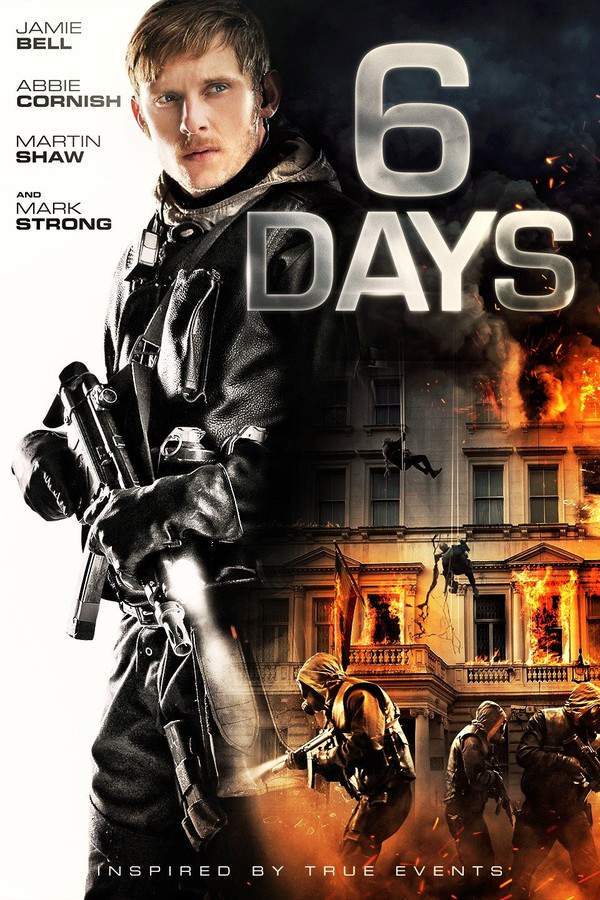
6 Days (2017) movie poster

Plot Summary

6 Days (2017) Plot Summary Explained

Release, runtime and language
2017 · 94 min · English
Echo score 56
JustWatch #5,142 55
Directed by
Toa Fraser
Starring
Ronan Vibert, Abbie Cornish, Mark Strong, Jamie Bell, Tim Pigott-Smith, John Henshaw
Budget
$1.5M

In April 1980, a group of heavily armed gunmen stormed the Iranian Embassy in London, taking hostages and triggering a tense standoff that captivated the world. As negotiations falter, a team of elite Special Air Service (SAS) commandos prepares a risky and intricate plan to rescue the hostages and eliminate the threat. The operation demands precision, bravery, and unwavering resolve as the commandos face a complex and dangerous situation with the eyes of the world upon them.

On this page (6)
  1. 1 Where to watch
  2. 2 What happens: full plot
  3. 3 Plot questions answered
  4. 4 Movie threads
  5. 5 Movies like 6 Days
  6. 6 Every angle

Where to watch

Where to Watch 6 Days (2017)

Where can you watch 6 Days? Stream, rent or buy it in the US, including on Amazon Prime Video, Hoopla and Tubi TV: current JustWatch availability with up-to-date prices.

Streaming availability powered by JustWatch

Full plot summary · contains spoilers

What Happens in 6 Days: Full Plot Summary

The whole story of 6 Days (2017) explained, from the opening scene to the final frame: every key event, every twist and what it all adds up to. Read it as a quick recap before the sequel, to check a scene you missed, or to finally understand what really happened.

International terrorism surged during the 1970s, with each attack prompting a familiar pattern of negotiations and compromises, which only served to give more legitimacy to the terrorists’ actions. The ramifications of a recent, failed mission by US special forces to free 52 American captives in Iran loomed large as Margaret Thatcher took office in the UK.

On 30 April 1980, a group of six Iranians, led by Salim, seized control of the Iranian Embassy at 16 Princes Gate, Kensington, London, taking at least 25 hostages in the process. This incident garnered the attention of significant figures including Lance Corporal Rusty Firmin from the SAS (Special Air Service), Kate Adie, a BBC reporter, her cameraman Bill, and Chief Inspector Max Vernon of the Metropolitan Police, who assumed the role of chief negotiator positioned seven doors from the embassy. The area was quickly cordoned off as tension escalated.

The terrorists, identifying as the Democratic Revolutionary Front for the Liberation of Arabistan, issued a chilling ultimatum over the phone: the release of 91 Arab prisoners in Iran, or a hostage would die by noon the next day if their demands were ignored. The Iranian government steadfastly refused to comply, leaving the UK Government to weigh the options between negotiation and the use of force.

The Home Secretary, William Whitelaw, 1st Viscount Whitelaw, was informed by Thatcher that the full extent of British law was to be applied in this crisis. On the first night, Max found himself in a challenging position, conversing with Salim while trying to discourage violence. He explained the difficult diplomatic landscape, stressing that Britain had minimal influence over Iran. As the terrorist threat escalated, Max managed to avert a premature assault by the SAS forces, which were prepared to intervene should a hostage be harmed.

During one of his negotiations, Salim released a hostage due to illness but remained firm on his threat to start executing the others unless their demands were met. After delivering food to the terrorists, Max learned that Salim was demanding two buses to Heathrow Airport, buying some time to meet this demand. Meanwhile, the SAS leveraged the extra 48 hours to gather intelligence on the embassy layout, discovering that the terrorists were heavily armed with Soviet-era grenades.

Planning was tense as the SAS contemplated a direct approach, with strategies discussed to infiltrate the embassy through the skylight during the night. However, these plans were put aside as the British government deemed them too risky.

As the situation drew on, Salim continued to make threats, resulting in increasing pressure on the authorities. When another hostage was fatally shot after demands were unmet, the SAS prepared to act decisively. Rusty and his team coordinated an intricate maneuver to keep Salim engaged on the line while they executed their plan.

On Day 6, the tension reached a boiling point as Faisal, Salim's right-hand man, killed a hostage after the bus demand was again unmet. Rusty took this opportunity, and with proper distraction from Max, the SAS stormed the embassy. They successfully freed the hostages and neutralized the terrorists, including Salim, during a fierce gunfight.

Thatcher’s decision to deploy the SAS during this crisis is viewed as a pivotal moment in counter-terrorism, setting a precedent for how governments respond to similar situations in the future.
Last updated: October 27, 2024 at 22:52

Was this helpful?

Plot questions answered

6 Days Plot Explained: Your Questions Answered

The questions people ask most about 6 Days (2017): what happens in the confusing scenes, why the characters do what they do, the twists, hidden details and what the ending means. Each answer contains spoilers.

Q1

Why did the Iranian government refuse to meet the terrorists' demands?

The Iranian government refused to release the 91 Arab prisoners because they did not want to appear capitulating to terrorist demands. The Iranian regime viewed the seizure of their London embassy as an internal Iranian matter and was unwilling to set a precedent of negotiating with hostage-takers. This refusal left the UK government in an extremely difficult position, forcing them to choose between appearing complicit in terrorism or risking the lives of the hostages.

Foreshadowing: The film establishes earlier that previous international terrorist attacks had been resolved through negotiations, which only encouraged further attacks.

  • iranian government
  • prisoners
  • demands
  • negotiation
  • refusal
Q2

Why did the SAS wait until Day 6 to launch their assault?

The SAS waited because the British government needed to exhaust all diplomatic options and faced immense pressure to avoid a bloody confrontation. Each day of negotiation provided time for intelligence gathering and planning. Additionally, any assault carried significant risk to the hostages, and the government was acutely aware that a failed operation would have severe political consequences, especially given Thatcher's recent assumption of office.

Foreshadowing: Early in the film, Thatcher's government is shown carefully weighing every decision, aware that the world's media was watching.

  • sas
  • 6 days
  • waiting
  • government
  • thatcher
Q3

What triggered the SAS to storm the embassy on Day 6?

The final assault was triggered when Faisal, Salim's right-hand man, shot and killed a hostage after the demand for buses to Heathrow Airport was not met. This direct loss of innocent life forced the British government's hand, and with the SAS already positioned and ready, they authorized the operation immediately. Rusty Firmin coordinated the assault while Max Vernon kept Salim distracted on the telephone line.

Foreshadowing: The film builds tension through repeated unmet demands, with each threat bringing the situation closer to violence.

  • faisal
  • hostage killed
  • day 6
  • assault
  • trigger
Q4

Why did the British government deem the initial SAS skylight plan too risky?

The government considered the skylight infiltration plan too risky because it would require the SAS to enter the building with limited visibility and potentially encounter armed terrorists in close quarters without adequate backup routes. The risk of casualties among both the hostages and the SAS soldiers was deemed unacceptable, especially with the world's media watching. The government preferred to wait for a clearer tactical advantage rather than rush an operation that could result in a disaster.

Foreshadowing: The film shows the SAS commanders discussing alternative entry points, but each option presents significant dangers.

  • skylight
  • plan
  • risky
  • government
  • assault plan
Q5

How did the SAS gather intelligence on the embassy layout?

The SAS used the extra time bought by the initial negotiations and the hostage release to gather intelligence through surveillance and observation. They monitored the building, gathered information from previous visitors to the embassy, and built a picture of the interior layout. They also discovered that the terrorists were heavily armed with Soviet-era grenades, which heightened concerns about the dangers of any assault.

Foreshadowing: The timeline shows that the SAS used the 48-hour extension from the bus demand to intensify their intelligence work.

  • sas
  • intelligence
  • gathering
  • embassy
  • surveillance
Q6

Why was Margaret Thatcher hesitant to authorize the SAS operation?

Thatcher was hesitant because she was newly in office and acutely aware that any failure would have catastrophic political consequences. The recent failed US mission to free American captives in Iran loomed large as a cautionary example. Additionally, with global media scrutiny intense, the world was watching her every decision. She needed to balance the need for decisive action against the very real possibility of a botched operation that could cost multiple lives.

Foreshadowing: The film opens with context about Thatcher's recent rise to power and the failed US mission in Iran, establishing the stakes she faced.

  • thatcher
  • hesitant
  • authorization
  • political
  • risk
Q7

How did Chief Inspector Max Vernon help the SAS operation?

Max Vernon played a critical role by maintaining constant communication with Salim, the terrorist leader. During the final assault, he kept Salim engaged on the telephone line, distracting him while the SAS teams breached the building. His negotiations also bought valuable time for the SAS to gather intelligence and prepare their assault plan. By building a rapport with Salim, Vernon was able to prevent premature violence and create the window the SAS needed.

Foreshadowing: Throughout the siege, Vernon is shown building a tentative relationship with Salim, which becomes crucial in the final moments.

  • max vernon
  • negotiator
  • distraction
  • salim
  • phone call
Q8

Why did the terrorists kill a hostage during the standoff?

The terrorists killed hostages to demonstrate their resolve and put pressure on the British government to meet their demands. After the initial deadline passed without the release of the 91 Arab prisoners, Salim executed a hostage to prove he was serious. On Day 6, Faisal killed another hostage when the demand for buses was not fulfilled. These executions were meant to show that the terrorists would follow through on their threats, escalating the pressure on authorities.

Foreshadowing: From the beginning, the terrorists issue a clear ultimatum with a noon deadline, establishing that they would take lethal action.

  • terrorists
  • hostage killed
  • execution
  • demands
  • ultimatum
Q9

Why is the Iranian Embassy siege considered a pivotal moment in counter-terrorism?

The 1980 siege is considered pivotal because it established the model for how governments would handle future terrorist hostage situations. Thatcher's decision to authorize the SAS assault, rather than negotiate indefinitely, set a new precedent of refusing to capitulate to terrorist demands. This approach influenced counter-terrorism strategies worldwide, demonstrating that military force could be used successfully to resolve hostage crises while minimizing further casualties.

Foreshadowing: The film explicitly states at the end that this operation became a template for future government responses to terrorism.

  • pivotal
  • counter-terrorism
  • precedent
  • thatcher
  • legacy
Q10

Why did Salim release one of the hostages during the negotiations?

Salim released one hostage due to illness, showing a brief moment of humanity amid his otherwise violent demands. This gesture was likely calculated to build trust with negotiator Max Vernon and potentially create a sense of reciprocity. However, Salim remained firm in his ultimate threat to execute the remaining hostages if the 91 prisoners were not released, demonstrating that the release was a tactical move rather than a genuine shift in his position.

Foreshadowing: The hostage release provided the SAS with crucial extra time to prepare their intelligence and assault plans.

  • salim
  • hostage release
  • illness
  • negotiation
  • tactical

Movie threads

More Movies Like 6 Days, by Mood & Story

Curated lists built around what makes 6 Days tick: the same mood, the same kind of story or the same emotional payoff. Each list explains why these movies belong together.

Tense, Methodical Siege Thrillers like 6 Days

High-stakes standoffs where patience and precision are the ultimate weapons. Discover movies like 6 Days that capture the gripping anxiety of a high-stakes hostage crisis. If you enjoyed the methodical pacing, tense negotiations, and explosive resolution of 6 Days, you'll find similar stories of elite forces and desperate standoffs in these films.

  • tense
  • claustrophobic
  • high-stakes
  • methodical
  • gripping
  • anxious
  • Tone: tense, bleak
  • Pacing: steady, methodical
Why these movies?

The story pattern: Narratives in this thread typically follow a dual or multi-perspective structure, bouncing between the besieged individuals, the negotiators, and the specialized tactical teams. The plot often progresses in real-time or over a compressed timeline, building methodically from initial chaos to failed diplomacy, culminating in a planned, high-intensity assault. The emotional journey is one of rising dread and grim professionalism.

Why they belong together: Movies are grouped here for their shared focus on tense standoffs, methodical pacing, and the high-pressure interplay between negotiation and tactical action. They create a specific, claustrophobic kind of suspense that feels grounded, realistic, and relentlessly gripping.

Grim Real-World Operation Dramas like 6 Days

Military and rescue missions where victory comes with a heavy human cost. Find movies similar to 6 Days that explore the sobering reality of historical counter-terrorism and special forces operations. If you appreciated the heavy emotional weight, bittersweet conclusion, and realistic portrayal of a precedent-setting event in 6 Days, these films deliver comparable impactful stories.

  • historical
  • serious
  • somber
  • gripping
  • methodical
  • realistic
  • Tone: serious, contemplative
  • Pacing: steady, procedural
Why these movies?

The story pattern: Stories in this thread are typically linear and based on true events, focusing on the procedural details of a complex operation. The character arcs often involve professionals confronting extreme pressure and the moral weight of their actions. The climax is a tense, realistic action sequence, but the resolution is bittersweet, acknowledging the human cost and the broader, often unsettling, consequences of the mission's success.

Why they belong together: These movies are united by their grounded, often docudrama approach to historical events, a bittersweet emotional core, and a focus on the human and political cost behind a tactical victory. They provide a thoughtful, heavy viewing experience that prioritizes realism over glorification.

If you liked this

Movies Like 6 Days

Similar movies to 6 Days: the same genre, themes or kind of story. Each one comes with its own plot summary, timeline and ending explained.

Browse all movie summaries

Every angle

6 Days (2017) Explained: Plot, Timeline & Characters

Everything about 6 Days in one place: what happens in the plot summary, the timeline in chronological order, the characters and meaning and a spoiler-free summary. What's After the Movie adds the cast, box office and post-credit scenes.

Coming soon on iOS and Android

The Plot Explained Movie Summary App

Plot summaries, endings explained and timelines on your phone. Catch up on any movie in minutes, save your favorites and never miss a twist again.

Be the first to know when we launch. Your email stays private, always.

Learn more about the app