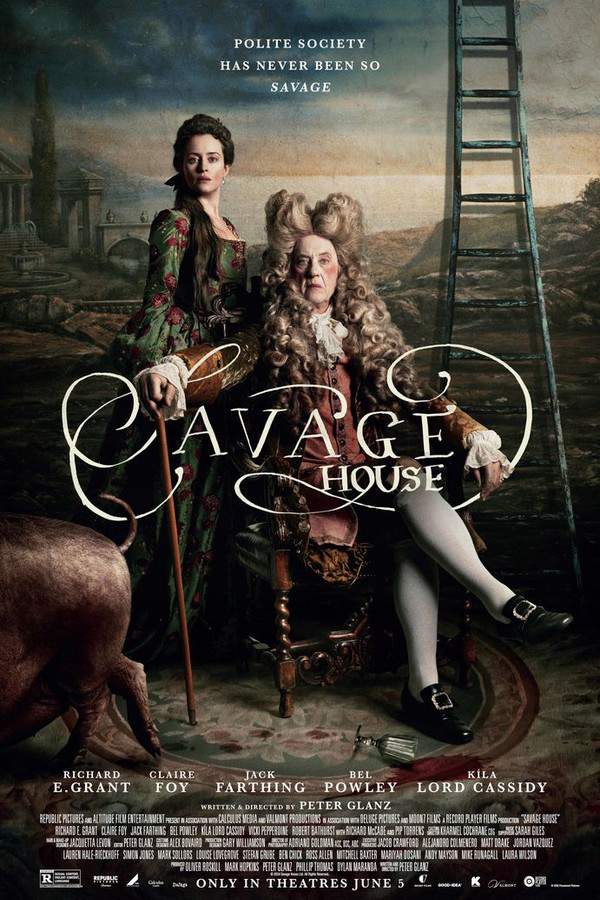
In 18th‑century England, amid a devastating pox epidemic and the turmoil of the Jacobite uprising, Sir Chauncey Savage (Richard E. Grant) and his wife Lady Savage (Claire Foy) chase the promise of a better future. Their surname proves ominously fitting as their home becomes a vortex of duels, decadence and relentless bloodshed, delivering a wildly chaotic portrait of a truly savage household.
Find where to stream, rent, or buy Savage House (2026) in the US with current JustWatch availability, up-to-date pricing, and platform listings for subscription, rental, and digital purchase options.
Warning: spoilers below!
Haven’t seen Savage House yet? This summary contains major spoilers. Bookmark the page, watch the movie, and come back for the full breakdown. If you're ready, scroll on and relive the story!
Read the complete plot breakdown of Savage House (2026), including all key story events, major twists, and the ending explained in detail. Discover what really happened, and what it all means.
In the early eighteenth century, Sir Chauncey Savage [Richard E. Grant] and Lady Savage [Claire Foy] are an impoverished couple living in a fading Yorkshire mansion with their daughter Fanny Savage [Kíla Lord Cassidy]. A looming crisis arrives when the Duke and Duchess of Devonshire announce they must stay with the Savages for a spell, driven by a massive pox outbreak and the Jacobite uprising that makes their usual host, Lord Vernon, unsafe. In a bid to weather the disruption, the family begins selling heirlooms and piling up debt, hoping to cushion the temporary intrusion while preserving some semblance of dignity.
Meanwhile, Reginald Halifax [Jack Farthing] and chambermaid Dorothy Neville hatch a secret plan to end the Savages’ marriage for their own gain, turning their private scheming into a dangerous game of leverage. The household’s routine is further unsettled by the arrival of two actors in masterful deception: Darby [Miles Jupp] and Leslie [Tom Godwin], two stablemen hired to pose as footmen for a rehearsal dinner, a ruse that exposes how fragile the Savages’ world really is. A doctor’s stern admonition—avoiding red meat and wine due to Chauncey’s inflammatory arthritis and gout—becomes another battleground, as Chauncey stubbornly defies medical orders, trying to hold onto comfort even as physical pain mounts.
The pressure mounts as Lady Savage continues to sell family treasures, including her grandmother’s priceless diamond ring, to fund the preparations. Invitations to the dinner are declined by nearly every guest, with fear of the pox cited as the reason, though the Savages fear it’s really Sir Chauncey’s low birth that keeps people away. In the garden, Leslie overhears Dorothy and Reginald’s plotting, and Reginald swiftly drives him off, tightening the noose around the couple’s fragile domestic life. While a portrait is being painted, Chauncey unleashes his anger at his staff, collapses, and a doctor administers laudanum and leeches, a scene that underscores how far his pride has driven him into illness and dependence. The doctor is [Roger Ashton-Griffiths], a reminder of the ever-present authority that intrudes on their affairs.
That night, Chauncey discovers his wife in an intimate moment with Reginald, sparking a duel between Chauncey and his rival. To serve as his second, Chauncey asks Mr. Bennett [Richard McCabe], which in turn compels him to extend invitations to the Bennetts—an irony not lost on anyone. Lady Savage tries to buy Reginald’s mercy with payment, but Reginald refuses; instead, Mr. Bennett arranges a bribe to have Reginald kill Chauncey, a plan that reveals how far money and manipulation can travel in a collapsing household. The duel ends with Chauncey wounded in the arm and Reginald shot dead, and the mood shifts from defiant bravado to the grim reality of ruin.
On the eve of the dinner, Chauncey’s wound worsens into gangrene, and debt collector Mr. Black [Erin Battle] arrives to arrest him. Yet even the threat of imprisonment cannot derail the dinner’s preparations, as Chauncey promotes Darby to valet and hires two forest vagrants—who turn out to be Jacobites—as make-do footmen. Fanny, watching a lunar eclipse with wonder, becomes a sobering counterpoint to the surrounding chaos, while Dorothy poisons Fanny’s pet mice, a cruel act that foreshadows the family’s unraveling. The doctor’s earlier warnings echo more loudly now, as Chauncey’s condition deteriorates and an amputation becomes unavoidable.
The grand dinner proceeds to a silent, tense dawn, with no sign of the Devonshires. A messenger appears at the door bearing news from the Duke and Duchess: they have chosen to stay with Lord Vernon after all. The revelation completes the Savages’ descent into financial and social ruin: Chauncey is arrested and sent to a debtors’ prison, while the Devonshire influence drifts away, leaving behind a house that can no longer sustain itself. In the end, the Savages’ world collapses under the weight of debt, deception, and the cold arithmetic of fortune, leaving only memories of a grand illusion that could not outlast the era’s changing tides.
Throughout the tale, the cast—Jack Farthing as Reginald Halifax, Kíla Lord Cassidy as Fanny Savage, Claire Foy as Lady Savage, Miles Jupp as Darby, Tom Godwin as Leslie, Sebastian Armesto as Hans, Dominic Charman as Nobleman, Phill Drew as Peasant 2, Sven Ironside as Player 1, James Nicholson as Messenger, Roger Ashton-Griffiths as Dr. Hemmings, Erin Battle as Mrs. Black, Shiona Brown as Mrs. Loughton, Richard McCabe as Mr. Bennett, Vicki Pepperdine as Mrs. Bennett, and Douglas? in other roles, all weave a precise, interlocking web of intentions and consequences that keep the central family drama in motion—from missteps and betrayals to a final reckoning that befalls those who chase status at the cost of security.
Last updated: July 13, 2026 at 12:13
Explore frequently asked questions about Savage House (2026) with spoiler-rich answers covering the full plot summary, major story beats, character motivations, hidden details, and ending meaning. This movie summary FAQ helps explain confusing scenes, plot twists, and narrative decisions in clear, searchable detail.
The Devonshires never arrive because they ultimately decide to stay with Lord Vernon instead. A messenger delivers this news on the night of the dinner, confirming that the danger from the pox outbreak and Jacobite uprising has passed enough for them to go to their original intended host. This final insult seals the Savages' ruin, as they've already spent their remaining fortune preparing for guests who were never coming.
Earlier, guests had already declined invitations due to fear of the pox, foreshadowing the social rejection to come.
Chauncey discovers his wife Lady Savage in an intimate moment with Reginald Halifax, the household's servant. The affair is the final betrayal that triggers Chauncey's challenge. He demands satisfaction through a duel and asks Mr. Bennett to serve as his second, which ironically forces the Bennetts to become involved in the dinner preparations they had previously refused.
Leslie had earlier overheard Reginald and Dorothy plotting against the Savages, revealing the affair plot to the audience before Chauncey discovers it.
Chauncey is arrested because he cannot pay his debts. Earlier, the family had sold heirlooms and piled up significant debt to fund lavish preparations for the Devonshires' visit. When debt collector Mr. Black arrives to arrest him, Chauncey briefly charms him into attending the dinner, but the arrest is inevitable. After the Devonshires' no-show and the dinner's failure, Chauncey is taken to debtors' prison, where he will remain until the debt is settled.
The arrival of the debt collector earlier in the timeline directly foreshadows Chauncey's ultimate fate.
The duel ends with Chauncey wounded in the arm but Reginald shot dead. During the fight, Chauncey takes a bullet to his arm while Reginald is struck in the head and killed instantly. The outcome is pyrrhic, Chauncey survives but his wound becomes infected and eventually gangrenous, requiring amputation. The victory brings no satisfaction, only accelerates the household's collapse.
Mr. Bennett had arranged a bribe to have Reginald kill Chauncey, but the plan backfires when Reginald is killed instead.
Chauncey's arm becomes gangrenous after the duel. The wound from the fight initially seems survivable, but infection sets in and spreads despite the doctor's attempts at treatment. By the evening before the dinner, the gangrene has worsened so severely that amputation becomes the only option to save his life. The procedure is performed in a desperate attempt to stop the infection, but it represents the final physical decline of a man already crumbling under financial and social pressures.
The doctor had earlier warned Chauncey about his health and admonished him for ignoring medical advice about diet, establishing his disregard for his own wellbeing.
The Savages are impoverished and living beyond their means. When the Duke and Duchess of Devonshire announce they must stay with the Savages due to a pox outbreak, the family desperately needs to maintain appearances. They begin selling family heirlooms, including Lady Savage's grandmother's priceless diamond ring, and accumulate significant debt to fund lavish preparations. Their pride won't allow them to admit they cannot afford the hospitality expected of their social station.
The summary establishes early on that they are an impoverished couple living in a fading Yorkshire mansion.
Reginald Halifax and chambermaid Dorothy Neville are secretly a couple plotting to ruin the Savages' marriage for financial gain. Their scheme involves exposing or manufacturing scandal to destroy the family from within. Leslie overhears them plotting in the garden, and Reginald pursues him aggressively to silence him. Eventually, Reginald's affair with Lady Savage becomes part of this plot, though it leads to his death in the duel rather than the financial reward he sought.
The timeline explicitly marks this as a conspiracy that threatens the Savages' stability and foreshadows ruin.
The invited guests decline primarily due to fear of the pox epidemic ravaging the area. However, the Savages suspect it's really because of Sir Chauncey's low birth, his social standing is questionable, and the elite guests consider him beneath them. The Bennetts in particular are repeatedly refused, highlighting the class tensions that pervade the household. The rejection leaves the Savages isolated and desperate to maintain their facade.
This social rejection prefigures the Devonshires' ultimate decision not to come at all.
Mr. Bennett becomes entangled in the Savages' web of deception when he is asked to serve as Chauncey's second in the duel. Lady Savage attempts to buy Reginald's mercy with payment, but Reginald refuses, he wants to destroy the marriage regardless. In response, Mr. Bennett arranges a bribe to have Reginald kill Chauncey during the duel. However, the plan backfires: Reginald is killed instead, and Chauncey survives wounded. Bennett's involvement reveals how far manipulation and money have penetrated the collapsing household.
This moment exposes the moral corruption spread throughout the household, where even neighbors resort to murder.
Chauncey hires two stablemen, Darby and Leslie, to pose as footmen for the rehearsal dinner because he desperately needs to project an image of wealth and status. The real servants are insufficient, and the household cannot afford proper staff. This deception, part of the broader theme of illusion versus reality, foreshadows the complete unraveling of the Savages' false prosperity. The ruse temporarily maintains appearances but exposes how fragile their world truly is.
This directly connects to the later hiring of two forest vagrants as additional footmen, who turn out to be Jacobite thieves.
Dorothy poisons Fanny's pet mice as she leaves the household, likely to cover her tracks after her conspiracy with Reginald is exposed or about to be exposed. The act is a petty cruelty that symbolizes the恶意 spreading through the household and foreshadows the family's complete unraveling. While Fanny watches a lunar eclipse with wonder, the darkness below reflects the moral decay destroying the Savages from within.
This scene occurs on the same night as the lunar eclipse, creating a stark contrast between innocence and malice.
The title refers to the Savages' surname being ominously fitting for their household. Throughout the film, the family experiences relentless bloodshed, duels, violence, and chaos, from the fatal duel to the amputation to multiple betrayals. The house becomes a vortex of savagery that matches the family's name, delivering a wildly chaotic portrait of a truly savage household amid the broader historical turmoil of pox and political uprising.
The meta notes describe the tone as dark with blackly comedic absurdity, matching the savage nature of events.
After Darby is promoted to valet and discovered to have the pox, Chauncey hires two forest vagrants as emergency footmen for the dinner. These vagrants turn out to be Jacobite supporters who are also thieves, adding another layer of danger and deception to the doomed dinner. Their presence represents the chaos of the era, political upheaval, class instability, and criminality, all converging on the Savages' failing household.
The Jacobite uprising was previously mentioned as the reason the Devonshires needed new lodging, tying the political backdrop to this character detail.
Discover curated groups of movies connected by mood, themes, and story style. Browse collections built around emotion, atmosphere, and narrative focus to easily find films that match what you feel like watching right now.
Stories of high society's desperate, chaotic collapse into ruin.If you enjoyed the chaotic downfall of the Savage family, you'll love these movies about aristocratic ruin. Discover similar dark comedies and dramas featuring desperate social climbers, crumbling mansions, and a relentless descent into chaos.
These narratives typically follow a wealthy or aspiring family whose greed and social ambitions blind them to their own moral decay. Their world becomes a pressure cooker of debt, betrayal, and manipulation, leading to a series of escalating, often farcical, disasters that culminate in total ruin.
They are grouped together by their shared focus on the darkly comedic and chaotic collapse of a privileged household. They blend high intensity, fast pacing, and a bleak tone to explore themes of class conflict, financial ruin, and the savage nature of social climbing.
Where the absurdity of history meets a dark and desperate humor.Fans of Savage House's blend of history and dark humor will enjoy these similar movies. Explore more grim historical farces that find comedy in epidemic, uprising, and the brutal absurdity of the past.
These stories are set against a well-researched but oppressive historical period, using its inherent struggles—like disease or political turmoil—as a catalyst for a series of disastrous and ironically humorous events. The narrative often follows characters whose attempts to maintain control or status are constantly undermined by the brutal realities of their era.
They share a unique mix of a darkly comedic tone with a heavy, historically-grounded emotional weight. The experience is defined by high intensity and fast pacing, creating a farcical portrait of a grim world where humor arises from desperation and chaos.
Don't stop at just watching - explore Savage House in full detail. From the complete plot summary and scene-by-scene timeline to character breakdowns, thematic analysis, and a deep dive into the ending - every page helps you truly understand what Savage House is all about. Plus, discover what's next after the movie.
Track the full timeline of Savage House with every major event arranged chronologically. Perfect for decoding non-linear storytelling, flashbacks, or parallel narratives with a clear scene-by-scene breakdown.
Discover the characters, locations, and core themes that shape Savage House. Get insights into symbolic elements, setting significance, and deeper narrative meaning - ideal for thematic analysis and movie breakdowns.