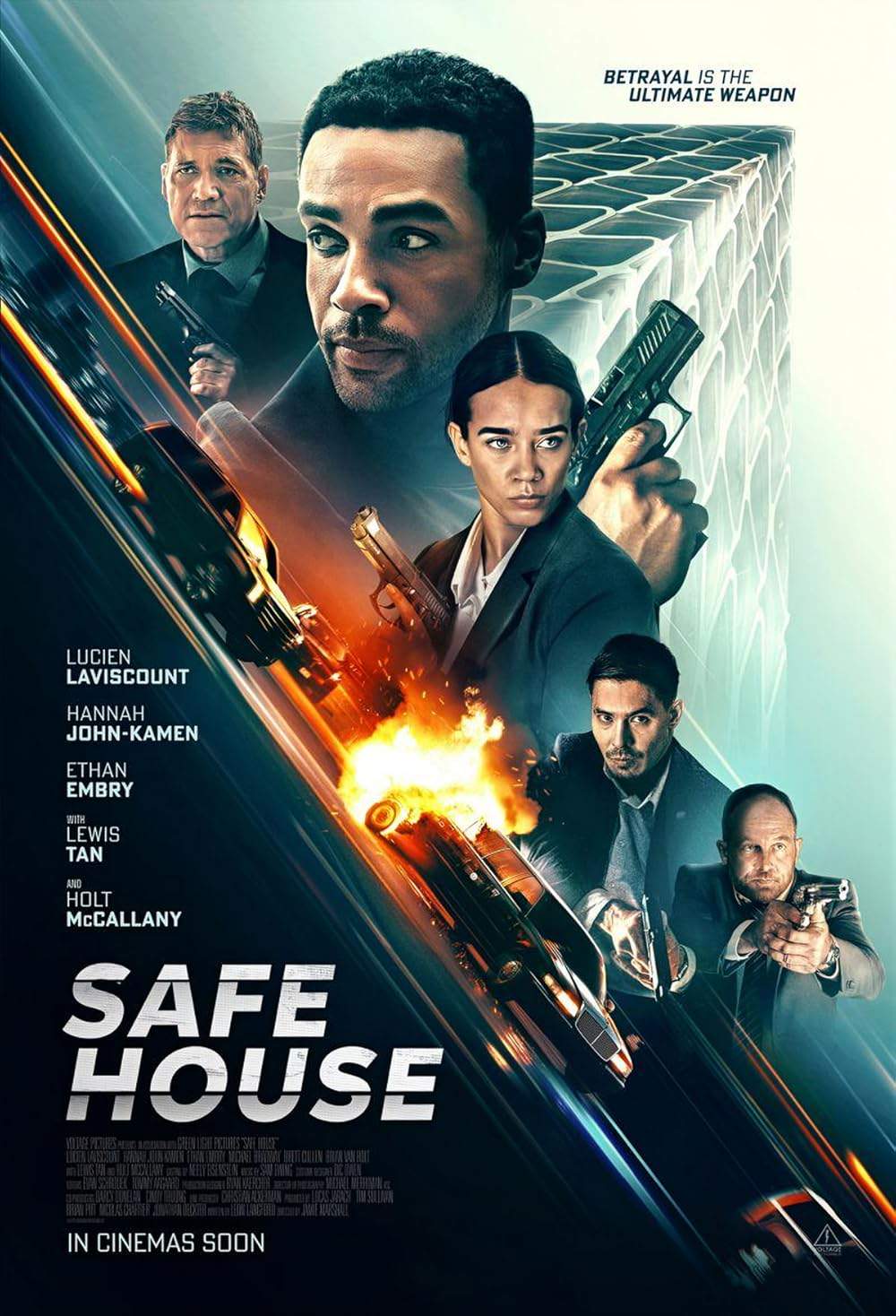
After a terrorist strike decimates downtown Los Angeles, six government agents find themselves locked inside a high‑security safe house. As they work to hold out against the hostile forces outside, suspicion grows that one of their own may be a traitor, forcing them to confront threats from both sides.
Warning: spoilers below!
Haven’t seen Safe House yet? This summary contains major spoilers. Bookmark the page, watch the movie, and come back for the full breakdown. If you're ready, scroll on and relive the story!
Trace every key event in Safe House (2025) with our detailed, chronological timeline. Perfect for unpacking nonlinear stories, spotting hidden connections, and understanding how each scene builds toward the film’s climax. Whether you're revisiting or decoding for the first time, this timeline gives you the full picture.
Last updated: June 27, 2026 at 15:37
Find frequently asked questions about the Safe House (2025) timeline, including chronological order, nonlinear jumps, cause-and-effect links, and scene sequence clarifications. This timeline FAQ helps explain when key events happen, how moments connect, and why the story unfolds in that specific order.
Agent Choi retrieves the backup nuclear football during the chaos of the motorcade attack because the Secret Service detail is wiped out. The nuclear football contains the authentication codes necessary to authorize nuclear launches, making it a critical target for the terrorists. Marshall orders Choi to shelter at the safehouse specifically to protect this sensitive cargo until extraction can be arranged.
The football's importance becomes clear later when Owens reveals C49 generates Gold Codes that work with the football's authorization system.
C49 is a classified device that generates Gold Codes, special authentication codes used alongside the nuclear football to authorize nuclear launches. The terrorists' coordinated plan targeted both the nuclear football and C49 because possessing both would give them the ability to launch nuclear strikes. This explains why Owens and Reeves were tasked with delivering C49 to Vice President Davis as a matter of national security.
Owens' confession about C49 comes during the interrogation of the group about their true missions.
Anderson is the traitor. He is revealed to have killed the actual housekeeper before the team arrived, then assumed his identity. His real name is Elijah King, a man claiming to crusade on behalf of disillusioned veterans. He orchestrated the attack from within the safehouse itself, allowing the terrorists to trace the detonator signal directly to the building.
Sorello suspects Anderson early on, accusing him of working with the terrorists, which proves tragically accurate.
Anderson kills Sorello and Choi during the second wave of the terrorist assault when Sorello releases him to help defend the safehouse. At that moment, Anderson turns on the agents because his true allegiance was never with the government team, he was working with the external attackers all along. His betrayal is the ultimate internal threat the group feared.
Anderson's violent turn happens immediately after Sorello advocates for releasing him, showing how the group's attempt to trust the housekeeper leads to tragedy.
Elijah King revealed a plan to launch an ICBM missile from Montana toward Washington, D.C. His goal was to use this catastrophic attack to remake America in a new image, justified in his mind as a crusade for disillusioned veterans he claimed to represent. The plan required both the nuclear football and C49's Gold Codes to authorize the launch, which is why both were targeted in the coordinated attack.
The terrorist attack's scale and sophistication hinted at something larger than a simple ambush.
General Marshall was orchestrating much of the attack from within the same building where the safehouse was located. Despite being the authority figure who ordered the lockdown and promised Choi's extraction, Marshall was coordinating with the terrorists. When his operations center is exposed, he destroys it with explosives and escapes on foot, leaving Owens to pursue him. His betrayal represents the deepest level of treachery, someone sworn to protect the nation leading the conspiracy.
Marshall's insistence on secrecy about the football and his extraction promise seem oddly detached from the actual crisis.
Whiskey Mike Delta is the emergency code protocol General Marshall initiates after the motorcade attack. This code triggers a rapid lockdown and activates the CIA safehouse as a secure shelter for sensitive assets, in this case, Agent Choi and the nuclear football he carries. The code signals that conventional protections have failed and only the most secure hidden locations should be used.
The code activates immediately after the detonator signal is traced, showing how seriously the breach is treated.
Reeves is killed during the first wave of the terrorist assault on the safehouse. He dies in the initial firefight when the attackers breach the building. His death establishes the immediate danger the team faces and removes one of the more optimistic characters, setting the tone for the brutal survival scenario that follows.
Reeves is killed early, showing that this is not a contained situation but a deadly siege.
The terrorists attacked the safehouse because they were tracing the detonator signal back to its location. The safehouse was chosen as the secure location precisely because it was hidden, but Anderson/King had already compromised it by killing the real housekeeper and communicating with the attackers. This allowed them to locate the nuclear football and C49 that Choi and Owens were protecting.
The lockdown begins specifically when the detonator signal traces to the safehouse, confirming the location was known to the attackers.
Owens stops the ICBM launch by disarming Elijah King and his accomplice using Reeves's sidearm that she retrieves during the chaos. This action prevents the missile from launching and averts the catastrophic attack on Washington, D.C. However, the victory feels hollow because the mastermind, General Marshall, escapes before she can capture him.
The tension peaks as King explains his plan, making Owens' quick action to seize the weapon critical.
Discover curated groups of movies connected by mood, themes, and story style. Browse collections built around emotion, atmosphere, and narrative focus to easily find films that match what you feel like watching right now.
Trapped groups turning on each other under extreme pressure and suspicion.Discover movies like Safe House that trap characters in high-pressure situations where trust is the first casualty. These tense, paranoid thrillers explore the breakdown of alliances under siege, perfect for fans of confined settings and betrayal plots.
These narratives typically confine a group in an inescapable location under external threat. The core conflict becomes internal as characters grapple with mounting evidence of a traitor in their midst. The plot unfolds through a series of reveals, accusations, and shifting alliances, often leading to tragic sacrifices.
They share a high-intensity, tense tone and a fast pace, driven by the dual threats of an external enemy and an internal mole. The heavy emotional weight comes from themes of betrayal, survival, and the brutal cost of suspicion, all within a claustrophobic, gritty atmosphere.

Uncovering deep corruption and treason within powerful institutions.If you liked the high-stakes betrayal and military corruption in Safe House, explore these espionage thrillers. They feature agents uncovering sinister plots within their own ranks, delivering tense, action-packed narratives with heavy emotional weight.
The narrative follows a protagonist, often an agent or insider, who stumbles upon a conspiracy that goes to the highest levels of power. Their journey involves uncovering the truth while being hunted by the very institution they serve, leading to a morally complex fight for survival against overwhelming odds.
They are united by themes of institutional betrayal, military corruption, and the existential dread of fighting an enemy from within. The experience is defined by a tense, gritty tone, fast pacing, and a heavy emotional weight that questions loyalty and the cost of truth.
Don't stop at just watching - explore Safe House in full detail. From the complete plot summary and scene-by-scene timeline to character breakdowns, thematic analysis, and a deep dive into the ending - every page helps you truly understand what Safe House is all about. Plus, discover what's next after the movie.
Read a complete plot summary of Safe House, including all key story points, character arcs, and turning points. This in-depth recap is ideal for understanding the narrative structure or reviewing what happened in the movie.
Discover the characters, locations, and core themes that shape Safe House. Get insights into symbolic elements, setting significance, and deeper narrative meaning - ideal for thematic analysis and movie breakdowns.
What really happened at the end of Safe House? This detailed ending explained page breaks down final scenes, hidden clues, and alternate interpretations with expert analysis and viewer theories.