





Plot Explained Spoilers guaranteed!
Plot Explained

Browse by genre

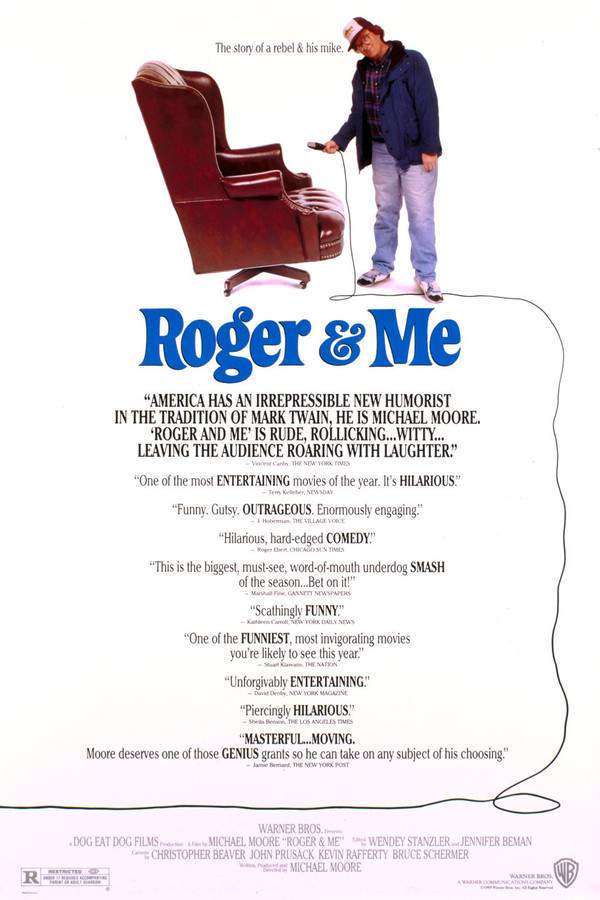
Roger & Me (1989) movie poster

Timeline

Roger & Me (1989) Timeline Explained – Every Event in Order

Release, runtime and language
1989 · 91 min · English
Directed by
Michael Moore
Starring
Anita Bryant, Fred Ross, James Blanchard, James Bond, Karen Edgely, Kaye Lani Rae Rafko
Budget
$160K

This documentary follows ex-journalist Michael Moore as he returns to his hometown of Flint, Michigan, a city grappling with the devastating impact of General Motors plant closures. Over 30,000 people are left jobless as the city experiences economic devastation and rising violence. Moore attempts to confront General Motors CEO Roger Smith, highlighting the human cost of corporate decisions and the struggles faced by the community.

On this page (6)
  1. 1 Where to watch
  2. 2 Events in order (15)
  3. 3 Timeline questions answered
  4. 4 Movie threads
  5. 5 Movies like Roger & Me
  6. 6 Every angle

Where to watch

Where to Watch Roger & Me (1989)

Where can you watch Roger & Me? Stream, rent or buy it in the US, including on Amazon Video, Apple TV Store and Fandango At Home: current JustWatch availability with up-to-date prices.

Streaming availability powered by JustWatch

15 events in order · contains spoilers

Roger & Me Timeline: Events in Chronological Order

Every key event of Roger & Me (1989) in order, scene by scene, with when and where it takes place. Use it to untangle flashbacks, time jumps and parallel storylines, to refresh your memory before the sequel or to find the exact scene you are thinking of.

  1. Introduction to Michael Moore

    Michael Moore begins the film by sharing personal insights about his early life and family through nostalgic home movies. He characterizes himself as a 'strange child' who grew up in a blue-collar Irish American Catholic family in Flint, Michigan.

    Where
    Flint, Michigan
  2. The Role of General Motors

    Moore reflects on the significant influence that General Motors had on his upbringing in Flint. He highlights the company’s historical impact, particularly referencing the 1937 Flint Sit-Down Strike that played a pivotal role in the establishment of the United Auto Workers union.

    Where
    Flint, Michigan
  3. Life in Flint

    The narrative portrays memories of local figures from Flint, including Bob Eubanks and musicians from Grand Funk Railroad. These reflections paint a picture of a vibrant community that once thrived but is now facing industrial decline.

    Where
    Flint, Michigan
  4. Moving to California

    Seeking a new life, Moore moves to California and secures a job at a magazine in San Francisco. However, the opportunity slips away, prompting a return to his roots in Flint in 1985, where he discovers the changing economic landscape.

    When
    1985
    Where
    California
  5. The Layoffs Announcement

    Upon returning to Flint, Moore learns that General Motors has announced significant layoffs that will ship jobs to Mexico, despite the company's record profits. This decision devastates the local workforce and ignites anger among the laid-off workers.

    Where
    Flint, Michigan
  6. Interviewing Workers

    Disguised as a Toledo journalist, Moore interviews various auto workers to uncover their resentment towards GM chairman, Roger B. Smith. These candid discussions reveal the emotional toll the layoffs have taken on the workers and their families.

    Where
    Flint, Michigan
  7. The Pursuit of Roger B. Smith

    Determined to confront Smith, Moore attempts to meet with him at GM headquarters in Detroit but faces obstacles with security. This marks the beginning of a prolonged journey to track down the elusive chairman across various locations.

    Where
    Detroit
  8. Documentation of Urban Decay

    A poignant montage set to the Beach Boys' 'Wouldn't It Be Nice' captures the stark urban decay of Flint. The imagery portrays the rising crime and the exodus of residents against the backdrop of economic decline and unemployment.

    Where
    Flint, Michigan
  9. Contrast with Suburban Life

    Moore contrasts life in Flint with the affluent surrounding suburbs, showcasing a troubling disconnect. He highlights the ignorance and classism of wealthier residents, as well as failed initiatives by local authorities to entice tourism to a struggling city.

    Where
    Surrounding Suburbs
  10. Political Commentary

    The film includes commentary from notable political figures like President Reagan, who suggests that unemployed workers should consider relocating. This underlines a broader theme of neglect towards the struggles faced by the Flint community.

  11. The Shareholders Convention

    Moore attends the 1988 GM Shareholders Convention, hoping to voice the grievances of laid-off workers. However, his efforts are met with refusal from Roger B. Smith, highlighting the stark divide between corporate officials and the affected workers.

    When
    1988
    Where
    Detroit
  12. Personal Stories of Struggle

    The documentary features personal accounts from residents, including a former radio host turned Amway saleswoman. Through these narratives, the film captures the devastating impact of economic collapse on individual lives and families.

    Where
    Flint, Michigan
  13. Confrontation with Roger B. Smith

    In a climactic moment, Moore finally confronts Roger B. Smith at a public event, contrasting the chairman's public image with the harsh realities faced by Flint families. The eviction of a local family serves as a poignant example of the consequences of corporate decisions.

  14. Closing Reflections

    Moore ends the film expressing his frustration over his inability to bring awareness to the struggles of Flint. He comments on the growing inequality, where the rich continue to prosper while the less fortunate find themselves in dire situations.

  15. Poignant Conclusion

    The film concludes with a striking message that reflects the fate of Flint: all movie theaters are closed, rendering it impossible to screen the film within the city. This encapsulates the broader narrative of economic decline and the loss of community.

    Where
    Flint, Michigan

Last updated: November 03, 2024 at 21:12

Was this helpful?

Timeline questions answered

Roger & Me Timeline Explained: Your Questions Answered

When does it happen, and why in that order? The questions people ask about the chronology of Roger & Me (1989): time jumps, flashbacks, cause and effect between scenes and the correct order of events, each answered with spoilers.

Q1

Why did General Motors lay off thousands of workers in Flint despite record profits?

General Motors laid off over 30,000 workers in Flint because the company chose to move production to Mexico, where labor costs were significantly lower. This decision came during a period when GM was enjoying record profits, which Moore uses to highlight the stark contrast between corporate earnings and the devastating human cost borne by the workers and their community.

Foreshadowing: Earlier in the film, Moore reflects on how GM shaped his upbringing in Flint, establishing the deep connection between the city and the company before revealing the layoffs.

  • general motors
  • layoffs
  • flint michigan
  • unemployment
  • mexico jobs
Q2

Why did Michael Moore want to confront Roger B. Smith?

Michael Moore wanted to confront GM CEO Roger B. Smith because he held him personally responsible for the devastating decision to ship jobs away from Flint to cheaper labor markets. Moore believed Smith was the one who made the call to close the plants, and he wanted to force the CEO to face the human consequences of his corporate decisions face-to-face.

Foreshadowing: Moore establishes early on that his father worked for GM assembling AC Spark Plugs, giving him personal stakes in the matter.

  • michael moore
  • roger smith
  • general motors
  • confrontation
  • ceo
Q3

What happened to Flint after the GM plant closures?

After GM closed its plants, Flint experienced severe economic devastation including mass unemployment, rising crime, urban decay, and a mass exodus of residents. The city fell into disrepair as evidenced by the montage set to the Beach Boys' 'Wouldn't It Be Nice,' showing abandoned buildings and struggling communities. The economic collapse also led to personal tragedies, including workers like Ben Hamper who struggled with mental health after losing their jobs.

Foreshadowing: The film contrasts Flint's vibrant past, featuring local figures like Bob Eubanks and Grand Funk Railroad, with its post-layoff decline.

  • flint michigan
  • economic collapse
  • urban decay
  • crime
  • gm closure
Q4

Why couldn't Michael Moore get Roger Smith to appear in the film?

Roger Smith consistently avoided appearing in the film despite Moore's persistent attempts to confront him at various venues including GM headquarters in Detroit, the Grosse Pointe Yacht Club, and the Detroit Athletic Club. At the 1988 GM Shareholders Convention, Moore was shut out by Smith when attempting to voice the grievances of laid-off workers. Smith only finally confronted Moore at a public event, years after the initial pursuit began.

Foreshadowing: Moore's repeated failures to meet Smith throughout the film build mounting frustration, underscoring the corporate disconnect from the community.

  • roger smith
  • gm headquarters
  • shareholders convention
  • interview
Q5

Why did General Motors move jobs to Mexico instead of keeping them in Flint?

General Motors moved jobs to Mexico because the company could pay workers significantly lower wages there compared to Flint. This cost-cutting measure allowed GM to increase profits even further, despite the devastating impact on the Michigan community. The film highlights this as a central injustice: the workers who had dedicated their lives to the company were discarded in pursuit of greater corporate profits.

Foreshadowing: The layoffs announcement comes shortly after Moore returns to Flint in 1985, marking the beginning of the economic crisis.

  • gm mexico
  • outsourcing
  • auto industry
  • wages
  • corporate profits
Q6

What was the AutoWorld project that failed in Flint?

AutoWorld was a failed tourism initiative constructed by the Flint Convention and Visitors Bureau in an attempt to attract visitors and revenue to the struggling city. Alongside the Hyatt Regency Hotel, it was one of several misguided attempts to revive Flint's economy that quickly failed, serving as a symbol of how local officials mishandled the economic crisis while the community continued to decline.

Foreshadowing: Moore contrasts these failed initiatives with the affluent suburbs that remained oblivious to Flint's struggles.

  • autoworld
  • flint tourism
  • hyatt regental
  • failed projects
Q7

Why does the film end with the message that all movie theaters in Flint are closed?

The closing message that the film cannot be shown within Flint because all movie theaters have closed serves as a poignant final statement on the city's complete economic collapse. It underscores the irony that a documentary about Flint's demise cannot even be screened in the city itself, reinforcing the film's commentary on how corporate decisions led to the deterioration of every aspect of community life.

Foreshadowing: The urban decay montage earlier in the film establishes the widespread deterioration that makes this closing detail believable.

  • flint theaters
  • ending
  • irony
  • economic collapse
Q8

What is the significance of the Flint Sit-Down Strike mentioned in the film?

The Flint Sit-Down Strike of 1937 was a pivotal moment when auto workers in Flint occupied GM factories for weeks to demand union recognition, ultimately leading to the establishment of the United Auto Workers union. Moore references this historical event to highlight the deep irony that a city whose workers once fought successfully for better conditions and rights was now being abandoned by the same corporation with no resistance mounted.

Foreshadowing: Moore establishes Flint's identity as a union town shaped by this historic labor victory.

  • flint sit-down strike
  • 1937
  • united auto workers
  • union
  • labor history
Q9

Why did Michael Moore disguise himself as a journalist from Toledo to interview workers?

Michael Moore disguised himself as a TV journalist from Toledo, Ohio to gain access to auto workers and elicit candid responses about their feelings toward GM and Roger Smith. This journalistic tactic allowed him to capture the genuine resentment and anger of laid-off workers without them being hesitant to speak frankly about their employer to someone who might be connected to the company.

Foreshadowing: This scene establishes Moore's unconventional, confrontational filmmaking approach that defines the documentary.

  • michael moore
  • disguised
  • interview
  • auto workers
  • toledo
Q10

What is the story of the former radio host turned Amway saleswoman in the film?

The film features a former radio host who, after losing her job due to the GM layoffs, was forced to become an Amway saleswoman to survive. This personal story illustrates the desperate measures Flint residents had to take to maintain some income, highlighting the human toll of the economic collapse on individuals and families who had previously held stable middle-class jobs.

Foreshadowing: This personal narrative appears as part of Moore's broader documentation of individual struggles caused by the layoffs.

  • amway
  • laid off worker
  • radio host
  • desperation
  • economic hardship

Movie threads

More Movies Like Roger & Me, by Mood & Story

Curated lists built around what makes Roger & Me tick: the same mood, the same kind of story or the same emotional payoff. Each list explains why these movies belong together.

Movies with an angry investigative quest like Roger & Me

Frustrated individuals challenging powerful institutions against bleak odds. If you liked the infuriating and personal quest in Roger & Me, this section features movies about determined individuals taking on powerful systems. Find similar stories of investigative journalism, activism, and challenging authority, all with a gritty, urgent, and morally outraged tone.

  • frustrated
  • angry
  • urgent
  • infuriating
  • gritty
  • satirical
  • Tone: bleak, angry, satirical
  • Pacing: steady, urgent
Why these movies?

The story pattern: Narratives in this thread typically center on a quest-driven structure, where a protagonist's repeated attempts to achieve a goal (like an interview or confrontation) are met with failure or evasion from a powerful entity. This pattern builds a sense of mounting frustration and highlights the vast power imbalance, often concluding with a bleak acknowledgment of systemic intractability.

Why they belong together: Movies are grouped here for their shared focus on a personal, often quixotic, investigation into systemic injustice. They share a frustrating, gritty, and angry mood, a steady or urgent pacing that builds tension through repeated attempts, and a bleak tone that underscores the human cost of corporate or institutional power.


Bleak movies about economic collapse like Roger & Me

Gritty, melancholic stories set in communities shattered by industry and greed. Viewers seeking more films like Roger & Me will find similar gritty and melancholic stories here. These movies depict communities facing economic devastation, unemployment, and corporate greed, capturing the heavy emotional weight and bleak reality of deindustrialization and its impact on everyday life.

  • melancholic
  • gritty
  • bleak
  • urgent
  • somber
  • desperate
  • Tone: bleak, melancholic, gritty
  • Pacing: steady, observational
Why these movies?

The story pattern: These stories are often structured as portraits of a specific location or community in decline. The narrative unfolds through vignettes and personal anecdotes from residents, contrasting their struggles with the distant, unaccountable forces that caused the crisis. The journey is one of collective suffering and a gradual loss of hope, rather than a traditional character arc.

Why they belong together: These films are connected by their unflinching depiction of economic hardship and its devastating social consequences. They share a bleak, gritty tone, a heavy emotional weight, and a focus on themes like unemployment, class disparity, and the erosion of community. The pacing is often steady, allowing the gravity of the situation to sink in.

If you liked this

Movies Like Roger & Me

Similar movies to Roger & Me: the same genre, themes or kind of story. Each one comes with its own plot summary, timeline and ending explained.

Browse all movie summaries

Every angle

Roger & Me (1989) Explained: Plot, Timeline & Characters

Everything about Roger & Me in one place: what happens in the plot summary, the timeline in chronological order, the characters and meaning and a spoiler-free summary. What's After the Movie adds the cast, box office and post-credit scenes.

Coming soon on iOS and Android

The Plot Explained Movie Summary App

Plot summaries, endings explained and timelines on your phone. Catch up on any movie in minutes, save your favorites and never miss a twist again.

Be the first to know when we launch. Your email stays private, always.

Learn more about the app