Plot Explained Spoilers guaranteed!
Plot Explained

Browse by genre

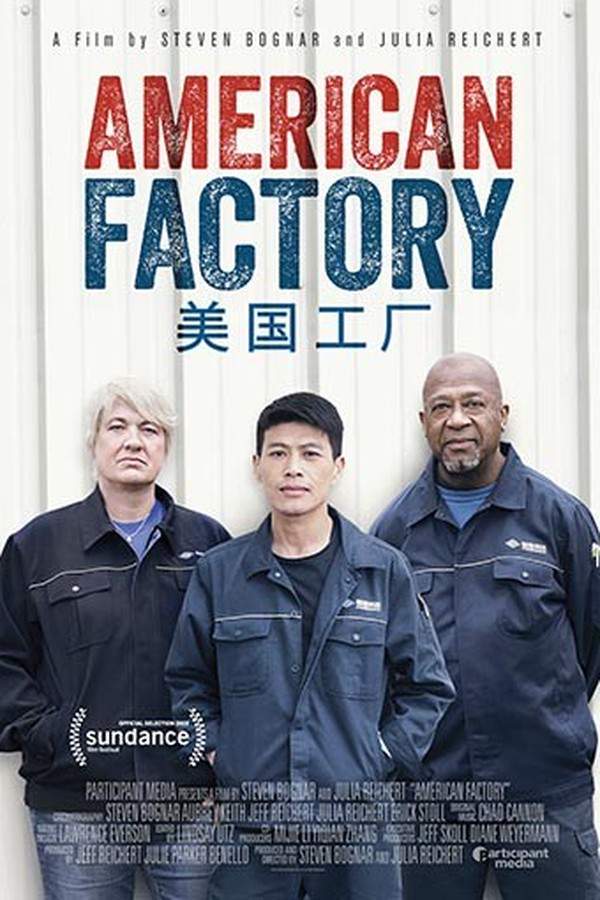
American Factory (2019) movie poster

Plot Summary

American Factory (2019) Plot Summary Explained

Release, runtime and language
2019 · 115 min · English
Echo score 77
JustWatch #31,024 1
Directed by
Julia Reichert, Steven Bognar
Starring
Austin Cole, Cho Tak Wong, Cynthia Harper, Dave Burrows, Jeff Daochuan Liu, Jill Lamantia

In post-industrial Ohio, a Chinese company opens a new factory in a shuttered General Motors plant, bringing the promise of jobs and economic revitalization. Initial optimism and excitement gradually give way to cultural clashes and labor disputes as American and Chinese workers navigate differing approaches to work and management. The film explores the challenges and complexities of globalization and the collision of cultures in a changing American landscape, revealing unexpected tensions and frustrations.

On this page (6)
  1. 1 Where to watch
  2. 2 What happens: full plot
  3. 3 Plot questions answered
  4. 4 Movie threads
  5. 5 Movies like American Factory
  6. 6 Every angle

Where to watch

Where to Watch American Factory (2019)

Where can you watch American Factory? Stream, rent or buy it in the US, including on Netflix and Netflix Standard: current JustWatch availability with up-to-date prices.

Streaming availability powered by JustWatch

Full plot summary · contains spoilers

What Happens in American Factory: Full Plot Summary

The whole story of American Factory (2019) explained, from the opening scene to the final frame: every key event, every twist and what it all adds up to. Read it as a quick recap before the sequel, to check a scene you missed, or to finally understand what really happened.

In post-industrial Ohio, a Chinese billionaire initiates a bold venture by establishing a factory within an abandoned General Motors plant, bringing employment opportunities to two thousand Americans. Initially marked by optimism and hope, this endeavor soon encounters difficulties as the technological advancements of high-tech China clash with the realities faced by the American working class.

On December 23, 2008, the GM facility in Dayton, Ohio, shuts its doors, resulting in the loss of 10,000 jobs. As showcased in a video depicting a glass manufacturing plant in China, these factories are heavily automated. By 2010, China begins investing in the U.S. market, buying up closed factories and revitalizing them. In 2015, Fuyao, a Chinese glass manufacturing company, secures the GM plant. Within half a year, they employ 1,000 workers and import the necessary equipment to start operations, with a significant number of Chinese workers on site. These workers are enrolled in special classes aimed at familiarizing them with American culture.

The Chairman, Cao, of the Fuyao group, attends the formal opening ceremony on October 7, 2016. Among his team is Rebecca, the Fuyao attorney in the U.S., and Dave, the Vice President of the Dayton factory. The event includes heavy public relations efforts, including naming a street after Fuyao, as the community is told that a bright future lies ahead. The Fuyao factory emerges as a symbol of Chinese investment in America.

However, the dynamics within the factory soon reveal challenges. Chinese supervisors report to the Chairman that the Americans seem slow and have "fat fingers," despite the fact that companies like Chrysler express satisfaction with the products. As part of aligning with Feng Shui, the Chairman orders the main entrance of the factory to be repositioned, which comes at a price of $35,000. He also advocates for local artworks to adorn the office, albeit with particular requests that conflict with local regulations.

Leon, the lead Chinese supervisor, along with Boddy, a U.S. furnace off-loader who struggled with unemployment for 18 months, works tirelessly at Fuyao. Shawnea, a glass inspector, experiences a salary drop, earning $12.84/hour at Fuyao compared to the $29/hour she made at GM. Jill, a forklift operator who lost her home following GM's closure, now resides with her sister.

Yet, production is marred by frequent stoppages as the employees grapple with language barriers while identifying defects in the output. Wong, a Chinese furnace engineer with 20 years of experience at Fuyao, subsists on Twinkies due to his busy schedule, while Rob serves as the furnace supervisor. John is the President of the factory, which does not support union activity—this stance draws media attention.

As tensions escalate, Sherrod Brown, a local senator, asserts that workers have the right to form a union. This comment seems improper to Dave and causes unease among the factory management, including John, who is made aware that their positions are at risk. The Chairman expresses to his management team that any union activity will jeopardize productivity and profitability, leading to job losses.

The Chinese leadership is adamant about producing glass at the same cost as in China. However, issues arise as glass begins to shatter throughout the plant. Moreover, safety protocols are ignored as workers risk close proximity to dangerously hot glass. During a return visit, Chairman Cao conveys disappointment to his Chinese staff, reiterating that factory goals have not been met and demanding increased effort. He embarks on private jet trips, concluding that U.S. workers are unmanageable.

When Cao tasks John and the American managers to visit the Fuyao facility in Fujiyan province, they witness a different culture of work—young, disciplined employees functioning in a fast-paced environment with minimal breaks. This stark contrast leads them to perceive U.S. workers as less industrious, who enjoy shorter work hours and greater time off.

Shimeng, Chairman of the Fuyao workers’ union in China and Cao’s brother-in-law, supports the management's perspective. Upon their return, the U.S. workers express dissatisfaction over minimal amenities and the strict work atmosphere, leading to a significant rise in workplace accidents. Eleven safety complaints are lodged against Fuyao, and a movement toward unionization gains traction.

As the Chairman dismisses John and Dave, he appoints Jeff, a Chinese President, and this transition marks a harsh turn for the U.S. workforce, resulting in 3,000 employee terminations or resignations. The Chinese supervisors, frustrated by the inability to mandate overtime or weekend hours, pursue ways to motivate the U.S. workers, ultimately opting to shower them with encouragement.

When Fuyao proposes a $2/hour raise in exchange for longer working hours, the workers take steps to vote for a union. Although they engage a Labor Relations Institute (LRI) consultant, who emphasizes that strikes are manageable for employers, workers vote against unionization, fearing plant closure.

Despite incurring losses of $40 million in 2016, Fuyao continues to invest in automation, ultimately dismissing more U.S. workers while maintaining only $14/hour wages for their remaining employees. As the landscape evolves, the factory employs 2,200 American and 200 Chinese workers, marking a transformation shaped by a complex interplay of culture, economics, and labor dynamics.
Last updated: November 15, 2024 at 15:51

Was this helpful?

Plot questions answered

American Factory Plot Explained: Your Questions Answered

The questions people ask most about American Factory (2019): what happens in the confusing scenes, why the characters do what they do, the twists, hidden details and what the ending means. Each answer contains spoilers.

Q1

Why did General Motors close its Dayton plant in 2008?

GM closed its Dayton plant on December 23, 2008, as part of a broader bankruptcy restructuring during the financial crisis. The closure eliminated approximately 10,000 jobs at a single facility, reflecting the decline of American manufacturing and the company's shift toward more cost-effective, often automated production methods.

Foreshadowing: The documentary opens with this closure, establishing the economic desperation that makes workers willing to accept lower wages from Fuyao.

  • gm closure
  • dayton ohio
  • 2008
  • manufacturing jobs
  • economic decline
Q2

Why did Fuyao choose to open a factory in Ohio?

Fuyao, a Chinese glass manufacturing company, purchased the abandoned GM plant in 2015 as part of China's strategic investment in the U.S. market. The company sought to supply glass directly to American automakers like Chrysler, avoiding import costs and tariffs while taking advantage of the readily available infrastructure and desperate local workforce.

Foreshadowing: The timeline shows China began buying closed U.S. factories in 2010, making this acquisition part of a broader economic strategy.

  • fuyao
  • china investment
  • ohio factory
  • glass manufacturing
  • auto industry
Q3

Why did the union vote fail at Fuyao?

The union vote failed because workers feared that unionizing would cause Fuyao to close the plant entirely. Despite dissatisfaction with wages and conditions, the Labor Relations Institute consultant hired by workers emphasized that employers typically survive strikes, making workers believe their jobs would be at risk if they voted yes.

Foreshadowing: Earlier, Chairman Cao explicitly warned that any union activity would jeopardize productivity and force job cuts.

  • union vote
  • labor rights
  • fuyao workers
  • unionization
  • job security
Q4

Why did Chairman Cao fire John and Dave?

Chairman Cao fired American managers John and Dave after they failed to meet production goals and could not implement the stricter work culture he demanded. Following their visit to the Fuyao facility in China, where they witnessed highly disciplined workers, Cao concluded that American workers were unmanageable and replaced them with Chinese President Jeff.

Foreshadowing: During his visits, Cao expressed repeated disappointment that factory goals were not being met.

  • chairman cao
  • john
  • dave
  • management firing
  • fuyao leadership
Q5

Why were American workers paid less at Fuyao than at GM?

American workers received significantly lower wages because Fuyao operated under different economic conditions. Glass inspector Shawnea earned $12.84/hour at Fuyao compared to $29/hour at GM, reflecting the company's goal to produce glass at Chinese cost levels while the local economy had few alternative employment options after the GM closure.

Foreshadowing: The salary disparity was established early, with workers like Shawnea, Boddy, and Jill highlighted as examples of economic sacrifice.

  • wages
  • salary
  • fuyao pay
  • gm comparison
  • worker compensation
Q6

Why did Chinese supervisors complain about American workers?

Chinese supervisors like Leon reported that American workers seemed slow and had "fat fingers," referring to difficulty with precision tasks. The supervisors were accustomed to the fast-paced, disciplined environment at Fuyao's Chinese facilities, where young workers operated with minimal breaks. Cultural differences in work expectations and communication barriers fueled these complaints.

Foreshadowing: This tension was visible from early operations, with Chinese supervisors expressing frustration to Chairman Cao.

  • chinese supervisors
  • leon
  • american workers
  • work culture
  • efficiency
Q7

What caused the safety problems at Fuyao?

Safety problems stemmed from ignored protocols as workers operated dangerously close to hot glass, language barriers that prevented effective communication about defects, and the intense pressure to meet production goals. Eleven safety complaints were lodged against Fuyao, and workplace accidents increased significantly as dissatisfaction grew.

Foreshadowing: The document notes workers risk close proximity to dangerously hot glass, and production stoppages were frequent.

  • safety complaints
  • workplace accidents
  • fuyao
  • glass
  • occupational hazard
Q8

Why did the visit to China's Fuyao factory change the American managers' perspective?

The visit to Fujiyan province revealed a starkly different work culture: young, disciplined employees working in a fast-paced environment with minimal breaks. Witnessing this efficiency made American managers see their own workforce as less industrious, ultimately leading them to adopt a more critical view of U.S. workers when reporting back to Cao.

Foreshadowing: This trip directly preceded Cao's decision to replace American leadership with Chinese management.

  • fujiyan province
  • china visit
  • work culture
  • american managers
  • fuyao china
Q9

Why did workers vote against the union despite poor conditions?

Workers voted against unionization primarily from fear that it would trigger plant closure. Although they were offered a $2/hour raise in exchange for longer hours, the consultant's message that employers typically survive strikes convinced workers that voting yes meant risking the only major employer in the area.

Foreshadowing: This fear was reinforced by Chairman Cao's explicit threats that union activity would threaten jobs.

  • union vote fear
  • plant closure
  • workers rights
  • labor organization
Q10

What happened to the Fuyao factory by the end of the documentary?

By the documentary's end, Fuyao continued operating despite losing $40 million in 2016. The company invested heavily in automation and reduced its American workforce while maintaining low wages of $14/hour. The factory employed 2,200 American and 200 Chinese workers, representing a transformed workplace where union efforts had failed and worker conditions remained challenging.

Foreshadowing: The ending reflects the bittersweet outcome: survival without victory for American workers.

  • fuyao ending
  • automation
  • job losses
  • factory outcome
  • 2016 losses
Q11

Why did Fuyao spend $35,000 to change the factory entrance?

Chairman Cao ordered the main entrance repositioned to align with Feng Shui, the Chinese practice of harmonizing buildings with natural energy flows. This $35,000 expense reflected the company's effort to incorporate Chinese cultural practices into the American facility, though it conflicted with local regulations in some cases.

Foreshadowing: This detail appears early, establishing the cultural clash between Chinese management practices and American norms.

  • feng shui
  • $35000
  • chinese culture
  • factory entrance
  • cao decisions
Q12

What happened to workers who lost their homes after GM closed?

Workers like Jill, a forklift operator, lost their homes following GM's closure and were forced to move in with relatives. The documentary highlights how the 2008 plant closure created cascading economic hardships for workers who had dedicated years to the auto industry, with few viable job alternatives in the region.

Foreshadowing: Jill's situation is introduced early, demonstrating the desperate economic circumstances that made Fuyao's jobs appealing despite lower pay.

  • jill
  • lost home
  • gm workers
  • economic hardship
  • dayton community

Movie threads

More Movies Like American Factory, by Mood & Story

Curated lists built around what makes American Factory tick: the same mood, the same kind of story or the same emotional payoff. Each list explains why these movies belong together.

Global culture clash documentaries like American Factory

Documentaries exploring the messy reality of global economic and cultural integration. For viewers who liked the cultural and economic tensions in American Factory, this section finds similar documentaries. These films explore the gritty reality of globalization, focusing on labor, class, and the human stories behind international business and cultural integration.

  • observational
  • thought-provoking
  • anxious
  • frustrating
  • gritty
  • urgent
  • Tone: tense, observational, sobering
  • Pacing: steady, methodical
Why these movies?

The story pattern: These documentaries typically begin with a promise of progress or economic benefit, following the establishment of a new venture or system. The narrative unfolds by contrasting the initial optimism with the gradual emergence of deep-rooted cultural differences, misunderstandings, and conflicts over values, leading to a complex and often unresolved situation.

Why they belong together: Movies in this thread are grouped by their shared focus on the tangible effects of globalization, their methodical observation of cultural friction, and their heavy emotional weight stemming from real-world economic anxieties and systemic conflicts.

Bittersweet economic documentaries like American Factory

Real-life stories where survival comes with a heavy cost and no clear victors. If you appreciated the nuanced, bittersweet ending of American Factory, this list features similar documentaries. These films explore themes of labor, automation, and economic decline, delivering heavy emotional impact and thought-provoking conclusions without easy answers.

  • bittersweet
  • sobering
  • frustrating
  • thought-provoking
  • anxious
  • urgent
  • Tone: tense, bittersweet, heavy
  • Pacing: steady, building
Why these movies?

The story pattern: The narrative journey in these films follows a struggle for stability or rights within a larger economic system. The conflict intensifies steadily, but the resolution is ambiguous or mixed; a problem is 'solved' in a practical sense, but at a significant human or ethical cost, leaving the viewer with a feeling of unresolved tension.

Why they belong together: These films share a specific emotional mix: a steady, tense pacing that builds to a bittersweet conclusion. They are united by a heavy emotional weight, a focus on class and labor, and a realistic portrayal of systemic challenges that defy simple happy or sad endings.

If you liked this

Movies Like American Factory

Similar movies to American Factory: the same genre, themes or kind of story. Each one comes with its own plot summary, timeline and ending explained.

Browse all movie summaries

Every angle

American Factory (2019) Explained: Plot, Timeline & Characters

Everything about American Factory in one place: what happens in the plot summary, the timeline in chronological order, the characters and meaning and a spoiler-free summary. What's After the Movie adds the cast, box office and post-credit scenes.

Coming soon on iOS and Android

The Plot Explained Movie Summary App

Plot summaries, endings explained and timelines on your phone. Catch up on any movie in minutes, save your favorites and never miss a twist again.

Be the first to know when we launch. Your email stays private, always.

Learn more about the app