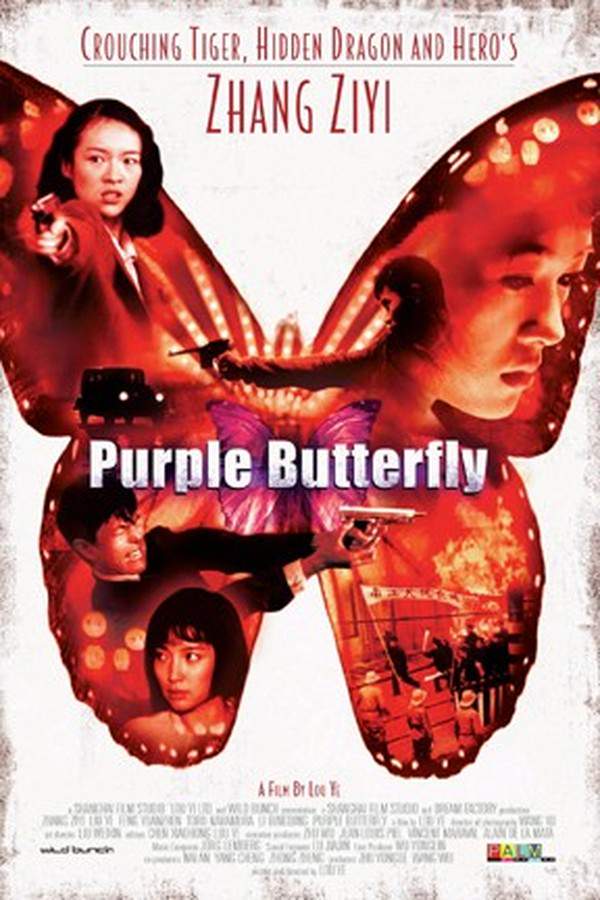
Year: 2004
Runtime: 127 min
Language: Chinese
Director: Ye Lou
Set in 1930s Shanghai, this film follows a lone individual drawn into a dangerous plot orchestrated by a Japanese operative. The scheme aims to compromise Chinese patriots, including the mysterious Zhang Ziyi and Feng Yuanzheng. As war rages around them, the story explores themes of loyalty, betrayal, and the struggle for resistance amidst a complex web of espionage.
Warning: spoilers below!
Haven’t seen Purple Butterfly yet? This summary contains major spoilers. Bookmark the page, watch the movie, and come back for the full breakdown. If you're ready, scroll on and relive the story!
Read the complete plot breakdown of Purple Butterfly (2004), including all key story events, major twists, and the ending explained in detail. Discover what really happened, and what it all means.
In 1928 Manchuria, Japanese translator Hidehiko Itami Tôru Nakamura leaves his Chinese lover, Ding Hui Ziyi Zhang, and returns to Tokyo. Years later, when he arrives in Shanghai, he has become a spy. Meanwhile, Ding Hui witnesses her brother, who ran an anti-Japanese newspaper, being assassinated by the Japanese. She travels to Shanghai, joins an underground resistance called Purple Butterfly, and falls in love with its leader, Xie Ming.
The resistance hatches a plan to strike at a Japanese intelligence officer named Yamamoto, enlisting an assassin from out of town. At a train station, a highly accidental mix-up places a low-level clerk named Szeto across from the real killer on the same car, and Szeto becomes an unwitting focus of the operation. The resistance passes Szeto some materials about the target, and his puzzled, almost chaotic reaction triggers a small crisis that spirals into a larger one. In the ensuing gunfight, Ding Hui accidentally kills Szeto’s girlfriend, Yiling, who had hurried to meet him.
Szeto is briefly captured by Yamamoto’s subordinates, including Itami. Under brutal interrogation, Szeto remains unable to articulate what he truly knows. An informant within the resistance reveals that Szeto is merely a bystander who was pulled into events by chance, and Itami releases him. Nonetheless, the resistance regards Szeto as a potential traitor and decides to erase him.
From outsider to a man entangled in a widening web, Szeto finds himself pursued by both the Japanese secret police and the resistance, unable to explain his presence to either side. Meanwhile, Itami reconnects with his former lover, Ding Hui, and Szeto witnesses their reunion, which deepens his confusion about everything unfolding around him. He is consumed by a thirst for vengeance for Yiling, yet he has no clear target to aim at.
With the real assassin out of circulation, the resistance must take on the mission to kill Yamamoto themselves. Ding Hui stands at a crossroads, torn between Itami and Xie Ming, who lead opposing sides, and her loyalties become a dangerous bargaining chip in the factions’ schemes. Ding Hui accompanies Itami to a gathering at a Japanese club, where the two share a moment of intimacy as they dance. Itami tells her that Yamamoto will not be coming, and that Xie Ming is already dead, a revelation that shocks her. In a sudden turn, Ding Hui stabs Itami. Szeto then bursts into the ballroom, shoots Itami, and pivots his aim toward Ding Hui, leaving the fate of everyone involved hanging in the balance.
Last updated: April 07, 2026 at 21:05
Explore frequently asked questions about Purple Butterfly (2004) with spoiler-rich answers covering the full plot summary, major story beats, character motivations, hidden details, and ending meaning. This movie summary FAQ helps explain confusing scenes, plot twists, and narrative decisions in clear, searchable detail.
Ding Hui accidentally kills Yiling during the chaos at the train station. The resistance had arranged for an assassin to board the train, but due to a mix-up, the low-level clerk Szeto was sitting in the same car instead. When the resistance members attempted to pass materials to the supposed assassin, Szeto's confused and chaotic reaction created confusion. In the ensuing gunfight between resistance members and Japanese agents, Ding Hui's gun discharged and struck Yiling, who had rushed to meet Szeto at the station.
Earlier, the resistance's plan to use an outsider assassin already contained the seeds of this disaster, as the outsider's failure to arrive on time set the tragic chain of events in motion.
Purple Butterfly is an underground anti-Japanese resistance organization operating in 1930s Shanghai. Led by the enigmatic Xie Ming, the group operates secretly to fight Japanese occupation through espionage and targeted operations, including assassinations of Japanese intelligence officers. Ding Hui joins this group after witnessing her brother's assassination by Japanese agents, seeking revenge and solidarity against the occupation.
Itami releases Szeto because interrogation and an informant within the resistance reveal that Szeto is completely innocent, a mere bystander who was pulled into the assassination operation by pure chance. Despite being a Japanese spy hunting resistance members, Itami recognizes that Szeto knows nothing useful and poses no threat. However, this act of mercy puts Itami in a difficult position with his superiors.
Xie Ming, the leader of Purple Butterfly and Ding Hui's current lover, is killed off-screen before the final confrontation. Itami informs Ding Hui at the Japanese club that Xie Ming is already dead, which is what triggers her emotional breakdown and stabbing of Itami. The movie never shows Xie Ming's death directly, leaving the exact circumstances of his demise ambiguous.
The resistance's dangerous operations and the Japanese intelligence network's reach had been established throughout the film, making Xie Ming a vulnerable target.
Ding Hui stabs Itami in shock after he reveals two devastating pieces of information: that Yamamoto will not be coming to the club as planned, and that Xie Ming, the leader of Purple Butterfly and Ding Hui's current lover, is already dead. The combination of these revelations, losing both her revenge opportunity and the man she loves, causes her to lash out violently against the man who represents everything she hates.
Ding Hui's torn loyalties between her former lover Itami and current lover Xie Ming had been building throughout the film, making this emotional explosion inevitable.
Szeto is a low-level clerk who becomes an innocent bystander caught in the resistance's assassination plot. At the train station, due to a highly accidental mix-up, Szeto ends up sitting across from the real hired assassin in the same train car. When resistance members approach and try to pass materials about the target, Szeto's confused reaction makes them believe he is the assassin. From that moment, he becomes hunted by both the Japanese secret police and the resistance.
Despite Szeto being an innocent bystander, the resistance believes he may have betrayed them. After Szeto is captured and interrogated by the Japanese, the resistance suspects he revealed information under torture. Even when Itami releases Szeto because he knows nothing, the resistance still views him as a potential traitor who could lead the Japanese to their operations. They decide to eliminate him as a precaution.
Itami was originally a Japanese translator who lived in Manchuria with his Chinese lover Ding Hui. In 1928, he left her and returned to Tokyo. Years later, when he arrives in Shanghai, he has transformed from a translator into a Japanese intelligence operative working within the spy network. The film does not explicitly explain what happened during his time in Tokyo or what compelled him to become a spy, but his return sets up the tragic collision between his past and present loyalties.
The film opens with Itami's departure from Ding Hui in 1928, establishing the personal betrayal that would later fuel the story's emotional conflict.
Szeto shoots Itami in the ballroom after bursting in, motivated by vengeance for Yiling's death, his girlfriend whom Ding Hui accidentally killed at the train station. After shooting Itami, Szeto turns his gun toward Ding Hui, who stands beside the dying Itami. The film ends ambiguously, leaving unclear whether Szeto fires the final shot, but his thirst for revenge against everyone involved in his misfortune drives this final violent act.
The title Purple Butterfly refers to the name of the underground resistance organization that Ding Hui joins in Shanghai. The purple butterfly serves as a symbolic code name for the anti-Japanese resistance movement, representing both the fragility and the beauty of resistance fighters operating in secret. The organization uses this name to identify themselves and coordinate their operations against Japanese occupation.
Discover curated groups of movies connected by mood, themes, and story style. Browse collections built around emotion, atmosphere, and narrative focus to easily find films that match what you feel like watching right now.
Spy thrillers where loyalties blur and characters are consumed by paranoia.If you liked the tense, morally complex espionage of Purple Butterfly, you'll find more movies like it here. This collection features bleak wartime spy stories filled with betrayal, torture, and the heavy psychological toll of living undercover.
These narratives typically follow an individual drawn into a dangerous intelligence operation, often against their will. The plot is a complex web of double-crosses, mistaken identities, and covert missions where the stakes are life and death. The protagonist's journey is one of psychological unraveling, as the pressure of maintaining a facade and the moral cost of their actions lead to a bleak and fatalistic ending.
These films are grouped together for their shared high-stakes, paranoid atmosphere, complex plotting, and focus on the psychological destruction wrought by espionage. They deliver a consistent experience of tense dread, moral ambiguity, and a heavy emotional weight that leaves a lasting impact.
Love stories shattered by the brutal machinery of war and occupation.For viewers who appreciated the melancholic romance and heavy sacrifice in Purple Butterfly, this thread collects similar movies. Discover more heartbreaking stories of love and resistance set against the grim backdrop of war.
The narrative pattern centers on characters who find a profound connection during a time of extreme duress, often through involvement in a resistance cell or as enemies on opposite sides. Their love is tested by the constant threat of discovery, acts of violence, and the overwhelming demands of their cause. The story arc is inevitably downward, culminating in immense sacrifice, separation, or death, emphasizing the high cost of war on the human heart.
This group shares a core focus on the intersection of romance and wartime resistance, delivering a potent mix of heavy emotional weight, tragic endings, and a tense, oppressive atmosphere. They are united by their exploration of how love becomes both a source of strength and a point of ultimate vulnerability in a world falling apart.
Don't stop at just watching - explore Purple Butterfly in full detail. From the complete plot summary and scene-by-scene timeline to character breakdowns, thematic analysis, and a deep dive into the ending - every page helps you truly understand what Purple Butterfly is all about. Plus, discover what's next after the movie.
Track the full timeline of Purple Butterfly with every major event arranged chronologically. Perfect for decoding non-linear storytelling, flashbacks, or parallel narratives with a clear scene-by-scene breakdown.
Discover the characters, locations, and core themes that shape Purple Butterfly. Get insights into symbolic elements, setting significance, and deeper narrative meaning - ideal for thematic analysis and movie breakdowns.