






Plot Explained Spoilers guaranteed!
Plot Explained

Browse by genre

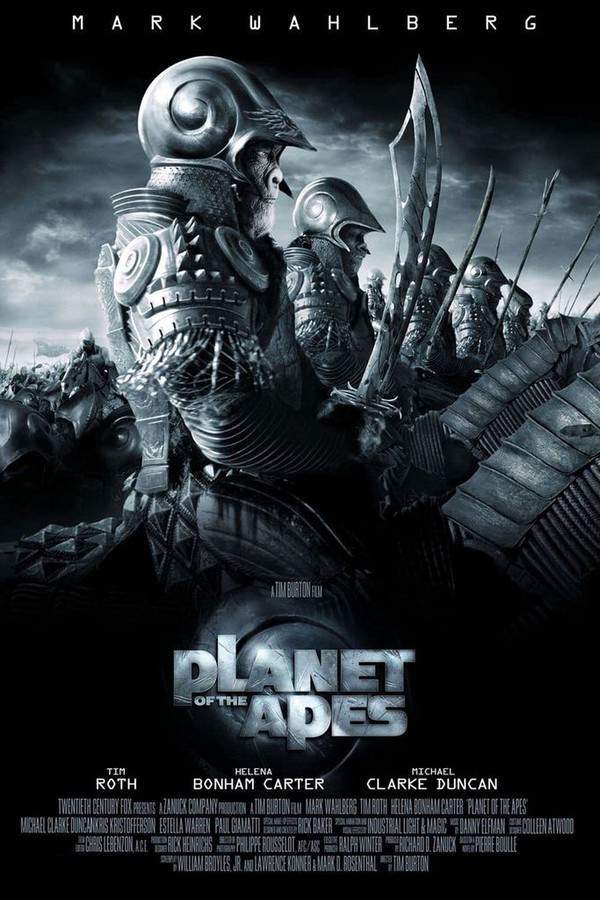
Planet of the Apes (2001) movie poster

Timeline

Planet of the Apes (2001) Timeline Explained – Every Event in Order

Release, runtime and language
2001 · 119 min · English
JustWatch #5,223 9
Directed by
Tim Burton
Starring
Mark Wahlberg, Helena Bonham Carter
Budget
$100M

A pilot crash-lands on a distant planet and finds himself in a startling world ruled by intelligent apes. The human population has fallen, and the apes have built a complex society with a strict hierarchy. He must navigate this unfamiliar and dangerous environment, encountering both threats and unexpected alliances as he tries to understand what happened to humanity and find a way home.

On this page (7)
  1. 1 Where to watch
  2. 2 Events in order (14)
  3. 3 Timeline questions answered
  4. 4 The book behind the movie
  5. 5 Movie threads
  6. 6 Movies like Planet of the Apes
  7. 7 Every angle

Where to watch

Where to Watch Planet of the Apes (2001)

Where can you watch Planet of the Apes? Stream, rent or buy it in the US, including on Hulu, Amazon Video and Apple TV Store: current JustWatch availability with up-to-date prices.

Streaming availability powered by JustWatch

14 events in order · contains spoilers

Planet of the Apes Timeline: Events in Chronological Order

Every key event of Planet of the Apes (2001) in order, scene by scene, with when and where it takes place. Use it to untangle flashbacks, time jumps and parallel storylines, to refresh your memory before the sequel or to find the exact scene you are thinking of.

  1. Sirius's Unique Development

    Ulysse Mérou and Nova are astonished to discover that their child, Sirius, begins to walk and talk at just three months old. This unusual development signifies a leap in evolution that changes their perspective on parenting and the future.

  2. Plans for Space Travel

    Motivated by Sirius’s remarkable abilities, Ulysse and Nova devise an audacious plan. They decide to pose as human test subjects in a scientific experiment related to space travel, showcasing their determination to protect their child’s exceptional future.

  3. Infiltration of the Spacecraft

    Employing their unique looks to blend in, Ulysse and Nova manage to infiltrate a spacecraft. Their cunning plan involves taking control of the spacecraft's systems, marking the first step of their bold escape from their current existence.

  4. Journey Back to Earth

    With remarkable skill, Ulysse piloted the spacecraft back towards Earth. As they soared through space, they were overwhelmed with hope while gazing upon breathtaking sights, including the City of Light.

    Where
    City of Light
  5. Returning to Familiar Sights

    As they fly closer to Earth, the iconic Eiffel Tower and Orly Airport come into view. This sight stirs memories of home for Ulysse and Nova, filling them with nostalgic emotions about their past life.

    Where
    Eiffel Tower, Orly Airport
  6. Unexpected Encounter

    In a dramatic turn, Ulysse and Nova’s joyous return is cut short by an unexpected obstacle. They come face-to-face with a field officer in a jeep, who is shockingly revealed to be a gorilla, a symbolism of the chaos that surrounds them.

  7. Abandoning the Escape Plan

    The revelation of the gorilla forces Ulysse and Nova to reassess their escape strategy. Overwhelmed by mixed emotions, they decide to abandon their daring plan and leave their hopes for a future behind.

  8. Ulysse's Reflection

    In a poignant moment, Ulysse takes time to reflect on their incredible journey. He pens down their story and seals it within a bottle, symbolically casting it into the void of space, as if reaching for an audience yet unknown.

  9. Discussion Among Chimpanzees

    Meanwhile, a subplot unfolds featuring Jinn and Phyllis, a couple of chimpanzees. They engage in a spirited discussion about Ulysse's extraordinary narrative, struggling to comprehend the existence of intelligent beings like humans.

  10. Doubt and Dismissal

    As Jinn and Phyllis debate Ulysse’s adventures, they find it difficult to believe in the tales of human civilization. Their skepticism highlights the stark contrasts in perceptions of intelligence and evolution in their world.

  11. Sirius's Future

    Amidst the chaos of their escape and reflection, the future of Sirius remains uncertain. Ulysse and Nova's experiences and the challenges they face will play a crucial role in determining the next steps for their rapidly evolving child.

  12. Journey to Understanding

    Both Ulysse and Nova must seek new ways to understand their unique situation as parents of a precocious child. They aim to ensure Sirius has the opportunities to thrive despite the adversities they encounter.

  13. Hope Amidst Uncertainty

    Despite the challenges ahead, Ulysse holds onto hope for a better future. He reflects on the lessons learned from their journey while contemplating what it means to be a parent in a world filled with uncertainty.

  14. The Unknown Audience

    As Ulysse releases his story into space, he imagines the possibilities of who might find it. This act represents a desire for connection with others as he navigates his family's unique legacy.

Last updated: November 22, 2024 at 10:43

Was this helpful?

Timeline questions answered

Planet of the Apes Timeline Explained: Your Questions Answered

When does it happen, and why in that order? The questions people ask about the chronology of Planet of the Apes (2001): time jumps, flashbacks, cause and effect between scenes and the correct order of events, each answered with spoilers.

Q1

Why does Sirius begin walking and talking at just three months old?

Sirius's rapid development represents a significant leap in evolution. This extraordinary ability is what motivates Ulysse and Nova to attempt their escape plan, as they believe their child's exceptional future requires them to leave the ape-ruled planet and return to Earth where humans once ruled.

Foreshadowing: Earlier scenes establish that apes have evolved intelligence while humans have regressed, making Sirius's development a reverse evolution that signals hope for humanity.

  • sirius evolution
  • rapid development
  • apes planet of the apes
  • human evolution
Q2

Why do Ulysse and Nova pose as human test subjects?

They disguise themselves as human test subjects in a space travel experiment because their unique appearance allows them to blend in with the subjects. This ruse gives them access to a spacecraft, which they need to escape the ape-ruled planet and return to Earth with their child.

  • disguise
  • spacecraft
  • infiltration
  • escape plan
Q3

Why do Ulysse and Nova abandon their escape plan after seeing the gorilla officer?

The appearance of a gorilla officer on Earth shocks them because it confirms that apes now rule Earth just as they do on the distant planet. This realization that humanity's fate cannot be reversed forces them to abandon their attempt to return home, as there would be no place of safety for them.

Foreshadowing: Earlier scenes establish the strict ape hierarchy with gorillas as the military/police force.

  • gorilla officer
  • earth ruled by apes
  • escape failed
  • return to earth
Q4

What happens when Ulysse and Nova see the Eiffel Tower and Orly Airport?

As they approach Earth, the sight of the Eiffel Tower and Orly Airport fills them with nostalgia and hope for returning to their old life. However, this joy is immediately cut short when they encounter the gorilla officer, revealing that apes now dominate Earth.

  • eiffel tower
  • orly airport
  • paris
  • homecoming
Q5

Why does Ulysse seal his story in a bottle and send it into space?

After their escape fails, Ulysse writes down their entire adventure and sends it into space in a bottle, hoping that someone, perhaps humans from another time or another world, might one day discover and believe their story. This act represents his desire for his family's legacy to survive and be understood.

  • bottle message
  • story
  • space
  • legacy
  • communication
Q6

What is the purpose of the Jinn and Phyllis subplot?

Jinn and Phyllis are chimpanzees who find and discuss Ulysse's written story. They struggle to believe that intelligent humans once existed, dismissing his account as fantasy. This nested narrative adds thematic depth by showing how history gets distorted, Ulysse's true experience becomes legend that others cannot accept.

Foreshadowing: The subplot mirrors the main story's themes of perception versus reality.

  • jinn
  • phyllis
  • chimpanzees
  • subplot
  • history interpretation
Q7

Why is there a gorilla officer on Earth when they return?

The gorilla officer confirms the movie's central premise: apes have evolved to become the dominant species on Earth, just as they did on the distant planet where Ulysse was stranded. This reveals that human civilization fell worldwide, and apes now run everything, including military operations.

  • gorilla
  • earth evolution
  • apes take over
  • planet of apes
Q8

Why do the chimpanzees dismiss Ulysse's story as fiction?

Jinn and Phyllis cannot conceive that humans were once the dominant intelligent species. Their dismissal reflects how history has been rewritten, the truth of human civilization is now considered impossible or mythical. This creates dramatic irony since the viewer knows Ulysse's account is true.

  • skepticism
  • history revision
  • dismissal
  • truth fiction
Q9

What does the gorilla officer encounter symbolize in the story?

The gorilla officer represents the final barrier between Ulysse's hope and reality. It symbolizes that escape is impossible, there is no returning to the old world. The ape hierarchy that oppressed him on the distant planet has now been shown to exist on Earth as well, making their situation truly hopeless.

  • symbolism
  • oppression
  • ape hierarchy
  • final obstacle
Q10

Why does the movie end with an ambiguous, unresolved feeling?

The ending leaves multiple questions open: Ulysse and Nova's fate after abandoning their escape is uncertain, and their incredible story has been dismissed as fiction by the chimpanzees. This ambiguity reinforces the themes of displacement, lost history, and the difficulty of truth being accepted.

  • ambiguous ending
  • uncertain fate
  • resolution
  • themes

Movie threads

More Movies Like Planet of the Apes, by Mood & Story

Curated lists built around what makes Planet of the Apes tick: the same mood, the same kind of story or the same emotional payoff. Each list explains why these movies belong together.

Movies about surviving in alien societies like Planet of the Apes

Protagonists must infiltrate and survive within a complex, unfamiliar civilization. If you enjoyed the tension of navigating the ape civilization in Planet of the Apes, you'll find similar stories here. These movies feature protagonists who must survive and find their way within complex, unfamiliar societies, often with a steady pace and a focus on infiltration and cultural shock.

  • unsettling
  • isolated
  • tense
  • reflective
  • strange world
  • infiltration
  • Tone: tense, unsettling, reflective
  • Pacing: steady, methodical
Why these movies?

The story pattern: The narrative follows an outsider's journey into the heart of an established, non-human or radically different society. The plot is driven by the need to understand the rules, avoid detection, and form unlikely alliances, often leading to a reflective examination of the protagonist's own humanity and place in the universe.

Why they belong together: These films are grouped by their shared premise of a character confronting a complete alien civilization. They deliver a specific blend of tension, cultural exploration, and survival drama, creating a consistent vibe of unease and fascination with 'the other'.

Movies with a mood of bleak hope and escape like Planet of the Apes

A desperate journey towards hope, shadowed by melancholic loss and ambiguous outcomes. For viewers who liked the mix of desperate hope and melancholic reflection in Planet of the Apes, this list captures films with a similar emotional tone. These stories follow characters striving for escape or redemption in oppressive worlds, often leading to bittersweet or ambiguous conclusions.

  • hopeful
  • melancholic
  • tense
  • desperate
  • bittersweet
  • ambiguous ending
  • Tone: tense, melancholic, hopeful
  • Pacing: steady, determined
Why these movies?

The story pattern: The narrative arc is a push-and-pull between the drive to achieve a goal (like returning home) and the crushing reality that makes success unlikely. This creates a specific emotional journey where moments of triumph are undercut by loss, resulting in an ending that feels more complex and ambiguous than purely happy or sad.

Why they belong together: This thread connects films through their distinct emotional blend—a steady, tense pace fueled by a goal-oriented plot, but emotionally colored by a medium-to-heavy weight of melancholy and loss, often culminating in an ending that isn't neatly resolved.

If you liked this

Movies Like Planet of the Apes

Similar movies to Planet of the Apes: the same genre, themes or kind of story. Each one comes with its own plot summary, timeline and ending explained.

Browse all movie summaries

Every angle

Planet of the Apes (2001) Explained: Plot, Timeline & Characters

Everything about Planet of the Apes in one place: what happens in the plot summary, the timeline in chronological order, the characters and meaning and a spoiler-free summary. What's After the Movie adds the cast, box office and post-credit scenes.

Coming soon on iOS and Android

The Plot Explained Movie Summary App

Plot summaries, endings explained and timelines on your phone. Catch up on any movie in minutes, save your favorites and never miss a twist again.

Be the first to know when we launch. Your email stays private, always.

Learn more about the app