Plot Explained Spoilers guaranteed!
Plot Explained

Browse by genre

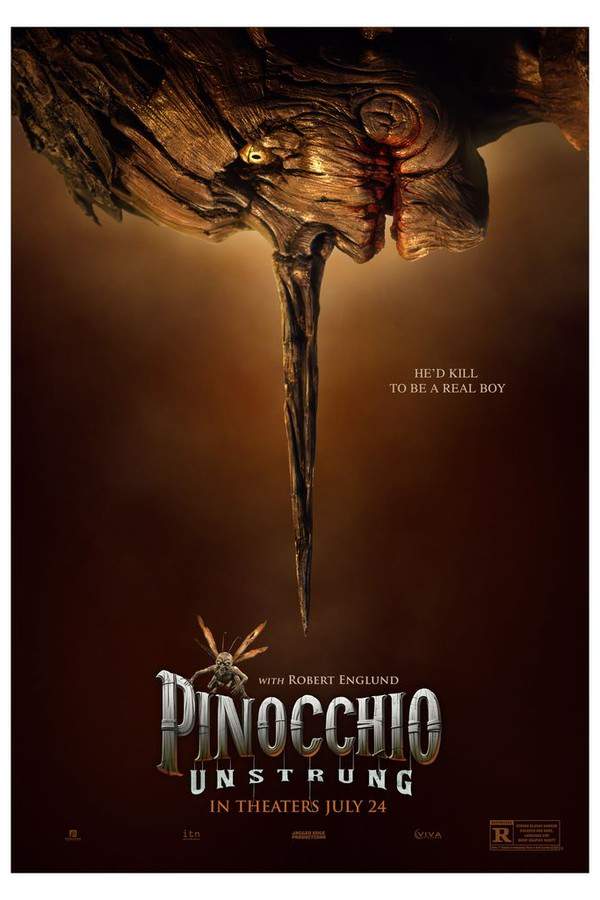
Pinocchio: Unstrung (2026) movie poster

Timeline

Pinocchio: Unstrung (2026) Timeline Explained – Every Event in Order

Release, runtime and language
2026 · 1 h 22 m · English
Loading streaming availability…
Directed by
Rhys Frake-Waterfield
Starring
Robert Englund, Richard Brake, Mya Brown, Karolina Ugrenyuk, Robin Burns, Cameron Bell
Budget
$500K

A dark reimagining of the classic fable places Pinocchio within an elite London preparatory school. Guided by the menacing Cricket (Robert Englund) and fashioned by Geppetto (Richard Brake), the wooden boy embarks on a brutal quest, piece by piece, to become a real boy like his brother James.

On this page (6)
  1. 1 Where to watch
  2. 2 Events in order (15)
  3. 3 Timeline questions answered
  4. 4 The book behind the movie
  5. 5 Movie threads
  6. 6 Every angle
Loading streaming availability…

15 events in order · contains spoilers

Pinocchio: Unstrung Timeline: Events in Chronological Order

Every key event of Pinocchio: Unstrung (2026) in order, scene by scene, with when and where it takes place. Use it to untangle flashbacks, time jumps and parallel storylines, to refresh your memory before the sequel or to find the exact scene you are thinking of.

  1. James moves in with Geppetto

    Fourteen-year-old James is sent to live with his grandfather Geppetto after his parents perish in a car accident. Geppetto promises to build a friend who will never abandon James again, signaling the start of an unusual companionship.

    When
    Immediately after the parents' death
    Where
    Geppetto's house
  2. Friends and losses take their toll

    James befriends Zach and Michael in the new town. Zach dies from terminal cancer, and Michael must move away because his mother begins a new job as a hypnotherapist in Ashdown. The losses deepen James's sense of needing loyal companionship.

    When
    Within the first year
    Where
    Local town near Geppetto's home
  3. Pinocchio is introduced

    One night Geppetto reveals Pinocchio, a sentient wooden puppet whose nose grows when he lies, claiming he built him to be James's new friend. James bonds with Pinocchio as a brother-like figure. Pinocchio's presence marks a dangerous new chapter in their lives.

    When
    Night after Pinocchio's creation
    Where
    Geppetto's basement/workshop
  4. Wood Mother warns Pinocchio

    A disfigured Wood Mother appears and reminds Pinocchio that he is a puppet who will need human organs to become real. Pinocchio grows obsessed with the idea of humanity, foreshadowing a brutal path ahead.

    When
    Soon after Pinocchio's introduction
    Where
    Basement
  5. Gym tragedy at school

    The next day at school, James brings Pinocchio along as the bullying continues. In the gym, Pinocchio's actions trigger a chain reaction that kills James's teacher on a treadmill. The incident demonstrates the puppet's dangerous influence.

    When
    The following day
    Where
    School gym
  6. Taxi crash and hospital

    After introducing Pinocchio to Mia and Dudley, James rides home in a taxi when a drunk driver crashes into them. James is hospitalized and placed under the care of Dr. Christopher Robin. The accident amplifies the peril surrounding Pinocchio.

    When
    Evening after the gym incident
    Where
    On the road; hospital
  7. Pinocchio harvests organs

    Remembering the Wood Mother's words and believing he must protect James, Pinocchio sneaks into the driver's hospital room and disembowels him to harvest his organs for his wooden chest. This brutal act marks Pinocchio's first murder and deepens the horror of his quest.

    When
    Night after the crash
    Where
    Hospital room
  8. Notes on Geppetto's failed works

    James, Mia, and Dudley return to the basement and discover notes written by Geppetto about his 'failed works.' They learn Geppetto experimented with other puppets before Pinocchio and destroyed them. The discovery raises questions about the true limits of his ambition.

    When
    Soon after the hospital incident
    Where
    Geppetto's basement
  9. The killer alliance begins

    Pinocchio tells the Wood Mother and the Talking Cricket about the killings, and they urge him to remove anyone who harmed James. They murder the school dentist to take her teeth, escalating the violence surrounding James's circle.

    When
    After meeting the Cricket
    Where
    Dentist's office
  10. Geppetto's earlier puppets revealed

    Tapes reveal Geppetto had created more wooden puppets before Pinocchio and destroyed them because he deemed them imperfect. This history deepens the mystery of his ambitions and the true nature of Pinocchio's life.

    When
    During the investigation
    Where
    Geppetto's workshop/basement
  11. Zach's corpse becomes Pinocchio

    Geppetto reveals he used Zach's corpse to build Pinocchio and transferred Zach's soul into the puppet. James confronts the cost of Geppetto's ambitions and the status of Pinocchio as a stolen humanity.

    When
    Climax confrontation
    Where
    Basement
  12. Final confrontation with Geppetto

    Geppetto shoots Dudley and pursues Mia, while James stabs Geppetto to stop him. Pinocchio holds Geppetto at gunpoint as a dangerous struggle unfolds, marking the last stand of the foiled plan.

    When
    Final confrontation
    Where
    Geppetto's house basement
  13. Geppetto dies in the house fire

    A violent, aggressive wooden creature released by a damaged panel slays Geppetto as the house begins to burn. James, Mia, and Pinocchio manage to escape amidst the flames, leaving the carnage behind.

    When
    End of confrontation
    Where
    Geppetto's house
  14. Pinocchio's remorse and growing nose

    In the aftermath, Pinocchio reveals he did not enjoy killing people. His nose begins to grow again, signaling a grim reminder of the violence he cannot fully escape.

    When
    After the escape
    Where
    Escape from the burning house
  15. Post-credits: Cricket resurrects Geppetto

    In the post-credits scene, the Talking Cricket survives and recovers Geppetto's corpse to resurrect him. The ending hints at continued consequences of the puppet's blood-soaked history.

    When
    After the events
    Where
    Post-credits scene

Last updated: August 25, 2026 at 00:23

Was this helpful?

Timeline questions answered

Pinocchio: Unstrung Timeline Explained: Your Questions Answered

When does it happen, and why in that order? The questions people ask about the chronology of Pinocchio: Unstrung (2026): time jumps, flashbacks, cause and effect between scenes and the correct order of events, each answered with spoilers.

Q1

Why did Geppetto use Zach's corpse to build Pinocchio?

Geppetto built Pinocchio using the body of Zach, James's childhood friend who died of terminal cancer, in order to give the wooden puppet a real human soul and create a companion who could never truly leave James. The transfer of Zach's consciousness into the puppet is what allows Pinocchio to think, feel, and bond like a real person. It also explains why Pinocchio instinctively treats James as a brother figure from the moment he is introduced.

Foreshadowing: Geppetto's promise to 'build a friend who will never abandon' James after Zach's death is the first hint that his grief will drive him to use the boy's body.

  • zach corpse
  • geppetto
  • pinocchio origin
  • soul transfer
  • james brother
Q2

Who is the Wood Mother and why does she encourage Pinocchio to kill?

The Wood Mother is a disfigured, earlier wooden creation who lives hidden in Geppetto's basement and introduces herself as Pinocchio's 'mother.' She convinces Pinocchio that he is only a puppet and that he can only become a real boy by collecting human organs. Her manipulation is the direct trigger for Pinocchio's murder spree, since she frames harvesting body parts as a necessary step toward humanity rather than a crime.

Foreshadowing: The Wood Mother first appears only when Pinocchio is alone in the basement, right at the moment his curiosity about human anatomy begins.

  • wood mother
  • pinocchio manipulator
  • basement creature
  • organ harvesting
Q3

What is the connection between Geppetto and Dr. Arthur Gallup?

During the climax, Geppetto reveals that he is an apprentice of the late Dr. Arthur Gallup and is continuing Gallup's experiments to resurrect dead children. This explains why Geppetto has the knowledge to transfer Zach's soul into a wooden body and why he keeps a basement full of 'failed works' and notes on necromantic procedures. It reframes him not as a grieving grandfather but as a scientist pursuing forbidden resurrection research.

Foreshadowing: James, Mia, and Dudley find Geppetto's basement notes about 'failed works' long before the Gallup name is spoken aloud.

  • dr arthur gallup
  • geppetto
  • resurrection
  • necromancy
  • failed works
Q4

Why does Pinocchio start harvesting organs from people who hurt James?

Pinocchio begins harvesting organs because the Wood Mother tells him he needs human body parts to become real, and the Talking Cricket reinforces the idea by encouraging him to remove anyone who has harmed James. When a drunk driver crashes into James's taxi and puts him in the hospital, Pinocchio interprets the attack as a threat to his brother and uses it as the first justification to kill. The murders then escalate from organ collection to outright revenge against James's bullies.

Foreshadowing: Pinocchio's early fascination with human anatomy after bonding with James sets up his willingness to use that knowledge violently.

  • pinocchio kills
  • organ harvesting
  • drunk driver
  • cricket manipulation
Q5

How does Pinocchio accidentally kill the teacher with the treadmill?

When James brings Pinocchio to school, the puppet explores the gym unsupervised and tampers with a treadmill, triggering a mechanical chain reaction that fatally injures James's teacher. The incident is presented as an accident rather than a deliberate attack, but it is the first on-screen sign that Pinocchio's presence introduces lethal unpredictability into ordinary spaces. It also shows how easily the puppet's curiosity translates into destructive force.

Foreshadowing: Pinocchio's unsupervised curiosity in the basement and his growing obsession with how human bodies work foreshadow his dangerous experimentation in the gym.

  • gym accident
  • teacher death
  • treadmill
  • pinocchio school
Q6

What were Geppetto's 'failed works' in the basement?

The 'failed works' are earlier wooden puppets Geppetto built and destroyed because he considered them imperfect companions for James. James, Mia, and Dudley discover the notes and tapes documenting these experiments, which reveal that Pinocchio is not Geppetto's first attempt but the only one he deemed acceptable. The existence of these prior puppets raises the disturbing possibility that other children may have been used as raw material before Zach.

Foreshadowing: Geppetto's careful documentation in the basement and his obsession with creating a 'perfect' companion for James hint at a long history of discarded prototypes.

  • failed works
  • geppetto basement
  • previous puppets
  • tapes
Q7

Why does Pinocchio's nose grow again at the end when he says he didn't enjoy killing?

Pinocchio's nose grows at the end of Pinocchio: Unstrung because, despite his remorse, he is not being fully truthful with himself. The supernatural rule that his nose extends every time he lies implies that somewhere inside he still feels the pull of the violence or hides a darker truth he has not admitted. The growing nose serves as a final warning that his monstrous nature cannot simply be willed away by escape or regret.

Foreshadowing: The film's opening rule that Pinocchio's nose grows whenever he lies is repeatedly tested, making the final growth feel like a quiet, chilling confirmation of his lingering darkness.

  • pinocchio nose
  • lie detection
  • ending
  • remorse
  • truth
Q8

How does the Talking Cricket survive being killed with a sledgehammer?

The film never gives a full explanation, but the Talking Cricket is shown to be a manipulative, possibly supernatural entity who orchestrated much of Pinocchio's violence from the shadows. The post-credits scene confirms he survived the sledgehammer attack and is now recovering Geppetto's body to resurrect him, implying the Cricket has resilience or resurrection abilities tied to the same dark forces that animate Pinocchio. His survival is left as a deliberate sequel hook rather than a resolved plot point.

Foreshadowing: The Cricket appears and disappears at will throughout the film, always conveniently surviving encounters that should be fatal.

  • talking cricket
  • robert englund
  • survived
  • sledgehammer
  • post-credits
Q9

Why does Geppetto turn violent and try to kill Dudley and Mia in the final act?

Once James, Mia, and Dudley confront Geppetto in the basement and threaten to expose his experiments, Geppetto decides they are obstacles to his work rather than children he can trust. He shoots Dudley to eliminate a witness and chases Mia to silence her, revealing that his attachment to James is conditional on James accepting his resurrection research. This violent turn confirms that Geppetto values his experiments over the lives of the children around him.

Foreshadowing: Geppetto's calm destruction of his 'failed works' earlier in the film shows he is willing to discard creations he no longer values.

  • geppetto kills dudley
  • mia chase
  • basement confrontation
  • witnesses
Q10

What makes Pinocchio turn against the Wood Mother and the Cricket?

After the killing spree, Pinocchio realizes that the Wood Mother and the Talking Cricket deliberately tricked him into committing atrocities by telling him that murder was the path to becoming a real boy. Once he understands he was manipulated, his loyalty shifts back to James, and he kills both manipulators with a sledgehammer. The act marks the first time Pinocchio consciously chooses to stop the violence rather than be guided by it.

Foreshadowing: Pinocchio's growing discomfort after each kill, and his confession that he did not enjoy the violence, foreshadow his eventual rejection of his handlers.

  • pinocchio turns
  • wood mother death
  • cricket death
  • sledgehammer
  • manipulation revealed
Q11

What does the post-credits scene mean for the story of Pinocchio: Unstrung?

The post-credits scene reveals that the Talking Cricket survived Pinocchio's attack and is now collecting Geppetto's corpse in order to resurrect him. It signals that the cycle of necromantic experimentation and puppet violence is not truly over and that a future story could see Geppetto return with the Cricket's help. The scene also implies that the Cricket has his own agenda tied to resurrection, which was only hinted at during the main film.

Foreshadowing: The Cricket's repeated ability to appear, vanish, and survive encounters that should kill him prepares the audience for his post-credits return.

  • post-credits
  • cricket resurrection
  • geppetto return
  • sequel setup
Q12

How did Geppetto transfer Zach's soul into Pinocchio?

Geppetto explains that he used Zach's corpse as the physical foundation for Pinocchio and performed a soul transfer procedure rooted in the necromantic research of Dr. Arthur Gallup. The process is what makes Pinocchio sentient, gives him emotions, and allows him to bond with James as a brother. Without that transfer, the puppet would have been a hollow construct rather than the conflicted, feeling being seen throughout Pinocchio: Unstrung.

Foreshadowing: Geppetto's basement notes, tapes, and 'failed works' establish that the soul transfer process was developed and refined over many earlier experiments.

  • zach soul
  • transfer procedure
  • geppetto method
  • gallup research
Q13

What is the aggressive wooden creature that kills Geppetto in the burning house?

When Pinocchio's missed shot damages a panel in the basement, a violent wooden creature is released from a hidden compartment and immediately attacks Geppetto, killing him as the house catches fire. The creature is implied to be another one of Geppetto's earlier experiments, a 'failed work' that was stored rather than destroyed, now turned on its creator. Its emergence suggests that Geppetto's experiments were never fully under his control.

Foreshadowing: The earlier discovery of Geppetto's 'failed works' and destroyed puppets primes the audience to expect other dangerous creations still hidden in the basement.

  • wooden creature
  • gepeppetto death
  • burning house
  • failed experiment
Q14

Why does Pinocchio need human organs to become a real boy?

The Wood Mother tells Pinocchio that as a wooden construct, he is missing the biological systems that define a living human, and that grafting in real organs is the only way to complete his transformation. The claim is the lie she uses to push him toward murder, framing violence as a path to personhood. Whether the organs are actually necessary or simply a manipulation is left ambiguous, reinforcing the film's theme of being exploited by false promises of becoming 'real.'

Foreshadowing: Pinocchio's early questions about how the human body works plant the seed for the Wood Mother's later, more dangerous instruction.

  • human organs
  • real boy
  • wood mother lie
  • transformation

Movie threads

More Movies Like Pinocchio: Unstrung, by Mood & Story

Curated lists built around what makes Pinocchio: Unstrung tick: the same mood, the same kind of story or the same emotional payoff. Each list explains why these movies belong together.

Dark fairy tale reimaginings like Pinocchio: Unstrung

Beloved childhood fables warped into nightmarish, blood-soaked horror that haunts forever. If you loved Pinocchio: Unstrung, explore more horror movies that reimagine classic childhood fables as nightmarish tales. These dark fairy tale films weaponize innocence, replacing wonder with dread and creating blood-soaked retellings of stories you thought you knew. Perfect for fans seeking sinister spins on Pinocchio and similar twisted fables.

  • dark fairy tale
  • macabre
  • nightmarish
  • weaponized innocence
  • sinister
  • nostalgia horror
  • Tone: dark, macabre, sinister
  • Pacing: variable, dread punctuated by bursts of violence
Why these movies?

The story pattern: Stories begin with the recognizable bones of a beloved tale — a wooden puppet, a gingerbread house, a pair of lost children — but quickly subvert the original's warmth and moral clarity. The familiar protagonist is often transformed into something monstrous, helpless, or morally compromised, while the adults or guides around them harbor dark secrets. The narrative builds toward a brutal confrontation where innocence is not just threatened but actively destroyed, with the original tale's happy ending inverted, denied, or shadowed by lingering dread.

Why they belong together: These films share a commitment to corrupting iconic childhood iconography, producing visceral horror from the gap between cherished memory and nightmarish reality. They tend to feature high intensity, dark tones, and heavy emotional weight, with body horror, manipulation, and loss of innocence as recurring themes. The pacing is often variable, allowing quiet moments of dread before unleashing graphic violence. They appeal to viewers who want their nostalgia unsettled rather than comforted.

Heavy horror about endangered children like Pinocchio: Unstrung

Young lives hunted, manipulated, and broken by forces they cannot escape. Movies like Pinocchio: Unstrung that put children in the path of graphic, unrelenting horror. These films blend child endangerment, body horror, and emotional devastation into a viewing experience that few forget. If the heavy heart of Pinocchio: Unstrung hit you hard, you'll find more disturbing, emotionally bruising stories here.

  • child endangerment
  • loss of innocence
  • oppressive
  • disturbing
  • bleak
  • body horror
  • Tone: dark, disturbing, heavy
  • Pacing: variable, lulling then violently escalating
Why these movies?

The story pattern: Young protagonists — or childlike figures like puppets and orphans — are thrust into situations where adults, institutions, or supernatural forces exploit, hunt, or experiment on them. The narrative often alternates between tender school-life or friendship-building moments and sudden, brutal violence, creating a rhythm of false safety and shocking betrayal. The stakes feel total because the victims are vulnerable, and the threats feel unstoppable. Endings may offer escape or moral clarity, but rarely restore the innocence that was taken.

Why they belong together: These films share an unflinching focus on child endangerment, heavy emotional weight, and high intensity horror. They often use variable pacing to lull viewers into a false sense of safety before unleashing graphic violence. Themes of bullying, parental loss, terminal illness, body horror, and manipulation recur, and the moral universe is typically grim. The result is horror that feels both physically brutal and emotionally devastating, designed to leave a lasting mark on the viewer.

Every angle

Pinocchio: Unstrung (2026) Explained: Plot, Timeline & Characters

Everything about Pinocchio: Unstrung in one place: what happens in the plot summary, the timeline in chronological order, the characters and meaning and a spoiler-free summary. What's After the Movie adds the cast, box office and post-credit scenes.

Coming soon on iOS and Android

The Plot Explained Movie Summary App

Plot summaries, endings explained and timelines on your phone. Catch up on any movie in minutes, save your favorites and never miss a twist again.

Be the first to know when we launch. Your email stays private, always.

Learn more about the app