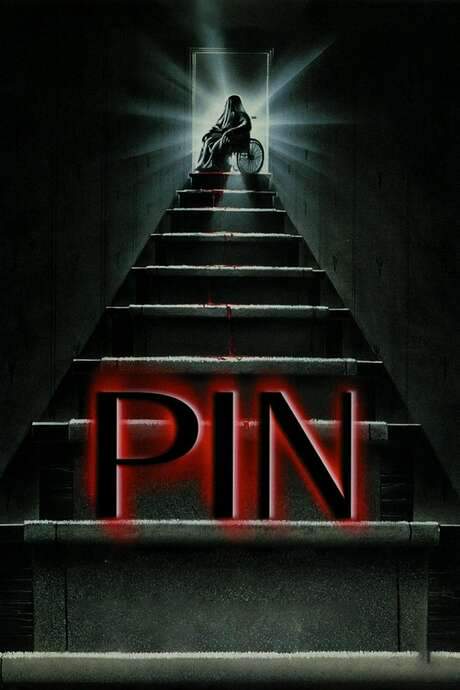
Dr. Frank Linden, Terry O'Quinn, keeps a life-size, anatomically correct medical dummy in his office that he calls Pin, Jonathan Banks. Through ventriloquism, he uses Pin to explain bodily functions to his children in a way that feels approachable and oddly comforting, a warmth that lightly contradicts his otherwise cool, emotionally distant demeanor. The practice frames a curious beacon in the house for Leon, David Hewlett, and Ursula, [Cynthia Preston](/actor/cynthia-preston, who grow up alongside Pin as a constant, almost living, presence.
Unknown to Dr. Linden, Leon is mentally unstable and clings to the belief that Pin is real. He has little real friendship outside the home, partly because his mother discourages outdoor play, leaving him with Pin as his closest companion. A pivotal, chilling moment comes when he secretly witnesses the nurse in the house using Pin as a sex toy, an event that imprints a deep, troubling fixation on women and sexuality. As the two siblings navigate adolescence, they discuss sex education, and Ursula divulges that she is looking forward to growing older and feeling the pull of “the urge.”
The story advances into their teenage years with brutal clarity. At a high school dance, Leon discovers graffiti implying Ursula’s promiscuity and confronts her in a car with a boy, threatening to hold her to account. Ursula later confesses she is pregnant, and Leon—through Pin—presses that they tell their father, who ends up performing an abortion on the fifteen-year-old Ursula. When Leon becomes an adult, Dr. Linden, drawn back to collect case studies for a speech, catches Leon speaking to Pin and realizes the depth of his son’s psychosis. The revelation compounds the family tragedy: the Lindens die instantly in a car crash, caused by either Dr. Linden’s recklessness or Pin’s malevolent influence. Leon, however, manages to retrieve Pin from the wreckage and begins to carve out a new, terrifying autonomy for himself.
Orphaned and grieving, Ursula and Leon try to carve out independence until Aunt Dorothy, Aunt Dorothy, Patricia Collins arrives to help. Ursula settles into a library job, which Leon resents, and Ursula starts to academically explore schizophrenia as a potential explanation for his brother. Leon escalates, dressing Pin in Dr. Linden’s clothes and eventually giving Pin latex skin and a wig to further the ruse. He lures Stan Fraker, John Pyper-Ferguson, to the house under the pretense of planning Ursula’s surprise party, drugs Stan, and brutally bludgeons him, concealing the body in a woodpile. Pin’s voice and instructions become a haunting backdrop as Ursula confronts the increasingly unstable reality, moving toward a confrontation that leaves her reeling.
When the police eventually discover Stan, they find him alive, a jolt that underscores the film’s unnerving tension. Some time later, Ursula and Stan return to visit Pin, and Ursula confesses she plans to travel with Stan. The final act interweaves memory and manipulation as Ursula speaks to Pin, only to reveal that she is actually speaking to Leon, who has fully absorbed Pin’s persona and now exists as Pin’s malevolent, embodied echo. In the end, the line between person and dummy blurs completely, and the chilling truth is that Leon’s fractured mind has weaponized Pin to become a malevolent presence that walks—and talks—in the flesh.