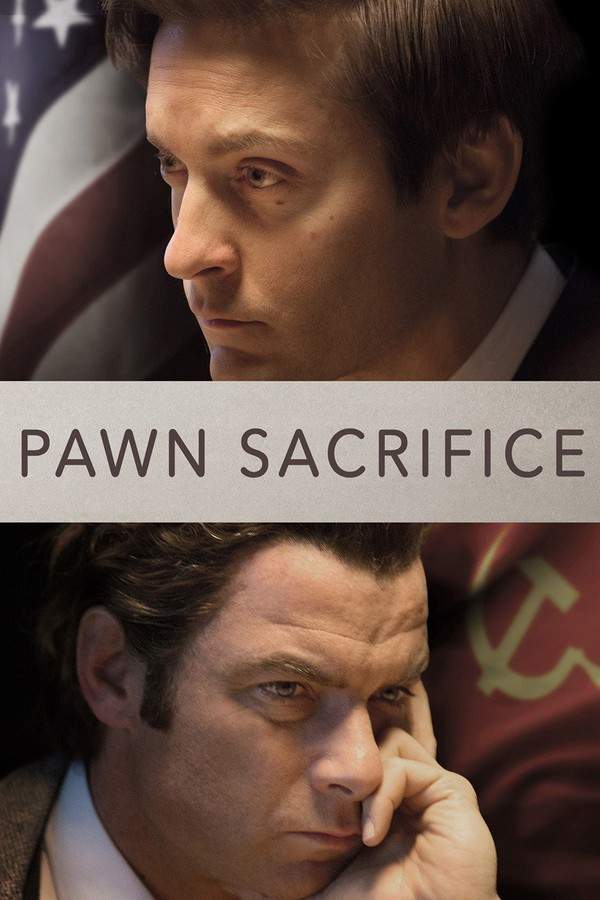
Pawn Sacrifice

Pawn Sacrifice

Year: 2015

Runtime: 115 min

Language: English

Director: Edward Zwick

BiographyDrama

During the height of the Cold War, American chess prodigy Bobby Fischer, portrayed by Tobey Maguire, takes on Soviet Grandmaster Boris Spassky, played by Liev Schreiber, in the 1972 World Chess Championship. This gripping drama explores the intense rivalry and psychological pressures faced by both players as their iconic match becomes a proxy battle between the United States and the Soviet Union, captivating audiences worldwide. The film delves into Fischer's complex personality and the extraordinary circumstances surrounding this pivotal moment in sporting history.

Where to Watch Pawn Sacrifice?

Find where to stream, rent, or buy Pawn Sacrifice (2015) in the US with current JustWatch availability, up-to-date pricing, and platform listings for subscription, rental, and digital purchase options.

Warning: spoilers below!

Haven’t seen Pawn Sacrifice yet? This summary contains major spoilers. Bookmark the page, watch the movie, and come back for the full breakdown. If you're ready, scroll on and relive the story!

Timeline – Pawn Sacrifice (2015)

Trace every key event in Pawn Sacrifice (2015) with our detailed, chronological timeline. Perfect for unpacking nonlinear stories, spotting hidden connections, and understanding how each scene builds toward the film’s climax. Whether you're revisiting or decoding for the first time, this timeline gives you the full picture.

1

Bobby's Paranoia Begins

In 1972, Bobby Fischer's hotel room was in chaos, reflecting his deepening paranoia. He believed that the Soviet KGB was tracking him, capturing the pressure he felt as he prepared for competition.

1972 Hotel Room
2

Bobby's Childhood Warnings

Growing up in Brooklyn, Bobby received stern warnings from his mother, a Soviet Jewish immigrant, about the FBI's watchful eyes. These early lessons instilled in him the strategies for navigating a world filled with potential threats.

Brooklyn
3

Obsession with Chess

Bobby developed an intense obsession with chess during his childhood, a passion that worried his mother. Despite her concerns, she enrolled him in an adult chess club where he captivated a resident grandmaster.

Adult Chess Club
4

Youngest Grandmaster

After years of dedication, Bobby set a record by becoming the youngest grandmaster in history. This achievement marked him as a rising star in the world of chess, igniting his passion even further.

5

Tournament in Varna

During a team tournament in Varna, Bulgaria, Bobby discovered that Soviet grandmasters were colluding to draw games. Frustrated and disheartened, he made the shocking decision to withdraw from the tournament entirely.

Varna, Bulgaria
6

Return to the United States

After withdrawing from the tournament, Bobby returned to the United States seeking support. He found an ally in lawyer Paul Marshall, who offered to help him adjust tournament regulations for a fair chance.

United States
7

Choosing a Second

Bobby chose Father William Lombardy, a former World Junior Chess Champion, as his second for upcoming matches. Lombardy faced challenges maintaining Bobby's volatile temperament but accepted the responsibility.

8

Fischer's Rise to Fame

As Bobby's skills flourished, he attracted nationwide admiration, becoming emblematic of American aspirations during the Cold War. His journey was closely observed by political figures like Richard Nixon and Henry Kissinger.

9

Loss to Spassky

Bobby faced a significant setback when he lost to Boris Spassky in Santa Monica, California. This loss sparked a heated confrontation between Bobby and Spassky on the beach, showcasing Bobby's intense competitive nature.

Santa Monica, California
10

Family Concerns

Bobby's sister, Joan, expressed concerns about his deteriorating mental state as he grew increasingly paranoid. Her worries prompted her to seek psychiatric help for him, though skepticism remained about its effectiveness.

11

World Chess Championship

The chess community converged in Reykjavík, Iceland, for the pivotal 1972 World Chess Championship between Bobby and Spassky. The event was electric with tension, and Bobby's focus wavered due to various distractions.

1972 Reykjavík, Iceland
12

Game Two No-Show

In a stunning display, Bobby failed to show up for the second game, infuriating Spassky. This unexpected absence raised eyebrows and contributed to the mounting pressure on Fischer as the match progressed.

13

Victory in Game Three

Bobby showcased his ingenuity with an unconventional strategy that led to a victory in game three. This crucial win restored his confidence and shifted the momentum of the championship in his favor.

14

Groundbreaking Game Six

Bobby's unprecedented opening move in game six left Spassky stunned, leading to his resignation and a triumphant victory for Fischer. This game would later be hailed as one of the greatest matches in chess history.

15

Life as a Fugitive

After forfeiting the championship title due to his ongoing mental struggles, Bobby's life spiraled into turmoil. He lived as a fugitive, evading U.S. legal actions until his passing in 2008, a tragic end for such a brilliant mind.

2008

Last updated: November 22, 2024 at 15:27

Was this helpful?

Pawn Sacrifice (2015) Timeline Questions Answered – Chronology FAQ

Find frequently asked questions about the Pawn Sacrifice (2015) timeline, including chronological order, nonlinear jumps, cause-and-effect links, and scene sequence clarifications. This timeline FAQ helps explain when key events happen, how moments connect, and why the story unfolds in that specific order.

Q1

What caused Bobby Fischer's paranoia during the 1972 Championship?

A.

Fischer's paranoia stemmed from a lifetime of psychological factors. His mother, a Soviet Jewish immigrant, taught him as a child to fear FBI surveillance, instilling deep-seated distrust. As the pressure mounted during the Reykjavík Championship, with the world's attention on him and Cold War politics at stake, his underlying mental health issues intensified, leading to delusions that the KGB was tracking him and that Soviets were conspiring against him.

His mother's early warnings about government surveillance planted the seeds of paranoia that would later consume him.

paranoiamental healthFBIKGB1972 championship
Q2

Why did Bobby Fischer miss Game 2 of the World Championship?

A.

Fischer failed to show up for Game 2 due to his extreme sensitivity to distractions in the playing hall. He complained about camera sounds, spectator movements, and even the texture of the chessboard. When his demands for a quieter environment weren't met, he simply refused to play, shocking everyone, including Spassky, who was furious at the no-show. This was part of his increasingly erratic behavior throughout the match.

Earlier in the film, Fischer's aversion to any distractions during games was established as a recurring issue.

game 2no-showdistractionschampionship Reykjavík
Q3

Why did Fischer withdraw from the Varna tournament?

A.

During the team tournament in Varna, Bulgaria, Fischer discovered that Soviet grandmasters were colluding, drawing games against each other with support from the World Chess Federation to control tournament outcomes. Recognizing the corruption and feeling betrayed by what he saw as systemic Soviet manipulation, Fischer ragefully withdrew and vowed never to play chess again, at least temporarily.

This incident fueled Fischer's deep suspicion of Soviet chess institutions and intensified his anti-establishment views.

Varna tournamentwithdrawalSoviet grandmasterscollusion
Q4

Why was the 1972 World Chess Championship a big deal during the Cold War?

A.

The match became a geopolitical proxy battle between the United States and Soviet Union. For decades, Soviets dominated chess and used it as propaganda to demonstrate Communist intellectual superiority. Fischer, an American, was seen as a symbol of democratic capability against Soviet dominance. Nixon and Kissinger closely followed the match, hoping Fischer's victory would score a symbolic win for American democracy during heightened Cold War tensions.

Fischer's rise coincided with peak Cold War tensions, turning his personal achievement into a nationalistic cause.

Cold WarpropagandaSoviet UnionNixonKissingerpolitics
Q5

Why did Fischer confront Spassky on the beach after losing?

A.

After suffering a surprising loss to Spassky in a Santa Monica tournament, Fischer's competitive rage exploded. He stormed to the beach where Spassky was relaxing and unleashed a furious tirade at the world champion. This incident revealed Fischer's volatile temperament and inability to handle defeat, foreshadowing the psychological toll the upcoming championship would take on him.

This outburst demonstrated how Fischer's identity became intertwined with winning, making any loss emotionally devastating.

Spasskybeach confrontationloss Santa Monicatemper
Q6

What made Game 6 so special in the 1972 Championship?

A.

Game 6 featured Fischer's revolutionary opening move, a never-before-seen variation that stunned the chess world. He played 1.b3 (the Sokolsky Opening), an extremely rare move at the highest level, catching Spassky completely off guard. Fischer went on to win this game decisively, and it's now celebrated as one of the greatest chess games ever played. This victory shifted momentum definitively in Fischer's favor.

Fischer's unconventional thinking and willingness to take risks had always set him apart from traditional grandmasters.

game 6opening moveSokolskyvictorygreatest game
Q7

Who was Father William Lombardy and why was he important to Fischer?

A.

Father William Lombardy was a former World Junior Chess Champion and a Roman Catholic priest whom Fischer chose as his "second", a strategic assistant who helps prepare for matches. Despite struggling to manage Fischer's flamboyant behavior and unreasonable demands, Lombardy remained committed to helping him. His role was crucial in navigating Fischer's psychological challenges while attempting to keep him focused on the championship.

Lombardy's background as both a chess prodigy and clergyman made him uniquely suited to understand Fischer's complex personality.

William Lombardysecondpriestchess secondsupport
Q8

Why did Bobby Fischer give up his chess title?

A.

After winning the 1972 Championship, Fischer's mental health rapidly deteriorated. He became increasingly paranoid, developing delusional beliefs about Jewish conspiracies and government persecution. Unable to defend his title under conditions he found unacceptable, Fischer refused to play and was stripped of his championship in 1975. His mental decline made it impossible for him to function as a professional chess player, leading to his tragic forfeiture.

The film's tension between Fischer's brilliant achievement and his declining mental state made this outcome feel tragically inevitable.

forfeittitle1975mental healthchampionship
Q9

What was Fischer's relationship with his mother like?

A.

Bobby's mother, Regina, was a Soviet Jewish immigrant who instilled in him both his chess talent and his deep distrust of authority. She taught him survival strategies for dealing with potential FBI encounters, a paranoid worldview that stayed with him. While she encouraged his chess early on, she also feared his obsessive fixation was consuming him. Their complex relationship shaped his psychological foundation.

Regina's warnings about government surveillance planted the paranoid seeds that would later flower during the 1972 Championship.

ReginamotherBrooklynSovietjewishinfluence
Q10

What happened to Bobby Fischer after he won the Championship?

A.

After his historic 1972 victory, Fischer's life unraveled rapidly. His mental health deteriorated into severe paranoia and delusional thinking. He became a fugitive after violating U.S. sanctions by playing chess in Yugoslavia during the 1990s. He lived in exile, mostly in Iceland, until his death in 2008. Despite achieving the greatest chess victory in history, he spent his final years as a reclusive, troubled man wanted by U.S. authorities.

The film depicts the bittersweet nature of his triumph, achieving immortality while beginning his tragic descent.

fugitiveexileIcelanddeath 2008post-championship
Mobile App Preview

Coming soon on iOS and Android

The Plot Explained Mobile App

From blockbusters to hidden gems - dive into movie stories anytime, anywhere. Save your favorites, discover plots faster, and never miss a twist again.

Sign up to be the first to know when we launch. Your email stays private, always.

Explore Movie Threads

Discover curated groups of movies connected by mood, themes, and story style. Browse collections built around emotion, atmosphere, and narrative focus to easily find films that match what you feel like watching right now.

Movies about the torment of genius like Pawn Sacrifice

Stories exploring the immense psychological cost of extraordinary talent.If you were fascinated by Bobby Fischer's story in Pawn Sacrifice, explore these movies about genius under pressure. This collection features similar biographical dramas and intense character studies where extraordinary talent comes at a devastating personal cost, focusing on psychological unraveling and the heavy burden of brilliance.

psychologicalagonizingmelancholicgrippinganxiousobsessivetragic

Narrative Summary

These narratives typically follow a linear biographical or character-driven arc, charting the rise of an individual with exceptional skill. The central conflict is internal, as the protagonist's mind, plagued by paranoia, obsession, or mental illness, becomes the primary antagonist. The story builds steadily towards a significant achievement, but the victory is overshadowed by the clear onset of a profound personal decline.

Why These Movies?

Movies are grouped here because they share a heavy emotional weight and a bittersweet or bleak ending tone. They are united by their intense focus on the psychological distress accompanying genius, often set against high-stakes backdrops that amplify the pressure. The pacing is typically steady, allowing for a deep, anxious dive into the character's deteriorating mental state.

Movies with psychological pressure like Pawn Sacrifice

Films where intense focus and pressure create a suffocating atmosphere.For viewers who appreciated the claustrophobic tension of Pawn Sacrifice, this list highlights films with a similar high-stakes psychological atmosphere. Discover movies where the primary conflict is a battle of wits and wills, creating a gripping, anxious, and paranoid mood through steady pacing and intense focus on internal struggle.

claustrophobictenseanxiousparanoidgrippingagonizingunsettling

Narrative Summary

In these stories, the plot is secondary to the atmosphere. The narrative unfolds in a steady, methodical pace, building unease as characters are consumed by their situation. The world often feels small and constrained, mirroring the characters' mental states. The focus is on the slow, agonizing build-up of tension as individuals confront an opponent, a system, or their own minds under extreme duress.

Why These Movies?

These films are connected by their dominant tense tone and high intensity, despite often having a steady pacing. They share key mood tags like claustrophobic, anxious, and paranoid. The experience is defined by a gripping, heavy feel where the viewer is placed directly into the stressful headspace of the protagonist.

Unlock the Full Story of Pawn Sacrifice

Don't stop at just watching - explore Pawn Sacrifice in full detail. From the complete plot summary and scene-by-scene timeline to character breakdowns, thematic analysis, and a deep dive into the ending - every page helps you truly understand what Pawn Sacrifice is all about. Plus, discover what's next after the movie.

Pawn Sacrifice Summary

Read a complete plot summary of Pawn Sacrifice, including all key story points, character arcs, and turning points. This in-depth recap is ideal for understanding the narrative structure or reviewing what happened in the movie.

Pawn Sacrifice Summary

Characters, Settings & Themes in Pawn Sacrifice

Discover the characters, locations, and core themes that shape Pawn Sacrifice. Get insights into symbolic elements, setting significance, and deeper narrative meaning - ideal for thematic analysis and movie breakdowns.

Characters, Settings & Themes in Pawn Sacrifice

Pawn Sacrifice Spoiler-Free Summary

Get a quick, spoiler-free overview of Pawn Sacrifice that covers the main plot points and key details without revealing any major twists or spoilers. Perfect for those who want to know what to expect before diving in.

Pawn Sacrifice Spoiler-Free Summary

More About Pawn Sacrifice

Visit What's After the Movie to explore more about Pawn Sacrifice: box office results, cast and crew info, production details, post-credit scenes, and external links - all in one place for movie fans and researchers.

More About Pawn Sacrifice