Plot Explained Spoilers guaranteed!
Plot Explained

Browse by genre

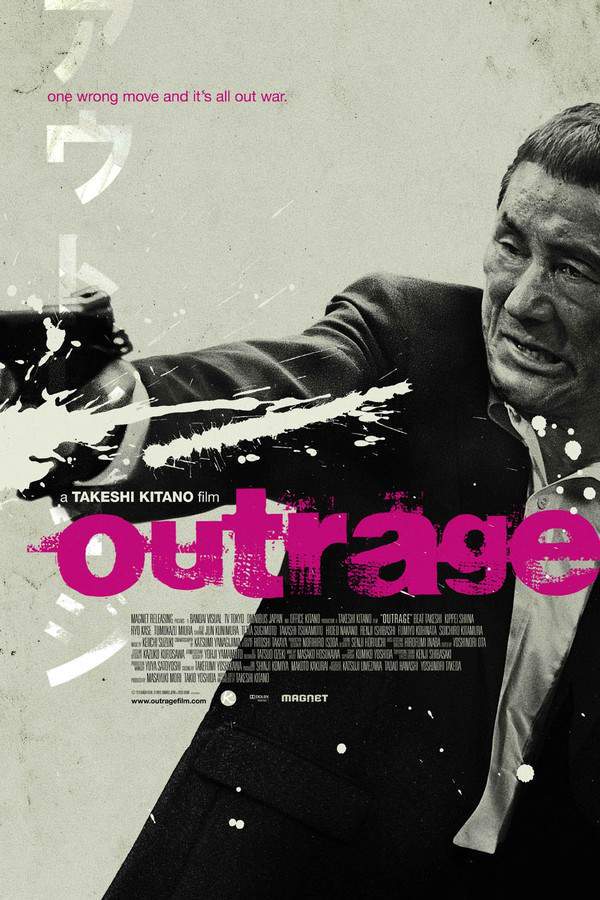
Outrage (2011) movie poster

Timeline

Outrage (2011) Timeline Explained – Every Event in Order

Release, runtime and language
2011 · 109 min · English
Loading streaming availability…

Within the shadowy world of Tokyo’s criminal underworld, fragile alliances crumble as Ikemoto’s deception is revealed. A brutal chain of betrayal and escalating violence ignites between competing yakuza families. Amidst ruthless power struggles and elaborate schemes, the distinction between right and wrong becomes increasingly unclear as each clan vies for dominance and control.

On this page (6)
  1. 1 Where to watch
  2. 2 Events in order (10)
  3. 3 Timeline questions answered
  4. 4 The book behind the movie
  5. 5 Movie threads
  6. 6 Every angle
Loading streaming availability…

10 events in order · contains spoilers

Outrage Timeline: Events in Chronological Order

Every key event of Outrage (2011) in order, scene by scene, with when and where it takes place. Use it to untangle flashbacks, time jumps and parallel storylines, to refresh your memory before the sequel or to find the exact scene you are thinking of.

  1. Banquet at the Grand Yakuza Leader's Estate

    The film opens with a lavish banquet at the opulent estate of Grand Yakuza leader Sekiuchi, showing the Sanno-kai's grip on the Kanto region. Behind the celebration, tensions simmer as Kato makes his displeasure known about Ikemoto's friendship with rival Murase. He orders Ikemoto to bring the Murase-gumi back in line, setting the power struggle in motion.

    When
    Evening
    Where
    Sekiuchi estate, Kanto region
  2. Kato's Displeasure and Orders to Ikemoto

    Kato voices his frustration with Ikemoto's leniency toward Murase and commands him to rein in the rival gang. Ikemoto delegates the task downward, signaling a split in loyalty within the Sanno-kai. He passes the assignment to Otomo, who runs his own crew and will carry it out.

    When
    Evening
    Where
    Sekiuchi estate / Sanno-kai HQ
  3. Otomo Receives the Assignment

    Ikemoto passes the job to his subordinate Otomo, who leads his own crew and takes on the plan to neutralize Murase. The move signals a personal, treacherous shift in loyalties within the Sanno-kai. Otomo now acts with Ikemoto's authority rather than direct orders from Sekiuchi.

    When
    Evening
    Where
    Ikemoto's crew HQ
  4. Nightclub Shakedown Orchestrated

    At Murase's nightclub, a man posing as a customer is used as a pretext for a shakedown of about one million yen. The incident reveals that Otomo's men are already inside Murase's camp, intended to spark a broader gang war. Murase remains ignorant of his falling out with Sekiuchi.

    When
    Night
    Where
    Murase's nightclub
  5. Murase Attempts to Heal Rift

    Murase, unaware of Ikemoto's behind-the-scenes orders, tries to salvage relations and reassure his men. He leans on his former prison friendship with Ikemoto, hoping for a cooling-off, but each move weakens his position. The tension tightens as Murase's resources dwindle.

    When
    In the days that follow
    Where
    Murase's operations
  6. Ikemoto Quietly Undermines Murase

    Ikemoto quietly tightens the pressure on Murase, orchestrating moves that erode his power without revealing his true role. Murase's grip on his operations begins to loosen as the Sanno-kai consolidates its advantage.

    When
    Leading up to the clashes
    Where
    Murase's territory
  7. Otomo Scars Kimura

    During a confrontation, Otomo's forces leave vicious scars on Kimura, Murase's loyal lieutenant, signaling the brutal toll of the ruling conflict. The attack underscores that Murase's faction is being worn down from the inside. The event deepens Murase's desperation as his leadership frays.

    When
    During the tensions
    Where
    Murase's base
  8. Final Clashes and Deaths

    As the dust settles from the escalating tensions, Ikemoto and Murase are killed. The killings wipe out key figures and accelerate the fragmentation of Murase's faction. The city-wide strife signals the Sanno-kai's shifting balance of power.

    When
    Climax
    Where
    Various locations around the city
  9. Otomo in Prison and Kimura's Ambush

    Otomo ends up in a maximum-security prison, unexpectedly sharing space with Kimura. In a brutal ambush, Kimura stabs Otomo twice in the belly with a makeshift knife.

    When
    Aftermath
    Where
    Maximum-security prison
  10. Kato Takes Control

    In the final turn, Kato quietly murders Sekiuchi and takes over as the new Grand Yakuza leader of the Sanno-kai. The film closes on a grim note, with the old order toppled from within and a new power broker stepping into Sekiuchi's place.

    When
    Final act
    Where
    Sanno-kai HQ

Last updated: October 09, 2025 at 16:21

Was this helpful?

Timeline questions answered

Outrage Timeline Explained: Your Questions Answered

When does it happen, and why in that order? The questions people ask about the chronology of Outrage (2011): time jumps, flashbacks, cause and effect between scenes and the correct order of events, each answered with spoilers.

Q1

Why does Kato order Ikemoto to bring Murase's gang in line?

Kato is upset because Ikemoto grew friendly with Murase while they were in prison together. This friendship threatens the Sanno-kai hierarchy, as Ikemoto's personal connection to a rival gang leader could compromise his loyalty. Kato sees this as a breach that must be corrected, so he orders Ikemoto to neutralize Murase's faction, forcing Ikemoto to betray his former friend.

  • kato
  • ikemoto
  • murase
  • orders
  • prison friendship
  • sanno-kai
Q2

Why does Ikemoto give the task to Otomo instead of handling Murase himself?

Ikemoto cannot bring himself to directly betray his prison friend Murase. By delegating the job to Otomo, Ikemoto maintains plausible deniability and avoids being the one to strike the final blow. This reflects the film's theme of fractured loyalty within the yakuza, even when ordered to eliminate a threat, Ikemoto chooses to let someone else do the dirty work while he subtly undermines Murase through advice.

Foreshadowing: Earlier, Ikemoto's discomfort with the assignment is visible when Kato confronts him.

  • ikemoto
  • otomo
  • delegation
  • loyalty
  • betrayal
Q3

What was the point of the nightclub shakedown in Murase's club?

The shakedown was staged by Otomo's men who had infiltrated Murase's nightclub. The purpose was to create a fabricated pretext for war, a fake customer complaint about being cheated out of one million yen. This manufactured incident gave the Sanno-kai a justification to escalate tensions against Murase without appearing to act arbitrarily, allowing them to portray the coming violence as a response to Murase's wrongdoing.

  • nightclub
  • shakedown
  • infiltration
  • provocation
  • war
Q4

Why does Murase trust Ikemoto when he's clearly being set up?

Murase is unaware that his prison friendship with Ikemoto has become a liability. He genuinely believes Ikemoto is trying to help him navigate the political crisis, taking his advice at face value. Each piece of counsel from Ikemoto actually weakens Murase's position, but because Murase has no reason to suspect betrayal from his old friend, he walks willingly into his own downfall.

Foreshadowing: Kato's early warning about Ikemoto's friendship hints that this trust will be exploited.

  • murase
  • ikemoto
  • trust
  • prison friendship
  • manipulation
Q5

Why does Otomo scar Kimura instead of killing him directly?

Scarring Kimura serves as a calculated psychological weapon, it sends a brutal message to Murase's entire faction that they are being systematically dismantled. The scars are meant to degrade Murase's leadership by humiliating his trusted lieutenant, demonstrating that Otomo's forces can reach anyone. Killing Kimura outright would have been simpler but less terrifying; the visible mutilation is intended to terrify and demoralize.

  • otomo
  • kimura
  • scarring
  • intimidation
  • message
Q6

Why does Kato kill Sekiuchi to become the new leader?

Kato orchestrates the entire conflict between Ikemoto, Otomo, and Murase to eliminate rivals and clear his own path to power. By the time the dust settles, the key players are dead or imprisoned, leaving Sekiuchi vulnerable. Kato quietly assassinates Sekiuchi and takes his place as the new Grand Yakuza leader, revealing that he was the true architect of the bloodshed, all while appearing loyal to Sekiuchi throughout.

Foreshadowing: Kato's dissatisfaction with Ikemoto's leniency hints at his ruthless ambition from the start.

  • kato
  • sekiuchi
  • assassination
  • power grab
  • succession
Q7

Why does Kimura attack Otomo in prison?

Kimura and Otomo end up in the same maximum-security prison after the yakuza conflicts. The attack is Kimura's vendetta for the scarring and humiliation he suffered at Otomo's hands. Kimura waits for the opportunity and stabs Otomo twice in the belly with a makeshift knife, fulfilling the blood feud that began when Otomo's men marked him.

Foreshadowing: The scarring of Kimura earlier directly motivates this violent confrontation.

  • kimura
  • otomo
  • prison
  • stabbing
  • revenge
  • vendetta
Q8

What happens to Ikemoto and Murase in the end?

Both Ikemoto and Murase are killed as the Sanno-kai consolidates its power. Ikemoto, despite trying to maintain distance from the violence, is eliminated, likely because he was seen as compromised after his friendship with Murase became known. Murase is killed as his faction is wiped out, never realizing that his closest ally was working against him until the end.

  • ikemoto
  • murase
  • deaths
  • eliminated
  • killed
Q9

What happens to Otomo after he gets sent to prison?

Otomo is imprisoned in a maximum-security ward alongside Kimura, the man whose face he ordered scarred. Rather than being safe from his enemies, Otomo finds himself trapped with someone who has every reason to seek brutal revenge. Kimura ambushes him and stabs him twice in the belly with a makeshift knife, showing that even incarceration offers no escape from the consequences of yakuza violence.

  • otomo
  • prison
  • kimura
  • stabbing
  • maximum security
Q10

How does the power shift within the Sanno-kai happen throughout the film?

The Sanno-kai starts under Sekiuchi's control, with Kato as his chief lieutenant. Kato engineers a conflict that eliminates multiple competing factions, Ikemoto's, Murase's, and ultimately Sekiuchi himself. By eliminating these threats through manipulation rather than direct confrontation, Kato seizes power as the new Grand Yakuza leader, demonstrating that survival in the yakuza requires ruthless betrayal.

  • sanno-kai
  • kato
  • sekiuchi
  • power shift
  • leadership
  • yakuza

Movie threads

More Movies Like Outrage, by Mood & Story

Curated lists built around what makes Outrage tick: the same mood, the same kind of story or the same emotional payoff. Each list explains why these movies belong together.

Grim Yakuza Epics Like Outrage

Stories that dissect the ruthless power struggles within criminal syndicates. If you liked the ruthless power struggles in Outrage, explore more movies like it. This section features similar yakuza and organized crime stories characterized by methodical betrayal, bleak endings, and a grim examination of loyalty and ambition within closed criminal worlds.

  • ruthless
  • methodical
  • grim
  • suspenseful
  • oppressive
  • brutal
  • Tone: dark, bleak
  • Pacing: steady, methodical
Why these movies?

The story pattern: The narrative follows a clear cause-and-effect chain of betrayal and reprisal within a hierarchical structure. The plot is driven by ambitious underlings challenging their superiors, leading to a spiral of violence that often culminates in a pyrrhic victory or a bleak consolidation of power, reinforcing the cyclical nature of this world.

Why they belong together: Movies are grouped here for their shared focus on the internal dynamics of organized crime, a consistently dark and oppressive tone, and a steady, deliberate pacing that builds suspense towards inevitable, violent confrontations and morally bleak conclusions.

Movies About Betrayal and Violence Like Outrage

Narratives where deception triggers an inescapable chain of fatal consequences. For viewers who appreciated the chain reaction of betrayal in Outrage, this collection features similar stories. Discover movies with a steady pace and high tension, where a single deception ignites a grim spiral of violence, resulting in a heavy emotional weight and a ultimately bleak resolution.

  • suspenseful
  • grim
  • ruthless
  • paranoid
  • brutal
  • bleak
  • Tone: dark, tense, grim
  • Pacing: steady, relentless
Why these movies?

The story pattern: The narrative pattern begins with a foundational betrayal that shatters the status quo. The story then unfolds with a relentless, logical progression of retaliatory acts, each more violent than the last. The character journey is one of increasing isolation and moral compromise, culminating in an ending that affirms the destructive, inescapable nature of the cycle.

Why they belong together: These films share a core plot mechanism—a betrayal-driven spiral—resulting in a similar viewing experience: a steady-paced build of tension, a dark and grim atmosphere, high stakes, and a profoundly heavy, bleak emotional payoff.

Every angle

Outrage (2011) Explained: Plot, Timeline & Characters

Everything about Outrage in one place: what happens in the plot summary, the timeline in chronological order, the characters and meaning and a spoiler-free summary. What's After the Movie adds the cast, box office and post-credit scenes.

Coming soon on iOS and Android

The Plot Explained Movie Summary App

Plot summaries, endings explained and timelines on your phone. Catch up on any movie in minutes, save your favorites and never miss a twist again.

Be the first to know when we launch. Your email stays private, always.

Learn more about the app