









Plot Explained Spoilers guaranteed!
Plot Explained

Browse by genre

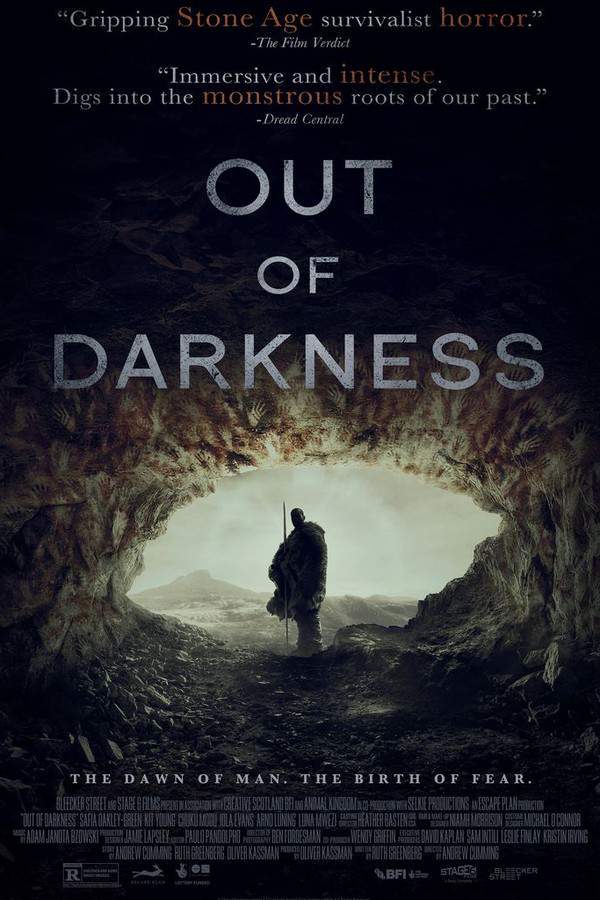
Out of Darkness (2024) movie poster

Timeline

Out of Darkness (2024) Timeline Explained – Every Event in Order

Release, runtime and language
2024 · 1 h 28 m · Unknown language
Echo score 78
Directed by
Andrew Cumming
Starring
Chuku Modu, Kit Young, Iola Evans, Safia Oakley-Green, Luna Mwezi, Arno Luening
Budget
$1.5M

During the Paleolithic era, a small group of survivors struggles to find shelter and food in a harsh, frozen landscape. Driven by desperation and hunger, they embark on a dangerous journey toward distant mountains, hoping to find refuge and the promise of survival.

On this page (6)
  1. 1 Where to watch
  2. 2 Events in order (15)
  3. 3 Timeline questions answered
  4. 4 Movie threads
  5. 5 Movies like Out of Darkness
  6. 6 Every angle

Where to watch

Where to Watch Out of Darkness (2024)

Where can you watch Out of Darkness? Stream, rent or buy it in the US, including on Kanopy, Fandango at Home Free and Plex: current JustWatch availability with up-to-date prices.

Streaming availability powered by JustWatch

15 events in order · contains spoilers

Out of Darkness Timeline: Events in Chronological Order

Every key event of Out of Darkness (2024) in order, scene by scene, with when and where it takes place. Use it to untangle flashbacks, time jumps and parallel storylines, to refresh your memory before the sequel or to find the exact scene you are thinking of.

  1. Arrival at New Land

    A group of six humans, led by Adem, arrives on the shores of an unknown land around 45,000 years ago. They are in search of a better life, comprising Adem, his pregnant mate Ave, his brother Geirr, and his son Heron.

    When
    45,000 years ago
    Where
    Unknown Land
  2. Search for Shelter

    The group embarks on a journey toward the mountains, looking for a cave to settle in. Their adventure is filled with uncertainty as they face the challenges of a new environment.

    Where
    Mountains
  3. Heron's Abduction

    While camping at night, the group encounters a mysterious creature that abducts young Heron. This pivotal moment sets off a series of desperate decisions as the group decides to pursue the creature.

    When
    Night
    Where
    Campsite
  4. Adem's Pursuit

    Adem insists on tracking the creature into the woods, leading the group deeper into an unknown and perilous forest. As darkness falls, he ventures alone and is subsequently attacked by the creature.

    When
    Night
    Where
    Woods
  5. Adem's Fatal Wounds

    Geirr finds Adem gravely injured after the attack and brings him back to the group. In a heart-wrenching decision, Beyah mercy kills Adem to spare him from suffering.

    When
    Night
    Where
    Campsite
  6. Cannibalism for Survival

    Faced with starvation, the group, except for Geirr, resorts to cannibalism by consuming Adem's body. This act reflects the dire circumstances they are caught in within the wilderness.

    Where
    Campsite
  7. Odal's Sacrifice Attempt

    Odal, convinced they are being hunted by a demon, plots to sacrifice Beyah. The situation escalates during a struggle, resulting in the unconsciousness of Geirr and a fierce confrontation.

    Where
    Campsite
  8. Odal Attacks Ave

    In a chaotic turn of events, Odal stabs Ave, believing she is a suitable offering. Although Ave manages to injure Odal, the group faces mounting dangers both internally and externally.

    Where
    Campsite
  9. The Creature's Lair

    After the chaos, Beyah and Geirr track the creature back to its cave, discovering that the creature is a female Neanderthal. They realize the creature has taken Ave's body, intensifying their sense of urgency.

    Where
    Cave
  10. Beyah's Fight for Survival

    Inside the cave, Beyah bravely fights off a male Neanderthal, wounding him seriously in a desperate bid for survival. This encounter showcases her resilience amidst terrifying odds.

    Where
    Cave
  11. Geirr's Tragic Fate

    While Beyah battles, Geirr arrives to aid her but is quickly attacked and killed by the female Neanderthal. This loss further deepens the human group's tragedy and raises the stakes for Beyah.

    Where
    Cave
  12. Beyah's Escape

    After mortally wounding the male Neanderthal, Beyah manages to escape with Heron through a narrow opening in the cave. As the female Neanderthal tries to follow, Beyah makes the agonizing decision to kill her.

    Where
    Cave
  13. Confronting Their Past

    In the aftermath, Beyah reflects on the nature of the Neanderthals, realizing they were simply beings trying to survive just like her group. This moment of empathy reveals the complexity of their encounter.

  14. A Burial and New Beginnings

    Beyah and Heron give Ave a proper burial, acknowledging the loss within their small group. Beyah claims the cave for themselves, representing a new chapter as they decide to carry on with the knowledge they have gained.

    Where
    Cave
  15. Looking to the Future

    The film concludes with Beyah contemplating their struggles and the lessons learned throughout their harrowing journey. Her final words to Heron, 'We try again,' signal hope for a new beginning.

Last updated: May 12, 2025 at 07:03

Was this helpful?

Timeline questions answered

Out of Darkness Timeline Explained: Your Questions Answered

When does it happen, and why in that order? The questions people ask about the chronology of Out of Darkness (2024): time jumps, flashbacks, cause and effect between scenes and the correct order of events, each answered with spoilers.

Q1

Why did Beyah kill Adem after he was injured?

Beyah mercy killed Adem to end his suffering after he was gravely injured during his solo hunt for the creature that abducted Heron. Adem returned from the woods with fatal wounds, and in a moment of compassion, Beyah made the difficult decision to spare him from further pain. This act was motivated by mercy rather than cruelty, reflecting the desperate circumstances they faced.

Foreshadowing: Earlier, Adem insisted on tracking the creature alone despite the group's concerns, setting the stage for his fatal injury.

  • adem
  • beyah
  • mercy killing
  • injury
  • survival
Q2

Why did the group resort to cannibalism after Adem's death?

The group faced extreme starvation in the harsh, frozen landscape with no food sources available. After Adem died, the remaining members, except for Geirr, made the desperate choice to consume his body to survive. This act reflects the dire circumstances and extreme desperation of the survivors rather than any inherent cruelty.

Foreshadowing: The opening establishes the group as struggling to find food in a harsh, frozen landscape.

  • cannibalism
  • starvation
  • survival
  • adem
  • desperation
Q3

What was the creature that abducted Heron?

The creature that abducted Heron was a female Neanderthal, not a supernatural monster as the group initially believed. She had taken Heron to her cave, where he remained unharmed throughout his captivity. The Neanderthals were simply trying to survive in their own territory, much like the human group.

Foreshadowing: The creature was described as haunting the dark woods, creating fear and mystery around its true nature.

  • neanderthal
  • heron
  • creature
  • cave
  • abduction
Q4

Why did Odal want to sacrifice Beyah?

Odal became convinced that a demon was pursuing them and blamed Beyah's menstrual cycle for their misfortunes. In his paranoid state, he suggested sacrificing Beyah as a ritual offering to appease whatever force he believed was hunting them. This reflects the group's desperation and the superstitious fear that took hold amid their suffering.

Foreshadowing: The group had already experienced tragedy, loss, and starvation, creating an environment where irrational beliefs could flourish.

  • odal
  • beyah
  • sacrifice
  • ritual
  • superstition
Q5

Why did Avé break Odal's ankle during the struggle?

Avé broke Odal's ankle to defend herself when he attacked her during the sacrifice attempt. When Odal stabbed Avé believing she would be a suitable offering, she fought back and managed to injure him severely enough to break his ankle, though she was ultimately unable to prevent her own death.

Foreshadowing: Odal had already targeted Beyah for sacrifice, and the situation escalated when he turned his attention to Avé.

  • ave
  • odal
  • attack
  • self-defense
  • injury
Q6

Why did Beyah kill the female Neanderthal at the end?

Beyah killed the female Neanderthal because she believed the Neanderthals were monsters responsible for killing her people. When the female tried to follow them through the narrow escape passage, Beyah made the agonizing decision to kill her with a rock. However, Heron's words, 'They are like us,' later caused Beyah to realize the Neanderthals were simply frightened people trying to survive, just like them.

Foreshadowing: The discovery of the Neanderthal cave and the realization that they had taken Avé's body foreshadowed their true nature as sentient beings.

  • beyah
  • neanderthal
  • killing
  • heron
  • realization
Q7

What did Heron mean when he said 'They are like us'?

Heron meant that the Neanderthals were not monsters or demons but rather human-like beings with the same capacity for emotion, care, and survival instincts. His time with the female Neanderthal showed him that they were simply trying to protect their territory and family, much like his own group. This realization contrasted with Beyah's view of them as killers.

Foreshadowing: The female Neanderthal had kept Heron unharmed in her cave, suggesting protective rather than predatory intent.

  • heron
  • neanderthals
  • empathy
  • understanding
  • monsters
Q8

Why did the Neanderthals prepare Avé's body for burial?

The Neanderthals prepared Avé's body for burial because, despite being from a different group, they possessed the same capacity for compassion and ritual mourning as modern humans. When Beyah and Heron found Avé's body, it was meticulously prepared for a funeral, demonstrating that the Neanderthals understood dignity and respect for the dead, proving Heron's point that they were indeed 'like us.'

Foreshadowing: The female Neanderthal was shown watching Avé's body under the aurora borealis before taking it.

  • ave
  • neanderthals
  • burial
  • ritual
  • compassion
Q9

Why did Adem decide to hunt the creature alone?

Adem insisted on tracking the creature alone because his son Heron had been abducted, and as the leader, he felt responsible for rescuing him. Despite the unease of the other group members, his paternal duty drove him to pursue the creature into the dangerous forest alone, ultimately leading to his fatal injury.

Foreshadowing: Adem was established as the steadfast leader of the group, and his bond with Heron was evident from the start.

  • adem
  • heron
  • hunt
  • creature
  • pursuit
Q10

What caused the conflict between the humans and Neanderthals?

The conflict arose from fear and misunderstanding on both sides. The humans viewed the Neanderthals as dangerous monsters haunting the dark woods, while the Neanderthals were simply defending their territory and family. Neither group understood the other, leading to violent confrontation. The film suggests this conflict was tragic because both groups were just trying to survive.

Foreshadowing: The mysterious creature was first encountered in the dark woods, immediately setting up the humans as intruders in Neanderthal territory.

  • conflict
  • fear
  • misunderstanding
  • territory
  • survival
Q11

What does Beyah's final message 'We try again' mean?

Beyah's final message 'We try again' signifies hope and resilience despite the tremendous loss they endured. After losing nearly everyone in their group, Adem, Geirr, Avé, and the Neanderthals, Beyah and Heron decide to move forward, applying the lessons they learned. They claim the cave as their new home, representing a new beginning for what Beyah calls 'the first of a new people.'

Foreshadowing: The film opened with the group arriving in search of a brighter future, and the ending fulfills that search despite the tragic cost.

  • ending
  • hope
  • survival
  • new beginning
  • resilience

Movie threads

More Movies Like Out of Darkness, by Mood & Story

Curated lists built around what makes Out of Darkness tick: the same mood, the same kind of story or the same emotional payoff. Each list explains why these movies belong together.

Primordial survival horror movies like Out of Darkness

Stories of humanity's raw fight for existence in unforgiving ancient worlds. If you liked the raw, desperate struggle in Out of Darkness, explore these other movies featuring primitive survival horror. This collection includes stories set in ancient or harsh prehistoric worlds where characters battle the elements, monstrous threats, and the darkness within themselves.

  • gritty
  • brutal
  • primal
  • desperate
  • ancient world
  • claustrophobic
  • Tone: dark, brutal, desperate
  • Pacing: steady, relentless
Why these movies?

The story pattern: Narratives typically follow a small group pushed to the brink in a hostile, primitive landscape. The journey is linear and focused on survival, often revealing that the true monster is not an external beast but humanity's own capacity for violence and fear of the unknown. Endings are often bittersweet or bleak, with survival coming at a profound cost.

Why they belong together: These films are grouped by their shared setting of a primitive world, the high-intensity emotional weight of survival, and the dark exploration of human nature under extreme duress. They create a specific, gritty, and claustrophobic mood that connects the experience.
Movies where humanity is the real monster like Out of Darkness

Thrillers where the true horror is the darkness within human nature. If you appreciated the thematic twist in Out of Darkness, you'll enjoy these movies that explore the idea that humanity is the real monster. These similar thrillers and horror films feature groups turning on each other, moral decay, and a bitter reflection on the nature of fear and prejudice.

  • somber
  • reflective
  • paranoid
  • moral dilemma
  • tribal conflict
  • anxious
  • Tone: dark, somber, reflective
  • Pacing: steady, character-driven
Why these movies?

The story pattern: The narrative often begins with a clear external antagonist but pivots to focus on internal group conflict, betrayal, and moral compromises. The climax involves a tragic realization that the 'other' was misunderstood or a mirror of the group's own savagery. The emotional journey is heavy, leading to a bittersweet or bleak ending filled with regret and somber reflection.

Why they belong together: These films are united by their shared thematic focus on the monstrous potential of humanity, often triggered by fear and survival instincts. They share a dark tone, heavy emotional weight, and a narrative pattern that subverts the expectation of a simple external monster.

If you liked this

Movies Like Out of Darkness

Similar movies to Out of Darkness: the same genre, themes or kind of story. Each one comes with its own plot summary, timeline and ending explained.

Browse all movie summaries

Every angle

Out of Darkness (2024) Explained: Plot, Ending, Timeline & Characters

Everything about Out of Darkness in one place: what happens in the plot summary, the timeline in chronological order, the characters and meaning, the ending explained and a spoiler-free summary. What's After the Movie adds the cast, box office and post-credit scenes.

Coming soon on iOS and Android

The Plot Explained Movie Summary App

Plot summaries, endings explained and timelines on your phone. Catch up on any movie in minutes, save your favorites and never miss a twist again.

Be the first to know when we launch. Your email stays private, always.

Learn more about the app