Plot Explained Spoilers guaranteed!
Plot Explained

Browse by genre

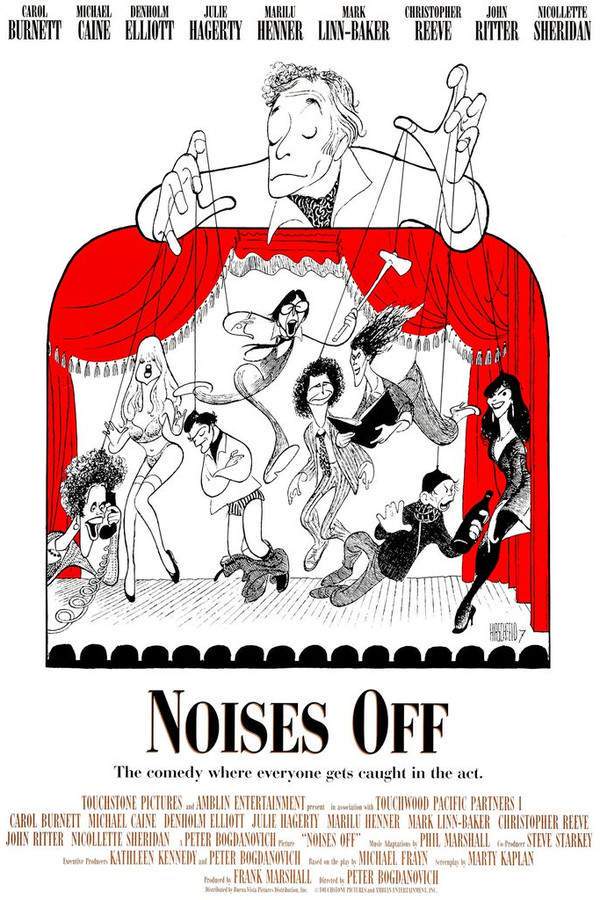
Noises Off... (1992) movie poster

Plot Summary

Noises Off... (1992) Plot Summary Explained

Release, runtime and language
1992 · 101 min · English
Directed by
Peter Bogdanovich
Starring
Michael Caine, Denholm Elliott, Christopher Reeve, Julie Hagerty, Carol Burnett, John Ritter

A touring theatre company’s production descends into hilarious chaos both on and off stage. As they prepare for their Broadway debut, the actors' personal and professional lives become entangled in a web of mistaken identities, romantic entanglements, and mounting frustrations. The director struggles to maintain order amidst the escalating mayhem, where the play's plot mirrors the actors' own complicated relationships, leading to a farcical and unforgettable performance.

On this page (7)
  1. 1 Where to watch
  2. 2 What happens: full plot
  3. 3 Plot questions answered
  4. 4 The book behind the movie
  5. 5 Movie threads
  6. 6 Movies like Noises Off...
  7. 7 Every angle

Where to watch

Where to Watch Noises Off... (1992)

Where can you watch Noises Off...? Stream, rent or buy it in the US, including on Hoopla, Amazon Video and Apple TV Store: current JustWatch availability with up-to-date prices.

Streaming availability powered by JustWatch

Full plot summary · contains spoilers

What Happens in Noises Off...: Full Plot Summary

The whole story of Noises Off... (1992) explained, from the opening scene to the final frame: every key event, every twist and what it all adds up to. Read it as a quick recap before the sequel, to check a scene you missed, or to finally understand what really happened.

As the curtain rises on Noises Off, we are immersed in a triple-layered performance where the lines between reality and farce wonderfully intertwine. The play unfolds through three acts, framed by performances of Nothing On, a raucous sex farce that would raise eyebrows even among the most seasoned theatre-goers. Within this clever meta-theatrical setup, we dive headfirst into the chaos as the cast of Nothing On grapples with the challenges of staging their own production.

In Act One, we find ourselves at the Grand Theatre in Weston-super-Mare on the eve of opening night. As the clock strikes midnight, the cast is anything but ready, fumbling through technical rehearsals marked by missed cues and misplaced lines, while an array of pesky props, including a rather enticing selection of sardines, create additional hurdles. The beleaguered director, Lloyd, finds himself repeatedly pushed to his limits by his ensemble's antics, only to be drawn back to managing this chaotic venture over and over.

Jumping to Act Two, a month later at the Theatre Royal in Ashton-under-Lyne, we witness a Wednesday matinée from behind the scenes. Here, simmering tensions and romantic entanglements threaten to bubble over, resulting in a hilariously chaotic spectacle on stage. Behind the curtain, the actors' relationships deteriorate, leading to increasingly precarious interactions as they struggle to keep their performance afloat. The question remains: can they maintain their composure long enough to deliver a successful show? The helter-skelter nature of their lives offers a glimpse into the exquisite madness of Nothing On.

As we approach the finale at the Municipal Theatre's ten-week run in Stockton-on-Tees, the once-united cast has crumbled into dysfunction. Underlying tensions, exacerbated by a disintegrating set and a chaotic array of misplaced props, loom large like landmines across the stage. Despite the impending pandemonium, the actors, including Denholm Elliott, Christopher Reeve, and Julie Hagerty, do their utmost to uphold a veneer of professionalism. However, the mounting chaos soon forces them to abandon their meticulously rehearsed script in favor of desperate improvisation.

The uproarious comedy that ensues is rooted in the comedic discrepancies between each performer's on-stage personas and their chaotic off-stage realities. As character flaws emerge amidst their orchestrated performances, audiences are treated to a delightful blend of slapstick hilarity. With the contrasting personalities of the cast, including Carol Burnett, John Ritter, and Mark Linn-Baker, each mishap unfolds into a series of laugh-out-loud moments that are sure to leave viewers in stitches.

Last updated: November 18, 2024 at 20:23

Was this helpful?

Plot questions answered

Noises Off... Plot Explained: Your Questions Answered

The questions people ask most about Noises Off... (1992): what happens in the confusing scenes, why the characters do what they do, the twists, hidden details and what the ending means. Each answer contains spoilers.

Q1

Why does the director Lloyd struggle so much with his cast?

Lloyd struggles because the cast is ill-prepared for opening night, missing cues and forgetting lines while dealing with misplaced props like sardines. The actors' personal dramas and romantic entanglements constantly interfere with their professional responsibilities, forcing Lloyd to repeatedly manage crises both on and off stage. As the tour progresses and tensions rise, maintaining any semblance of order becomes increasingly impossible.

Foreshadowing: Early technical rehearsals already show the cast fumbling through cues, hinting at the deeper chaos to come.

  • director
  • lloyd
  • cast
  • chaos
  • stage management
Q2

How do the romantic entanglements affect the production?

The romantic relationships among the cast members create simmering tensions that spill onto the stage during performances. As these personal conflicts escalate, the actors struggle to maintain composure, leading to on-stage mishaps and deteriorating teamwork. By the third act, these entanglements have fractured the once-united cast, contributing significantly to the dysfunction.

Foreshadowing: The second act at Theatre Royal explicitly shows how romantic tensions threaten to spiral out of control during a Wednesday matinée.

  • romance
  • relationships
  • actors
  • tensions
  • performance
Q3

What causes the cast to start improvising during performances?

The cast begins improvising because the mounting chaos makes it impossible to follow their rehearsed script. With a crumbling set, misplaced props, and deteriorating relationships, the actors must abandon their planned choreography to salvage each performance. This desperate improvisation becomes both a survival mechanism and the source of the play's greatest comedy.

Foreshadowing: Early prop issues and missed cues already hint that the script cannot be followed exactly as written.

  • improvisation
  • script
  • chaos
  • performance
  • improvise
Q4

Why does the chaos escalate as the tour progresses?

The chaos escalates because underlying tensions among the actors compound over time rather than resolving. What starts as minor frustrations during opening night in Weston-super-Mare grows into full dysfunction by the ten-week run in Stockton-on-Tees. The deteriorating set, accumulating personal grudges, and mounting frustrations create a perfect storm that makes each subsequent performance more precarious than the last.

Foreshadowing: The transition from Act One to Act Two already shows a marked deterioration in cast relationships and stage management.

  • escalation
  • tour
  • chaos
  • relationships
  • progression
Q5

What role do the misplaced props play in the comedy?

Props, particularly the recurring sardines, serve as catalysts for physical comedy and plot complications. Misplaced props force actors to improvise, create on-stage accidents, and generate misunderstandings between characters. The prop disarray symbolizes the broader breakdown of order, making each performance increasingly unpredictable.

Foreshadowing: The sardine prop is introduced early in Act One as a source of technical difficulty.

  • props
  • sardines
  • comedy
  • mistaken identity
  • slapstick
Q6

How does the play "Nothing On" mirror the actors' real lives?

The play-within-a-play "Nothing On" is a sex farce whose plot parallels the actors' own complicated relationships and mistaken identities off-stage. As the production descends into chaos, the line blurs between the characters they play and their real personalities, creating a metafictional layer where the onstage farce reflects the backstage drama. This mirroring is central to the movie's comedic and structural design.

Foreshadowing: The triple-layered performance setup establishes this parallel from the very beginning.

  • nothing on
  • play within play
  • meta
  • theatrical
  • mirroring
Q7

Why do the actors' relationships deteriorate over time?

The actors' relationships deteriorate because prolonged close contact, professional stress, and romantic rivalries create mounting resentments. By the ten-week run, the once-tight-knit ensemble has fragmented into dysfunction as personal baggage and grievances poison their interactions. The pressure of nightly performances combined with failing chemistry makes reconciliation impossible.

Foreshadowing: The second act shows clear signs of relationship breakdown during the Wednesday matinée.

  • relationships
  • friction
  • cast conflict
  • deterioration
  • ensemble
Q8

What makes the backstage drama parallel the on-stage performance?

The backstage drama mirrors the on-stage farce because the actors bring their personal conflicts into their characters' lives, causing the lines between reality and performance to blur. As off-stage tensions rise, the characters they play begin to exhibit the same chaotic behaviors, creating a comedy of errors that plays out simultaneously in both realms. This dual chaos intensifies the comedic effect.

Foreshadowing: The structure deliberately weaves together on-stage and off-stage narratives from the start.

  • backstage
  • stage
  • parallel
  • chaos
  • performance
Q9

How does the crumbling set contribute to the mounting chaos?

The deteriorating set becomes a physical obstacle that forces actors to adapt to collapsing scenery and unstable props. As the set falls apart during performances, it creates unexpected comedic moments and forces improvisation. The set's collapse symbolizes the broader breakdown of the production's organization and the cast's ability to function as a unit.

Foreshadowing: Early technical troubles hint at set instability that worsens over the tour.

  • set
  • crumbling
  • stage
  • props
  • breakdown
Q10

Why can't the cast maintain their professionalism as the run continues?

The cast cannot maintain professionalism because personal conflicts, exhaustion, and mounting frustrations erode their ability to separate personal issues from their work. By the later acts, their emotional baggage so heavily impacts their performances that they abandon the script entirely. The veneer of professionalism becomes impossible to sustain as dysfunction takes over.

Foreshadowing: Act Two already shows actors struggling to balance personal issues with professional obligations.

  • professionalism
  • cast
  • behavior
  • performance
  • decline
Q11

What triggers the shift from scripted to improvised comedy?

The shift to improvised comedy is triggered by the complete breakdown of the original production, the set is crumbling, props are lost, relationships are fractured, and the script becomes impossible to follow. Faced with potential disaster, the actors resort to desperate improvisation to keep the audience entertained. This spontaneous comedy becomes the only way to survive each performance.

Foreshadowing: Prop disarray and missed cues accumulate until following the script is no longer feasible.

  • improvised
  • comedy
  • script
  • breakdown
  • desperation
Q12

How do the characters' personality flaws drive the farcical elements?

Each actor's character flaws, such as vanity, insecurity, or rivalry, manifest in their behavior both on and off stage, creating misunderstandings and conflicts that fuel the farce. These personality-driven interactions generate the physical comedy, mistaken identities, and escalating disasters that define the film. The contrasting personalities of cast members ensure that every mishap spirals into larger hilarity.

Foreshadowing: Character flaws begin emerging as early as Act One, becoming more pronounced as tensions rise.

  • personality flaws
  • characters
  • farce
  • comedy
  • behavior

Movie threads

More Movies Like Noises Off..., by Mood & Story

Curated lists built around what makes Noises Off... tick: the same mood, the same kind of story or the same emotional payoff. Each list explains why these movies belong together.

Backstage farce movies like Noises Off...

Stories where behind-the-scenes mayhem mirrors and complicates the on-stage performance. If you enjoyed the backstage chaos and metafictional humor of Noises Off..., you'll love these movies. This section features comedies about theatre troupes, film sets, and performers where the drama behind the curtain is just as entertaining as the show itself, blending slapstick with clever narrative layers.

  • farcical
  • metafiction
  • chaotic
  • playful
  • uproarious
  • ensemble cast
  • Tone: light, hilarious, playful
  • Pacing: fast, frantic
Why these movies?

The story pattern: Narratives in this thread typically unfold on multiple layers, juxtaposing a staged performance with the 'real' lives of the performers. The primary conflict arises from the escalating chaos as personal issues sabotage professional duties, often leading to a farcical climax where the boundaries between the play and the players become hilariously blurred.

Why they belong together: These movies are grouped together because they share a specific comedic structure built on metafiction, ensemble casts, and the fertile ground of backstage drama. They deliver a unique mix of intellectual pleasure from the layered narrative and pure joy from the physical comedy and chaotic energy.

Ensemble farce comedies similar to Noises Off...

Fast-paced comedies where a large cast's mishaps and misunderstandings spiral into madness. Fans of the fast-paced, madcap energy and large cast of Noises Off... will find more to love here. This collection features hilarious ensemble-driven farces where complex plots, rapid-fire dialogue, and physical comedy create a whirlwind of laughter, perfect for when you need a non-stop comedic ride.

  • madcap
  • energetic
  • slapstick
  • farcical
  • uproarious
  • rapid-fire
  • Tone: light, madcap, uproarious
  • Pacing: fast, frantic
Why these movies?

The story pattern: The narrative pattern revolves around a central situation—often a performance, an event, or a gathering—that attracts a diverse group of characters. Their conflicting agendas, secrets, and quirks inevitably collide through a series of doors slamming, props being misplaced, and identities being confused, leading to an explosively funny and cathartic resolution.

Why they belong together: These films are united by their reliance on a large cast to generate comedic momentum, a breakneck pacing that leaves little room for breath, and a complexity derived from intertwining character arcs. The primary appeal is the kinetic energy and the joy of watching a perfectly orchestrated chaos unfold.

If you liked this

Movies Like Noises Off...

Similar movies to Noises Off...: the same genre, themes or kind of story. Each one comes with its own plot summary, timeline and ending explained.

Browse all movie summaries

Every angle

Noises Off... (1992) Explained: Plot, Timeline & Characters

Everything about Noises Off... in one place: what happens in the plot summary, the timeline in chronological order, the characters and meaning and a spoiler-free summary. What's After the Movie adds the cast, box office and post-credit scenes.

Coming soon on iOS and Android

The Plot Explained Movie Summary App

Plot summaries, endings explained and timelines on your phone. Catch up on any movie in minutes, save your favorites and never miss a twist again.

Be the first to know when we launch. Your email stays private, always.

Learn more about the app