







Plot Explained Spoilers guaranteed!
Plot Explained

Browse by genre

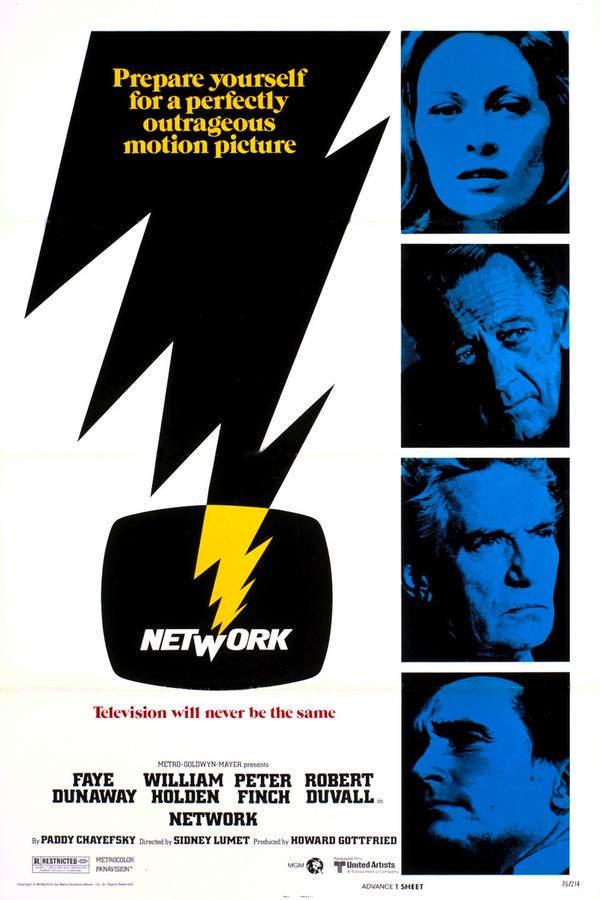
Network (1976) movie poster

Timeline

Network (1976) Timeline Explained – Every Event in Order

Release, runtime and language
1976 · 121 min · English
Directed by
Sidney Lumet
Starring
Faye Dunaway, Peter Finch, William Holden
Budget
$3.8M

This film offers a sharp critique of the television industry's relentless pursuit of higher ratings. Howard Beale, a news anchor facing disillusionment, publicly announces his intention to commit suicide on air. Instead of stopping him, the network decides to capitalize on the situation, recognizing the potential for increased viewership. Beale embraces the chaos, delivering increasingly outrageous and provocative broadcasts that resonate with a public feeling ignored and disenfranchised. His unconventional approach unexpectedly transforms him into an unlikely symbol of rebellion and a voice for the masses.

On this page (6)
  1. 1 Where to watch
  2. 2 Events in order (14)
  3. 3 Timeline questions answered
  4. 4 Movie threads
  5. 5 Movies like Network
  6. 6 Every angle

Where to watch

Where to Watch Network (1976)

Where can you watch Network? Stream, rent or buy it in the US, including on YouTube Free, Amazon Video and Apple TV Store: current JustWatch availability with up-to-date prices.

Streaming availability powered by JustWatch

14 events in order · contains spoilers

Network Timeline: Events in Chronological Order

Every key event of Network (1976) in order, scene by scene, with when and where it takes place. Use it to untangle flashbacks, time jumps and parallel storylines, to refresh your memory before the sequel or to find the exact scene you are thinking of.

  1. Howard Beale is Fired

    In September 1975, Howard Beale learns from his friend Max Schumacher that he will be terminated from the UBS Evening News due to significantly dropping ratings. This devastating news strikes Beale hard, as he realizes his decades-long career is coming to an abrupt end.

    When
    September 1975
  2. Beale's Shocking Announcement

    That same night, Beale provocatively announces to his audience that he plans to commit suicide during the next Tuesday newscast. His declaration stuns viewers and prompts the network to consider immediate action to remove him from the air.

    When
    Night of announcement
    Where
    UBS Evening News Studio
  3. Max Schumacher's Intervention

    Max Schumacher intervenes, insisting that Beale deserves a dignified farewell rather than a rushed dismissal. This decision reflects Schumacher's struggle with the pressures from the network while also trying to protect his friend's well-being.

  4. Stockholder's Meeting Reveals New Strategy

    At the annual stockholder's meeting, CCA's CEO Frank Hackett announces a shift towards making the news division accountable to the local network. This revelation blindsides Schumacher and threatens his influential position in the newsroom.

    Where
    Stockholder's Meeting
  5. Beale's Passionate Outburst

    In a surprising turn, instead of an apology, Beale delivers a passionate tirade on live television, calling life 'bullshit' and expressing his outrage. The network is taken aback, but Schumacher sees potential in Beale's raw emotions.

  6. Beale's Ratings Surge

    After his emotional outburst, Beale's unconventional candidness captivates viewers and leads to a massive spike in ratings. This newfound popularity catches the UBS executives off guard, prompting them to leverage his public persona.

  7. The Howard Beale Show Begins

    As a result of his rising fame, Beale is given a new program titled The Howard Beale Show. This launch propels Beale into a position of national prominence, making his show one of the top-rated programs in the country.

  8. Schumacher's Marital Issues

    Schumacher experiences turmoil in his personal life as his marriage to Louise deteriorates amidst the show's success. As he grows closer to Diana Christensen, the complications in his personal and professional life begin to intertwine dangerously.

  9. Christensen's Influence Grows

    Diana Christensen seeks to take full control of Beale's image, aiming to turn him into a more marketable figure. However, this causes tension between her and Schumacher as they clash over how to best manage Beale’s newfound success.

  10. Ratings Begin to Falter

    As Beale shifts his focus to addressing serious societal issues, the show's ratings begin to decline. Audiences are overwhelmed by the darker narrative, putting pressure on the network executives who fear losing their ratings-driven revenue.

  11. Executives Plot Against Beale

    Fearing the consequences of Beale's influence and the potential for declining ratings, UBS executives hatch a dramatic plot to assassinate him live on air. This extreme decision underscores the network's prioritization of viewership over human life.

    Where
    UBS Studio
  12. Climactic Assassination

    In a chilling climax, Beale is killed live on air as part of the network's ruthless strategy to regain control. This shocking event marks the abrupt end of The Howard Beale Show, leaving audiences stunned and provoking widespread outrage.

    Where
    UBS Studio
  13. Introduction of The Mao Tse-Tung Hour

    Following Beale's assassination, the network hastily introduces a new program titled The Mao Tse-Tung Hour. This transition signifies a dark new chapter for the network and reflects the ruthless nature of entertainment driven exclusively by profit.

  14. The Legacy of Howard Beale

    The film concludes with a voice-over highlighting the legacy of Howard Beale, noting that he was the first to be killed due to poor ratings. This chilling commentary encapsulates the tragic reality of a world where human life is sacrificed for entertainment value.

Last updated: November 16, 2024 at 14:56

Was this helpful?

Timeline questions answered

Network Timeline Explained: Your Questions Answered

When does it happen, and why in that order? The questions people ask about the chronology of Network (1976): time jumps, flashbacks, cause and effect between scenes and the correct order of events, each answered with spoilers.

Q1

Why did UBS keep Howard Beale on air after he announced he would commit suicide?

UBS executives decided to keep Beale on air after his suicide announcement because Max Schumacher insisted he receive a dignified farewell rather than being abruptly fired. However, when Beale delivered an unscripted passionate tirade about life being "bullshit," Schumacher saw an opportunity to boost ratings and allowed him to continue. The raw emotion resonated with viewers, causing a surge in ratings that intrigued executives enough to capitalize on his popularity rather than remove him.

Foreshadowing: Early in the film, Schumacher warns Beale about declining ratings, establishing the network's desperation for viewership.

  • howard beale
  • suicide announcement
  • max schumacher
  • ratings
  • ubs network
  • tv news
Q2

What was The Howard Beale Show?

The Howard Beale Show was a new program created by UBS after Beale's emotional on-air outburst made him a national sensation. The show featured Beale delivering passionate rants about societal issues, culminating in his famous line "I'm as mad as hell, and I'm not going to take this anymore!" It became the first news program to reach #4 in ratings, transforming a disgruntled anchor into an unlikely revolutionary voice.

Foreshadowing: The network's decision to capitalize on Beale's breakdown was foreshadowed when Diana Christensen calculated the show could generate $100,000 per minute in ad revenue.

  • the howard beale show
  • angry man
  • ratings
  • television program
  • mad as hell
Q3

Why did UBS executives have Howard Beale killed on air?

UBS executives ordered Beale's assassination because they believed he had become too influential and dangerous to the network's interests. When Beale began exposing uncomfortable truths about the system and corporations in his broadcasts, ratings plummeted as audiences found his message overwhelming. Fearing the consequences of his growing influence and the loss of revenue, the executives plot to eliminate him live on air, choosing profit and control over his life.

Foreshadowing: Earlier, Jensen warned Beale to abandon his critical message and become an "Evangel," hinting at the network's intolerance for content that threatened advertisers.

  • assassination
  • howard beale death
  • live television
  • network executives
  • ratings
  • corporate conspiracy
Q4

What was the relationship between Max Schumacher and Diana Christensen?

Max Schumacher, the news division president and Beale's friend, became romantically involved with Diana Christensen, the ambitious programming chief who wanted control of Beale's show. Their professional collaboration on The Howard Beale Show blurred personal boundaries, with Christensen using the relationship to undermine Schumacher's authority. Meanwhile, Schumacher's marriage to Louise deteriorated under the strain of his work pressures and this affair.

Foreshadowing: Christensen's initial outreach to Schumacher was strategic, as she promised to transform Beale's image while seeking full control of the program.

  • max schumacher
  • diana christensen
  • affair
  • marriage
  • news division
  • programming chief
Q5

Why did the ratings for The Howard Beale Show start to decline?

Ratings began to decline when Howard Beale shifted his broadcasts from angry rants to addressing serious societal issues and exposing corporate corruption. Audiences who had tuned in for his cathartic anger found the darker, more substantive content overwhelming and stopped watching. This drop in viewership panicked executives who had built the show's success purely on entertainment value rather than meaningful journalism.

Foreshadowing: This shift was foreshadowed when Schumacher tried to move the show toward focusing on Beale's well-being rather than perpetuating the "angry man" format.

  • ratings decline
  • audience
  • serious content
  • societal issues
  • howard beale show
Q6

What is the significance of "I'm as mad as hell" in the film?

"I'm as mad as hell, and I'm not going to take this anymore!" became Howard Beale's signature declaration and a cultural touchstone representing widespread public frustration. The line resonated with millions of viewers who felt ignored and disenfranchised, making Beale an unlikely symbol of rebellion against the establishment. The network initially celebrated this catchphrase as ratings gold, never anticipating that Beale would later use his platform to genuinely challenge the systems of power.

Foreshadowing: Beale's initial eruption was sparked by his personal crisis and disillusionment with the television industry, foreshadowing his later evolution from performer to genuine critic.

  • mad as hell
  • famous line
  • cultural impact
  • public anger
  • rebellion
  • howard beale
Q7

What happened to Max Schumacher's marriage to Louise?

Max Schumacher's marriage to Louise collapsed as his professional life consumed him entirely. The success of The Howard Beale Show brought immense pressure and personal turmoil, while his affair with Diana Christensen developed during their close work together. As Schumacher grappled with the ethical compromises at the network and his growing involvement with Christensen, his relationship with Louise deteriorated beyond repair.

Foreshadowing: The strain was evident early on as Schumacher juggled protecting Beale's dignity while facing pressure from CCA's strategy to restructure the news division.

  • max schumacher
  • louise schumacher
  • marriage
  • divorce
  • affair
  • personal life
Q8

What was The Mao Tse-Tung Hour that replaced Beale's show?

The Mao Tse-Tung Hour was the new program UBS launched immediately after assassinating Howard Beale on live television. It represented the network's complete embrace of sensationalist, ratings-driven programming with no regard for human cost. The cold voice-over at the film's end reveals this替换 marked an even darker chapter in television, where murder for ratings became the ultimate extreme in the pursuit of profit.

Foreshadowing: The transition was planned by executives who saw Beale's growing criticism as a threat, demonstrating the network's willingness to eliminate anyone who threatened their bottom line.

  • mao tse-tung hour
  • replacement show
  • ratings
  • network
  • television programming
  • finale
Q9

Why was Howard Beale fired from UBS Evening News?

Howard Beale was fired because his ratings had been steadily declining since 1969, with his Home Use Television ratings dropping from 16 to 8 and his audience share plummeting from 28 to 12. In September 1975, news division president Max Schumacher informed Beale he had only two weeks left on air, as the network sought younger talent to reverse their ratings slide.

Foreshadowing: The decline was established as a long-term trend, setting up the network's desperation that would later lead to exploiting Beale's breakdown.

  • firing
  • ratings decline
  • ubs evening news
  • anchor
  • career
  • 1969
Q10

Why did Howard Beale become a symbol of rebellion?

Howard Beale became an unlikely symbol of rebellion because he articulated the bottled-up frustration of ordinary Americans who felt ignored by the establishment. His genuine emotional breakdown on television struck a chord with viewers who saw their own disillusionment reflected in his anger. What began as a personal crisis became a conduit for collective rage against corporate America and a media system that prioritized profit over people.

Foreshadowing: The public's response to Beale's authenticity revealed a hunger for genuine emotion in a sanitized television landscape, foreshadowing his transformation into a cultural phenomenon.

  • rebellion symbol
  • public anger
  • cultural phenomenon
  • voice of masses
  • authentic emotion
  • americans
Q11

What was CCA's strategy for the news division revealed at the stockholder meeting?

At the annual stockholder meeting, CCA CEO Frank Hackett announced a strategy to make the news division directly accountable to the local network rather than maintaining its traditional independence. This move blindsided Max Schumacher, who had enjoyed significant autonomy in running the newsroom. The restructuring would severely curtail Schumacher's influence and prioritize profitability over journalistic integrity.

Foreshadowing: This corporate decision established the pressure Schumacher faced, contributing to his controversial decisions regarding Beale's fate.

  • cca
  • frank hackett
  • stockholder meeting
  • news division
  • corporate restructuring
  • max schumacher

Movie threads

More Movies Like Network, by Mood & Story

Curated lists built around what makes Network tick: the same mood, the same kind of story or the same emotional payoff. Each list explains why these movies belong together.

Scathing Media Satires like Network

Biting satires that expose the dark underbelly of the entertainment and news industries. Explore movies like Network that offer a cynical and critical look at the media industry. These films share a darkly satirical tone, exploring themes of corporate greed, sensationalism, and the erosion of ethics for entertainment and profit.

  • satirical
  • cynical
  • prophetic
  • unsettling
  • angry
  • disillusioned
  • Tone: dark, satirical, cynical
  • Pacing: steady, escalating
Why these movies?

The story pattern: Stories in this thread often follow institutions or individuals within the media landscape as they abandon principle for popularity. The narrative typically involves a descent into moral bankruptcy, where success is measured by shock value and audience engagement, regardless of the human cost.

Why they belong together: These films are grouped by their shared focus on critiquing the media apparatus. They possess a dark, satirical tone, a steady pacing that builds to a revelation of systemic rot, and a heavy emotional weight derived from witnessing integrity being traded for influence.

Bleak Corporate Critiques like Network

Stories where institutions prioritize profit over humanity, leading to bleak conclusions. If you liked Network's takedown of corporate America, you'll find similar themes here. These movies depict worlds where business interests crush human spirit, often leading to tense, heavy dramas with cynical or bleak endings about systemic failure.

  • cynical
  • unsettling
  • prophetic
  • disillusioned
  • angry
  • moral decay
  • Tone: dark, bleak, tense
  • Pacing: steady, methodical
Why these movies?

The story pattern: The narrative pattern involves a character or group confronting a powerful, amoral institution. The conflict highlights the institution's cold logic, which ultimately overwhelms individual humanity. The journey is often one of disillusionment, ending with the system's victory or a stark revelation of its pervasive power.

Why they belong together: They share a dominant theme of institutional critique, a consistently dark tone, and a high-intensity atmosphere fueled by the tension between human values and corporate imperatives. The endings are frequently bleak, reinforcing the seemingly insurmountable nature of the system.

If you liked this

Movies Like Network

Similar movies to Network: the same genre, themes or kind of story. Each one comes with its own plot summary, timeline and ending explained.

Browse all movie summaries

Every angle

Network (1976) Explained: Plot, Timeline & Characters

Everything about Network in one place: what happens in the plot summary, the timeline in chronological order, the characters and meaning and a spoiler-free summary. What's After the Movie adds the cast, box office and post-credit scenes.

Coming soon on iOS and Android

The Plot Explained Movie Summary App

Plot summaries, endings explained and timelines on your phone. Catch up on any movie in minutes, save your favorites and never miss a twist again.

Be the first to know when we launch. Your email stays private, always.

Learn more about the app