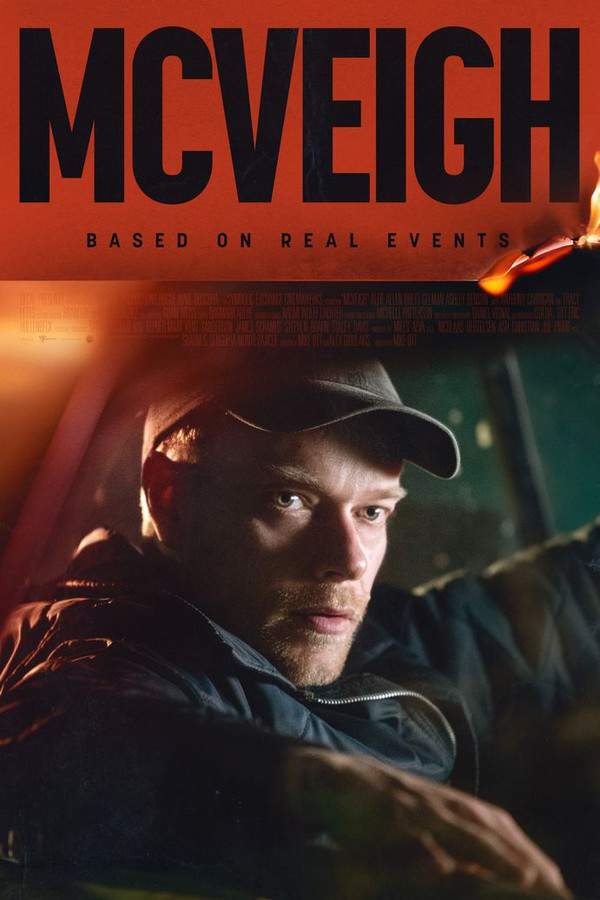
McVeigh

McVeigh

JustWatch#12,13817

Year: 2025

Runtime: 1 h 30 m

Language: english

Director: Mike Ott

Echo Score: 43
DramaThriller

Following the Waco siege, army veteran Timothy McVeigh develops a plan that culminates in the deadliest act of domestic terrorism in U.S. history. The film explores the harrowing events leading up to this tragic occurrence.

Where to Watch McVeigh?

Find where to stream, rent, or buy McVeigh (2025) in the US with current JustWatch availability, up-to-date pricing, and platform listings for subscription, rental, and digital purchase options.

Warning: spoilers below!

Haven’t seen McVeigh yet? This summary contains major spoilers. Bookmark the page, watch the movie, and come back for the full breakdown. If you're ready, scroll on and relive the story!

Timeline – McVeigh (2025)

Trace every key event in McVeigh (2025) with our detailed, chronological timeline. Perfect for unpacking nonlinear stories, spotting hidden connections, and understanding how each scene builds toward the film’s climax. Whether you're revisiting or decoding for the first time, this timeline gives you the full picture.

1

McVeigh's quiet life and anti-government stance

Timothy McVeigh is depicted as a quiet, solitary army veteran who sells anti-government stickers at roadside fairs in Kansas and Oklahoma. The film establishes his disenchantment with the government and his willingness to act if pushed.

Kansas and Oklahoma roadside fairs
2

Outrage over Waco siege and media coverage

McVeigh watches news coverage of the Waco siege and government responses, fueling his sense of grievance. He absorbs claims that the Branch Davidians provoked the FBI, pushing him toward violence.

Home (Kansas/Oklahoma)
3

Visits to Richard Snell at Tucker Unit

He makes several visits to Richard Wayne Snell, a white supremacist and convicted murderer, who has an execution date set for April 19, 1995. The meetings further radicalize McVeigh's belief that he must act against the government.

Tucker Unit, Arkansas
4

Decision to act and recruiting Nichols

After his visits, McVeigh becomes convinced he has to challenge the government and recruits fellow veteran Terry Nichols. Together they begin gathering materials to build a bomb, including fertilizers and nitrate.

Arkansas
5

Frédéric's arrival and Elohim City connection

Frédéric, a French Canadian living in Elohim City, approaches McVeigh and learns of his network. The encounter widens McVeigh's circle but also raises suspicions that cause him to reassess his plan.

Elohim City, Oklahoma
6

Suspicion and accelerated plans

After visiting Elohim City, McVeigh grows suspicious of Frédéric and leaves abruptly. The encounter accelerates his resolve to act sooner rather than later.

Elohim City area
7

Romantic encounter with Cindy

McVeigh meets Cindy, a waitress at a roadside gas station, and they quickly form a sexual connection. The relationship becomes entangled with his secret plans as his paranoia grows.

Roadside gas station
8

Cindy stays at his home and raises suspicion

Cindy stays at McVeigh's home, and he becomes paranoid that she might uncover his plan. This fear strains the relationship and pushes him toward completing the mission.

McVeigh's home
9

Breakup with Cindy and full commitment to the bombing

After their relationship ends, McVeigh fully commits to the bombing. He rents a truck and enlists Nichols to help load the explosives.

Oklahoma
10

Day of the attack: plan comes together with a mysterious accomplice

On the morning of the attack, McVeigh goes to Nichols's home only to find he has left. He then calls an unknown person from a public phone and brings this accomplice to Oklahoma City. The face of the accomplice is never shown.

April 19, 1995 (morning) Nichols's home; public phone; Oklahoma City
11

Drive to downtown Oklahoma City to carry out the bombing

McVeigh and the unknown companion drive toward downtown Oklahoma City to execute their plan. The movie interleaves footage of the unfolding catastrophe with moments that emphasize the scale of the attack.

April 19, 1995 (morning) Downtown Oklahoma City
12

Richard Snell's execution waiting at Cummins Unit

As the city plans its attack, Richard Snell sits in seclusion at Cummins Unit, awaiting his own execution. The parallel timelines heighten the sense that acts of violence are part of a broader, doomed cycle.

April 19, 1995 Cummins Unit, Oklahoma
13

Aftermath: news clips and 60 Minutes interview

The film ends with real-life news clips showing victims' families and the devastation of the bombing. An archive interview from 60 Minutes features McVeigh justifying his actions.

Post-attack

Last updated: August 02, 2026 at 13:01

Was this helpful?

McVeigh (2025) Timeline Questions Answered – Chronology FAQ

Find frequently asked questions about the McVeigh (2025) timeline, including chronological order, nonlinear jumps, cause-and-effect links, and scene sequence clarifications. This timeline FAQ helps explain when key events happen, how moments connect, and why the story unfolds in that specific order.

Q1

Why did Timothy McVeigh target the Oklahoma City federal building?

A.

McVeigh selected the Alfred P. Murrah Federal Building because it symbolized the federal government he believed had overstepped its constitutional bounds. The Waco siege convinced him that agencies like the FBI and ATF were abusing their power, and the building, which housed multiple federal offices, represented a concentrated target of that authority.

Early in the film, McVeigh sells anti-government stickers at roadside fairs, establishing his belief that the federal government is a singular enemy worth confronting.

oklahoma cityfederal buildingtargetanti-governmentmcveigh motivation
Q2

How did the Waco siege influence McVeigh's plan?

A.

McVeigh watched extensive news coverage of the 1993 Waco siege and became convinced that the government had acted unconstitutionally against the Branch Davidians. This belief that the state had crossed a line became the central justification for his retaliatory act, transforming abstract outrage into a concrete plan for violence against federal institutions.

The film shows McVeigh absorbing televised panels and headlines about Waco, gradually shifting his language from protest to retaliation.

waco siegebranch davidiansfbiradicalizationgovernment overreach
Q3

What role did Richard Wayne Snell play in McVeigh's radicalization?

A.

Richard Wayne Snell was a white supremacist and convicted murderer whose execution was scheduled for April 19, 1995. Through repeated visits to Tucker Unit in Arkansas, McVeigh absorbed Snell's extremist ideology and his conviction that violence against the government was justified, which gave McVeigh a framework for turning his grievances into action.

The first visit to Tucker Unit marks the moment McVeigh stops talking about protest and begins talking about consequences.

richard wayn snelltucker unitwhite supremacistradicalizationexecution
Q4

Why is April 19, 1995 significant in the film?

A.

April 19, 1995 was the date of both the Oklahoma City bombing and Richard Wayne Snell's scheduled execution. The film uses this convergence to draw a deliberate parallel between different acts of domestic violence, suggesting they are part of the same ideological cycle rather than isolated events.

The execution date is mentioned during McVeigh's early visits to Snell, long before the bombing timeline becomes clear.

april 19 1995execution dateoklahoma city bombingsymbolismconvergence
Q5

Why wasn't Terry Nichols with McVeigh on the day of the bombing?

A.

On the morning of April 19, McVeigh went to Nichols's home only to find him gone. The film never fully explains his absence, but it heightens the sense of isolation McVeigh faced in the final hours and forces him to recruit an unknown accomplice from a public phone, underscoring how the plan nearly collapsed at the last moment.

Earlier scenes show Nichols growing quieter and more cautious as the plan escalates, hinting at his wavering commitment.

terry nicholsaccomplicemorning of attackplanpublic phone
Q6

Who was the unidentified accomplice riding with McVeigh?

A.

The film deliberately never reveals the face or identity of McVeigh's companion on the day of the attack. This anonymity functions as a narrative device, emphasizing the broader network of people who enable such violence without ever being fully known or held accountable in the story.

The call from the public phone and the obscured face foreshadow the moral ambiguity of who else was complicit.

unidentified accomplicejohn doeunknowncomplicityanonymity
Q7

Why did McVeigh grow suspicious of Frédéric?

A.

Frédéric, a French Canadian living in Elohim City, had knowledge of McVeigh's ties to Richard Snell and to the broader extremist network. McVeigh feared that Frédéric's loose connections could expose his plans, so he abruptly cut the interaction short, which paradoxically accelerated his resolve to act before the circle could widen further.

The Elohim City visit is framed from the start as an unfamiliar social environment, signaling that McVeigh is out of his element.

frédéricelohim citysuspicionexposurenetwork
Q8

How did McVeigh's relationship with Cindy affect his plan?

A.

Cindy, a waitress at a roadside gas station, offered McVeigh a brief emotional reprieve from his fixation. However, when she began staying at his home, his paranoia that she might uncover the bomb materials strained the relationship, and her potential exposure pushed him to fully commit to the attack rather than risk being discovered.

Cindy notices small inconsistencies in McVeigh's story early on, which the film returns to as evidence of her growing awareness.

cindywaitressparanoiarelationshipgas station
Q9

What materials did McVeigh and Nichols use to build the bomb?

A.

McVeigh and Nichols gathered agricultural fertilizers and nitrate-based compounds to construct the explosive device. These materials were inexpensive and widely available in the farming regions of Kansas and Oklahoma, which is why McVeigh was able to operate across the Midwest without drawing immediate attention.

McVeigh's interest in rural supply stores and his familiarity with farming communities is established early in the film.

fertilizernitratebomb materialsanfomidwestrural
Q10

Why does the film interweave Snell's execution with the Oklahoma City bombing?

A.

The parallel timelines emphasize a cycle of violence, showing how extremist ideology at one level, embodied by Snell, feeds into larger acts of terrorism. The convergence on April 19 reinforces the idea that the Oklahoma City bombing was not an isolated event but the predictable outcome of a broader ideological ecosystem.

Snell's final writings, shown in prison, mirror language McVeigh later uses in the 60 Minutes interview.

richard snellcummins unitparallel timelinecycle of violenceextremism
Q11

Why did the film end with archival footage and a 60 Minutes interview?

A.

The archival news coverage and 60 Minutes interview ground the fictionalized narrative in real-world consequences, showing the human cost of the attack through victims' families and devastation on the ground. McVeigh's own justifications in the interview also leave viewers to confront the dissonance between his stated constitutional motives and the mass casualties he caused.

Throughout the film, McVeigh rehearses his ideological talking points, foreshadowing the polished justifications he later delivers on camera.

archival footage60 minutesaftermathvictimsdocumentary
Q12

How does the film portray McVeigh's psychology?

A.

The film portrays McVeigh as a man shaped by isolation, selective information consumption, and constitutional paranoia. Rather than sensationalizing him, it traces how repeated exposure to grievance-driven media, combined with personal alienation, gradually moved him from selling anti-government stickers to planning a mass-casualty attack.

McVeigh's preference for solitary activities and his reaction to news coverage hint early on at a man who internalizes grievance rather than seeking community.

psychologyisolationparanoiagrievanceradicalization
Mobile App Preview

Coming soon on iOS and Android

The Plot Explained Mobile App

From blockbusters to hidden gems - dive into movie stories anytime, anywhere. Save your favorites, discover plots faster, and never miss a twist again.

Sign up to be the first to know when we launch. Your email stays private, always.

Explore Movie Threads

Discover curated groups of movies connected by mood, themes, and story style. Browse collections built around emotion, atmosphere, and narrative focus to easily find films that match what you feel like watching right now.

Slow burn radicalization like in McVeigh

Stories that methodically trace one person's quiet slide into dangerous beliefs.Movies like McVeigh that patiently trace a character or community's slide into extremism and ideological violence. If you liked McVeigh's documentary-style restraint and the quiet, suffocating pressure of watching a plan take shape, these slow burn stories about radicalization and political extremism will hit the same way.

slow burnoppressivebroodingclaustrophobicparanoidchillingisolated

Narrative Summary

These films typically follow a single protagonist or small group whose worldview slowly hardens through grievance, isolation, and exposure to dangerous ideas. The narrative unfolds in deliberate, often quiet scenes that emphasize the mundanity of preparation and belief rather than spectacle. There is rarely a redemptive arc; instead, the story builds toward a devastating act or realization that the audience feels coming long before it arrives.

Why These Movies?

Grouped for their shared commitment to slow pacing, psychological interiority, and the portrayal of ideology as something that grows rather than arrives out of nowhere. They use restraint, atmosphere, and documentary-style realism to make violence feel both inevitable and disturbingly human. The result is a viewing experience that is heavy, uncomfortable, and hard to shake.
Bleak true crime reckonings like in McVeigh

Real-world horrors that refuse easy answers and demand the viewer sit with grief.If you liked McVeigh and want more true crime dramas that confront the darkest chapters of American history, these films deliver similar gravity. Movies like McVeigh that handle domestic terrorism, mass casualty events, and political violence with documentary-style realism and unflinching bleakness belong in this thread.

somberbleakdocumentary feelheavychillingtrue crimegrief-stricken

Narrative Summary

These films typically follow the architecture of a known historical tragedy, weaving together the perspectives of perpetrators, victims, investigators, and witnesses. They unfold with the weight of inevitability, often blending dramatized scenes with archival footage, interview material, or journalistic framing. The emotional arc is almost always downward, toward loss, complicity, and the recognition that violence is rooted in identifiable social and political forces.

Why These Movies?

Grouped for their commitment to sober, restrained storytelling about real events involving mass violence, extremism, or institutional failure. They share a heavy emotional register, bleak conclusions, and a willingness to sit with discomfort rather than resolve it. Viewers who appreciate McVeigh's refusal to dramatize or sensationalize will find kindred films here.

Unlock the Full Story of McVeigh

Don't stop at just watching - explore McVeigh in full detail. From the complete plot summary and scene-by-scene timeline to character breakdowns, thematic analysis, and a deep dive into the ending - every page helps you truly understand what McVeigh is all about. Plus, discover what's next after the movie.

McVeigh Summary

Read a complete plot summary of McVeigh, including all key story points, character arcs, and turning points. This in-depth recap is ideal for understanding the narrative structure or reviewing what happened in the movie.

McVeigh Summary

Characters, Settings & Themes in McVeigh

Discover the characters, locations, and core themes that shape McVeigh. Get insights into symbolic elements, setting significance, and deeper narrative meaning - ideal for thematic analysis and movie breakdowns.

Characters, Settings & Themes in McVeigh

McVeigh Ending Explained

What really happened at the end of McVeigh? This detailed ending explained page breaks down final scenes, hidden clues, and alternate interpretations with expert analysis and viewer theories.

McVeigh Ending Explained

McVeigh Spoiler-Free Summary

Get a quick, spoiler-free overview of McVeigh that covers the main plot points and key details without revealing any major twists or spoilers. Perfect for those who want to know what to expect before diving in.

McVeigh Spoiler-Free Summary

More About McVeigh

Visit What's After the Movie to explore more about McVeigh: box office results, cast and crew info, production details, post-credit scenes, and external links - all in one place for movie fans and researchers.

More About McVeigh