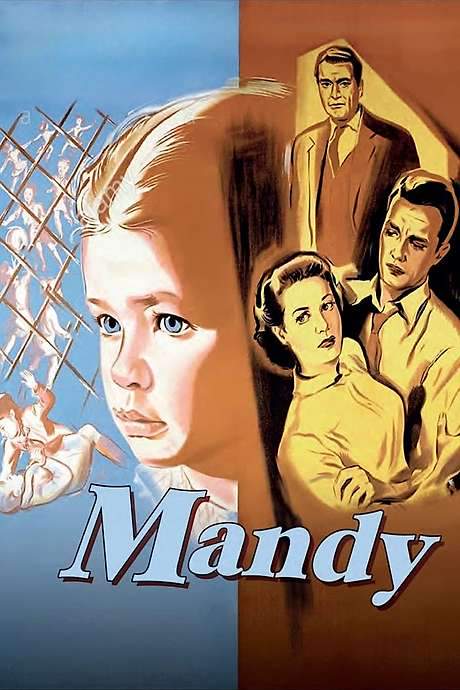
Christine Garland, Phyllis Calvert, has a young deaf daughter, Mandy. Her husband Harry Garland, Terence Morgan, is away from home, and the family is trying to adjust to Mandy’s needs. As they confront the challenge of Mandy’s communication, they enroll her in special education classes in hopes she will learn to speak. The process places pressure on their marriage, stirring arguments and strain between Christine and Harry, and it opens up the possibility of additional tension as Christine and the school’s headmaster, Dick Searle, Jack Hawkins, grow closer in the care and attention Mandy receives.
Mandy’s journey toward speech begins in a creative moment: a balloon helps her feel the vibrations of sound, proof that she has produced something audible. This breakthrough marks a turning point for the family, even as it complicates the adults’ relationships. When Harry returns and suggests pulling Mandy out of the school for a private alternative, Christine refuses to give up on the public program that has begun to unlock her daughter’s voice.
Dick Searle’s steady, patient guidance helps Mandy progress, and the moment of real progress arrives when she finally articulates the word that has been eluding her for so long. The scene underscores the professional commitment of Searle, but it also heightens the unease felt by Ackland, Searle’s superior, played by Edward Chapman, who is unhappy about the potential personal entanglement between Searle and Christine.
The tension reaches a breaking point as word of the personal relationship travels. Harry Garland, still staying with his parents in a grand London townhouse, confronts Ackland with the implications of the affair. The confrontation leads to a decisive family moment: Harry takes Mandy out of the school and brings her to the family home. In the back garden that overlooks a bombed-out area, Mandy experiences a scene full of hesitation and hope as children nearby invite her to join them in play. The parents watch as Mandy is coaxed to rejoin the world of children, and, with her parents behind her, she speaks the name that matters most to her, a first victory shared by the whole family.
In the end, the film remains intimate and focused on Mandy’s voice and the resilience of a family navigating loss, learning, and new beginnings. The quiet triumph of a child finding a way to say her own name—“Mandy”—becomes a poignant moment of connection for everyone involved, a small but powerful reminder of how perseverance, support, and patience can open doors that words alone cannot immediately unlock.