Plot Explained Spoilers guaranteed!
Plot Explained

Browse by genre

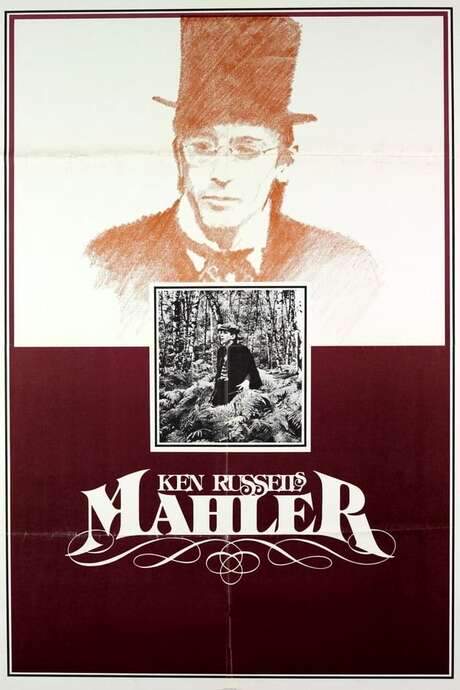
Mahler (1974) movie poster

Timeline

Mahler (1974) Timeline Explained – Every Event in Order

Release, runtime and language
1974 · 115 mins · English
Loading streaming availability…
Directed by
Ken Russell
Starring
Oliver Reed, Kenneth Colley, George Coulouris, Ronald Pickup, Peter Eyre, Rosalie Crutchley

Through striking cinematography, the film becomes an electrifying visual odyssey that immerses the viewer in musical madness and a savage romance. As he journeys by train, famed composer Gustav Mahler confronts the tragedies of his past, the disintegration of his marriage, and the inner turmoil that shapes his art.

On this page (6)
  1. 1 Where to watch
  2. 2 Events in order (12)
  3. 3 Timeline questions answered
  4. 4 Movie threads
  5. 5 Categories
  6. 6 Every angle
Loading streaming availability…

12 events in order · contains spoilers

Mahler Timeline: Events in Chronological Order

Every key event of Mahler (1974) in order, scene by scene, with when and where it takes place. Use it to untangle flashbacks, time jumps and parallel storylines, to refresh your memory before the sequel or to find the exact scene you are thinking of.

  1. Opening credits: hut on pier bursts into flame

    The film opens with a small hut on a pier burning dramatically as opening credits roll. A cocooned woman struggles to break free of white wrappings in an outdoor setting near a rough rock carving of Mahler's head. The image hints at themes of transformation and mortality that will thread through the story.

    Where
    Pier by a lake
  2. On the train to Vienna, crowds greet Mahler

    On the train back to Europe, Mahler and Alma journey toward Vienna while crowds throng the platforms to greet him. Alma's lover Max is aboard, urging her to leave Mahler and run away with him. Across the moving carriage, memories and visions begin to interrupt the journey.

    Where
    Train to Vienna
  3. Lake hut flashback: hush the noise

    A flashback reveals the idyll of a hut by the lake where Mahler tries to compose. Alma persuades and hushes animals and people around the lake, giving beer to keep them quiet. The memory frames their creative and personal dynamic at the root of the story.

    Where
    Lake hut
  4. Ninth Symphony and death discourse

    A woman changing compartments remarks that Mahler's Ninth Symphony is all about death, unsettling him. The notion that after Beethoven no composer can write more than nine symphonies haunts his self-image. The moment foregrounds the fragility and pressure surrounding his art.

    Where
    Train compartment
  5. Heart attack and coffin vision

    Mahler experiences a heart attack, and a doctor on the train revives him. He then imagines himself alive in a windowed coffin while Alma and Max ignore his pleas and carry on with their relationship. The vision deepens the tension between life, death, and desire.

    Where
    On the train
  6. Emperor illusion in asylum (Hugo Wolf)

    In a flashback, Mahler seeks a music-director job with a figure presented as Emperor Franz Josef, who is far too young for the era and makes outrageous demands while pressing his Jewish identity. It turns out the 'Emperor' is Mahler's friend Hugo Wolf, impersonating the ruler in an asylum. The scene plays with delusion, status, and anti-Semitic pressures in the music world.

    Where
    Asylum
  7. Alma yearns to compose and is told her role

    Alma longs to compose, and Mahler's lead singer performs her song, but Mahler tells her her job is wife and mother and that composition is too stressful. He cites their mad friend and his brother's failed artistic career as cautionary tales. Alma buries her song in the woods and mourns its loss.

    Where
    Woods
  8. Cosima Wagner baptism fantasy

    In a fantasy sequence, Mahler undergoes a baptism of fire and blood on a mountaintop as Cosima Wagner presides. Cosima's influence and anti-Semitic attitudes loom over the music world, depicted through goose-stepping imagery and loaded symbols. The surreal sequence signals a crisis of faith and artistic identity.

    Where
    Mountaintop
  9. Alma attacks over Kindertotenlieder

    In a final flashback, Alma attacks Mahler in the hut on the pier after he wrote Kindertotenlieder, conflating it with the death of one of his children. The scene links personal grief to his music and reveals strains in their marriage. The event foreshadows tragedy within the larger story.

    Where
    Hut on the pier
  10. Train doctor: health vs. vitality

    A doctor on the train declares Mahler to be in perfect health, creating a stark contrast with the looming illness later revealed. Mahler tells Alma that he will live forever with their bond and music, resisting medical verdicts. The moment heightens the tension between mortality and artistic immortality.

    Where
    Train
  11. Choice: Max off, Alma stays; music as love

    Mahler gives Alma the choice to disembark with Max or stay aboard with him. He proclaims that all his music is for her and that she is his music. They kiss as Max exits the train, leaving Alma and Mahler together.

    Where
    Train
  12. Vienna arrival and prognosis

    They arrive at Vienna, and a doctor reports to Mahler's regular physician that he is very ill with only a week or two to live. Mahler declines to hear the prognosis, telling Alma they are going to live forever. The film closes on a defiant note of mortal defiance.

    Where
    Vienna station

Last updated: October 09, 2025 at 09:28

Was this helpful?

Timeline questions answered

Mahler Timeline Explained: Your Questions Answered

When does it happen, and why in that order? The questions people ask about the chronology of Mahler (1974): time jumps, flashbacks, cause and effect between scenes and the correct order of events, each answered with spoilers.

Q1

Why does Mahler vision himself alive in a coffin while Alma and Max ignore him?

The vision occurs right after Mahler's heart attack on the train. The coffin scene represents his deepest fear, not of death itself, but of being forgotten or replaced while still alive. He sees Alma and Max continuing their affair without him, symbolizing his anxiety about his marriage failing and his legacy disappearing. This hallucination projects his emotional insecurity onto the reality of Alma's infidelity.

  • coffin vision
  • heart attack
  • alma
  • max
  • death anxiety
Q2

Who is the Emperor that Mahler meets in the asylum scene?

The Emperor is actually Hugo Wolf, Mahler's friend and fellow composer, who is institutionalized in an asylum. The entire meeting is a delusional fantasy where Wolf impersonates Emperor Franz Josef. The scene explores the pressure and anti-Semitism faced by Jewish musicians in the music world, while also reflecting Mahler's own anxieties about his career and status.

  • hugo wolf
  • emperor
  • asylum
  • fantasy
  • delusion
Q3

Why does Alma attack Mahler after he composes Kindertotenlieder?

Alma becomes furious because Mahler's Kindertotenlieder (Songs on the Death of Children) strikes too close to home, they had lost a daughter. The song cycle's subject matter felt like a cruel reminder of their grief, and Alma interpreted it as insensitive or even morbid. This incident reveals the deep emotional strain in their marriage and how Mahler's art sometimes wounded those closest to him.

  • kindertotenlieder
  • alma attack
  • children death
  • grief
  • marriage
Q4

What does Mahler's baptism by Cosima Wagner represent?

The surreal baptism scene represents Mahler's conversion to Catholicism, which he underwent in 1897 to improve his career prospects in Vienna. Cosima Wagner, Richard Wagner's widow, looms as a powerful figure in the music world. The disturbing imagery, goose-stepping, Nazi symbols, foreshadows the dark historical forces that would later appropriate Wagner's work, reflecting the era's rising anti-Semitism and the complicated legacy Mahler navigated.

  • cosima wagner
  • baptism
  • catholicism
  • conversion
  • wagner
Q5

Why does Mahler tell Alma she cannot compose music?

Mahler believed a woman's role was wife and mother, and he feared that the stress of composition would harm Alma's health. He cited his brother's failed artistic career and a friend who went mad as cautionary tales. Mahler genuinely believed he was protecting her, though his stance suppressed Alma's own creative ambitions, creating resentment in their marriage.

  • alma composer
  • marriage
  • suppression
  • ambition
  • composition
Q6

Why does one doctor say Mahler is healthy while another says he's dying?

The train doctor examines Mahler during the journey and declares him in excellent health, creating dramatic irony. Later, upon arrival in Vienna, another doctor reveals Mahler has a terminal illness with only weeks to live. The contradiction highlights the unpredictable nature of his condition and sets up the film's central tension between mortality and artistic defiance.

  • train doctor
  • diagnosis
  • terminal illness
  • vienna
  • health
Q7

Does Alma leave with Max or stay with Mahler?

Alma chooses to stay with Mahler. At the next stop, Max departs the train alone. Mahler tells Alma that all his music is for her, she is his music, he declares, even claiming she is the second theme of his Sixth Symphony. They kiss, and Alma remains aboard as the train continues toward Vienna, reaffirming their bond despite everything.

  • alma
  • max
  • choice
  • love
  • marriage
Q8

Why does the woman say Mahler's Ninth Symphony is about death?

A woman changing train compartments remarks that Mahler's Ninth Symphony is all about death, a thought that deeply unsettles him. The comment taps into the superstitious belief that after Beethoven, composers who write a ninth symphony invite death. The notion haunts Mahler because he is aware of his own mortality and the symbolic weight of his final symphonic work.

  • ninth symphony
  • death
  • superstition
  • beethoven
  • symphony
Q9

What is the purpose of the train journey structure in the film?

The train journey serves as the narrative backbone, with each station triggering memories and visions. The traveling setting allows Mahler to confront his past, the lakeside hut, the Emperor meeting, the Cosima baptism, while his present situation unfolds with Alma and Max. This non-linear structure mirrors how the mind drifts between present circumstances and past experiences, creating an electrifying visual odyssey through Mahler's consciousness.

  • train journey
  • memories
  • flashbacks
  • structure
  • non-linear
Q10

Why does Mahler say they will live forever at the end?

When doctors inform Mahler he has only a week or two to live, he refuses to accept the prognosis. He tells Alma they are going to live forever, choosing defiant optimism over despair. This closing moment captures the film's bittersweet tone, Mahler finds immortality through his music and his love for Alma, embracing art and memory as resistance against time.

  • defiance
  • death
  • prognosis
  • immortality
  • ending

Movie threads

More Movies Like Mahler, by Mood & Story

Curated lists built around what makes Mahler tick: the same mood, the same kind of story or the same emotional payoff. Each list explains why these movies belong together.

Surreal artist biographies like Mahler

Films that blur memory, fantasy, and reality to explore a creator's inner turmoil. Find other movies like Mahler that explore the lives of creators through a surreal and psychologically intense lens. This thread gathers films where artistic genius is intertwined with personal turmoil, presented with dreamlike visuals and complex, non-linear narratives.

  • surreal
  • melancholic
  • introspective
  • oppressive
  • dreamlike
  • reflective
  • Tone: melancholic, introspective, tormented
  • Pacing: variable, contemplative
Why these movies?

The story pattern: The narrative pattern follows the life of a creative figure, eschewing conventional chronology in favor of a stream-of-consciousness journey. The story weaves together key memories, existential fears, and symbolic fantasies, often triggered by a present-moment catalyst like a journey or illness, to paint a portrait of the artist's soul.

Why they belong together: Movies in this thread share a focus on the creative process as a form of madness or salvation, a melancholic and heavy tone, and a complex structure that mirrors the fractured nature of memory and inspiration. The visual style is often striking and symbolic.

Journeys of memory like in Mahler

Stories where a physical voyage prompts a heavy reckoning with love, loss, and legacy. If you liked Mahler's train journey through a life of music and regret, explore this thread of movies with similar bittersweet voyages. These stories use travel as a framework for characters to reflect on love, legacy, and mortality, leading to emotionally heavy and reflective conclusions.

  • reflective
  • nostalgic
  • bittersweet
  • melancholic
  • romantic
  • anxious
  • Tone: reflective, bittersweet, nostalgic
  • Pacing: variable, meditative
Why these movies?

The story pattern: The narrative is structured around a journey in the present that acts as a framing device for flashbacks and reflections. The central conflict is internal, as the protagonist grapples with the pain and beauty of their memories, culminating in a climax of self-acceptance that is both sad and strangely hopeful.

Why they belong together: This thread groups films that share a specific narrative structure (journey-as-memory-trigger), a bittersweet emotional arc, and a heavy, reflective mood. The pacing is often variable, shifting between the calm of travel and the emotional intensity of recalled moments.

Categories

Movie Lists Featuring Mahler

Mahler appears in these hand-built movie categories. Each one groups movies by a specific mood, theme or story type, with their plot summaries and endings explained.

View all movie categories

Every angle

Mahler (1974) Explained: Plot, Timeline & Characters

Everything about Mahler in one place: what happens in the plot summary, the timeline in chronological order, the characters and meaning and a spoiler-free summary. What's After the Movie adds the cast, box office and post-credit scenes.

Coming soon on iOS and Android

The Plot Explained Movie Summary App

Plot summaries, endings explained and timelines on your phone. Catch up on any movie in minutes, save your favorites and never miss a twist again.

Be the first to know when we launch. Your email stays private, always.

Learn more about the app