Plot Explained Spoilers guaranteed!
Plot Explained

Browse by genre

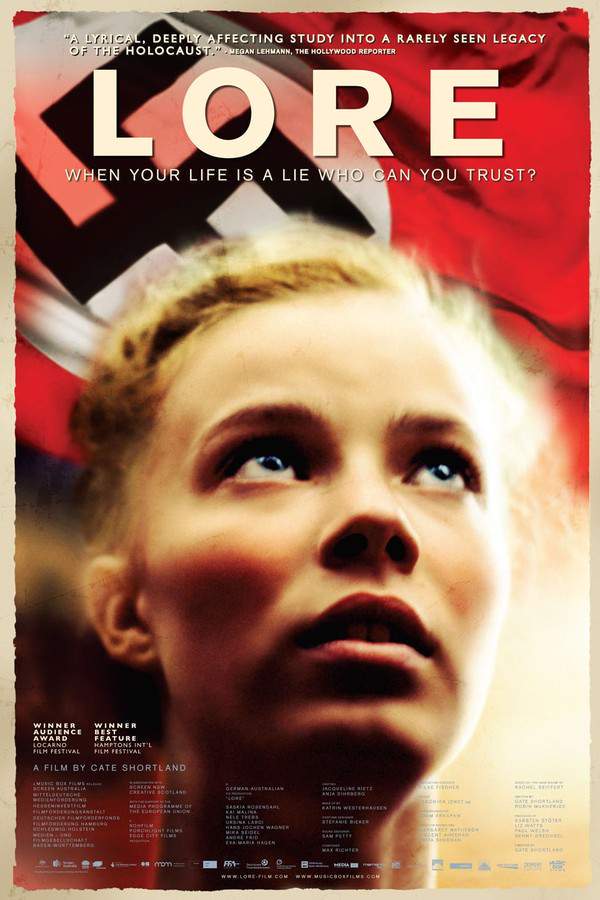
Lore (2013) movie poster

Timeline

Lore (2013) Timeline Explained – Every Event in Order

Release, runtime and language
2013 · 109 min · German
Loading streaming availability…
Directed by
Cate Shortland
Starring
Ursina Lardi, Hans-Jochen Wagner, André Frid, Kai-Peter Malina, Mika Seidel, Nele Trebs

Near the end of World War II, Lore, a young and fiercely loyal teenager, must guide her siblings across a devastated Germany. As they journey toward their parents, they are confronted with the horrifying reality of the Nazi regime and the suffering it has caused. Their perilous escape forces Lore to question everything she has ever known and to confront her prejudices when she is unexpectedly aided by a mysterious refugee, a person she has been taught to despise.

On this page (7)
  1. 1 Where to watch
  2. 2 Events in order (12)
  3. 3 Timeline questions answered
  4. 4 The book behind the movie
  5. 5 Movie threads
  6. 6 Movies like Lore
  7. 7 Every angle
Loading streaming availability…

12 events in order · contains spoilers

Lore Timeline: Events in Chronological Order

Every key event of Lore (2013) in order, scene by scene, with when and where it takes place. Use it to untangle flashbacks, time jumps and parallel storylines, to refresh your memory before the sequel or to find the exact scene you are thinking of.

  1. Escape to the Black Forest

    The family packs in a rush as a Nazi officer father returns and the war closes in. They flee from their stately home, killing the family dog, and seek refuge in a secluded cabin in the Black Forest. Lore's mother wraps a porcelain deer figurine to take along, while the others prepare for a dangerous journey ahead.

    When
    1945
    Where
    Black Forest, Southern Germany
  2. Lore Takes Command

    Günther's departure is uncertain; Lore's mother heads to a camp after news of Hitler's death, leaving Lore in charge with instructions to reach Omi's house in Husum. The family tears themselves away from a peaceful interior to a dangerous road, as trains stop running and food runs scarce. They set out on foot with few possessions.

    When
    1945
    Where
    Southern Germany, en route to Husum
  3. On the Road Without Trains

    With trains halted, the siblings abandon all belongings and begin a grueling trek on foot. They cross rural landscapes, growing more exhausted as supplies dwindle and fear grows in silence. The journey marks their first test of survival without adult protection.

    When
    1945
    Where
    German countryside
  4. Discovery in an Abandoned House

    The children arrive at a ruined house and Lore discovers the corpse of a woman. She also encounters a sleeping young man who will become a recurring, troubling presence. The encounter signals the collapse of safety and the start of a desperate scavenger path.

    When
    1945
    Where
    Ruined house, along their route
  5. Church Visit and the Camp News

    In a nearby village, the children seek shelter and Lore pays a woman to breast-feed her baby brother Peter. Later, they encounter the same young man again as photos of Nazi atrocities are posted in the village square. Lore studies the images and recognizes her father among the uniformed officers.

    When
    1945
    Where
    Village near church
  6. A Moment in the School

    The troupe spends the night in a school where the young man makes an unwanted sexual advance on Lore, who rebuffs him. He later follows them as they continue their journey, hinting at danger and manipulation from a person close to them.

    When
    1945
    Where
    School in a village
  7. Exchange of Jewelry for Food

    At a farm, Lore exchanges her mother's gold ring and a gold bracelet for food. She also discovers a dead man who shot himself and steals his watch, while an old woman pleads that they abandon the baby for the family's survival. Lore refuses, determined to keep the sibling group together.

    When
    1945
    Where
    Farm in rural Germany
  8. The Familiar Stranger Becomes Ally

    The same young man reappears, now calling himself 'Thomas' and presenting fake papers that claim he is Lore's brother. A truck with American soldiers stops them, and Thomas shows his 'papers' to gain passage, earning them a ride toward safety. Lore grows wary but depends on his survival instincts.

    When
    1945
    Where
    Rural road toward Allies' zones
  9. Illness, Kindness, and Tension

    Lore falls ill, and Thomas tends to her and the others with food and care. While bathing, Liesel questions Lore about Thomas, and Lore's ambivalence about him becomes more evident as she moves closer to him in a dangerous, fragile way.

    When
    1945
    Where
    Along the road, later in the journey
  10. Crossing a River Under Threat

    In the forest, Lore buries photographs of her father and his concentration-camp picture. When a river blocks their path, Thomas offers to help Peter cross and Lore seeks assistance from a boatman who is not interested. Lore allows the man to assault her to distract him while Thomas kills him. They use the boat and cross, but Lore is left shaken by the act.

    When
    1945
    Where
    Forest and river crossing, Germany
  11. Günther's Death and Betrayal of Trust

    As they approach the Soviet sector, the group contends with a tense plan to cross into the British sector at night. Günther is shot by Soviet soldiers, and Thomas threatens to leave them behind if they slow their progress. Lore's trust in Thomas fractures after she labels him 'a filthy Jew' during their argument, but he stays with them.

    When
    1945
    Where
    Border regions, between Soviet and British zones
  12. Arrival at Oma's House and a Bitter Homecoming

    The siblings finally reach Omi's house in Husum near Hamburg. Oma feeds them and admonishes them not to be ashamed of their parents. Lore places her mother's porcelain deer on the dresser, a symbol of memory and loss, and struggles to adjust to civilian life. The family tensions erupt as Lore smashes the deer figurines in anger.

    When
    1945
    Where
    Omi's house, Husum, near Hamburg

Last updated: October 09, 2025 at 16:23

Was this helpful?

Timeline questions answered

Lore Timeline Explained: Your Questions Answered

When does it happen, and why in that order? The questions people ask about the chronology of Lore (2013): time jumps, flashbacks, cause and effect between scenes and the correct order of events, each answered with spoilers.

Q1

Why does Lore allow the man to assault her to cross the river?

Lore makes the desperate choice to trade her body for safe passage because the boatman refuses to help without payment, and the siblings desperately need to cross the river to escape the dangerous area. While the man is distracted by assaulting Lore, Thomas kills him from behind, allowing the group to steal the boat and cross. This scene highlights the moral compromises Lore is forced to make to keep her siblings alive in a lawless landscape.

Foreshadowing: Earlier, Lore already steals a watch from a dead man and considers abandoning her baby brother, showing her growing willingness to do whatever it takes for survival.

  • lore boat crossing river assault thomas killed man sacrifice
Q2

Why does Thomas continue helping Lore's family after she insults him?

Despite Lore calling him "a filthy Jew" during an argument, a phrase reflecting the anti-Semitic views she was raised with, Thomas stays because he has already invested in getting them to safety and likely understands that her prejudice stems from her Nazi upbringing rather than genuine hatred. Additionally, Thomas has nowhere else to go and may genuinely care for Lore despite her hurtful words. His decision reflects the moral complexity of survival where people must look past deepest prejudices to collaborate.

Foreshadowing: Thomas has already been helping the family throughout the journey, providing food, papers, and protection despite receiving nothing in return.

  • thomas lore insult jew anti-semitic prejudice stays argument
Q3

What happens to Günther in the film?

Günther is shot and killed by Soviet soldiers when the family attempts to cross into the British sector at night. The Soviet soldiers are guarding the border, and Günther is killed during the dangerous nighttime crossing attempt. His death represents the constant peril the siblings face and the heavy cost of their journey to reach safety.

Foreshadowing: The family was already struggling with scarcity and danger, and the timeline shows Günther's fate becomes increasingly uncertain as they approach the border regions.

  • gunther shot killed soviet soldiers border crossing death
Q4

Why does Lore destroy the porcelain deer at her grandmother's house?

Lore smashes the porcelain deer figurines in a moment of rage and rebellion against her parents and the past they represented. The deer were her mother's keepsakes, tangible links to the family identity and the world that collapsed with the Nazi defeat. By destroying them, Lore symbolically rejects the family legacy, her mother's abandonment, and the ideology she was raised in, but the act also represents her inability to peacefully reconcile with her painful memories.

Foreshadowing: The deer figurine was introduced early when Lore's mother carefully wrapped it to take along, marking it as a significant symbol throughout the journey.

  • lore destroys deer porcelain figurines anger rebellion grandmother house smashing
Q5

Who is Thomas and what is his real identity?

Thomas presents himself as a helpful stranger, but his papers identify him as "Thomas Weil," suggesting he may be Jewish and using false identity documents for survival. He carries documents that could incriminate him if his true identity is discovered. Throughout the journey, he proves resourceful and protective of the children, though his past remains mysterious. The ambiguity around his identity reflects the precarious situation of displaced persons trying to survive in post-war Germany.

Foreshadowing: Thomas first appears as a sleeping man in the abandoned house, then reappears multiple times before finally offering to help as "Lore's brother."

  • thomas real identity fake papers jewish thomas weil refugee
Q6

Why does Lore's mother leave for the camp and abandon her children?

After learning of Hitler's death and the approaching Allied forces, Lore's mother makes the devastating choice to volunteer for a camp, likely a concentration camp, rather than face the consequences of her Nazi affiliation. This decision essentially abandons her children, though she leaves instructions for them to reach their grandmother in Husum. Her choice may reflect guilt, despair, or an inability to face the post-war world as a former Nazi supporter. The mother prioritizes her own fate over her children's safety, leaving Lore to parent her siblings.

Foreshadowing: The family already senses danger as their Nazi father returns briefly and they flee their home, indicating the collapse of their previous life.

  • lore mother abandons children camp volunteer leaves them Nazi
Q7

What does Lore see in the concentration camp photographs in the village?

Lore sees photographs of Nazi atrocities posted on village walls, including images that reveal the Holocaust's horrors. Most significantly, she recognizes her own father among the soldiers in a Nazi uniform in one of the photographs. This devastating moment forces Lore to confront the reality of her father's involvement in the regime's crimes, shattering any remaining innocence or denial about what the Nazis did.

Foreshadowing: The family has been running from their Nazi past, and Lore's father was a Nazi officer who briefly returned at the start of their journey.

  • lore sees concentration camp photos father uniform village wall recognize
Q8

Why does Lore steal a watch from the dead man at the farm?

Lore steals a watch from a dead man who shot himself, driven by desperation and the need to survive. Food is extremely scarce, neighbors refuse to sell to them, and she has already traded her mother's jewelry for food. The theft represents Lore's moral decay, she is willing to desecrate a corpse to obtain resources. An old woman at the farm also urges her to abandon the baby brother Peter to improve their chances, a suggestion Lore refuses, showing her determination to keep the family together even as she compromises her morality.

Foreshadowing: Food scarcity has been a constant problem since they fled, with Günther stealing and neighbors refusing to help.

  • lore steals watch dead man farm gold jewelry food scarcity
Q9

Why does Thomas present fake papers claiming to be Lore's brother?

Thomas creates fake papers identifying himself as Lore's brother to help the family gain passage through Allied checkpoints. When American soldiers stop them, Thomas uses these documents to explain why he is traveling with the children, presenting himself as their older sibling rather than a suspicious stranger. This ruse allows the family to get a ride in an American truck toward safety. The papers are essential survival documents in the chaotic post-war landscape where identity verification can mean the difference between safety and capture.

Foreshadowing: Thomas has been following the family since the abandoned house and finally reveals his plan when the American soldiers arrive.

  • thomas fake papers american soldiers truck passage identity claim brother
Q10

How does Lore's relationship with Thomas develop throughout the journey?

Lore's relationship with Thomas evolves from suspicion to reluctant dependence to ambiguous intimacy. She first encounters him as a threatening figure in the abandoned house and school, but gradually accepts his help as her siblings' survival depends on it. When Lore becomes ill, Thomas cares for her, and during the journey she grows closer to him despite her underlying prejudice. The final interaction shows complicated closeness, she injures him by calling him a slur yet he stays, and she allows him into her bed, suggesting a bond formed through shared trauma rather than traditional affection.

Foreshadowing: At the school, Thomas makes an unwanted advance on Lore, establishing a troubling dynamic that later transforms.

  • lore thomas relationship closeness intimacy trust suspicion development

Movie threads

More Movies Like Lore, by Mood & Story

Curated lists built around what makes Lore tick: the same mood, the same kind of story or the same emotional payoff. Each list explains why these movies belong together.

Harrowing survival journeys like in Lore

Desperate treks across war-torn lands that shatter innocence and beliefs. Discover movies like Lore that follow characters on desperate, morally complex journeys through war-torn or broken worlds. If you liked Lore's grim trek across Germany, these survival stories feature high emotional weight, dark tones, and a focus on the loss of innocence.

  • harrowing
  • desperate
  • morally conflicted
  • grim
  • unsettling
  • anxious
  • Tone: dark, grim, unsettling
  • Pacing: variable, tense
Why these movies?

The story pattern: The narrative follows a linear but arduous journey, using the physical traversal of a devastated setting as a metaphor for a psychological and ethical unravelling. The protagonist begins with a certain worldview, which is systematically dismantled by the horrors they witness and the compromises they must make to survive.

Why they belong together: Movies in this thread share a focus on survival as a crucible for moral transformation. They combine high-intensity physical danger with the heavy emotional weight of confronting atrocity and complicity, resulting in a deeply unsettling and thought-provoking experience.


Movies about shattered ideologies like Lore

Stories where characters must face the horrific truth of their own side. Find films similar to Lore, where a character's belief system collapses under the weight of horrific truths. If you were fascinated by Lore's confrontation with Nazi crimes, these stories explore dark themes of prejudice, complicity, and the heavy cost of realizing you were on the wrong side.

  • morally conflicted
  • unsettling
  • somber
  • grim
  • thought-provoking
  • harrowing
  • Tone: dark, somber, morally conflicted
  • Pacing: steady, deliberate
Why these movies?

The story pattern: The narrative arc is primarily psychological. A catalyst event—often proximity to violence or an encounter with a victim—forces the protagonist to see the evil their side has perpetuated. The conflict is internal, a battle between ingrained indoctrination and the undeniable evidence of suffering, resulting in a mixed or bleak resolution with no easy answers.

Why they belong together: These movies are united by the core theme of a devastating reckoning with one's own identity and upbringing. They share a dark, somber tone, heavy emotional weight, and a focus on the unsettling process of deconstructing deep-seated prejudice and acknowledging complicity.

If you liked this

Movies Like Lore

Similar movies to Lore: the same genre, themes or kind of story. Each one comes with its own plot summary, timeline and ending explained.

Browse all movie summaries

Every angle

Lore (2013) Explained: Plot, Timeline & Characters

Everything about Lore in one place: what happens in the plot summary, the timeline in chronological order, the characters and meaning and a spoiler-free summary. What's After the Movie adds the cast, box office and post-credit scenes.

Coming soon on iOS and Android

The Plot Explained Movie Summary App

Plot summaries, endings explained and timelines on your phone. Catch up on any movie in minutes, save your favorites and never miss a twist again.

Be the first to know when we launch. Your email stays private, always.

Learn more about the app