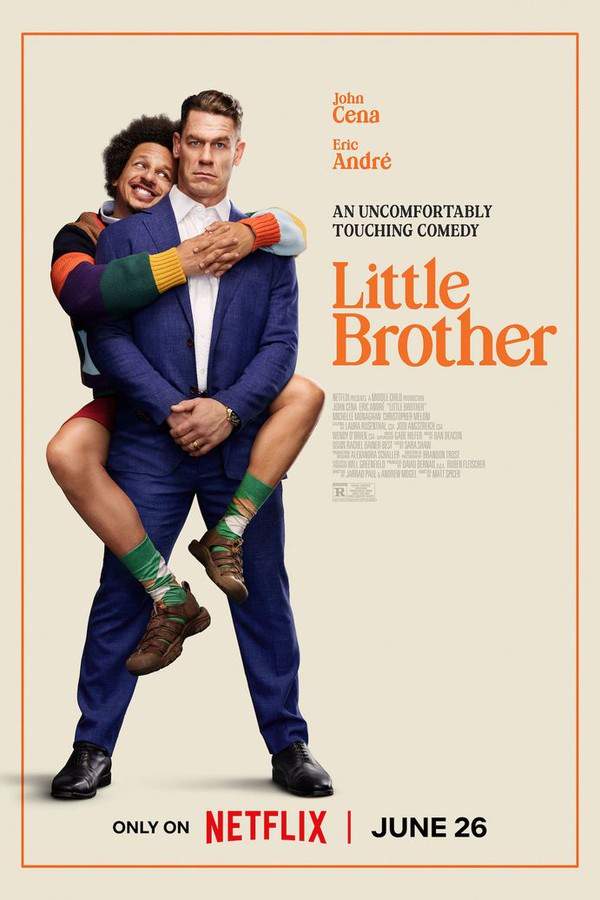
Rudd (John Cena) enjoys a picture‑perfect life—stable job, loving family, and a booming real‑estate career—until his younger brother Marcus (Eric Andre) bursts back into his world. Marcus, a wild‑card agent of chaos, turns Rudd’s ordered existence upside down, testing every relationship and forcing Rudd to confront the limits of his control.
Find where to stream, rent, or buy Little Brother (2026) in the US with current JustWatch availability, up-to-date pricing, and platform listings for subscription, rental, and digital purchase options.
Warning: spoilers below!
Haven’t seen Little Brother yet? This summary contains major spoilers. Bookmark the page, watch the movie, and come back for the full breakdown. If you're ready, scroll on and relive the story!
Trace every key event in Little Brother (2026) with our detailed, chronological timeline. Perfect for unpacking nonlinear stories, spotting hidden connections, and understanding how each scene builds toward the film’s climax. Whether you're revisiting or decoding for the first time, this timeline gives you the full picture.
Last updated: August 02, 2026 at 13:01
Find frequently asked questions about the Little Brother (2026) timeline, including chronological order, nonlinear jumps, cause-and-effect links, and scene sequence clarifications. This timeline FAQ helps explain when key events happen, how moments connect, and why the story unfolds in that specific order.
Rudd humiliates Marcus at Josh's party in Little Brother because his jealousy and paranoia overwhelm him when he sees Marcus bonding with the brother he spends his life trying to impress. Already intoxicated and insecure, Rudd panics that Marcus is about to steal the spotlight he desperately craves from Josh. Instead of letting Marcus receive gratitude for saving Josh's life with an emergency tracheotomy, Rudd grabs the microphone and turns a heroic moment into a public destruction of Marcus's dignity.
Earlier attempts by Rudd to push Marcus out through bribery and manipulation hint at the jealousy that eventually explodes at the party.
Rudd confesses everything on live television at the Big Brother of the Year ceremony because he finally reads the emails Marcus sent over the years and understands how deeply he failed someone who genuinely needed him. Producers had planned to digitally paste Marcus's face onto a body double for ratings, giving Rudd a perfect excuse to stay silent. In Little Brother, this public confession becomes the moment Rudd abandons his lifelong chase for Josh's approval and chooses honesty over image.
The opening scenes of Rudd's relentless self-help routine hint at someone desperate to perform who is one breaking point away from real self-reflection.
Mia, Rudd's assistant, wrote the emails pretending to be Rudd because she couldn't bring herself to tell Marcus that Rudd had never replied to him in all those years. Marcus, who grew up in sixteen foster homes and lost his own brother, clung to the idea that his childhood mentor still cared about him. Mia's deception in Little Brother is rooted in pity, but it ultimately sets up one of the cruelest public revelations of the film.
Marcus checks back into the psychiatric hospital at the end of Little Brother not because he's mentally unstable, but because the institution is the only place that has ever felt safe to him. After Rudd publicly exposes his psychiatric history and the email lie, Marcus has nowhere else to turn. Having cycled through sixteen foster homes, the hospital represents a rare constant in his life, making it a refuge rather than a sentence.
Rudd's obsession with Josh's approval in Little Brother comes from a lifetime of being outclassed by an older brother who is a billionaire and effortlessly dominant at every family gathering. Josh won't even let Rudd sell his mansion, constantly reinforcing the power gap between them. This dynamic drives most of Rudd's insecurities, fuels his need to perform on reality TV, and ultimately pushes him to destroy Marcus when Josh seems to prefer him.
The opening scenes establish Josh's wealth and effortless dominance as the standard Rudd measures himself against.
Rudd's change of heart in Little Brother begins when his family turns against him, his wife and sons are repulsed by his behavior at the party, leaving him alone with the consequences of his cruelty. In that silence, he finally reads the years of emails Marcus had sent him and understands what the mentorship meant to a child who had nobody. This combination of personal loss and belated empathy pushes him toward the public confession at the Big Brother of the Year ceremony.
When Josh tumbles from the balcony at the party, Marcus performs an emergency tracheotomy on the spot to restore his airway and keep him alive. The act happens in seconds and shows Marcus acting with surprising clarity under pressure despite his chaotic reputation. In Little Brother, this heroic moment should have earned Marcus real gratitude, but Rudd seizes the stage instead to humiliate him.
Marcus believed he and Rudd were exchanging heartfelt emails for years because Mia, Rudd's assistant, had been writing back to him the entire time. In Little Brother, those messages became proof for Marcus that his childhood mentorship with Rudd still mattered, while Rudd had long forgotten about him and never once replied. The deception only surfaces when Rudd publicly reveals it during his humiliation of Marcus at Josh's party.
Marcus doesn't forgive Rudd immediately at the psychiatric hospital because the wound from the public humiliation is still raw, and trust cannot be rebuilt with a single apology. He accepts Rudd's gesture and allows a hug, signaling willingness to begin again, but he refuses to give the easy absolution Rudd wants. This restraint is what makes the reconciliation in Little Brother feel earned rather than rushed.
The Broker Brothers partnership symbolizes Rudd and Marcus finally building a genuine, equal brotherhood rather than the one-sided validation Rudd chased from Josh. It marks the shift from Rudd performing success for someone who didn't care to actually showing up for someone who did. The real estate venture in Little Brother becomes a concrete expression of the emotional repair at the heart of the film's ending.
Marcus becomes the breakout star on NYC Hustlers by accident when he visits the set and displays the same unfiltered, chaotic energy that defines his personality. His willingness to be himself, whether peeing in public or speaking without a filter, stands out against the polished reality TV personas around him. In Little Brother, this unexpected appeal directly threatens Rudd's bid for fame and intensifies the jealousy that erupts at Josh's party.
Rudd originally signed up for the Big Brothers–style mentorship only because it would strengthen his college applications. He never intended to form a real bond with Marcus and forgot about him entirely once the program ended. The deep irony in Little Brother is that the relationship Marcus treasured for decades was built on a moment of self-interest Rudd couldn't even remember.
The opening scenes show Rudd treating image and status as transactional, foreshadowing his self-interested reasons for mentoring Marcus.
Deirdre insists Marcus stay with their family after the hospital stay because she recognizes his vulnerability and feels compassion for someone with no support system. Her decision sets the entire plot of Little Brother in motion, giving Marcus access to Rudd's world and allowing their complicated dynamic to play out. It also highlights the contrast between Deirdre's natural warmth and Rudd's calculated self-interest.
Discover curated groups of movies connected by mood, themes, and story style. Browse collections built around emotion, atmosphere, and narrative focus to easily find films that match what you feel like watching right now.
One reckless disruptor, one controlled life, and a brotherhood that forces both to grow.Movies like Little Brother where a chaotic, irreverent figure disrupts a picture-perfect life and forces both parties toward honest growth. Expect sibling rivalry, messy brotherhood arcs, abandonment backstories, and bittersweet comedy-dramas about redemption, mentorship, and earning forgiveness through lived experience rather than easy apologies.
An organized protagonist with a curated life meets a wildcard family member whose chaos strips away pretense. Early scenes lean on humor and humiliation as the disruptor exposes the protagonist's self-obsession, control issues, and hidden envy. A mid-story betrayal or public fall forces a reckoning, after which the brothers test whether real partnership can replace rivalry. The arc ends not in instant absolution but in earned, tentative reconciliation that points toward a healthier shared future.
These films share a core character pairing: a responsible, image-conscious lead and a reckless, free-spirited counterpart whose arrival destabilizes everything. They blend messy family comedy with real emotional beats about abandonment, validation, and brotherhood, balancing gross-out humor with quieter reflective moments before resolving toward warmth and tentative forgiveness.
Absurd comedy on the surface, real heartbreak underneath, and a warm landing.If you liked Little Brother, explore irreverent comedies that balance absurd, gross-out, or chaotic humor with grounded emotional beats about family, abandonment, and redemption. These bittersweet comedy-dramas use raunchy laughs as a Trojan horse for genuine heart, alternating wild set pieces with quieter reflections and resolving toward warmth.
These stories open with sharp, chaotic humor that signals a comedy, then introduce emotional stakes through family trauma, betrayal, or a humiliating public moment. Reflective beats sit alongside gross-out set pieces, letting real grief, jealousy, or loneliness surface between laughs. The climax forces honesty rather than letting jokes deflect, and the ending rewards the emotional work with forgiveness, partnership, or tentative hope rather than a tidy reset.
They share a tonal recipe: high humor score, medium emotional weight, variable pacing that swings between chaos and quiet, and a happy but earned ending. Tone reads as bittersweet because real sadness is present, but the throughline trends toward warmth. The result is a viewing experience that feels funny, messy, uncomfortable, and ultimately comforting in roughly equal measure.
Don't stop at just watching - explore Little Brother in full detail. From the complete plot summary and scene-by-scene timeline to character breakdowns, thematic analysis, and a deep dive into the ending - every page helps you truly understand what Little Brother is all about. Plus, discover what's next after the movie.
Read a complete plot summary of Little Brother, including all key story points, character arcs, and turning points. This in-depth recap is ideal for understanding the narrative structure or reviewing what happened in the movie.
Discover the characters, locations, and core themes that shape Little Brother. Get insights into symbolic elements, setting significance, and deeper narrative meaning - ideal for thematic analysis and movie breakdowns.