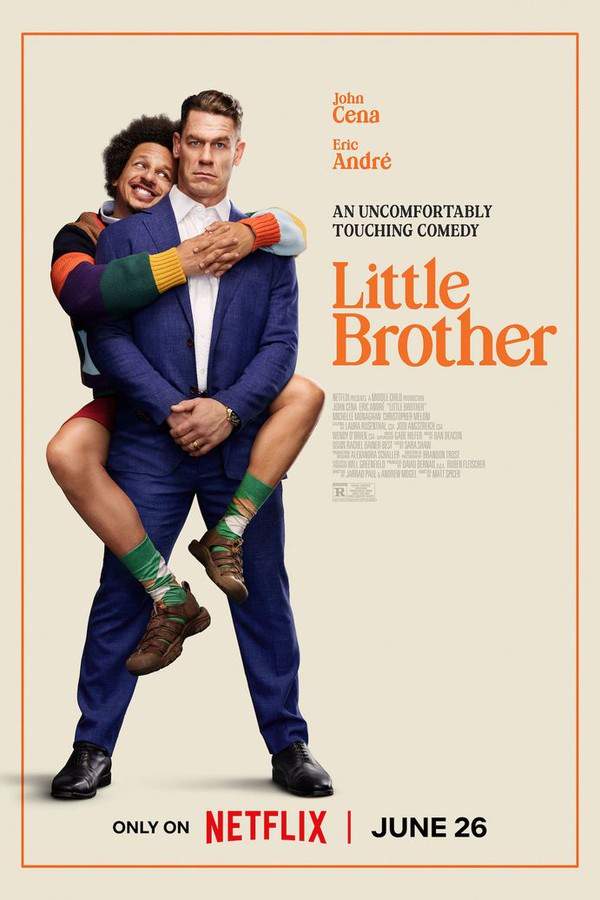
Rudd (John Cena) enjoys a picture‑perfect life—stable job, loving family, and a booming real‑estate career—until his younger brother Marcus (Eric Andre) bursts back into his world. Marcus, a wild‑card agent of chaos, turns Rudd’s ordered existence upside down, testing every relationship and forcing Rudd to confront the limits of his control.
Find where to stream, rent, or buy Little Brother (2026) in the US with current JustWatch availability, up-to-date pricing, and platform listings for subscription, rental, and digital purchase options.
Warning: spoilers below!
Haven’t seen Little Brother yet? This summary contains major spoilers. Bookmark the page, watch the movie, and come back for the full breakdown. If you're ready, scroll on and relive the story!
Explore the full timeline and setting of Little Brother (2026). Follow every major event in chronological order and see how the environment shapes the story, characters, and dramatic tension.
Last updated: August 02, 2026 at 13:00
Meet the key characters of Little Brother (2026), with detailed profiles, motivations, and roles in the plot. Understand their emotional journeys and what they reveal about the film’s deeper themes.
Last updated: August 02, 2026 at 13:00
Explore the central themes of Little Brother (2026), from psychological, social, and emotional dimensions to philosophical messages. Understand what the film is really saying beneath the surface.
Last updated: August 02, 2026 at 13:00
Browse frequently asked questions about Little Brother (2026) focused on characters, relationships, themes, symbols, setting, and story context. This movie info FAQ gives spoiler-aware explanations for character arcs, world details, and thematic interpretation so readers can better understand what the film is really about.
Set in New York City, Little Brother moves between a gleaming real estate empire and a high-society lifestyle. Key locations include Josh's mansion, a hospital where Marcus recovers, and the glamorous NYC Hustlers reality TV set. The city functions as a pressure cooker where status, appearances, and wealth shape every character's choices.
Little Brother inhabits a world of high-society luxury, reality-TV culture, and social-media-driven celebrity wealth. This environment magnifies personal insecurities and turns private struggles into public entertainment, shaping how characters seek approval, status, and connection. The setting frames every relationship through the lens of image and competition.
Little Brother is set in the present day, grounded in a contemporary New York environment. The story reflects modern technology, live televised events, and reality-TV culture that influence the characters' decisions and self-image. The timeline is anchored to the social-media age rather than any historical or futuristic period.
Little Brother explores how the search for approval can hollow out authentic relationships. Rudd's drive to win his brother's recognition exposes a fragile self-image built on external success, and the film critiques a culture that rewards appearances and status over genuine connection. The story ultimately invites forgiveness by exposing that vulnerable core.
Little Brother portrays mentorship as a bond that can be manufactured but also as one that transcends its origins. While Rudd's early "mentoring" of Marcus was largely a means to boost his own status, the relationship becomes genuine as Marcus continues to see Rudd as a real mentor-figure and family. The film ultimately asks what it means to truly earn someone's trust.
Little Brother argues that true family is defined by acts of care rather than bloodlines. The story traces a journey from rivalry and obsession with status toward prioritizing loved ones, ultimately framing kinship as something chosen and earned through care. The conclusion points to renewed partnerships and brotherhood that reflect this redefinition.
Little Brother exposes how reality-TV narratives are manufactured for ratings, with producers willing to paste a face onto a body double and sensationalize personal tragedy. The film critiques the moral cost of turning private struggles into entertainment, showing how editing and production shape perception at the expense of genuine relationships and dignity.
Rudd Landy is a real estate broker with a gym-sculpted physique and a booming career, driven by a desperate need for his older brother Josh's approval. His vanity and competitive streak push him to manipulate others and push his family away, revealing a fragile sense of self-worth built on external success. He is the central figure whose arc drives the film's exploration of validation.
Marcus Pinchel is a man who survived sixteen foster homes and clings to a hopeful belief in family and belonging. He sees his bond with Rudd as mentorship and kinship, cherishing the connection deeply even as that bond is tested and redefined. His resilience and longing for stability anchor the film's emotional throughline.
Josh is Rudd's older brother and billionaire rival who seems to outclass him at every turn. Though aloof and competitive, he forms a genuine connection with Marcus over the course of the story. His presence highlights the gap between real affection and competitive success, making him a mirror for Rudd's insecurities.
Deirdre is Rudd's wife and a grounding presence in his chaotic life. She bonds with Marcus during his recovery, confronts the imbalance in Rudd's obsession with status, and champions the needs of her family. Her empathy and willingness to repair relationships position her as the film's emotional anchor for what healthy family looks like.
Mia is Rudd's assistant whose hidden involvement in the correspondence between Marcus and Rudd reshapes the meaning of their bond. Her role becomes central to the film's exploration of mentorship and trust, complicating questions about who truly built the relationship. Her place in the story later extends into a personal connection with Marcus.
Discover curated groups of movies connected by mood, themes, and story style. Browse collections built around emotion, atmosphere, and narrative focus to easily find films that match what you feel like watching right now.
One reckless disruptor, one controlled life, and a brotherhood that forces both to grow.Movies like Little Brother where a chaotic, irreverent figure disrupts a picture-perfect life and forces both parties toward honest growth. Expect sibling rivalry, messy brotherhood arcs, abandonment backstories, and bittersweet comedy-dramas about redemption, mentorship, and earning forgiveness through lived experience rather than easy apologies.
An organized protagonist with a curated life meets a wildcard family member whose chaos strips away pretense. Early scenes lean on humor and humiliation as the disruptor exposes the protagonist's self-obsession, control issues, and hidden envy. A mid-story betrayal or public fall forces a reckoning, after which the brothers test whether real partnership can replace rivalry. The arc ends not in instant absolution but in earned, tentative reconciliation that points toward a healthier shared future.
These films share a core character pairing: a responsible, image-conscious lead and a reckless, free-spirited counterpart whose arrival destabilizes everything. They blend messy family comedy with real emotional beats about abandonment, validation, and brotherhood, balancing gross-out humor with quieter reflective moments before resolving toward warmth and tentative forgiveness.
Absurd comedy on the surface, real heartbreak underneath, and a warm landing.If you liked Little Brother, explore irreverent comedies that balance absurd, gross-out, or chaotic humor with grounded emotional beats about family, abandonment, and redemption. These bittersweet comedy-dramas use raunchy laughs as a Trojan horse for genuine heart, alternating wild set pieces with quieter reflections and resolving toward warmth.
These stories open with sharp, chaotic humor that signals a comedy, then introduce emotional stakes through family trauma, betrayal, or a humiliating public moment. Reflective beats sit alongside gross-out set pieces, letting real grief, jealousy, or loneliness surface between laughs. The climax forces honesty rather than letting jokes deflect, and the ending rewards the emotional work with forgiveness, partnership, or tentative hope rather than a tidy reset.
They share a tonal recipe: high humor score, medium emotional weight, variable pacing that swings between chaos and quiet, and a happy but earned ending. Tone reads as bittersweet because real sadness is present, but the throughline trends toward warmth. The result is a viewing experience that feels funny, messy, uncomfortable, and ultimately comforting in roughly equal measure.
Don't stop at just watching - explore Little Brother in full detail. From the complete plot summary and scene-by-scene timeline to character breakdowns, thematic analysis, and a deep dive into the ending - every page helps you truly understand what Little Brother is all about. Plus, discover what's next after the movie.
Read a complete plot summary of Little Brother, including all key story points, character arcs, and turning points. This in-depth recap is ideal for understanding the narrative structure or reviewing what happened in the movie.
Track the full timeline of Little Brother with every major event arranged chronologically. Perfect for decoding non-linear storytelling, flashbacks, or parallel narratives with a clear scene-by-scene breakdown.