Plot Explained Spoilers guaranteed!
Plot Explained

Browse by genre

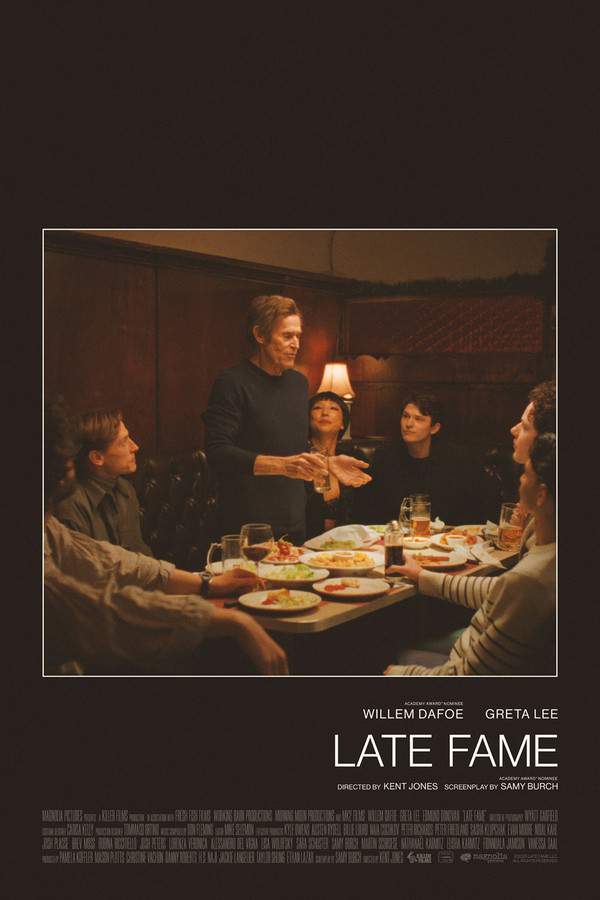
Late Fame (2026) movie poster

Timeline

Late Fame (2026) Timeline Explained – Every Event in Order

Release, runtime and language
2026 · 1 h 36 m · English
Loading streaming availability…
Directed by
Kent Jones
Starring
Willem Dafoe, Greta Lee, William Hill, Welker White, Jake Lacy, Clark Johnson

When the long‑overlooked poems of legendary New York poet Ed Saxberger are discovered by an eccentric circle of young artists, their fascination revives his dormant creative spark. As they delve deeper, the enigmatic actress Gloria weaves her beguiling presence through their world, adding intrigue.

On this page (5)
  1. 1 Where to watch
  2. 2 Events in order (15)
  3. 3 Timeline questions answered
  4. 4 Movie threads
  5. 5 Every angle
Loading streaming availability…

15 events in order · contains spoilers

Late Fame Timeline: Events in Chronological Order

Every key event of Late Fame (2026) in order, scene by scene, with when and where it takes place. Use it to untangle flashbacks, time jumps and parallel storylines, to refresh your memory before the sequel or to find the exact scene you are thinking of.

  1. Ed's Obscure Life

    Ed Saxberger lives a quiet and uneventful life as a post office worker in downtown Manhattan. Having moved from Pennsylvania fifty years ago, he spends his time working and playing pool with his friends, avoiding deep family connections, particularly with his sister.

    Where
    Downtown Manhattan
  2. Voicemail from Sister

    Ed receives multiple voicemails from his sister, who is pleading with him to visit their ailing brother. Instead of responding, Ed listens to her messages, which chronicle their brother's medical decline and his sister's concerns for the family.

  3. Meeting Meyers

    Ed is approached by Meyers, a wealthy NYU graduate who admires his poetry collection 'Way Past Go'. This unexpected encounter leads Ed to a world of young affluent writers eager to meet him, instigating a change in his mundane routine.

  4. Welcome to the Enthusiasm Society

    Upon meeting the Enthusiasm Society, Ed feels flattered by the admiration of the group's members, especially actress Gloria. He agrees to write an original poem to be performed by Gloria at the upcoming reading, revitalizing his long-dormant creative spirit.

  5. Writer's Block

    Despite the initial excitement, Ed confronts a debilitating writer's block as the reading approaches. This struggle is worsened by his continued neglect of family obligations, specifically avoiding his sister's calls about their brother's health.

  6. Gift to Arnold

    Ed gifts his friend Arnold a copy of 'Way Past Go' for his birthday, reflecting his past as a Bohemian poet. However, when Arnold and their friends mock him for his past, Ed retaliates with insults and leaves the gathering in anger.

  7. A Mushrooms Adventure

    Ed spends time with Gloria, leading them to take mushrooms together as they wander through SoHo. Their shared experience culminates in a kiss at a park, showcasing the chemistry between them amidst the backdrop of New York's vibrant arts scene.

    Where
    SoHo
  8. The Panic Before the Reading

    The day before the reading, Ed confesses to the Enthusiasm Society that he hasn't written anything for his performance. Angry and anxious, the group decides to fallback on a previous poem, further feeding Ed's insecurities.

  9. Gloria's Tense Argument

    Ed visits Gloria but finds her in a difficult situation with another man at her apartment. Despite her protests, Ed insists on checking on her well-being, raising tension between him and the other parties present.

    Where
    Gloria's Apartment
  10. The Reading Night

    At the scheduled reading, Ed is in a state of panic as Gloria is conspicuously absent. When she finally arrives dramatically and in character, she steals the spotlight, leaving Ed to read his own poem under pressure.

  11. Ed's Poetic Breakthrough

    Ed reads a heartfelt poem reflecting his recent experiences and unrequited love, earning him enthusiastic applause from the crowd. This marks a triumphant moment in his journey to reconnect with his past as a poet.

  12. Gloria's Departure

    After the reading, Gloria informs Ed of her acceptance for a role in a theatre production in Minneapolis, signifying a bittersweet moment for Ed as he reflects on their time together. This news further underlines Ed's emotional unraveling post-performance.

  13. Family Tragedy

    Ed receives a voicemail from his sister revealing that their brother has passed away. This tragic news hits Ed hard, forcing him to confront his family ties and the reality of his brother's decline that he failed to witness.

  14. Dissolution of the Enthusiasm Society

    The Enthusiasm Society erupts in conflicts after reviewing the negative feedback on their readings, blaming each other for their failures. The disputes culminate in the group's disbandment, leaving Ed feeling disconnected from the once-thriving network.

  15. Advice to Winn

    Winn, a young member of the Society, approaches Ed for guidance on his writing, admitting that he and others have never read Ed's works. Ed advises him against defining his self-worth through others' opinions, signifying a moment of introspection and realization for Ed.

Last updated: September 18, 2026 at 08:59

Was this helpful?

Timeline questions answered

Late Fame Timeline Explained: Your Questions Answered

When does it happen, and why in that order? The questions people ask about the chronology of Late Fame (2026): time jumps, flashbacks, cause and effect between scenes and the correct order of events, each answered with spoilers.

Q1

What does Ed's poem at the reading actually mean?

In Late Fame, Ed's poem reflects on his decades in New York City and the unreciprocated feelings he has carried through the weeks leading up to the reading. It channels his private grief over his brother's decline and the ambiguous bond he formed with Gloria into a public artistic statement. The reading marks his return to poetry not as a rediscovered genius, but as an ordinary man processing loss and longing on his own terms, which is why the audience responds so warmly to its honesty.

  • ed saxberger
  • poem
  • reading
  • new york city
  • grief
  • gloria
Q2

Why do the Enthusiasm Society members admit they never read Ed's poetry?

Winn's confession near the end of Late Fame reveals that the Enthusiasm Society's admiration was built on reputation and mystique rather than genuine engagement with Way Past Go. They were seduced by the idea of a rediscovered underground poet, not by the poetry itself, which Meyers had curated and promoted. This admission becomes the central disillusionment for Ed, exposing that his revival was always more performance than substance.

Foreshadowing: The group's initial over-the-top reverence, focused more on Ed's persona than his actual words, hints that their appreciation may be superficial.

  • enthusiasm society
  • way past go
  • meyers
  • ed saxberger
  • winn
  • poetry
Q3

What motivates Gloria's interest in Ed Saxberger?

Gloria is drawn to Ed's mystique as a forgotten poet whose work has suddenly resurfaced in elite literary circles, giving her a compelling artistic persona to inhabit. Her attraction is deeply intertwined with performance and self-curation, with the flirtation functioning partly as a role she plays for the society's benefit. Whether her feelings are ever genuine remains deliberately ambiguous in Late Fame, which is part of what unsettles Ed.

Foreshadowing: Gloria's flirtation carries a performative quality from her earliest appearance, hinting that her interest in Ed is entangled with the roles she inhabits.

  • gloria
  • ed saxberger
  • enthusiasm society
  • performance
  • attraction
Q4

What advice does Ed give Winn at the end of Late Fame?

Ed counsels Winn not to tie his self-worth to external validation, drawing directly from his own experience of being celebrated by people who had never actually read his work. He tells Winn to focus on the writing itself rather than how others receive it. The moment marks Ed's hard-earned clarity about the difference between authentic artistic connection and the manufactured fame that Meyers engineered.

Foreshadowing: Ed's earlier irritation at Meyers' manufactured enthusiasm foreshadows the disillusionment he articulates to Winn.

  • ed saxberger
  • winn
  • advice
  • self-worth
  • validation
  • writing
Q5

Why does Ed Saxberger ignore his sister's calls about their dying brother?

Ed avoids his sister's calls because he deliberately distanced himself from his Pennsylvania family when he moved to Manhattan fifty years earlier to pursue the bohemian art scene. Listening to her voicemails without responding lets him stay informed about his brother's medical decline without having to confront the emotional weight of returning home. His avoidance reflects both decades of family estrangement and an unwillingness to face the mortality that his rediscovery has forced him to reckon with in other ways.

  • ed saxberger
  • sister
  • brother
  • family estrangement
  • voicemail
  • pennsylvania
Q6

Why can't Ed write the poem he promised for the reading?

Ed's writer's block reflects his deeper inability to reconcile his dormant artistic identity with the artificial enthusiasm of the Enthusiasm Society in Late Fame. The pressure to perform for admirers who worship a curated version of him paradoxically silences his authentic voice. Compounding this is his unresolved family grief and complicated feelings for Gloria, which consume the emotional energy he would need to write.

Foreshadowing: Ed's decades of creative silence after publishing Way Past Go hint at the paralysis that resurfaces once he is asked to produce new work.

  • ed saxberger
  • writer's block
  • poem
  • reading
  • enthusiasm society
Q7

What did Meyers do with the reviews of the reading?

Meyers manipulated the reviews to manufacture an image of success for the Enthusiasm Society, selectively amplifying praise directed at Ed and Gloria while suppressing the largely unfavorable feedback. The deception is exposed after the reading when the group compares Meyers' curated summaries to the actual publications. This revelation exposes the hollowness of the cultural credibility Meyers had been projecting, fueling the society's collapse.

Foreshadowing: Meyers' eagerness early on to present an image of success, even before any performance had taken place, hints at his willingness to fabricate results.

  • meyers
  • reviews
  • enthusiasm society
  • manipulation
  • reading
Q8

Why does Ed storm out of the bar when his friends mock his poetry past?

Ed's anger at Arnold and the others stems from the unresolved tension between his working-class present in Late Fame and the bohemian artistic identity he buried decades ago. When his friends laugh at his past as a poet, they trivialize the part of himself he has kept hidden behind the pool-hall routine. The outburst exposes vulnerabilities he normally keeps sealed and pushes him further into the arms of the Enthusiasm Society, where his past is suddenly celebrated rather than mocked.

  • ed saxberger
  • arnold
  • bar
  • poetry
  • working class
  • embarrassment
Q9

Why does Gloria become incapacitated at the reading?

Gloria arrives at the reading in a drug-influenced state consistent with the substance use she displayed earlier during the mushrooms night with Ed. Her resulting incapacitation during his reading forces Ed to take the stage himself rather than listening to her perform his work. This collapse in Late Fame transforms what was meant to be Gloria's showcase into Ed's moment of artistic reclamation, and it exposes the fragility behind her glamorous persona.

Foreshadowing: The mushrooms outing with Ed foreshadows Gloria's drug-influenced state at the reading.

  • gloria
  • reading
  • drugs
  • performance
  • ed saxberger
Q10

Why does Ed agree to meet the Enthusiasm Society in the first place?

Ed is drawn to the society because their admiration offers him a chance to reclaim a part of himself he had abandoned decades earlier when he settled into life as a post office employee in Late Fame. After years of unrecognized work and a quiet routine at the bar, the flattery and attention reawaken the creative identity he had suppressed. Meyers' enthusiasm validates a self Ed had quietly mourned, which is why he agrees despite his instinct that the attention may be suspect.

  • ed saxberger
  • enthusiasm society
  • meyers
  • poetry
  • fame
Q11

Why does Gloria pretend to be Ed's girlfriend during Arnold's visit?

Gloria inserts herself into Ed's working-class world by pretending to be his girlfriend when Arnold comes to apologize, blurring the line between performance and genuine intimacy. The act allows her to inhabit a domestic role while also protecting Ed's dignity in front of his old friends who had just mocked his past. It leaves the authenticity of their relationship unclear in Late Fame, which is a tension that runs through their entire connection.

  • gloria
  • ed saxberger
  • arnold
  • performance
  • relationship
Q12

What does Ed returning to the bar at the end of Late Fame mean?

Ed's return to the pool hall symbolizes his acceptance of his ordinary working-class life after the fleeting excitement of artistic revival. Stripped of illusions about Gloria, the society, and the promise of rediscovery, Ed chooses the familiar game of pool over the performative world of readings and reviews. The ending is bittersweet in Late Fame because he has gained genuine artistic self-knowledge but lost the temporary community that briefly made him feel seen.

  • ed saxberger
  • bar
  • pool
  • ending
  • working class
Q13

Why does Gloria leave for Minneapolis after the reading?

Gloria departs to take a role in a production of The Winter's Tale in Minneapolis, making clear that her involvement in Ed's life was always contingent and temporary. Her exit crystallizes Ed's realization that the connection they shared was as performative and fleeting as the society itself in Late Fame. She leaves him with the knowledge that her affection and her presence were part of the same artistic role she had been playing.

Foreshadowing: Gloria's references to her acting career and commitments early in the story hint that her time in Ed's world would be temporary.

  • gloria
  • minneapolis
  • departure
  • winter's tale
  • ed saxberger
Q14

What is the argument Ed witnesses at Gloria's apartment?

Ed finds Gloria distressed and in a heated disagreement with another man, hinting at coercion or unresolved conflict in her personal life. The scene in Late Fame deliberately obscures the specifics, but it underscores Gloria's vulnerability and complicates the glamorous persona she projects onto the Enthusiasm Society. The encounter is the clearest signal that her life outside the society is darker and more pressured than she allows anyone to see.

  • gloria
  • argument
  • apartment
  • ed saxberger
  • coercion

Movie threads

More Movies Like Late Fame, by Mood & Story

Curated lists built around what makes Late Fame tick: the same mood, the same kind of story or the same emotional payoff. Each list explains why these movies belong together.

Late-life artistic rediscovery like in Late Fame

Forgotten creators rediscovered at the edge of mortality, wrestling with what their work still means. If you liked Late Fame, these slow, bittersweet dramas follow aging writers, poets, and artists rediscovered in their twilight years. Movies like Late Fame explore mortality, artistic authenticity, and the fragile comfort of belated recognition, all delivered with contemplative, understated pacing and medium emotional weight.

  • bittersweet
  • contemplative
  • aging
  • artistic
  • mortality
  • rediscovery
  • Tone: bittersweet, contemplative
  • Pacing: slow, reflective
Why these movies?

The story pattern: An overlooked or retired creative figure is pulled back into their artistic world by admirers, family obligations, or personal crisis. Initial attention feels flattering or restorative, but the narrative slowly exposes tensions between past ambition and present reality, between the person they were and the person they have become. By the end, the protagonist has not been rescued by recognition but has gained a clearer, sadder view of their own art and life, often marked by the loss of a sibling, a lover, or an illusion.

Why they belong together: These films share a slow, reflective pacing, bittersweet endings, and a meditative interest in aging, creative identity, and what art costs over a lifetime. They tend to favor character over plot, with low-to-medium intensity that builds through quiet scenes of reading, performing, conversing, and remembering. Mortality, family estrangement, and the gap between public reputation and private truth recur across them.


Bohemian urban melancholy like in Late Fame

Atmospheric city stories where intellectuals, artists, and dreamers collide with their own pretensions. If you liked Late Fame's Manhattan drift, you'll love these slow, contemplative dramas set in artistic urban enclaves. Movies like Late Fame capture coffee shops, literary circles, and bohemian pretensions, weaving grief, romance, and self-reflection through atmospheric city streets with understated, bittersweet humor.

  • bohemian
  • urban
  • wistful
  • intellectual
  • contemplative
  • understated
  • Tone: melancholic, wistful, wry
  • Pacing: slow burn, drifting
Why these movies?

The story pattern: An outsider or returning figure moves through a tight-knit creative community and gradually sees through its charms and illusions. The narrative is episodic and observational, drifting between cafes, studios, parties, and apartments. Romance and friendship entangle with gossip, hierarchy, and self-performance, and the protagonist's deepening honesty often costs them their place in the circle. The ending rarely resolves cleanly, instead settling for a quieter, lonelier clarity about who they really are.

Why they belong together: These films are united by their urban artistic settings, slow-burn pacing, and a tone that blends melancholy with dry, understated wit. They traffic in intellectual and creative pretension as both subject and mild satire, and they use atmosphere, dialogue, and character interiority rather than plot momentum. Themes of self-worth, authenticity, romance, and the gap between reputation and reality recur across the group.

Every angle

Late Fame (2026) Explained: Plot, Ending, Timeline & Characters

Everything about Late Fame in one place: what happens in the plot summary, the timeline in chronological order, the characters and meaning, the ending explained and a spoiler-free summary. What's After the Movie adds the cast, box office and post-credit scenes.

Coming soon on iOS and Android

The Plot Explained Movie Summary App

Plot summaries, endings explained and timelines on your phone. Catch up on any movie in minutes, save your favorites and never miss a twist again.

Be the first to know when we launch. Your email stays private, always.

Learn more about the app