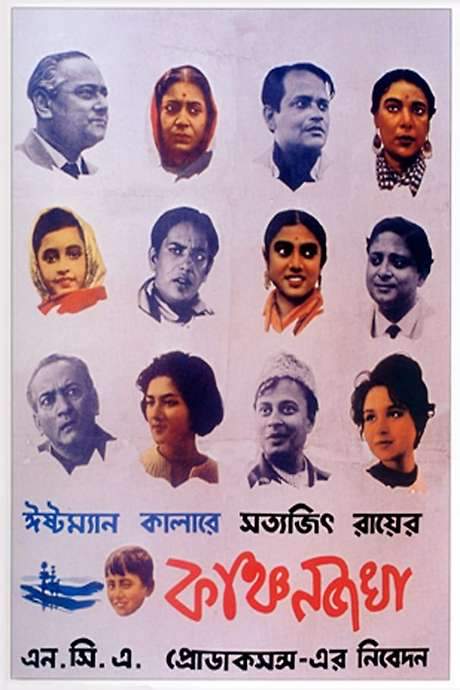
Set against the early poetic impulses of writer Sunil Gangopadhyay, the film follows a tight-knit circle of four educated friends who bond across their differences and seek a respite from the city’s grind by venturing into the tribal lands of Palamau in Bihar.
The quartet is led by Asim, a man who owns the car they drive, enjoys the company of women, and wields a confident air about how he is seen by others. Alongside him are Sanjoy, a labour executive who would rather immerse himself in literature; Hari, a blunt and straightforward cricketer trying to forget a heartbreak; and Shekhar, the witty but unemployed jester whose roving eye sits behind a surprisingly steady loyalty to his friends. Although they come from different social layers, their shared urge to escape the routine of city life binds them into a fearless, if restless, fellowship.
They set their sights on the tribal expanse of Palamau, a region they have heard about in legends for its open, simple, and beautiful women. In a bid to feel truly free, they bribe the local chowkidar and take up residence in a forest rest house, a choice that marks their deliberate distancing from civilization. The stay becomes a small rebellion against their ordinary lives, even as they debate trivial, almost ceremonial questions—like whether to shave or not. The mood shifts when Hari draws nearer to a Santhal girl, a moment sparked when she approaches the men for an extra drink and a conversation.
The dynamics shift further when Aparna and her sister-in-law Jaya appear in the forest, offering a counterpoint to the group’s urban fluency. The two women, representing a different world, bring a fresh energy and a sense of measured poise. The four friends, now confronted with a pair of urbane figures, find themselves recalibrated. Asim’s flirtations with Aparna unfold with a mixture of charm and hesitation, as he attempts to coax her to show him her space, only to discover that her composure, presence of mind, and intelligence outpace his expectations. The suspense of this encounter is underscored by Aparna’s own reserve, which quietly challenges the group’s assumptions about status and desire.
Later that night, the friends drift back to the forest rest house and drink in the country liquor hall, and Hari’s longing for Duli grows stronger as he cannot easily reconnect with the girl he met the night before. On the road back, a comic moment turns vivid as they stumble upon a car they shout at, only to realize it belongs to Aparna and Jaya. This misstep foreshadows the day’s impending social unease, and the friends oversleep, missing breakfast at Jaya’s home. A forest conservator visits the bungalow, and the group’s presence there without permission becomes a point of tension. Aparna, who knows the conservator, navigates the situation with grace and a poised assurance that underscores the gap between the two worlds.
Aparna’s tact becomes a pivot for the group’s social game. They sit down to chat and play, while Aparna’s father is away with Jaya’s son, turning the afternoon into a delicate negotiation of power, vulnerability, and willingness to bend rules. The game reaches a fever pitch with Asim at the center, and Aparna deliberately yields the victory to him, a move that exposes the fragility behind his confidence and the force of Aparna’s own restraint.
The village fair becomes the crucible for the trip’s tensions. Shekhar gambles with money borrowed from Asim, and Hari escorts Duli into the forest, where a sexual encounter with her unfolds. The moment tests Asim’s vanity as Aparna reveals a more vulnerable, human side beneath her composed exterior, drawing attention to the group’s blind spots—such as their casual neglect of the chowkidar’s wife after three days in the bungalow. Meanwhile, Shekhar remains the loyal, supportive friend, especially when Hari is injured and robbed, a reminder that camaraderie sometimes shows its strength in quiet, practical acts rather than bravado.
Sanjoy, weighed down by bourgeois morals, finds himself unable to respond to Jaya’s bold advances, a tension that peels back another layer of the trio’s social conditioning. By the next morning, the four decide to return to Calcutta, their new mutual acquaintances having had to depart in a hurry. As a parting gesture, Jaya sends a simple can of boiled eggs, a small, thoughtful token that lingers in their memory as they step back into their familiar city life, carrying with them the mixed lessons of freedom, desire, responsibility, and the limits of escape.