Plot Explained Spoilers guaranteed!
Plot Explained

Browse by genre

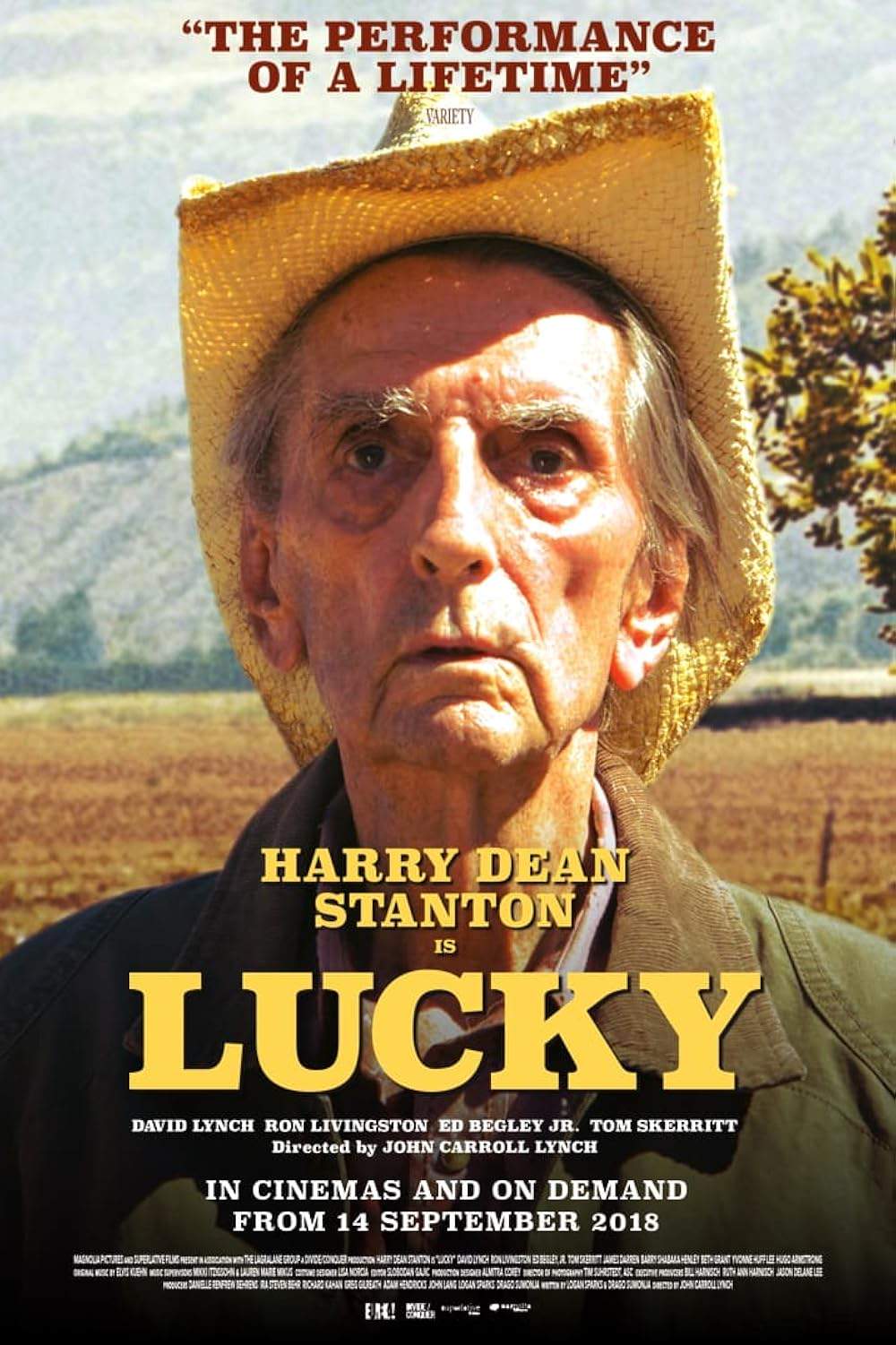
Lucky (2017) movie poster

Plot Summary

Lucky (2017) Plot Summary & Ending Explained

Release, runtime and language
2017 · 88 min · French
Echo score 83
JustWatch #1,218
Starring
Barry Shabaka Henley, Beth Grant

In a remote desert town, a hardened 90-year-old man named Lucky, who doesn's believe in anything, embarks on an unexpected journey of self-discovery. Having lived a long life and outlived his friends, he finds himself confronting the big questions. Through a series of unusual encounters with a diverse cast of characters, Lucky is challenged to examine his beliefs and consider the possibility of something more.

On this page (7)
  1. 1 Where to watch
  2. 2 What happens: full plot
  3. 3 Plot questions answered
  4. 4 How it ends
  5. 5 Movie threads
  6. 6 Movies like Lucky
  7. 7 Every angle

Where to watch

Where to Watch Lucky (2017)

Where can you watch Lucky? Stream, rent or buy it in the US, including on Amazon Prime Video, Hoopla and Kanopy: current JustWatch availability with up-to-date prices.

Streaming availability powered by JustWatch

Full plot summary · contains spoilers

What Happens in Lucky: Full Plot Summary

The whole story of Lucky (2017) explained, from the opening scene to the final frame: every key event, every twist and what it all adds up to. Read it as a quick recap before the sequel, to check a scene you missed, or to finally understand what really happened.

Lucky chronicles the life of a 90-year-old man grappling with the inevitability of aging. The film beautifully portrays his journey towards acceptance of his own mortality, as he seeks deeper meaning in life.

It begins with Lucky waking up in his modest desert home in Piru, California, where he starts his day with a leisurely smoke and some yoga exercises. His refrigerator holds little more than a glass of cold milk, symbolizing his simple lifestyle. After finishing his morning routine, he heads over to his favorite diner for coffee, where he shares a friendly rapport with the owner, Joe, and the staff. Joe, ever the caring friend, urges him to quit smoking for his health. Lucky retorts, confidently asserting that if smoking could kill him, he would have been gone long ago. After engaging in his beloved crossword puzzle, Lucky makes his way to a local market, where he cheekily refers to a boy, Juan, as "Juan Wayne," noting the boy's approaching tenth birthday.

As the sun sets, Lucky finds himself at a bar, enjoying his favorite Bloody Marys among the locals. One regular, named Howard (played by David Lynch), shares his woes over a lost tortoise that has outlived two wives. The next morning, a sudden incident leaves Lucky lightheaded, prompting a visit to Dr. Christian Kneedler (Ed Begley Jr.). The doctor assures him of his good health, referring to him as a "wonder of medical science," a testament to his resilience. A poignant moment occurs as he learns about the death of the doctor’s father, hinting at their long-standing acquaintance.

At the diner, the mood shifts when Lucky expresses his feeling of burdening his friends after his fall by stating, > "What's the fucking point?" Following this, he opens up to a friend over the phone about a childhood regret involving a mockingbird, illustrating the weight of his past memories.

Later, he listens to Paulie (James Darren) recount his marriage story, leading Lucky to reflect on his own life—void of lasting relationships or marriage. A somewhat chaotic moment arises when he witnesses Howard discussing his will with Bobby Lawrence (Ron Livingston), and he interjects, insisting that loneliness is a universal fate.

Days pass, and Loretta (Yvonne Huff), a diner staff member, checks on Lucky, prompting them to reminisce about his military service while indulging in some light-hearted moments, including watching Liberace performances. During a less-than-ordinary day in the diner, Lucky confides in Bobby about his recent fall, sparking a conversation about being prepared for life's unpredictable turns.

In search of companionship, Lucky visits a pet store but opts for a pack of crickets instead of adopting a small animal. At a diner the following morning, he strikes up a conversation with Fred, a fellow veteran who shares a haunting experience from World War II, highlighting a moment of unexpected joy amid chaos—a Buddhist girl smiling as fate loomed.

As Lucky attends Bibi's son Juan's birthday celebration, he finds warmth in the gathering and sings a heartfelt song, displaying a side of him that embraces connection. His usual evening at the bar leads to deeper discussions about life's transient nature. While enjoying a cigarette against Elaine's wishes (played by Beth Grant), he philosophically remarks that all things must eventually end, which uplifts the atmosphere around him.

The following morning sees Lucky reestablish his routine, this time engaging in cleaning his house for the first time in months. During his daily walk, he encounters a significant cactus—symbolic of endurance—before breaking the fourth wall with a direct smile into the camera. In a concluding twist of fate, Lucky's solitary journey is graced by a tortoise crossing his path, potentially a nod to Howard's beloved pet, representing life’s circle and its delicate continuance in the vast desert.
Last updated: November 15, 2024 at 16:26

Was this helpful?

Plot questions answered

Lucky Plot Explained: Your Questions Answered

The questions people ask most about Lucky (2017): what happens in the confusing scenes, why the characters do what they do, the twists, hidden details and what the ending means. Each answer contains spoilers.

Q1

Why does Lucky say 'What's the fucking point?' at the diner?

Lucky says this after experiencing a dizzy spell that left him feeling vulnerable and reliant on his friends' help. The moment represents a turning point where he confronts his fear of becoming a burden as he ages. This emotional outburst reveals his deep-seated anxiety about mortality and losing his independence, which he usually masks with humor and stoicism.

  • Lucky
  • diner scene
  • burden
  • mortality
  • vulnerability
Q2

What does the tortoise crossing Lucky's path at the end symbolize?

The tortoise serves as a symbol of life continuity and the cyclical nature of existence. Earlier in the film, Howard, a bar regular, mourns his lost tortoise that has outlived two wives. By having Lucky encounter a tortoise at the end, the film suggests that life persists despite loss and aging. The tortoise represents endurance, slow but steady progress through life's journey, and the connection between all living things.

Foreshadowing: Howard's story about his tortoise earlier in the film sets up this symbolic ending.

  • tortoise
  • symbolism
  • ending
  • cycle of life
  • Howard
Q3

What was Lucky's childhood regret involving a mockingbird?

Lucky reveals to a friend over the phone that he has a childhood regret about a mockingbird, though the specific details remain somewhat abstract. This memory represents the weight of unfulfilled promises and missed opportunities that Lucky carries throughout his life. It illustrates how past decisions continue to resonate in old age, adding depth to his character as someone reflecting on a lifetime of choices.

  • mockingbird
  • childhood
  • regret
  • memory
  • past
Q4

Why does Lucky buy a pack of crickets instead of adopting a pet?

Lucky visits a pet store seeking companionship but chooses crickets rather than a cat, dog, or bird. This decision reflects his complex relationship with connection, he craves life and presence around him but is hesitant to take on the responsibility of caring for another living creature. The crickets represent a minimal commitment to life without the emotional weight of a traditional pet, showing Lucky's unique way of engaging with the world while maintaining his independence.

  • crickets
  • pet store
  • companionship
  • loneliness
  • independence
Q5

What is the significance of the cactus Lucky encounters during his walk?

Lucky encounters a significant cactus during his morning walk, which symbolizes endurance and survival in harsh conditions. The cactus, like Lucky himself, thrives in the challenging desert environment despite its harshness. It represents the ability to adapt and persist through life's difficulties while maintaining one's core identity. This moment occurs as Lucky begins cleaning his house, signaling his renewed engagement with life.

  • cactus
  • desert
  • endurance
  • symbolism
  • walk scene
Q6

Why does Lucky visit Dr. Kneedler after feeling lightheaded?

Lucky experiences a sudden dizzy spell that prompts him to visit Dr. Christian Kneedler. The doctor examines him and declares him remarkably healthy, referring to Lucky as a 'wonder of medical science' despite his age and smoking habit. This visit serves as a reminder that Lucky is mortal and his body is eventually failing him, even though he appears resilient. The doctor also shares that his own father has died, adding a layer of mortality to their conversation.

  • doctor
  • lightheaded
  • health
  • Dr. Kneedler
  • medical
Q7

Why does Lucky clean his house for the first time in months?

Lucky decides to clean his house one morning, an activity he hasn't done in months. This act represents a significant shift in his attitude toward life and his environment. Rather than simply existing in his space, he actively engages with it, suggesting a renewed purpose and willingness to participate in life. This change occurs after his moment of existential crisis and symbolizes his acceptance and readiness to embrace whatever time remains.

  • cleaning
  • house
  • routine
  • renewal
  • engagement
Q8

What is the story with Howard's lost tortoise?

Howard, a regular at the bar played by David Lynch, shares with Lucky that his tortoise has been lost. Remarkably, the tortoise has outlived two wives, making it a symbol of extreme longevity and perhaps a reflection of Howard's own fears about being left behind. This story becomes a recurring theme that culminates in Lucky's own encounter with a tortoise at the film's end, connecting the characters through shared experiences of loss and the passage of time.

  • Howard
  • tortoise
  • bar scene
  • loss
  • longevity
Q9

Why is the main character named Lucky when his journey is about mortality?

The character's name 'Lucky' carries ironic meaning given the film's themes of aging and mortality. Despite living to 90 and outliving most of his friends, Lucky grapples with existential questions about meaning and acceptance. His name may refer to his good fortune in living a long life, or it could be a bitter irony, he feels anything but lucky as he confronts loneliness and the inevitability of death. The name invites viewers to consider what it truly means to be lucky in life.

  • name
  • Lucky
  • irony
  • mortality
  • meaning
Q10

What does Lucky learn from Paulie's marriage story at the diner?

Paulie recounts his marriage story to Lucky at the diner, prompting Lucky to reflect on his own life void of lasting relationships or marriage. This conversation highlights Lucky's solitude and the choices he has made throughout his life. Listening to Paulie's experience makes Lucky contemplate what he has missed and whether his independent lifestyle has been fulfilling or lacking. It contributes to his broader meditation on connection and loneliness.

  • Paulie
  • marriage
  • reflection
  • loneliness
  • diner conversation
Q11

What does Lucky learn from his conversation with Fred, the fellow veteran?

Lucky meets Fred, another veteran, at a diner where they discuss their military service. Fred shares a haunting World War II experience involving a Buddhist girl smiling amid chaos, a moment of unexpected beauty and joy in the midst of war. This conversation connects the two men through shared military history and provides Lucky with perspective on finding moments of grace even in difficult circumstances.

  • Fred
  • veteran
  • World War II
  • military
  • conversation
Q12

Why does Elaine object to Lucky smoking?

Elaine, a bar regular, consistently expresses disapproval of Lucky's smoking habit. Her concerns reflect genuine care for his health and wellbeing. Throughout the film, Lucky brushes off these warnings with his characteristic humor, insisting that if smoking were going to kill him, it would have done so long ago. This dynamic illustrates the small ways people in Lucky's life try to look out for him, even as he maintains his stubborn independence.

  • Elaine
  • smoking
  • health
  • care
  • bar scene

Ending explained

What Happens at the End of Lucky?

How Lucky (2017) ends, in short: the final scene, the last twist and what it means for the characters. The full ending explained, with every spoiler, lives on its own page.

Read the full ending explained

Logan Lucky concludes with the main characters successfully carrying out their elaborate heist, celebrating at the Duck Tape bar, seemingly free from legal consequences. However, just before the credits roll, a subtle yet important detail hints at unresolved issues. Clyde is approached by a woman who turns out to be FBI Agent Sarah Grayson, implying that the investigation into the robbery isn't truly over. Grayson’s presence suggests she plans to continue her pursuit, possibly seeing through the Logan family's supposed break from their long-standing "curse" of bad luck.

Interestingly, the film hints that the family's luck might still be cursed, despite the crew’s confident celebrations. During the movie, Clyde discusses the "Logan Curse," which he believes has haunted their family with relentless misfortune. But by the end, their success in pulling off the heist — and the fact that the FBI agent keeps digging — seems to imply that the curse persists, or at least that history might be repeating itself. The final scene leaves open the possibility that the Logans haven't truly escaped their luck, as Agent Grayson remains on their trail, suggesting a potential sequel that could follow her continued investigation or another heist.

Continue reading the ending (1 more paragraphs)

The film's ending, while seemingly wrapping things up, delivers a sense of lingering uncertainty. It confirms that the Logans' apparent victory might be temporary, with the shadow of trouble still looming. Since the story closes with the FBI agent's pursuit unresolved, it leaves the door open for future complications, hinting that the curse might still be active and that the family's luck may not be as broken as they hope. Ultimately, the story ends with a balance between their triumphant moment and the ominous reminder that the past might still catch up with them.

Lucky ending explained in full

Movie threads

More Movies Like Lucky, by Mood & Story

Curated lists built around what makes Lucky tick: the same mood, the same kind of story or the same emotional payoff. Each list explains why these movies belong together.

Movies about late-life reflection like Lucky

Stories about elderly protagonists confronting mortality and finding meaning. Discover character-driven stories about elderly protagonists, similar to Lucky. If you enjoyed the quiet, philosophical tone and themes of aging and mortality, you'll find more movies here that explore the poignant and reflective journeys of later life.

  • contemplative
  • melancholic
  • gentle
  • philosophical
  • quiet
  • reflective
  • Tone: bittersweet, melancholic, contemplative
  • Pacing: slow, deliberate, observational
Why these movies?

The story pattern: Narratives in this thread typically follow a linear, straightforward path, centered on a single protagonist's internal journey. The plot is often minimal, serving as a backdrop for deep character reflection, encounters that prompt existential questions, and a gradual, bittersweet movement towards acceptance.

Why they belong together: Movies are grouped here for their shared focus on the elderly experience, their gentle and reflective mood, and their exploration of profound themes like mortality and life's meaning through a quiet, character-centric lens.

Bittersweet slice-of-life movies similar to Lucky

Gentle, slow-paced films finding profundity in everyday life. Explore more gentle, character-focused films with a bittersweet tone, like Lucky. These movies share a slow pace and find deep meaning in quiet moments and everyday routines, perfect if you appreciate thoughtful dramas about human connection.

  • bittersweet
  • gentle
  • slice-of-life
  • contemplative
  • quiet
  • melancholic
  • Tone: bittersweet, gentle, melancholic
  • Pacing: slow, atmospheric, meditative
Why these movies?

The story pattern: The narrative pattern is episodic and atmospheric, unfolding through a series of vignettes or low-key encounters. The central conflict is often internal—a character grappling with loneliness, change, or existential doubt—with resolution arriving not as a dramatic victory but as a quiet, nuanced acceptance of life's complexities.

Why they belong together: These films are united by their specific blend of tone, pacing, and focus. They share a bittersweet emotional core, a slow, immersive pacing that prioritizes atmosphere over plot, and a dedication to finding beauty and meaning in the mundane details of life.

If you liked this

Movies Like Lucky

Similar movies to Lucky: the same genre, themes or kind of story. Each one comes with its own plot summary, timeline and ending explained.

Browse all movie summaries

Every angle

Lucky (2017) Explained: Plot, Ending, Timeline & Characters

Everything about Lucky in one place: what happens in the plot summary, the timeline in chronological order, the characters and meaning, the ending explained and a spoiler-free summary. What's After the Movie adds the cast, box office and post-credit scenes.

Coming soon on iOS and Android

The Plot Explained Movie Summary App

Plot summaries, endings explained and timelines on your phone. Catch up on any movie in minutes, save your favorites and never miss a twist again.

Be the first to know when we launch. Your email stays private, always.

Learn more about the app