Plot Explained Spoilers guaranteed!
Plot Explained

Browse by genre

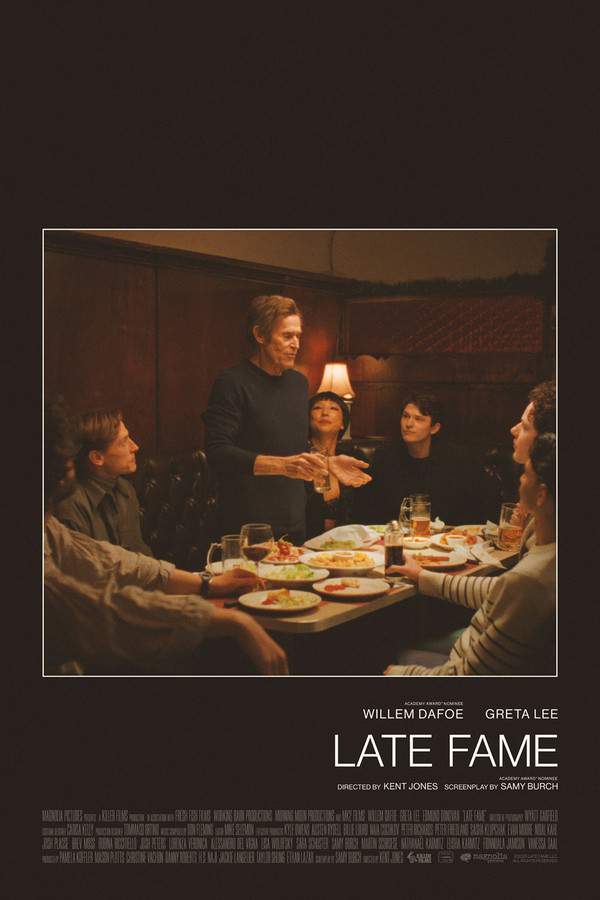
Late Fame (2026) movie poster

Ending Explained

Late Fame (2026) Ending Explained – Final Scene & Meaning

Release, runtime and language
2026 · 1 h 36 m · English
Loading streaming availability…
Directed by
Kent Jones
Starring
Willem Dafoe, Greta Lee, William Hill, Welker White, Jake Lacy, Clark Johnson

When the long‑overlooked poems of legendary New York poet Ed Saxberger are discovered by an eccentric circle of young artists, their fascination revives his dormant creative spark. As they delve deeper, the enigmatic actress Gloria weaves her beguiling presence through their world, adding intrigue.

On this page (6)
  1. 1 Where to watch
  2. 2 What happens at the end
  3. 3 Final events in order
  4. 4 Ending questions answered
  5. 5 Movie threads
  6. 6 Every angle
Loading streaming availability…

Ending explained · contains spoilers

What Happens at the End of Late Fame?

How Late Fame (2026) ends, what the final scene means, which earlier moments set it up and how to read the ending if the film leaves it open. The full ending explained, with every spoiler.

Ed Saxberger's rediscovery does not turn into the triumphant literary comeback the young Enthusiasm Society imagines. Their grand cultural ambitions prove fragile, and Gloria leaves for a respected theatre company in Minneapolis. Yet Ed does write again: his new poem looks back on arriving in New York, connecting the elderly postal worker with the young poet he once was. As the circle disperses, what remains is that renewed ability to notice his life and give it language, rather than a lasting position at the centre of a fashionable movement.

The ending treats fame as temporary but creative attention as something Ed can recover without becoming celebrated. The young admirers awaken a part of him that routine had buried, even if their enthusiasm cannot sustain the institution they invent around him. Gloria's departure similarly points toward an actual working artistic life beyond their self-conscious literary gatherings. Ed's modest renewal can be read as the deeper success: he regains a relationship with poetry, while the fantasy of being publicly rediscovered loses its hold.

Last updated: October 01, 2026 at 22:05

Was this helpful?

The last 4 events

How Late Fame Ends: The Final Events in Order

The last events of Late Fame (2026) in chronological order, the run-up to the ending explained above. The complete timeline has all 15 events, scene by scene.

Open the full timeline
  1. Gloria's Departure

    After the reading, Gloria informs Ed of her acceptance for a role in a theatre production in Minneapolis, signifying a bittersweet moment for Ed as he reflects on their time together. This news further underlines Ed's emotional unraveling post-performance.

  2. Family Tragedy

    Ed receives a voicemail from his sister revealing that their brother has passed away. This tragic news hits Ed hard, forcing him to confront his family ties and the reality of his brother's decline that he failed to witness.

  3. Dissolution of the Enthusiasm Society

    The Enthusiasm Society erupts in conflicts after reviewing the negative feedback on their readings, blaming each other for their failures. The disputes culminate in the group's disbandment, leaving Ed feeling disconnected from the once-thriving network.

  4. Advice to Winn

    Winn, a young member of the Society, approaches Ed for guidance on his writing, admitting that he and others have never read Ed's works. Ed advises him against defining his self-worth through others' opinions, signifying a moment of introspection and realization for Ed.

Ending questions answered

Late Fame Ending: Your Questions Answered

The questions people ask most about the ending of Late Fame (2026): what the final scene means, how the twist works, what happens to each character and how to read the ending. Each answer contains spoilers.

Q1

Why doesn't Ed's poetry discovery lead to a famous comeback?

Ed's rediscovery does not turn into a triumphant literary comeback in Late Fame because the Enthusiasm Society's grand cultural ambitions prove fragile. Their project of building a fashionable movement around his work lacks the institutional grounding to last, and once the circle disperses, Ed is left without a sustained public platform. He does write again, but the recognition stays private rather than turning into celebrity.

Foreshadowing: The Society's gatherings are framed early on as more performative than substantive, hinting that their enthusiasm cannot support a real literary revival.

  • comeback
  • rediscovery
  • fame
  • enthusiasm society
  • literary movement
Q2

Why does Gloria leave for Minneapolis at the end?

In Late Fame, Gloria departs for a respected theatre company in Minneapolis because she chooses a working artistic life over the self-conscious literary gatherings of the Enthusiasm Society. Her exit signals that real creative labor exists outside the group's pretensions. It also strips Ed of the romantic intrigue that had briefly energized his rediscovery, leaving him to face the end of that fantasy on his own.

Foreshadowing: Gloria is shown drifting between commitments, hinting that her presence in the group is temporary rather than devoted.

  • gloria
  • minneapolis
  • theatre
  • departure
  • enthusiasm society
Q3

What does Ed's new poem at the end mean?

In Late Fame, Ed's new poem looks back on arriving in New York and connects the elderly postal worker with the young poet he once was. Rather than chasing public recognition, the poem is an act of self-reconciliation, giving language to a life lived mostly in routine. It signals that Ed has recovered his creative voice, but on his own terms, not as part of a fashionable movement.

Foreshadowing: Ed's working routines at the post office and bar are threaded with small poetic observations throughout the film, foreshadowing that his writing will return through ordinary life rather than celebrity.

  • poem
  • new york
  • arrival
  • young poet
  • postal worker
  • self-reconciliation
Q4

What happens to the Enthusiasm Society by the end?

The Enthusiasm Society dissolves by the end of Late Fame once their shared project of reviving Ed loses momentum. The grand cultural ambitions they imagined around his poems prove too fragile to sustain, and the young artists drift apart. Their dispersal leaves Ed without an audience of admirers but also frees him from the expectations of being a public literary figure.

Foreshadowing: The Society's meetings lean heavily on performance and self-styling early on, hinting that their cohesion depends on novelty rather than genuine artistic community.

  • enthusiasm society
  • dissolution
  • young artists
  • disperses
  • circle
Q5

How does Ed Saxberger's story conclude?

Late Fame ends with Ed back in his ordinary routine, having written a new poem but stripped of illusions about both Gloria and his admirers. The film frames his modest renewal as a genuine success: he has regained a relationship with poetry, even as the fantasy of being publicly rediscovered falls away. The final image is one of quiet creative attention rather than celebrity.

  • ed saxberger
  • ending
  • final scene
  • quiet
  • creative attention
  • bittersweet
Q6

What is the deeper meaning of the ending?

The ending of Late Fame treats fame as temporary but creative attention as something Ed can recover without becoming celebrated. Ed's rediscovery fails to make him a public figure, yet his renewed ability to notice his life and give it language becomes the story's deeper, quieter triumph. The film suggests that authentic art and self-connection matter more than institutional recognition.

  • ending meaning
  • fame
  • creative attention
  • poetry
  • authenticity
  • recognition
Q7

Is the ending hopeful or bleak?

The ending of Late Fame is bittersweet rather than hopeful or bleak. Ed finds genuine artistic connection by writing a new poem, but the Enthusiasm Society falls apart, Gloria leaves, and he returns to his working-class life without public recognition. The tone is quietly affirming, suggesting that personal creative renewal can coexist with loss and disillusionment.

  • bittersweet
  • hopeful
  • bleak
  • tone
  • renewal
  • disillusionment
Q8

Why does Ed return to the bar in the final scene?

Ed returns to the bar in the final scene of Late Fame because the Enthusiasm Society has dissolved and Gloria has left, leaving his working-class community as the one stable presence in his life. The bar also represents the ordinary world his new poem draws from, contrasting with the bohemian literary scene he briefly re-entered. It signals that his artistic renewal is rooted in his real life, not in fashionable admiration.

  • bar
  • working-class
  • community
  • ordinary life
  • routine
  • return
Q9

What does Gloria's departure reveal about her character?

Gloria's move to a Minneapolis theatre company in Late Fame reveals that her interest in Ed was less about him personally than about the artistic life she wanted to access. Her exit exposes the asymmetry in the relationship and reinforces the film's theme of performance versus authentic connection. She ultimately chooses professional opportunity over the unstable orbit of the Enthusiasm Society.

Foreshadowing: Gloria's motives stay deliberately ambiguous throughout, hinting that her attachment to the group is more strategic than romantic.

  • gloria
  • departure
  • character
  • performance
  • ambition
  • theatre
Q10

How does the ending explore authenticity vs. performance?

The ending of Late Fame contrasts Ed's genuine return to writing with the manufactured nature of the Enthusiasm Society's cultural project. By giving Ed a quiet, self-reflective poem rather than public acclaim, the film suggests that authentic art thrives outside fashionable movements. Gloria's departure and the Society's collapse expose the performative layer the group had built around Ed's rediscovery.

Foreshadowing: The Society's elaborate posturing and curated gatherings foreshadow the gap between their cultivated image and the real artistic work happening beneath it.

  • authenticity
  • performance
  • manufactured fame
  • art
  • enthusiasm society
Q11

How does Ed's brother's death shape the ending?

Ed's brother's death in Late Fame casts a shadow over the ending, intensifying the bittersweet tone of his artistic renewal. The loss underscores the theme of mortality running beneath the literary rediscovery, reminding viewers that Ed's recovery of his poetic voice occurs alongside personal grief. The ending weighs creative renewal against bereavement rather than treating Ed's writing as a pure triumph.

Foreshadowing: Glimpses of Ed's complicated family history and a quiet funeral sequence foreshadow that bereavement will color any later artistic success.

  • brother
  • death
  • mortality
  • bereavement
  • grief
  • family
Q12

What does Ed's renewed writing say about his character arc?

Ed's renewed writing in Late Fame shows that his character arc is not about becoming famous but about reclaiming a lost relationship with poetry. By choosing to write about his own past rather than producing work tailored to his admirers, Ed reclaims authorship of his life. The ending suggests that personal creative integrity matters more to him than the recognition he briefly tasted.

Foreshadowing: Early scenes of Ed noticing small details on his postal route hint that his poetic sensibility has never fully gone dormant.

  • character arc
  • writing
  • renewal
  • integrity
  • poetry
  • authorship

Movie threads

More Movies Like Late Fame, by Mood & Story

Curated lists built around what makes Late Fame tick: the same mood, the same kind of story or the same emotional payoff. Each list explains why these movies belong together.

Late-life artistic rediscovery like in Late Fame

Forgotten creators rediscovered at the edge of mortality, wrestling with what their work still means. If you liked Late Fame, these slow, bittersweet dramas follow aging writers, poets, and artists rediscovered in their twilight years. Movies like Late Fame explore mortality, artistic authenticity, and the fragile comfort of belated recognition, all delivered with contemplative, understated pacing and medium emotional weight.

  • bittersweet
  • contemplative
  • aging
  • artistic
  • mortality
  • rediscovery
  • Tone: bittersweet, contemplative
  • Pacing: slow, reflective
Why these movies?

The story pattern: An overlooked or retired creative figure is pulled back into their artistic world by admirers, family obligations, or personal crisis. Initial attention feels flattering or restorative, but the narrative slowly exposes tensions between past ambition and present reality, between the person they were and the person they have become. By the end, the protagonist has not been rescued by recognition but has gained a clearer, sadder view of their own art and life, often marked by the loss of a sibling, a lover, or an illusion.

Why they belong together: These films share a slow, reflective pacing, bittersweet endings, and a meditative interest in aging, creative identity, and what art costs over a lifetime. They tend to favor character over plot, with low-to-medium intensity that builds through quiet scenes of reading, performing, conversing, and remembering. Mortality, family estrangement, and the gap between public reputation and private truth recur across them.

Bohemian urban melancholy like in Late Fame

Atmospheric city stories where intellectuals, artists, and dreamers collide with their own pretensions. If you liked Late Fame's Manhattan drift, you'll love these slow, contemplative dramas set in artistic urban enclaves. Movies like Late Fame capture coffee shops, literary circles, and bohemian pretensions, weaving grief, romance, and self-reflection through atmospheric city streets with understated, bittersweet humor.

  • bohemian
  • urban
  • wistful
  • intellectual
  • contemplative
  • understated
  • Tone: melancholic, wistful, wry
  • Pacing: slow burn, drifting
Why these movies?

The story pattern: An outsider or returning figure moves through a tight-knit creative community and gradually sees through its charms and illusions. The narrative is episodic and observational, drifting between cafes, studios, parties, and apartments. Romance and friendship entangle with gossip, hierarchy, and self-performance, and the protagonist's deepening honesty often costs them their place in the circle. The ending rarely resolves cleanly, instead settling for a quieter, lonelier clarity about who they really are.

Why they belong together: These films are united by their urban artistic settings, slow-burn pacing, and a tone that blends melancholy with dry, understated wit. They traffic in intellectual and creative pretension as both subject and mild satire, and they use atmosphere, dialogue, and character interiority rather than plot momentum. Themes of self-worth, authenticity, romance, and the gap between reputation and reality recur across the group.

Every angle

Late Fame (2026) Explained: Plot, Ending, Timeline & Characters

Everything about Late Fame in one place: what happens in the plot summary, the timeline in chronological order, the characters and meaning, the ending explained and a spoiler-free summary. What's After the Movie adds the cast, box office and post-credit scenes.

Coming soon on iOS and Android

The Plot Explained Movie Summary App

Plot summaries, endings explained and timelines on your phone. Catch up on any movie in minutes, save your favorites and never miss a twist again.

Be the first to know when we launch. Your email stays private, always.

Learn more about the app