Plot Explained Spoilers guaranteed!
Plot Explained

Browse by genre

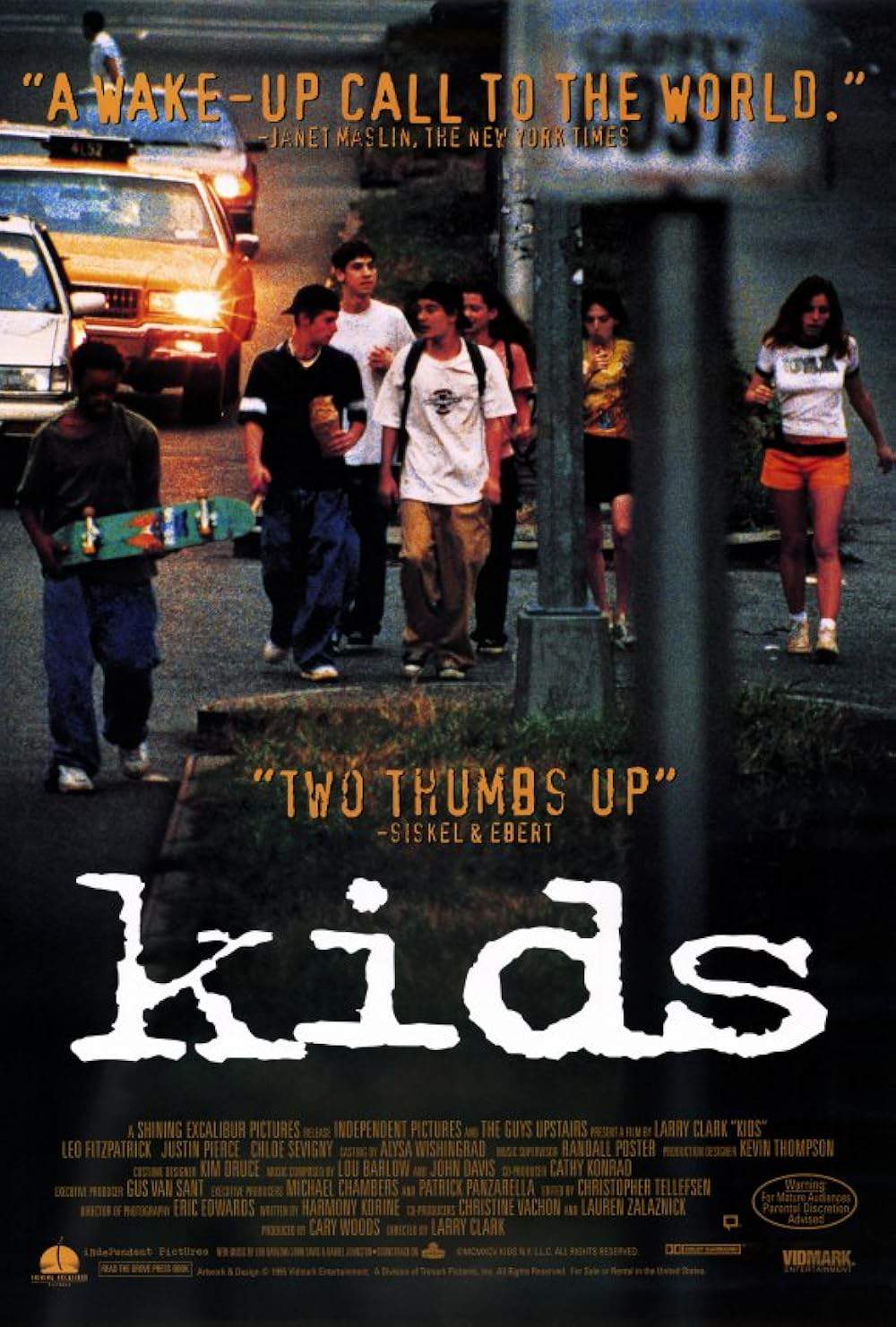
Kids (1995) movie poster

Timeline

Kids (1995) Timeline Explained – Every Event in Order

Release, runtime and language
1995 · 91 min · Lithuanian
Directed by
Larry Clark
Starring
Chloë Sevigny, Adriane Brown, Billy Valdes, Billy Waldeman, Johnathan Staci Kim, Joseph Chan
Budget
$1.5M

The film follows Telly, a teenager with a specific and troubling idea of safe sex. He believes it means only having sexual encounters with young, inexperienced women. When one of the girls he previously had relationships with discovers she has contracted HIV, she seeks him out to reveal the news. Telly, unaware of the potential consequences, is about to engage in another risky sexual encounter with a young woman.

On this page (5)
  1. 1 Events in order (12)
  2. 2 Timeline questions answered
  3. 3 Movie threads
  4. 4 Movies like Kids
  5. 5 Every angle

12 events in order · contains spoilers

Kids Timeline: Events in Chronological Order

Every key event of Kids (1995) in order, scene by scene, with when and where it takes place. Use it to untangle flashbacks, time jumps and parallel storylines, to refresh your memory before the sequel or to find the exact scene you are thinking of.

  1. Telly and Casper seek a night of rough crowd and drugs

    Telly and his friend Casper roam the city looking for drugs, food, and a place to hang out. They move through the streets with aimless energy, feeding their urge for thrills. The scene establishes a rebellious dynamic that drives much of what follows.

  2. The store thefts

    Casper shoplifts a 40 oz bottle of malt liquor, and the group exits with peaches from a vendor. Their petty theft marks a shift toward increasingly risky behavior. The act foreshadows later consequences of their actions.

    Where
    Local store
  3. Casper uses drugs and watches skate videos

    The friends head to Paul’s apartment to hang out, watch skaters on the TV, and take nitrous from a whippet. The moment emphasizes their detachment from responsibility and their appetite for reckless fun. It also hints at how quickly their party atmosphere can escalate.

    Where
    Paul's apartment
  4. Across-the-city concerns about sex and health

    Across the city, a group of girls discusses sex and STD testing, revealing varied attitudes toward risk and health. Ruby tests negative despite multiple encounters, while Jennie learns she is HIV positive. The revelation intensifies concern about who might be affected after sharing information.

    Where
    Across the city
  5. Telly and Casper steal from Telly's mother

    Telly and Casper sneak money from Telly’s mother, illustrating how far their behavior has spiraled. The act deepens the characters' moral decline and compounds the consequences of their choices. It also raises stakes for the rest of the night.

    Where
    Telly's home
  6. Rastafarian dealer and a violent confrontation

    After buying marijuana from a Rastafarian dealer, the group taunts a nearby gay couple, prompting a confrontation when Casper bumps into a man. The altercation ends with the man being knocked unconscious by a response from the group, underscoring the escalating violence around them.

    Where
    Street near the drug deal
  7. Darcy introduced and the pool scene

    The group visits Darcy, the younger sister of an acquaintance, and they head to a pool. The scene captures their carefree, reckless approach to relationships and boundaries. It foreshadows the looming consequences of their peers' influence.

    Where
    Pool area
  8. Unsupervised party at Steven's house

    They attend an unsupervised party at Steven’s house, where alcohol and drugs flow and safety boundaries blur. The atmosphere spirals into chaos as the night continues. The gathering marks a turning point toward more dangerous behavior.

    Where
    Steven's house
  9. Jennie seeks information and encounters danger

    Jennie heads toward the party after learning troubling information about HIV and the others’ whereabouts. She encounters danger and becomes entangled in the night’s escalating risk. The sequence heightens tension and shows how information travels through the social circle.

    Where
    Steven's party
  10. Morning aftermath and social bleakness

    In the morning, the characters confront the aftermath of the night’s actions. The film expands to show broader social hardship, including homelessness and drug use in New York City. A stark voiceover from Telly closes with a grim reflection on his worldview.

    When
    Morning
  11. Casper's confusion after the night

    Casper wakes disoriented, trying to make sense of what happened. The moment underscores the emotional toll of the night’s reckless choices. It hints at the fragile line between bravado and reality.

    Where
    Steven's house / city
  12. Closing montage and aftermath

    The closing montage depicts the harsh realities faced by homeless and drug-using populations. It emphasizes the consequences of reckless behavior and social neglect. The final images leave the audience with a bleak, unresolved sense of the characters’ futures.

    Where
    New York City

Last updated: October 09, 2025 at 15:40

Was this helpful?

Timeline questions answered

Kids Timeline Explained: Your Questions Answered

When does it happen, and why in that order? The questions people ask about the chronology of Kids (1995): time jumps, flashbacks, cause and effect between scenes and the correct order of events, each answered with spoilers.

Q1

Why does Telly think having sex with virgins is safe?

Telly operates under a dangerous misconception that virginity equals safety from HIV and STDs. He genuinely believes that if he only has sex with girls who have never had sex before, he cannot contract or spread diseases. This belief is rooted in ignorance and a complete misunderstanding of how HIV is transmitted, regardless of a person's sexual history. The film presents this as a chilling example of how lack of sex education and misinformation can lead to predatory behavior.

Foreshadowing: The opening scene establishes Telly's belief immediately, showing him with a 12-year-old virgin while claiming this makes his actions safe.

  • telly
  • virgin
  • safe sex
  • hiv
  • misinformation
Q2

How did Jennie get HIV from Telly if he only sleeps with virgins?

Telly's belief that virgins are safe is tragically flawed. Despite his conviction that he is practicing safe sex by seeking out inexperienced partners, he is actually spreading HIV. Jennie reveals that she contracted the virus from a single sexual encounter with Telly, demonstrating that his understanding of 'safe sex' was entirely wrong. The irony is central to the film's critique of adolescent ignorance about sexual health.

Foreshadowing: The girls' conversation about STD testing establishes early that Ruby remains negative while Jennie tests positive, hinting at Telly as the source.

  • jennie
  • hiv
  • telly
  • infection
  • transmission
Q3

Why can't Jennie find Telly to warn him about HIV?

Jennie struggles to locate Telly because he and his friends drift aimlessly through the city, moving between apartments, parties, and streets without any fixed plan. She relies on fragmentary information, learning from Misha that Telly might be at The Shelter, then discovering he's at Steven's house. By the time she arrives at the party, Telly has already had sex with Darcy, making her search tragically too late.

Foreshadowing: The parallel editing between Jennie's search and Telly's movements builds tension as their timelines slowly converge.

  • jennie
  • telly
  • search
  • party
  • warning
Q4

What happens between Telly and Darcy at Steven's house?

At Steven's unsupervised party, Telly isolates Darcy in his parents' bedroom and pressures her into sex. Although Darcy initially resists, she eventually acquiesces to Telly's persistence. Jennie arrives at the house, finds them in the act, and is too late to warn Telly about her HIV status. This encounter exposes Darcy to the virus Telly carries, completing the tragic cycle of transmission that Jennie tried to prevent.

Foreshadowing: Earlier scenes establish Telly's targeted interest in Darcy as 'the virginal younger sister of an acquaintance.'

  • telly
  • darcy
  • sex
  • party
  • steven house
Q5

What happens between Casper and Jennie the next morning?

The morning after the party, Casper finds Jennie in a drugged, semi-conscious state from the roofie she was given. While Jennie is incapacitated and unable to consent, Casper rapes her. This scene completes the film's cycle of exploitation and victimization. Casper later wakes confused and horrified, asking 'Jesus Christ, what happened?', unaware that he has now exposed himself to HIV.

Foreshadowing: The previous scenes show Jennie becoming increasingly incapacitated from the pill Fidget gave her.

  • casper
  • jennie
  • rape
  • morning
  • roofie
  • hiv
Q6

Why does the film end with such a bleak outlook and no redemption?

The film deliberately refuses to offer redemptive arcs or hopeful resolution. Director Larry Clark presents a unflinching documentary-style portrayal of urban youth navigating sex, drugs, and violence without adult guidance or moral judgment. The final montage of homelessness and drug use across New York, accompanied by Telly's voiceover declaring sex the only worthwhile thing, reinforces the film's commentary on how societal neglect and personal ignorance create irreversible tragedy. The lack of redemption is the point, showing the real consequences of the characters' choices.

Foreshadowing: The meta notes establish from the beginning that no character experiences growth or change.

  • ending
  • redemption
  • bleak
  • theme
  • social neglect
Q7

How does HIV spread between the characters in the film?

The HIV transmission forms a tragic chain: Jennie contracted HIV from Telly during a single sexual encounter. Jennie then desperately searches for Telly to warn him, but arrives too late at Steven's party. During that party, Telly has sex with Darcy, potentially spreading the virus to her. The next morning, Casper rapes the drugged Jennie, unknowingly exposing himself. The film suggests a cycle of infection that stems from ignorance, predators, and victims all interconnected.

Foreshadowing: Jennie's urgent search to find Telly before he sleeps with anyone else drives the entire narrative.

  • hiv
  • transmission
  • telly
  • jennie
  • darcy
  • casper
Q8

Why does Casper rape Jennie?

Casper rapes Jennie when she is in a severely compromised state, drugged, inebriated, and unconscious from the roofie Fidget gave her at the club. While the film does not provide explicit motivation, the scene depicts a predatory act against a vulnerable victim who cannot consent. Casper's subsequent confusion upon waking suggests he was also impaired and may not fully comprehend what happened, though this does not excuse the assault.

Foreshadowing: Jennie's condition deteriorates progressively after she ingests the pill, rendering her increasingly unresponsive.

  • casper
  • jennie
  • rape
  • assault
  • roofie
  • drugs
Q9

Why is the title 'Kids' appropriate for this film?

The title 'Kids' is ironic and critical, highlighting that the characters are indeed children, adolescents engaging in behaviors that lead to severe adult consequences like HIV infection, rape, and trauma. The film forces viewers to confront how kids navigate adult situations without proper guidance, education, or support systems. The youthful appearance and behavior of the cast underscores the tragedy of underage individuals experiencing such serious adult problems.

Foreshadowing: The opening scene immediately establishes the characters' ages, Telly is 16 and his partner is 12.

  • title
  • kids
  • meaning
  • theme
  • adolescence
Q10

What triggers the violent confrontation with the man on the street?

After buying marijuana from a Rastafarian dealer, Casper carelessly bumps into a man while riding a skateboard. The incident escalates when the man becomes aggressive toward the group. The confrontation ends violently when Harold strikes the man with a skateboard, knocking him unconscious. The attack continues until the man is rendered unconscious, demonstrating the group's escalating willingness to use violence and their complete disregard for consequences.

Foreshadowing: Earlier scenes establish the group's pattern of reckless behavior and escalating aggression.

  • violence
  • confrontation
  • casper
  • harold
  • skateboard
Q11

What is the film's message about HIV and adolescent behavior?

The film serves as a stark warning about the consequences of inadequate sex education and adolescent sexual ignorance. Through Telly's fatal misconception about 'virgin safety,' the film demonstrates how misinformation leads to predatory behavior and disease transmission. Jennie's desperate search to prevent further spread highlights the tragedy of preventable infection. The film argues that without proper education and adult guidance, youth are vulnerable to both exploiting others and being exploited, with life-altering or fatal consequences.

Foreshadowing: The parallel storylines of boys boasting about unprotected sex and girls learning about HIV status create thematic contrast.

  • hiv
  • message
  • sex education
  • adolescent
  • awareness
  • prevention
Q12

Why does Jennie test positive for HIV while Ruby tests negative despite having more partners?

The film does not explicitly explain why Ruby tests negative while Jennie tests positive, but HIV transmission is probabilistic and depends on specific encounters. Jennie reveals she contracted HIV from a single experience with Telly, while Ruby's partners may have been disease-free or less likely to transmit. The contrast highlights how HIV can spread from one encounter with an infected person, emphasizing that sexual history alone does not determine risk, partner status matters more than number of partners.

Foreshadowing: The girls' conversation establishes the different test results as a moment of tension and fear.

  • jennie
  • ruby
  • hiv
  • std test
  • transmission
Q13

Why does Telly specifically seek out virgins for sexual encounters?

Telly's pattern of targeting virgins stems from his misguided belief that virginity provides immunity from STDs and HIV. He views inexperienced girls as 'clean' and 'safe,' completely misunderstanding how the virus transmits regardless of sexual history. This belief allows Telly to rationalize his predatory behavior, he sees himself as being careful and responsible, when in reality he is actively spreading disease while seeking out the most vulnerable and inexperienced victims.

Foreshadowing: Casual conversations among the boys at Paul's apartment reveal their attitudes about sex and disease prevention.

  • telly
  • virgin
  • predators
  • behavior
  • exploitation

Movie threads

More Movies Like Kids, by Mood & Story

Curated lists built around what makes Kids tick: the same mood, the same kind of story or the same emotional payoff. Each list explains why these movies belong together.

Raw Urban Youth Stories Like Kids

Raw, unsettling portraits of young lives spiraling in a harsh urban reality. Explore movies like Kids that depict the grim realities of teenage life with unflinching honesty. These similar gritty dramas focus on urban settings, drug use, and sexual promiscuity, often with bleak endings. If you liked the raw, confrontational style of Kids, you'll find more films that capture this specific, desperate vibe.

  • gritty
  • raw
  • unflinching
  • anxious
  • desperate
  • grim
  • Tone: bleak, confrontational
  • Pacing: steady, procedural
Why these movies?

The story pattern: Stories in this thread typically follow a day-in-the-life structure, charting the inevitable downward spiral of characters trapped by their environment and poor choices. There is often a looming consequence—like disease or violence—that the narrative builds towards, culminating in a devastating climax that offers no redemption or escape.

Why they belong together: This thread groups films that share a commitment to realistic, non-judgmental portrayals of marginalized youth. They connect through their bleak tone, high emotional intensity, and focus on the raw, anxious, and transgressive aspects of growing up in a world devoid of safety nets.
Bleak Tragic Spiral Movies Like Kids

Stories where characters march relentlessly toward a devastating, foreshadowed fate. Discover films like Kids that follow characters on an irreversible path to tragedy. These movies share a steady pacing that builds to a devastating climax, high emotional weight, and a profoundly bleak ending feel. If you appreciated the inevitable, dreadful momentum of Kids, this list features similar stories of moral and physical collapse.

  • bleak
  • grim
  • desperate
  • tense
  • unflinching
  • anxious
  • Tone: bleak, tense
  • Pacing: steady, momentum-building
Why these movies?

The story pattern: The narrative pattern is defined by a linear, cause-and-effect progression where early actions have severe, inescapable consequences. There are no last-minute rescues or redemptive arcs; instead, the story functions as a cautionary tale or a stark observation of human failure, leaving the audience with a profound sense of loss and despair.

Why they belong together: Movies are grouped here based on their shared structural and emotional core: a steady pacing that conveys inevitability, a high-tension score derived from foreshadowed doom, and a bleak ending that confirms the worst-case scenario. The dominant mood is one of grim, desperate anxiety.

If you liked this

Movies Like Kids

Similar movies to Kids: the same genre, themes or kind of story. Each one comes with its own plot summary, timeline and ending explained.

Browse all movie summaries

Every angle

Kids (1995) Explained: Plot, Timeline & Characters

Everything about Kids in one place: what happens in the plot summary, the timeline in chronological order, the characters and meaning and a spoiler-free summary. What's After the Movie adds the cast, box office and post-credit scenes.

Coming soon on iOS and Android

The Plot Explained Movie Summary App

Plot summaries, endings explained and timelines on your phone. Catch up on any movie in minutes, save your favorites and never miss a twist again.

Be the first to know when we launch. Your email stays private, always.

Learn more about the app