Plot Explained Spoilers guaranteed!
Plot Explained

Browse by genre

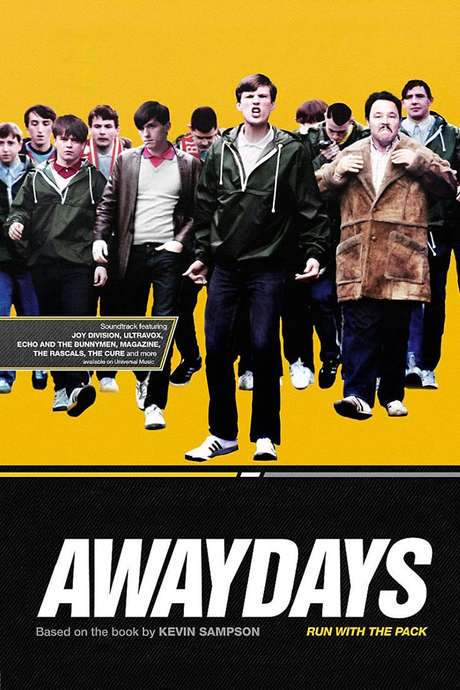
Awaydays (2009) movie poster

Plot Summary

Awaydays (2009) Plot Summary Explained

Release, runtime and language
2009 · 105 mins · English
Directed by
Pat Holden
Starring
Stephen Graham, Anthony Borrows, Sacha Parkinson, Holliday Grainger, Liam Boyle, Oliver Lee

Set on the Wirral during the bleak early years of Margaret Thatcher’s government, the film follows a group of restless young men who reject the monotony of nine‑to‑five work and chase thrills through sex, drugs, rock‑and‑roll, fashion, football and street fighting.

On this page (6)
  1. 1 Where to watch
  2. 2 What happens: full plot
  3. 3 Plot questions answered
  4. 4 Movie threads
  5. 5 Movies like Awaydays
  6. 6 Every angle

Where to watch

Where to Watch Awaydays (2009)

Where can you watch Awaydays? Stream, rent or buy it in the US, including on Fawesome, Hoopla and Cineverse: current JustWatch availability with up-to-date prices.

Streaming availability powered by JustWatch

Full plot summary · contains spoilers

What Happens in Awaydays: Full Plot Summary

The whole story of Awaydays (2009) explained, from the opening scene to the final frame: every key event, every twist and what it all adds up to. Read it as a quick recap before the sequel, to check a scene you missed, or to finally understand what really happened.

In 1979, a spirited, starry-eyed teenager named Paul Carty [Nicky Bell] stands at his mother’s graveside with his sister Molly [Holliday Grainger] and their father, trying to make sense of a world that feels out of reach. After Molly guides their dad away, Paul checks his watch, sheds his normal clothes, and hops aboard a special football train that will pull him toward a dangerous new family. On the train, he encounters John Godden [Stephen Graham], the hard-edged leader of a football firm who makes it clear there’s no room for beginners or dreamers—only those who can prove they belong. The journey quickly leads him to Elvis [Liam Boyle], a charismatic but volatile presence who embodies the thrill and risk Paul craves. Paul’s fascination with The Pack runs deep; he watches their brawls at Tranmere and imitates their rough swagger, even as Baby Millan [Oliver Lee] ridicules him and Elvis slides him a wary invitation.

Their bond grows through a shared longing to escape Birkenhead and its gray mornings; Paul and Elvis discover they share taste in music and a desire to flee to Berlin. Yet Elvis remains cautious, calling The Pack a “gang of pricks” and insisting Paul isn’t ready to join. A moment of proof follows when Paul headbutts a rude shop clerk to showcase his fighting spirit, and Elvis relents, telling him to meet on the train at twelve on Saturday. The thrill of initiation intensifies as the firm stages a clash with a rival crew, and Paul, swept up in the adrenaline, begins to feel like he finally belongs. He returns home with a dangerous glow, only to realize that his sister already knows how consumed he has become by this new allegiance.

The next stretch of the story shifts toward a fragile balance between loyalty and longing. Paul promises to take Molly shopping for her birthday in Chester, but a row with Elvis pulls him away, and the day slips by as he heads to another night out, chasing the Pack’s next big moment. A trip to Wrexham with the firm turns into a showcase of bravado and brinkmanship, and Paul’s courage is rewarded with acceptance as the leader’s newest top man. The Pack’s HQ, The Pelican, becomes a stage for power, sex, and the uneasy chemistry of a crew that’s always on the edge. In a uneasy initiation that goes south, Godden warns Baby Millan against supplying heroin to the members, hinting at a corrosive turn the group might take—an exchange that reveals how fragile their camaraderie really is. The night ends with Paul and a girl in tow, but the environment feels hollow, and a jeer from the pack—“twat out of himself”—lands with a sting.

A new chapter unfolds when Paul and Elvis follow two women, Sonia [Rebecca Atkinson] and Jackie, back to Elvis’s bohemian-flat haven, a space dotted with stars on the walls and a noose that reminds him of death itself—a chilling symbol of the path they’re treading. Elvis’s habit of heroin use grows louder and more dangerous, and Paul’s avoidance of that fate strains their friendship. A romantic interlude with Sonia is interrupted by Molly’s distress; Sonia’s presence becomes a counterpoint to Paul’s bond with Elvis, and a confrontation on a distant promenade leaves Paul questioning what he owes to the people who have welcomed him into their world. When Molly is attacked by a gang, Paul and Elvis rally The Pack to defend her, and the aftermath is raw and emotional: Elvis sits crying by the water, and Paul feels a debt he cannot easily repay. In a tense moment, Elvis confesses during a funeral, asking Paul to come away with him to Berlin; Paul declines, torn between family and the pull of the old life. Elvis’s voice, both haunting and comforting, lingers: > He always loved you, Carty.

At Godden’s funeral, the weight of loss sits heavy as Elvis steps into a confession booth for a strange, drug-fueled moment, signaling that the path they chose may be leading them toward a cliff. He asks for one more away day, and the promise hangs in the air like smoke. The final away day arrives with unsettling silence: Paul waits on a station platform, expecting Elvis to join him, but Elvis is absent. When the train finally rolls by, Elvis is seen perched on a bridge above the tracks, surrounded by smoke, and then he’s gone—an ominous hint of suicide that leaves Paul adrift in a world without the one person who made the danger feel like belonging. The Pack remains a changing cipher, and on a last, brutal encounter with Baby Millan [Oliver Lee], Paul is cut with a knife and told he’s a “ponce.” The condemnation stings, but it also frees him. In a final, hard-won decision, he turns away from The Pack and walks into an uncertain future, whispering to himself, “How long had I waited for this day? Out of here. Out of this.”

- Paul Carty [Nicky Bell] emerges as a boy on the edge, drawn to someone larger than life and to a community that thrives on risk.

- Molly [Holliday Grainger] anchors the emotional heart of the story, offering warmth and loyalty when the world grows brutal.

- John Godden [Stephen Graham] embodies the pull and peril of leadership within a violent subculture.

- Elvis [Liam Boyle] is the volatile spark that can lift a boy toward dreams or drive him into ruin.

- Baby Millan [Oliver Lee] is the volatile counterpoint to loyalty, wielding power and menace in equal measure.

- Natasha [Sacha Parkinson] appears as a touchstone of tenderness and danger tied to Paul’s evolving life.

- Sonia [Rebecca Atkinson] crosses paths with Paul in a way that adds complexity to his loyalties.

- Uncle Bob [Ian Puleston-Davies] stands as the family member caught between work, crime, and kin.

- Janie [Dannielle Malone] enters the narrative as a sister’s companion in a world that rarely stays still.

- Mr. Carty [Ged McKenna] and Eddie [David Barlow] anchor the broader slice of life outside the Pack’s inner circle, reminding Paul of the world beyond their reach.

Last updated: October 09, 2025 at 11:16

Was this helpful?

Plot questions answered

Awaydays Plot Explained: Your Questions Answered

The questions people ask most about Awaydays (2009): what happens in the confusing scenes, why the characters do what they do, the twists, hidden details and what the ending means. Each answer contains spoilers.

Q1

Why does Paul want to join The Pack football firm?

Paul is a restless teenager grieving his mother and desperate to escape the grim reality of Birkenhead in 1979. He feels disconnected from his normal life and is drawn to The Pack because they represent excitement, belonging, and a way out of the monotony. After watching their fights at Tranmere games and admiring their swagger, he sees joining as his ticket to a larger identity and a chance to flee to Berlin with Elvis.

Foreshadowing: The film opens with Paul at his mother's graveside, immediately checking his watch and running away, establishing his need to escape from the start.

  • paul carty
  • the pack
  • football hooligans
  • belonging
  • escape birkenhead
Q2

What happens to Elvis at the end of the film?

Elvis never boards the train with Paul on the final away day. As the train passes under a bridge, Paul sees Elvis standing alone on the bridge above, surrounded by smoke, and then he's gone. This strongly implies Elvis has committed suicide, ending his life the same way The Pack lived, on the edge, in smoke and danger.

Foreshadowing: Elvis's flat contains a noose on the wall, a constant reminder of death that foreshadows his fate.

  • elvis death
  • suicide
  • bridge scene
  • final away day
Q3

Why does Paul finally leave The Pack?

Paul leaves after Baby Millan knifes him and calls him a "ponce," but this is just the final trigger. Earlier, Paul had already begun pulling away to focus on family and his studies, he'd promised Molly he'd be there for her, and he was planning a Foundation Course. Elvis's disappearance and apparent death, combined with Baby Millan's rejection, convince him that the violent world of The Pack offers nothing but destruction. He walks away freely, whispering that he's finally getting out.

Foreshadowing: After Molly is attacked, Paul steps back to focus on family, marking his first real attempt to leave.

  • paul leaves pack
  • baby millan knife
  • escape
  • breaking away
Q4

What does the Berlin dream mean for Paul and Elvis?

Berlin represents escape from the bleakness of Birkenhead and the dead-end future that awaits them under Thatcher's Britain. Both Paul and Elvis dream of fleeing to Berlin, a city that symbolizes freedom, art, and a life beyond the factories and football violence. It's the one genuine aspiration they share that exists outside The Pack's criminal world.

Foreshadowing: Elvis's flat is described as bohemian, decorated with stars on the walls, reflecting his artistic yearning for something beyond Birkenhead.

  • berlin escape
  • birkenhead
  • elvis paul dreams
  • freedom
Q5

Why does Elvis ask Paul to come away with him to Berlin?

At Godden's funeral, Elvis, high and emotional, asks Paul to join him in the confession booth and urges him to come to Berlin. This is Elvis's last attempt to pull Paul toward their shared dream before his own destruction. He confesses his love for Paul, saying "He always loved you, Carty," revealing that their bond goes beyond friendship, Elvis sees Paul as the one person who truly understood him and represented a chance at a different life.

Foreshadowing: Earlier, Elvis tells Paul that The Pack is a "gang of pricks" and insists Paul isn't ready, showing he always saw the group as doomed.

  • elvis confession
  • berlin
  • love
  • cartys friendship
Q6

How does John Godden die?

The film doesn't explicitly show Godden's death, we learn about it when Elvis and Paul attend his funeral. Godden was the leader of The Pack, and his death marks the end of an era for the firm. The cause isn't detailed in the summary, but his absence creates a power vacuum that contributes to the group's unraveling.

Foreshadowing: Earlier, Godden warns Baby Millan about selling heroin to members, showing his awareness that the group is heading toward self-destruction.

  • john godden death
  • funeral
  • pack leader
Q7

Why does Elvis cry after helping Molly?

After Paul recruits The Pack to defend Molly when she's attacked by a local gang, Elvis is seen sitting by the water, crying. This moment reveals Elvis's deep emotional side, he's capable of loyalty and genuine care, not just violence. The cry shows the weight of his life and the contradictions within him: he's a violent man but also someone who craves connection and purpose.

Foreshadowing: This emotional moment foreshadows Elvis's later confession that he always loved Paul.

  • elvis crying
  • molly attack
  • loyalty
  • emotion
Q8

Why does Paul headbutt the shop clerk?

Paul headbutts a rude sales assistant to prove himself to Elvis and The Pack. He's been trying to join them and needs to demonstrate he's tough enough. The violent act is his initiation proof, Elvis had been telling him he wasn't ready, so Paul makes a bold statement of his willingness to fight. This convinces Elvis to finally let him join.

Foreshadowing: Earlier, Baby Millan ridicules Paul for being a dreamer, setting up his need to prove himself.

  • paul headbutt
  • initiation
  • proving himself
  • pack
Q9

Why does Elvis start using heroin heavily?

Elvis's heroin use escalates throughout the film, representing his descent into self-destruction. The timeline shows his use growing louder and more dangerous after bringing women back to his flat. The pressure of the firm, the violence, and possibly the impossibility of their Berlin dream all contribute. Godden even publicly taunts Elvis about his heroin use in front of the group, accelerating Elvis's downward spiral.

Foreshadowing: Early on, Elvis tells Paul The Pack is a "gang of pricks," suggesting he knows the lifestyle is toxic.

  • elvis heroin
  • drugs
  • addiction
  • pack corruption
Q10

Why does Paul abandon Molly's birthday?

Paul promises to take his sister Molly shopping in Chester for her birthday, but an argument with Elvis pulls him away. He chooses The Pack over family, forgetting the birthday entirely. This moment shows how deeply Paul has been consumed by his new identity, the same day meant for family is sacrificed for the thrill of belonging to The Pack.

Foreshadowing: Molly already knows about Paul's obsession with The Pack, showing the strain on their relationship before this moment.

  • molly birthday
  • paul ignores sister
  • family vs pack
Q11

What does Paul's final decision mean for his future?

Paul's final decision to walk away from The Pack represents hard-won self-awareness. He's beenknifeed, rejected as a "ponce," and has lost Elvis. Rather than retaliating, he walks into an uncertain future, whispering "Out of here. Out of this." It's bittersweet, he's free but at the cost of profound loss. He chooses an uncertain life outside violence over the dangerous belonging The Pack offered.

Foreshadowing: This moment completes Paul's arc from someone seeking belonging to someone who finds it within himself to reject a toxic community.

  • paul future
  • freedom
  • uncertainty
  • new life
  • leaving pack

Movie threads

More Movies Like Awaydays, by Mood & Story

Curated lists built around what makes Awaydays tick: the same mood, the same kind of story or the same emotional payoff. Each list explains why these movies belong together.

Movies about subculture identity like Awaydays

Stories of finding purpose in a tribe, followed by the pain of leaving it. If you were captivated by the hooligan culture and desperate search for belonging in Awaydays, you'll find similar stories here. This collection features films about characters drawn into intense subcultures—from gangs to music scenes—where the pursuit of identity comes with a heavy price, often culminating in a bittersweet or bleak awakening.

  • angsty
  • grim
  • restless
  • tense
  • oppressive
  • nostalgic
  • Tone: bleak, tense, angsty
  • Pacing: steady, immersive
Why these movies?

The story pattern: The narrative follows a protagonist seeking escape from a monotonous or oppressive life. They are initiated into a group that offers a powerful sense of identity through shared rituals, style, or conflict. The middle act deepens their involvement, often revealing the group's violence, toxicity, or hypocrisy. The climax involves a moral or physical crisis that forces the protagonist to choose between loyalty and self-preservation, leading to an ending marked by loss but also self-awareness.

Why they belong together: These movies are grouped by their shared focus on the intense, often destructive process of finding and losing a tribal identity. They consistently blend themes of rebellion, male bonding, and the grim realities of working-class life, all while maintaining a heavy emotional weight and a steady, immersive pacing that pulls you into the character's world.

Grim coming-of-age period dramas similar to Awaydays

Harsh portraits of youth navigating a bleak and oppressive era. For viewers who appreciated the gritty 1970s England setting and the heavy, bittersweet tone of Awaydays. This selection features movies like Awaydays that use a specific historical moment—often one of recession and social strife—as a backdrop for raw, unglamorous stories about the difficult transition from youth to adulthood.

  • grim
  • melancholic
  • nostalgic
  • oppressive
  • restless
  • angsty
  • Tone: bleak, melancholic, nostalgic
  • Pacing: steady, character-driven
Why these movies?

The story pattern: These narratives are grounded in a specific, grim historical period that directly impacts the characters' lives. The plot is a linear, character-driven arc following a young person's struggle for meaning. They experiment with rebellion, friendship, and self-destruction as outlets for their frustration. The story avoids sentimentalism, instead presenting a raw and often painful evolution where characters gain awareness of their circumstances at the cost of their innocence, leading to a sobering conclusion.

Why they belong together: The films share a potent combination of a bleak tone, a heavy emotional weight, and a meticulously recreated period setting that feels oppressive. The similarity comes from this specific mood—a mix of nostalgia for youth with the grim reality of the era—and the steady, unsentimental pacing that focuses on character development over plot contrivances.

If you liked this

Movies Like Awaydays

Similar movies to Awaydays: the same genre, themes or kind of story. Each one comes with its own plot summary, timeline and ending explained.

Browse all movie summaries

Every angle

Awaydays (2009) Explained: Plot, Timeline & Characters

Everything about Awaydays in one place: what happens in the plot summary, the timeline in chronological order, the characters and meaning and a spoiler-free summary. What's After the Movie adds the cast, box office and post-credit scenes.

Coming soon on iOS and Android

The Plot Explained Movie Summary App

Plot summaries, endings explained and timelines on your phone. Catch up on any movie in minutes, save your favorites and never miss a twist again.

Be the first to know when we launch. Your email stays private, always.

Learn more about the app