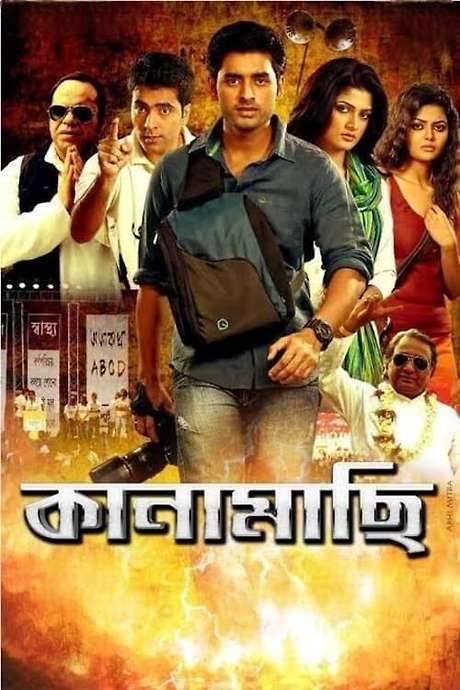
Kanamachi
Year: 2013
Runtime: 160 mins
Language: Bengali, Bangla
Director: Raj Chakraborty
Abir, a young ABP photojournalist, gets entangled in a political conspiracy when he witnesses Naxalites robbing a local bank. Is Abir’s friend the culprit?
Warning: spoilers below!
Haven’t seen Kanamachi yet? This summary contains major spoilers. Bookmark the page, watch the movie, and come back for the full breakdown. If you're ready, scroll on and relive the story!
Kanamachi (2013) – Full Plot Summary & Ending Explained
Read the complete plot breakdown of Kanamachi (2013), including all key story events, major twists, and the ending explained in detail. Discover what really happened—and what it all means.
Abir [Ankush Hazra] is a young, energetic photojournalist at ABP who lives for the rush of frontline reporting. One day, he spots a group of Naxalites robbing a local bank and dives into the chaos, snapping close-up shots as the heist unfolds. His reflexes pay off when he tamps down the criminals’ escape and manages to secure the memory card, but a young woman, Naina [Srabanti Chatterjee], mistakes him for one of the robbers and helps the gang wrestle his camera away. The chaos attracts the attention of the police, who detain him, yet he uses the evidence—photos that clearly identify the participants—to prove he’s a journalist, not a criminal. The face of the gang leader is hidden behind a mask, leaving a crucial mystery at the center of the investigation.
Back at ABP, where the newsroom hums with the clatter of keyboards and the clamor of deadlines, Abir runs into Nayana [Srabanti Chatterjee], who has just joined as Article Editor. Payel [Saayoni Ghosh] works in the same office and quietly carries a quiet, tugging affection for Abir, though he treats her as a friend rather than a romantic possibility. The atmosphere is charged with ambition and rivalry, as the editorial team strives to publish stories that will shake up the political landscape.
The plot thickens when Naina writes a cover story that targets Tarakeshwar Dutta [Supriyo Dutta], the leader of the opposition, accusing him of attempting to marry a minor. Tarakeshwar storms the newspaper office in a rage, demanding answers, and an audio recording of his interview vanishes—courtesy of manipulation from higher-ups—earning Naina dismissal for alleged falsified reporting. Undeterred, Abir risks everything to capture new photographs of Tarakeshwar in a temple at midnight, where the truth about his alleged child-marriage practices starts to surface. The paper runs with the explosive photos, and for the first time, Abir and Naina find themselves on the path to real notoriety and real love, as their audacious reporting draws them closer.
Meanwhile, Abhimanyu Mukherjee [Abir Chatterjee], a fresh graduate and determined engineer, dedicates himself to a cause: educating and empowering the poor. He and his team of graduates launch a political effort under the party name Borno Porichoy (Grammar Introduction), challenging seasoned politicians who rely on freebies to win votes. Their earnest campaign, though noble, struggles against the entrenched political machinery. One night, Abhimanyu’s volunteers are attacked, and the incident quick-pins Abhimanyu into a direct appeal for help to ABP. The newsroom’s staff protect him, and he becomes a focal point of coverage as Abir and the ABP team rally behind his reformist push, much to the annoyance of Tarakeshwar and the sitting Chief Minister.
During a high-stakes election rally, a bomb is rumored to be hidden under the stage. Abir, ever watchful, receives a text from Payel warning about danger and manages to pull Abhimanyu from danger just in time. The stage explodes moments later, and Payel is fatally wounded nearby. As she lies dying, Payel fights to share a final truth with Abir and Naina, hinting that the killer was embedded within the political machine. A later review of footage suggests the Naxalite gang’s leader bore a striking resemblance to the unknown killer, pointing to a web of conspiracy that connects violence, politics, and press freedom.
As Abir and Naina dig deeper, they notice a troubling discrepancy: a photo of Abhimanyu in a college class shot has been cut, erasing a key link in a chain of allies. Abir explains that he and Abhimanyu studied together and were close friends, and he emphasizes his unwavering support for Abhimanyu’s political career. The election landslide ushers Abhimanyu into the role of Chief Minister, raising hopes for a better governance model and the celebration of a new political era. But the euphoria is short-lived.
Inside the Chief Minister’s office, Abir discovers that the Naxalite leader who claimed Payel’s life has taken shelter there, while Abhimanyu appears to ignore Abir’s accusations. The journalist follows the leader to a hidden lair, where a tense confrontation unfolds. Abir obtains a confession from Shankar [Shantilal Mukherjee], the Naxalite liaison, detailing a shocking arrangement: Abhimanyu had struck a backdoor deal with the insurgents to secure victory, orchestrating acts of sympathy—the burning hut, the staged rescue, and even the staged bomb at the rally—to manipulate public sentiment. Payel had begun to uncover this truth and attempted to warn Abir and Naina before she was silenced fatally.
With evidence in hand, Abir records Shankar’s confession on his mobile and hands it to Naina, who plans to publish a hard-hitting exposé. Abhimanyu storms the hideout and, in a wildly dangerous moment, confronts Shankar. He shoots Shankar after a tense standoff, then turns his ire toward Abir. A desperate bomb blast is triggered, and although Abir barely escapes, Abhimanyu is killed in the ensuing chaos.
The aftermath is fraught with political tremors. Abir and Naina face a moral crucible: the party’s supporters, blissfully ignorant of the full truth, could be ruined if the public learns that their hero had dark, transactional aims. Abir urges Naina to withhold the explosive article to spare innocent colleagues from catastrophe, and she reluctantly agrees to avoid a wholesale collapse of their political careers—choosing instead to frame Abhimanyu’s death as a martyr’s sacrifice in the press.
The film closes on a quietly defiant note. Abir and Nayana present their resignations to the Chief Editor, hoping to purge themselves of false reporting and start anew. The editor, however, refuses the resignations, urging them to stay and continue covering the forthcoming elections. The last image lingers on the fragile line between truth and power, as the two journalists brace themselves for the turbulent political season ahead, compelled to navigate a world where information can mold reality just as easily as it can destroy it.
- Roles and performances weave a dense tapestry of courage, ambition, and the cost of speaking truth to power. The film builds a tense, political-thriller atmosphere while keeping a human focus on the journalists who chase the real story, even when it puts them at risk.
Last Updated: October 09, 2025 at 16:09

Explore Movie Threads
Discover curated groups of movies connected by mood, themes, and story style. Browse collections built around emotion, atmosphere, and narrative focus to easily find films that match what you feel like watching right now.
Investigative thrillers like Kanamachi
Journalists and investigators race against time to expose a dangerous conspiracy.If you enjoyed the gripping conspiracy and high-stakes investigation in Kanamachi, you'll find similar tension in these movies. This thread gathers fast-paced thrillers about journalists, whistleblowers, and truth-seekers risking everything to expose corruption and political secrets.











Narrative Summary
The narrative follows a determined protagonist, often a journalist or investigator, who stumbles upon a conspiracy far greater than they anticipated. The plot is driven by a race against time to connect clues, evade dangerous adversaries, and expose the truth before being silenced.
Why These Movies?
These movies are grouped by their shared focus on the investigative process, high levels of tension, and themes of corruption. They create a gripping, anxious experience where the pursuit of truth is both courageous and perilous.
Movies with bittersweet endings like Kanamachi
Stories where survival comes at the cost of a clear moral victory.For viewers who appreciated the morally complex and bittersweet conclusion of Kanamachi, this thread features movies where characters face heavy choices. These stories end on a note of somber realism, balancing survival with the emotional and ethical cost of their actions.

Revanche
2009
Backstabbing for Beginners
2018

The Sense of an Ending
2017

The End of the Affair
1999

Beyond a Reasonable Doubt
2009

Despite the Falling Snow
2017

No Tears for the Dead
2014

Cruel Intentions
2016

Where the Sidewalk Ends
1950

The Proposition
1998

Black Angel
1946

Such Good Friends
2025

Character
1997

Black Widow
1954

I Thank a Fool
1962
Narrative Summary
The narrative builds towards a climax where the protagonist must make a difficult choice, often involving a moral compromise. The ending reflects this ambiguity; while the immediate threat may be overcome, the characters are left scarred, having sacrificed ideals or relationships for a fragile stability.
Why These Movies?
These films are united by their emotionally heavy journeys and conclusions that are neither purely happy nor sad. They resonate with audiences who appreciate realistic, thought-provoking endings that prioritize thematic depth over neat resolutions.
Unlock the Full Story of Kanamachi
Don't stop at just watching — explore Kanamachi in full detail. From the complete plot summary and scene-by-scene timeline to character breakdowns, thematic analysis, and a deep dive into the ending — every page helps you truly understand what Kanamachi is all about. Plus, discover what's next after the movie.
Kanamachi Timeline
Track the full timeline of Kanamachi with every major event arranged chronologically. Perfect for decoding non-linear storytelling, flashbacks, or parallel narratives with a clear scene-by-scene breakdown.

Characters, Settings & Themes in Kanamachi
Discover the characters, locations, and core themes that shape Kanamachi. Get insights into symbolic elements, setting significance, and deeper narrative meaning — ideal for thematic analysis and movie breakdowns.