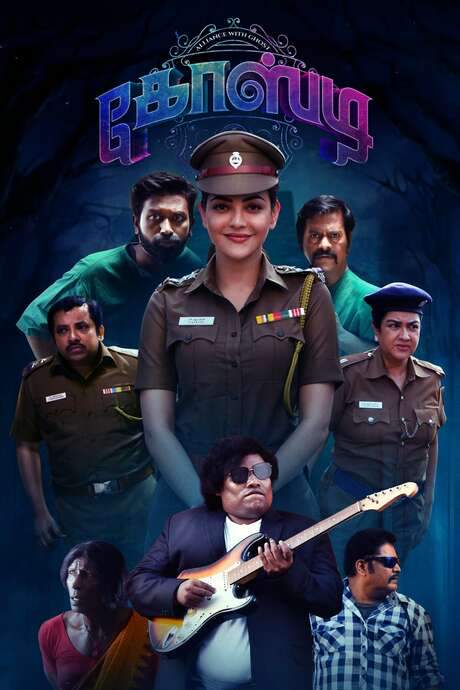
The film opens with a haunting image from a 1968 village festival: a careless act during the celebration causes an electric post to be cut, another to be toppled, and a live wire to ripple through the crowd, leaving the village scarred and its people terrified. This opening atmosphere sets a quiet, unsettled mood that will echo through the rest of the story.
Fast-forward to 2019, where a trio of kidnappers—Gajaa, Karunakaran; Kali Urundai, Ravi Mariya; and Sankar—kidnap Kamini, pulling her into a dangerous game that blends menace with money. Kamini’s captors quickly realize that Naina, the mastermind they’ve encountered, intends to extract a huge ransom from Kamini’s family. Naina’s ruthless orders drive the henchmen to eliminate the kidnap gang so their plan can’t be traced, which complicates the escape attempts and intensifies the tension surrounding the trio’s next moves.
In a surprising turn, Kamini’s abduction becomes a catalyst for a new alliance. Shwetha, the wife of Kiran, pushes the abductors toward a bold plan: kidnap Kamini from the henchmen and push for a king’s ransom. Kamini reveals a link to a man named Maanga Mani, and the group traces his whereabouts using a Truecaller search that leads them to a village called Kolaatipuram. Once they arrive, they find themselves in a place that feels less like a town and more like a haunting; the villagers are ghosts, the long-dead of 1968 returning to surveil the living. The retreat from danger proves futile, as every attempt to escape spirals back to the festival ground that started it all.
Kamini’s story takes another turn when she describes Sankar being taken by a specter who haunts Mathamma, a ghost who whispers a chilling question: “Am I beautiful?” The film leans into this unsettling motif as Shwetha instructs the group to visit Maathamma and answer a series of questions correctly to uncover the treasure that lurks beneath Kolaatipuram. The trio ventures deeper into this spectral history, while Shwetha distances herself from the danger after catching a glimpse of Mathamma.
Mathamma’s tale unfurls in a layered flashback. In 1968, Mathamma, her sister Mohini, and their uncle Venu share a house and a growing appetite for wealth that pushes them toward the depths of a well on their property. Venu enlists Sambath, a local well-digger, to dig behind the house. A landslide traps the digger and Mohini inside, and a rope is used to lower a lamp into the well to measure its depth. A muddy pot, found at the bottom, appears to hold gold, sparking greed and ambition. As Sambath returns with more lamps, disaster follows: the lamps are damaged, and a wooden barrel is revealed, bearing a new demand to “Keep sending this to me.” The family’s decisions grow darker: they push a drunk uncle into the well, and eventually they turn to dead bodies to feed the well’s thirst for gold, a horrifying cycle that culminates in the appearance of the Kaatteri, a menacing force that roams the village during the festival.
Aarumugam, a police officer who becomes entangled in Mathamma’s story, supplies the bodies that feed the well, a cruel twist that blurs the line between protector and predator. The Kaatteri’s presence is a constant reminder of the consequences of greed, punctuated by the chilling message scrawled on the wall: “Do not starve the well.” As the current festival unfolds, the living villagers attempt to neutralize the threat, but the past and present collide in a deadly reckoning. During the chaos of the festival, chase and violence intensify as the electric post is cut once again and the crowd is overwhelmed by fear and confusion. Mohini and Mathamma are ultimately driven into the well, severing the living’s tenuous link to the past and sealing their fates.
When Mathamma’s story ends, Kiran must decide which parts of the tale are real and which belong to myth. Kamini’s behavior shifts abruptly, and her face takes on Mohini’s likeness, signaling that the line between ghost and human has blurred beyond repair. Ponnambalam arrives with a grim demand to burn Kamini, and Kiran complies, only to trigger further consequences as Ponnambalam seizes Mohini’s ghost. The menacing Kaatteri reappears, threatening them all, but luck and quick thinking keep the survivors alive through the night. In the climactic moment, Kiran retrieves a bottle containing Mohini’s ghost and hands it to Naina, who opens it in terror and confronts the trapped spirit.
The film closes with a fragile, uneasy intimacy between Kiran and Shwetha in bed. As the couple lies together, Kiran asks how Shwetha knows that Aarumugam is Naina, and she responds with a provocative, unsettling question of her own: Am I beautiful?
Overall, the narrative weaves a spectral past with a present-day kidnapping plot, drawing out themes of greed, guilt, and the unresolved trauma of a community haunted by its own history. It uses the folkloric menace of Mathamma and themalicious force of the well to explore how secrets buried in a village’s soil can threaten the living long after the original misdeeds are committed.
Notes on cast links:
- Swetha, Sonam Bajwa
- Gajaa, Karunakaran
- Kali Urundai, Ravi Mariya
- Kamini, Aathmika
- Aarumugam / Naina, John Vijay
- Venu, Mime Gopi
- Chithra, Vinodhini Vaidyanathan
- Sambath, Namo Narayanan
- Maathamma, Varalaxmi Sarathkumar
- Mohini, Manali Rathod
- Maanga Mani’s trace and related clues involve a broader thread that connects to the village’s dark history.
- Kaatukuthiyan, Balaji Mohan
- Santhanam, TSR
- Shankar, Kutty Gopi
- Teacher, Aadhavi Chandrasekhar
- Etchakutty, Besant Ravi
- Short Film Maker, Lollu Sabha Manohar
- Santhanam’s Wife, Jangiri Madhumitha
- Ponnambalam, Ponnambalam
> Am I beautiful?