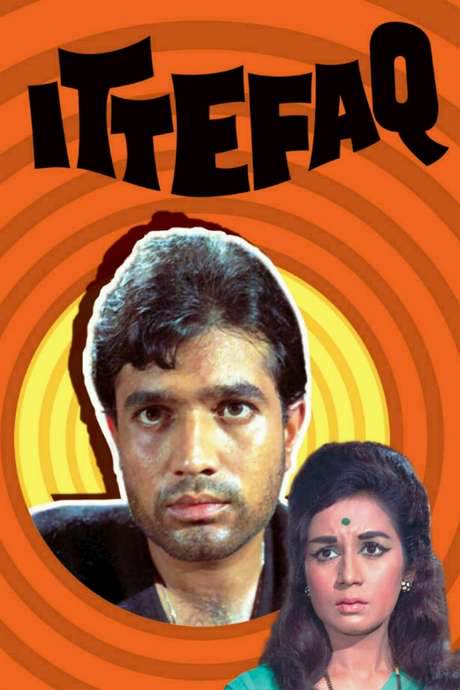
Year: 1969
Runtime: 104 mins
Language: Hindi
Director: Yash Chopra
Taking place almost entirely over the course of one stormy night, a woman is terrified when an accused murderer escapes from a mental hospital and seeks refuge in her home.
Warning: spoilers below!
Haven’t seen Ittefaq yet? This summary contains major spoilers. Bookmark the page, watch the movie, and come back for the full breakdown. If you're ready, scroll on and relive the story!
Read the complete plot breakdown of Ittefaq (1969), including all key story events, major twists, and the ending explained in detail. Discover what really happened—and what it all means.
Dilip Roy [Rajesh Khanna] is a dedicated painter whose life with his wealthy wife, Sushma [Alka], seems comfortable on the surface but is edged with rising tension. During a quiet, immersive session of painting, Dilip’s wife interrupts, asking him to accompany her out. He refuses, and the moment sparks a heated clash: she destroys one of his canvases, amplifying the strain between them. In a burst of emotion, Dilip shoves her and warns that he would kill her, then walks away from the heated scene. When he returns, he discovers his wife dead, and the police arrive to arrest him, propelled by the testimony of Renu [Bindu Desai], his sister-in-law who shares their home. Dilip maintains that his rage overwhelmed him, and that he cannot recall the exact sequence of events, insisting that he did not kill his wife.
As the trial unfolds, Dilip’s behavior becomes increasingly unpredictable, pushing him toward a deeper psychological unraveling. Dr. Trivedi [Gajanan Jagirdar], a seasoned psychologist, examines him and ultimately recommends keeping him under hospital observation for longer. The tension of confinement and the weight of suspicion carve a path for Dilip’s eventual escape. On a storm-soaked night, he slips away and finds himself at Rekha’s house, a residence of wealth in a neighborhood where privacy is supposed to be secure. Rekha [Nanda] is a married woman living with the comforts of a privileged environment, and her husband is away at the time. Dilip forces his entry and, at gunpoint, pleads with Rekha to hide him from the pursuing authorities. She attempts to summon help, but the call never goes through, and Rekha is compelled to shelter him.
With the danger temporarily contained, Dilip and Rekha share a tense, fragile conversation that nudges them toward mutual understandings and shaky trust. Dilip sheds his prison uniform and shifts into civilian clothes, a symbolic move that signals a fragile hope of normalcy. Yet night deepens around them, and Dilip awakens to a midnight sound, discovering Rekha isn’t there. A search reveals the shocking sight of a young man’s body in the bathroom, a discovery that Rekha hastily denies as reality and insists is only in Dilip’s mind. He grows suspicious, convinced that Rekha is hiding something far more dangerous than an abandoned crime scene.
Dilip decides to confront the truth by reaching out to the police, claiming that he found Jagmohan, Rekha’s husband, dead in the house and accusing Rekha of murder. Rekha counters that her husband has not yet returned from Calcutta, casting doubt on Dilip’s accusation. After a thorough search, Jagmohan’s body is found outside the house, and the investigation turns toward Dilip as a possible culprit, with a piece of his prison-issued cloth discovered in Jagmohan’s hands as a troubling clue that seems to bind him to the crime. Dilip insists that someone is manipulating the investigation, hinting that Inspector Diwan [Sujit Kumar] may be aiding Rekha, a suspicion he supports with a seemingly trivial but telling piece of evidence—an unused cigarette lighter that the inspector had taken on a prior visit to Rekha’s home, a visit the inspector had denied.
Facing a mounting tangle of accusations and half-truths, Rekha admits to having an affair with the inspector, admitting that her husband’s murder was the direct result of their secret liaison. Overcome by guilt and remorse, Rekha takes her own life. The turmoil does not end there, however. Inspector Karwe [Iftekhar], pursuing a different line of inquiry, continues the search for the truth and uncovers another layer to the case. Through careful forensic work, including a fragment of Renu’s bracelet found in Dilip’s color palette and fingerprint analysis, he identifies Renu as the actual killer of Dilip’s wife and clears Dilip of the murder charge. The truth reframes the entire drama: the woman who stood closest to the murder case was not the one who paid the ultimate price, and the real killer sits among those who concealed it for a time.
In the end, the story leaves viewers with a nuanced portrait of passion, betrayal, and the fragility of memory. Dilip’s name is cleared, not by a simple confession, but by a meticulous web of evidence that exposes the real perpetrator and the complexity of the relationships that tangled everyone in the tragedy. The movie unfolds with a balance of psychological tension and investigative rigor, presenting a moral landscape where appearances can be deceptive, and the quiet corners of a wealthy city can hide dangerous secrets. The performances—rooted in a grounded, dramatic realism—draw the audience into a labyrinth of doubt, shifting loyalties, and the uneasy realization that truth in a courtroom can hinge on the smallest, almost incidental details.
Last Updated: October 09, 2025 at 14:05
Discover curated groups of movies connected by mood, themes, and story style. Browse collections built around emotion, atmosphere, and narrative focus to easily find films that match what you feel like watching right now.
High-stakes psychological battles confined to one location and a ticking clock.If you liked the high-tension, single-night setting of Ittefaq, explore more movies that use a compressed timeline and confined space to create unbearable suspense. These stories feature characters trapped with imminent danger, leading to rapid psychological unraveling and shocking twists.
The narrative pattern involves a confined setting, a limited timeframe (often a single night), and a central crisis that forces characters to their psychological limits. Secrets are exposed under pressure, allegiances shift rapidly, and the plot progresses through a series of tense discoveries rather than expansive action.
Movies are grouped here for their shared use of temporal and spatial constraints to generate extreme tension. They prioritize a fast pace, high intensity, and a feeling of claustrophobia, making the viewer feel as trapped and desperate as the characters.
Stories where perception is distorted and the truth is a shifting target.Fans of Ittefaq's complex web of deception and shifting accusations will enjoy these movies where the truth is elusive. These films feature characters whose testimony is questionable, forcing the audience to piece together a puzzle from conflicting perspectives, often culminating in a major revalation.
The narrative journey is defined by doubt and re-evaluation. Information is presented through a potentially biased or compromised lens, forcing the audience to actively question what they see. The plot typically involves a central crime or mystery, but the investigation is as much about the characters' psyches as it is about forensic evidence, leading to a final twist that recontextualizes everything.
These films are connected by their core focus on subjective reality and moral ambiguity. They share a complex narrative structure, a heavy emotional weight dealing with betrayal and psychological distress, and a tone that is consistently tense and unsettling as the viewer's certainty is systematically dismantled.
Don't stop at just watching — explore Ittefaq in full detail. From the complete plot summary and scene-by-scene timeline to character breakdowns, thematic analysis, and a deep dive into the ending — every page helps you truly understand what Ittefaq is all about. Plus, discover what's next after the movie.
Track the full timeline of Ittefaq with every major event arranged chronologically. Perfect for decoding non-linear storytelling, flashbacks, or parallel narratives with a clear scene-by-scene breakdown.
Discover the characters, locations, and core themes that shape Ittefaq. Get insights into symbolic elements, setting significance, and deeper narrative meaning — ideal for thematic analysis and movie breakdowns.
Get a quick, spoiler-free overview of Ittefaq that covers the main plot points and key details without revealing any major twists or spoilers. Perfect for those who want to know what to expect before diving in.
Visit What's After the Movie to explore more about Ittefaq: box office results, cast and crew info, production details, post-credit scenes, and external links — all in one place for movie fans and researchers.
Discover movies like Ittefaq that share similar genres, themes, and storytelling elements. Whether you’re drawn to the atmosphere, character arcs, or plot structure, these curated recommendations will help you explore more films you’ll love.
Ittefaq (1969) Scene-by-Scene Movie Timeline
Ittefaq (1969) Movie Characters, Themes & Settings
Ittefaq (1969) Spoiler-Free Summary & Key Flow
Movies Like Ittefaq – Similar Titles You’ll Enjoy
Talaash (2012) Plot Summary & Ending Explained
Ittefaq (2017) Story Summary & Characters
Khamoshh… Khauff Ki Raat (2005) Ending Explained & Film Insights
Aggar (2007) Full Movie Breakdown
In Pursuit (2001) Story Summary & Characters
Qayamat: City Under Threat (2003) Movie Recap & Themes
Yakeen (2005) Ending Explained & Film Insights
Inquilaab (1984) Complete Plot Breakdown
Aitbaar (1985) Plot Summary & Ending Explained
Chehre (2021) Film Overview & Timeline
Haseen Dillruba (2021) Complete Plot Breakdown
Iratta (2023) Movie Recap & Themes
Teesri Manzil (1966) Full Movie Breakdown
Woh Kaun Thi (1964) Film Overview & Timeline
Visfot (2024) Film Overview & Timeline