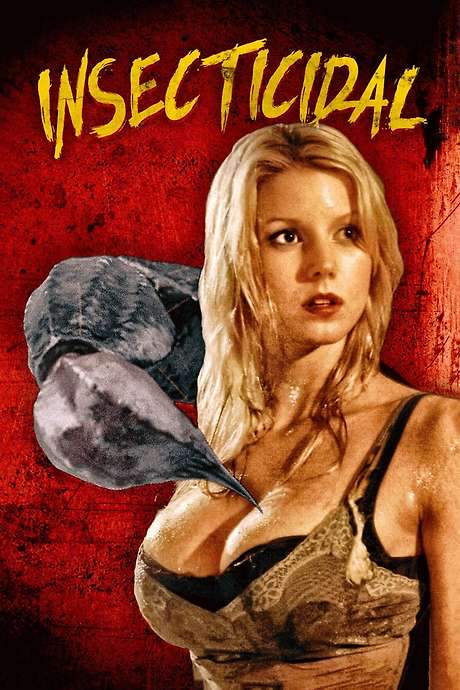
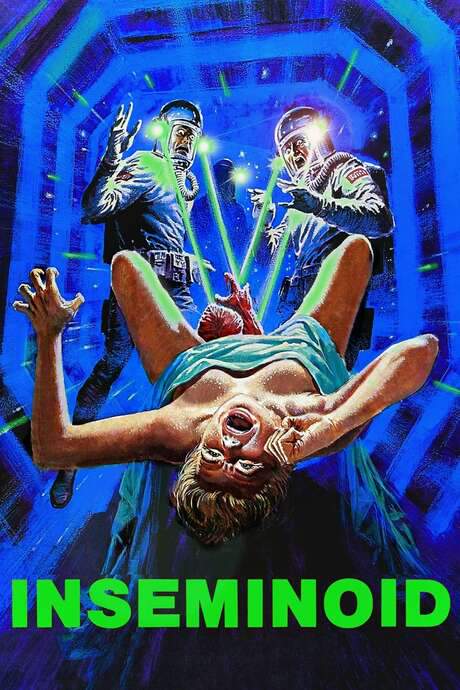
Neil Agar, [William Smith], a special agent with the State Department's Office of Security, is dispatched to Peckham, California to investigate the death of John Grubowsky, a bacteriologist working at the government-sponsored Brandt Research. He quickly makes the acquaintance of the laboratory's head librarian, Julie Zorn, and begins interviewing the facility's leading scientists, many of whom have reputations as sexual players. His inquiry is complicated by a troubling pattern: a number of men are dying of congestive heart failure—apparently caused by sexual exhaustion—even as the town buzzes with rumors and fear.
The local sheriff, Captain Peters [Cliff Osmond], calls a town meeting to discuss the crisis, while the lab’s resident sex researcher, Henry Murger, urges the community to embrace sexual abstinence as a preventative measure. His theory is met with derision by the townspeople, who are more curious than convinced. Later, Agar and Zorn press Murger for explanations, but their conversation takes a dark turn when Murger is suddenly run down by a car with an unseen driver. While Agar is on the phone with the agency, Julie is attacked and sexually assaulted by a group of thugs, an assault he later repels in a display that underscores the danger surrounding the investigation.
In Murger’s home, Agar uncovers a secret room filled with sexual paraphernalia and the presence of Murger’s lover, Joe, who reveals he saw Murger leaving with an unknown woman shortly before his death. The investigation intensifies as a curfew and a military-style quarantine fail to stop the pattern of behavior or the deaths themselves. One of the scientists, Herb Kline [Ben Hammer], is approached by Dr. Susan Harris [Anitra Ford], a brilliant entomologist whose fascination with bees borders on the unsettling. She invites Kline to her lab, where a dangerous liaison unfolds; during their encounter, Kline suffers a fatal thrombosis, and Harris reveals black compound eyes, hinting at a transformation beyond ordinary biology.
As the killer pattern begins to resemble an insect’s life cycle, Neil digs deeper into the mating habits of bees and asks Harris for information. His visit gives Harris the opportunity to advance her project—Nora Kline [Anna Aries], Herb’s wife, is cocooned and subjected to a mutative process. Nora emerges from a chamber swarmed by mutated honey bees, irradiated and awakened with the same eerie eyes and mating drive that marked the other transformed women. The next morning, Kline’s body is found, and Nora, now altered, attempts to seduce Captain Peters in a dangerous gambit to protect the secret.
Neil, having pieced together much of what has happened, calls a meeting of the remaining department heads and shares his theory. The skeptical Stan Williams [Sid Kaiser] dismisses the idea, but the head of diagnostics, Aldo Ferrara [Andre Philippe], is more open to the possibility of a wider conspiracy. At Grubowsky’s funeral, Neil and Julie carry a radiation detector that reveals gamma radiation emanating from the women in attendance—evidence that they have been subjected to the experiment. Realizing they have been detected, the transformed women move to eliminate the scientists left in the building; Williams narrowly escapes an attack from his now-mutated wife, and Dr. Harris herself descends on the lab to complete the transformation of Julie.
When Neil discovers Ferrara’s body, he understands the scope of Harris’s plan and races to the lab. He interrupts the process as the women begin turning Julie into another Bee Person. Harris threatens to kill Julie unless Neil leaves, but he chooses a different path: he draws a revolver, but instead of firing at Harris, he destroys the laboratory’s machinery. Neil then rescues Julie, slams the door shut, and leaves the rest to their doom as the facility’s devices explode around them, ensuring the mutated women perish with the collapsing, irradiated machinery.
The case closes with a quiet relief as the two protagonists step away from the wreckage, their bond forged in a harrowing confrontation with a bizarre, science-driven threat. The film leaves a lingering note about human curiosity, the peril of unchecked experimentation, and the fragile line between science and something almost alien in its drive to reproduce.