Plot Explained Spoilers guaranteed!
Plot Explained

Browse by genre

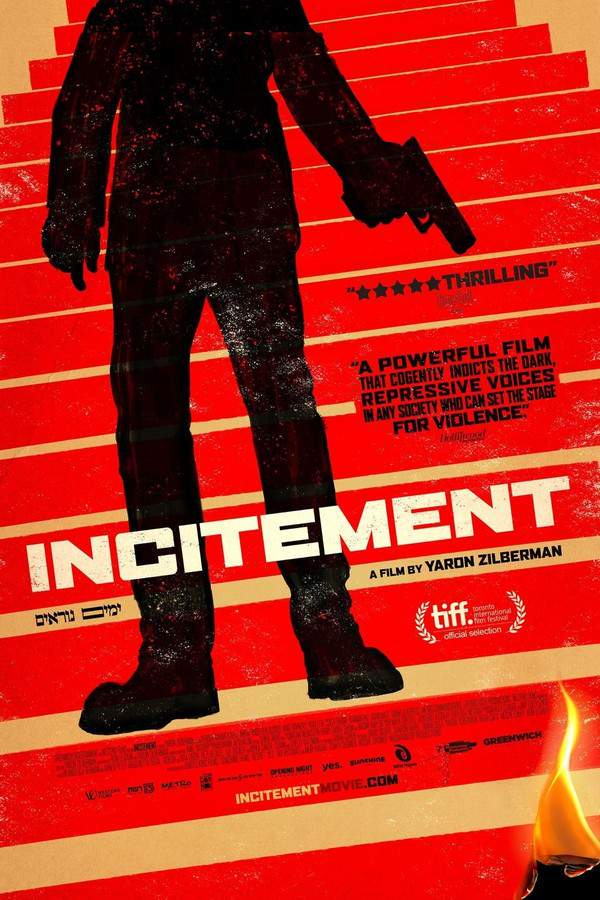
Incitement (2020) movie poster

Plot Summary

Incitement (2020) Plot Summary Explained

Release, runtime and language
2020 · 123 min · Hebrew
Echo score 66
Loading streaming availability…
Directed by
Yaron Zilberman
Starring
Dolev Ohana, Amitay Yaish Ben Ousilio, Anat Ravnitzki, Daniella Kertesz, Eldad Ben Tora, Gur Ya'ari
Budget
$80K

In the lead-up to the historic Oslo Accords, a young man named Yigal Amir becomes radicalized, rejecting moderate politics and embracing violent extremism. Fueled by feelings of rejection and isolation, he establishes a clandestine militia targeting Palestinians. Amir’s increasingly distorted worldview leads him to believe that the only way to safeguard Jewish dominance is to assassinate Israeli Prime Minister Yitzhak Rabin, setting in motion a dangerous and irreversible path.

On this page (5)
  1. 1 Where to watch
  2. 2 What happens: full plot
  3. 3 Plot questions answered
  4. 4 Movie threads
  5. 5 Every angle
Loading streaming availability…

Full plot summary · contains spoilers

What Happens in Incitement: Full Plot Summary

The whole story of Incitement (2020) explained, from the opening scene to the final frame: every key event, every twist and what it all adds up to. Read it as a quick recap before the sequel, to check a scene you missed, or to finally understand what really happened.

The movie Incitement delves into a pivotal year in the life of Yigal Amir, culminating in his tragic assassination of Prime Minister Yitzhak Rabin. The narrative begins with Amir's attendance at the night funeral of Baruch Goldstein in Kiryat Arba, near Hebron. He reveres Goldstein as a figure who executed what he believes to be God's will following a devastating mosque massacre.

Set against the backdrop of the Oslo Accords signed in 1993 between Rabin and Yasser Arafat, the film portrays a landscape marred by ongoing violence and repeated terrorist attacks in both Hebron and Kiryat Arba. Influential right-wing leaders, including Ariel Sharon and Benjamin Netanyahu, label Rabin a "traitor," while certain rabbis engage in contentious debates over whether Rabin can be deemed a rodef (persecutor). Though none explicitly call for his assassination, veiled implications, such as, > "Those who understand will understand," resonate throughout the community, stirring Amir's desires.

The film’s title, Incitement, highlights Amir's visits to various religious leaders, wherein he seeks their approval for the act he is considering. As a student at Bar-Ilan University, Amir also takes initiative by organizing free tours of Israeli settlements for his fellow classmates, embodying a passionate yet misguided nationalist fervor. His father, played by Amitay Yaish Ben Ousilio, appears as a deeply sympathetic figure with humanistic ideals that fail to sway his son's increasingly extreme views.

Amir's interaction with Nava, an Ashkenazi student residing in the Psagot settlement, offers a glimpse into personal versus political motivations. Despite her initial interest, Nava, portrayed by Daniella Kertesz, ultimately marries Amir's best friend, which does not solely drive Amir’s subsequent violent radicalization. Instead, his aspirations for violence bring forth his desire to establish a militia to confront Palestinians, fueled by a cocktail of political fury and toxic racism.

In a twist of dark ingenuity, Amir's brother, Yoav Levi, proposes the use of water pressure to execute an attack on Rabin's apartment. Yet, in a harrowing decision-making process, Amir opts for a more straightforward and chilling approach: to carry out the assassination himself.

As the narrative unfolds, Incitement powerfully examines the intersections of ideology, personal despair, and the tragic implications of radicalization, creating a compelling portrait of a man pushed to commit unspeakable acts in the name of beliefs he holds dear.

Last updated: September 18, 2026 at 08:59

Was this helpful?

Plot questions answered

Incitement Plot Explained: Your Questions Answered

The questions people ask most about Incitement (2020): what happens in the confusing scenes, why the characters do what they do, the twists, hidden details and what the ending means. Each answer contains spoilers.

Q1

Why does Yigal Amir attend Baruch Goldstein's funeral?

Amir attends the night funeral of Baruch Goldstein in Kiryat Arba because he reveres Goldstein as a martyr who carried out what he sees as God's will during the Hebron mosque massacre. This event marks the beginning of Amir's radicalization in Incitement, framing Goldstein's mass killing as a sacred act worth honoring and emulating.

Foreshadowing: Goldstein's legacy of religiously justified violence becomes the template Amir follows when he later seeks rabbinical approval for Rabin's assassination.

  • amir
  • goldstein
  • hebron massacre
  • kiryat arba
  • funeral
  • radicalization
Q2

Why do Israeli right-wing leaders call Rabin a traitor?

After Rabin signs the Oslo Accords with Yasser Arafat in 1993, right-wing opposition figures including Ariel Sharon and Benjamin Netanyahu publicly denounce him as a traitor for conceding land to the Palestinians. This public vilification creates the political climate of hostility that Amir absorbs and channels into his assassination plot in Incitement.

  • rabin
  • traitor
  • oslo accords
  • sharon
  • netanyahu
  • right-wing opposition
Q3

Why do the rabbis debate whether Rabin is a 'rodef'?

Rodef is a Hebrew term meaning 'persecutor,' a category in Jewish law that traditionally justifies lethal force to stop someone from endangering others. In Incitement, certain rabbis debate whether Rabin qualifies as a rodef for pursuing the Oslo Accords, and while they stop short of explicitly calling for his death, their veiled implications give Amir the religious framework he needs to justify murder.

  • rodef
  • persecutor
  • rabbis
  • rabbinical debate
  • hebrew
  • jewish law
Q4

Why does Amir seek approval from rabbis before deciding to kill Rabin?

Amir needs religious validation because he cannot act on his own moral authority alone. His visits to various rabbis in Incitement reflect his internal struggle and his desire to frame the assassination as a sanctioned religious duty rather than a personal vendetta, which intensifies the ideological weight behind his decision.

Foreshadowing: The title of the film itself refers to this process of seeking veiled endorsement for violence.

  • amir
  • rabbis
  • religious approval
  • assassination
  • ideology
  • incitement
Q5

Why doesn't Nava's rejection fully explain Amir's radicalization?

Although Amir is deeply hurt when Nava, an Ashkenazi student from the Psagot settlement, marries his best friend, Incitement explicitly shows that romantic rejection is not the primary driver of his radicalization. His path toward violence predates the relationship and is fueled instead by political fury, religious ideology, and deep-seated racism toward Palestinians and Ashkenazi Jews.

Foreshadowing: Amir's militia ambitions appear before the romance collapses, signaling that political violence was already his central obsession.

  • nava
  • amir
  • rejection
  • psagot
  • ashkenazi
  • romance
  • racism
Q6

Why does Amir reject his brother's plan and decide to assassinate Rabin himself?

Amir's brother, a plumber, proposes using water pressure to launch explosives at Rabin's apartment as a more detached and technical approach. Amir rejects it because he believes only a direct, personal act will fulfill what he sees as a sacred obligation. This decision in Incitement reflects his desire to be the instrument of what he considers divine justice, marking the final step toward the assassination.

Foreshadowing: Amir's preference for personal action over indirect methods mirrors Goldstein's example of carrying out violence with his own hands.

  • amir
  • brother
  • water pressure
  • assassination
  • explosives
  • yoav levi
Q7

How do the Oslo Accords push Amir toward assassinating Rabin?

The 1993 Oslo Accords represent, to Amir, a betrayal of Jewish sovereignty and a dangerous concession to enemies. Combined with the wave of terrorist attacks that erupts in Hebron and Kiryat Arba afterward, the peace process triggers Amir's conviction that Rabin must be stopped. In Incitement, the Accords are not just a political backdrop but the central catalyst that transforms Amir's ideology into a concrete assassination plan.

  • oslo accords
  • rabin
  • arafat
  • peace process
  • hebron
  • catalyst
Q8

What does Amir's militia plan reveal about his motivations?

Long before settling on assassinating Rabin, Amir plans to establish a militia aimed at confronting Palestinians directly, blending political zeal with toxic racism. This plan in Incitement shows that his violence is not a sudden impulse but a long-held ambition that simply finds its ultimate target in the Prime Minister.

Foreshadowing: The militia idea reveals that Rabin is chosen as a target of opportunity, not the original object of Amir's rage.

  • amir
  • militia
  • palestinians
  • racism
  • violence
  • extremism
Q9

Why does Amir organize free settlement tours for his Bar-Ilan classmates?

As a student at Bar-Ilan University, Amir organizes free weekend tours of Israeli settlements to expose his peers to the realities of what he considers the Jewish homeland. In Incitement, this initiative serves as a recruitment and radicalization tool, demonstrating his desire to spread his nationalist ideology and build a committed following beyond himself.

  • amir
  • bar-ilan university
  • settlement tours
  • students
  • nationalism
  • recruitment
Q10

What does the title 'Incitement' refer to in the film?

The title Incitement points to the layered system of provocation that enables Amir's act: the political rhetoric labeling Rabin a traitor, the rabbinical debates that imply violence without stating it, and the broader culture that allows such ideas to circulate unchecked. Rather than focusing on Amir alone, the title implicates the entire ecosystem of speech and ideology that made the assassination possible.

  • incitement
  • title
  • ideology
  • rhetoric
  • extremism
  • responsibility
Q11

Why can't Amir's father prevent his radicalization?

Amir's father is portrayed as a sympathetic and humane man who tries to instill humanistic values in his son, yet Incitement shows he cannot compete with the ideological and religious narratives Amir has already absorbed. His failure reflects a generational and ideological divide where parental love alone is no match for the seductive certainty of extremist conviction.

  • amir
  • father
  • humanism
  • family
  • radicalization
  • generational divide
Q12

Why does the film focus on the year before the assassination rather than the act itself?

The film deliberately spends most of its runtime on Amir's slow radicalization rather than the assassination because the tragedy lies not in a single violent moment but in the ordinary, step-by-step construction of justification. By tracing how ideology, religion, racism, and personal grievance converge over a year, Incitement shows how an unthinkable act becomes psychologically inevitable.

  • radicalization
  • pacing
  • year
  • assassination
  • structure
  • inevitability

Movie threads

More Movies Like Incitement, by Mood & Story

Curated lists built around what makes Incitement tick: the same mood, the same kind of story or the same emotional payoff. Each list explains why these movies belong together.

Movies about radicalization and ideological descent like Incitement

Stories that trace how ordinary people construct rationalizations for unthinkable violence. If you were gripped by Incitement's unflinching look at how Yigal Amir justified assassination, these movies like Incitement explore similar characters whose ordinary lives spiral toward extremism. Expect politically charged dramas and character studies that trace ideological corruption step by step, perfect for viewers seeking morally complex thrillers about the road to violence.

  • foreboding
  • chilling
  • methodical
  • disturbing
  • oppressive
  • unsettling
  • Tone: dark, foreboding, chilling
  • Pacing: slow burn, methodical
Why these movies?

The story pattern: Films in this thread typically follow a recognizable but troubled individual whose worldview begins to fracture under personal grievances, political pressure, or social isolation. As they seek validation from ideologues, mentors, or fringe communities, their moral framework slowly warps until violence becomes not just acceptable but necessary in their mind. The narrative structure is usually linear but psychological, peeling back layers of rationalization. The climax is rarely a surprise — it is an inevitability the audience has been dreading since early on, and the ending almost always refuses any redemptive arc.

Why they belong together: These films share a commitment to inhabiting the interior life of an extremist or morally compromised character rather than treating them as monsters or one-dimensional villains. They lean on slow pacing to allow ideology and resentment to seep in, complex political or social context to ground the descent, and bleak endings that refuse easy redemption. The shared emotional experience is intellectual discomfort — the slow recognition that ordinary human psychology can produce horrifying acts.


Slow burn political thrillers with bleak inevitability like Incitement

Films where dread comes from knowing exactly where the story is heading. If you appreciated Incitement's slow, methodical build toward an assassination you knew was coming, these movies like Incitement deliver similar slow burn dread. Expect atmospheric political thrillers and historical dramas where pacing is deliberate, tension is oppressive, and endings refuse any comfort — ideal for viewers who want intellectually and emotionally demanding cinema.

  • oppressive
  • foreboding
  • somber
  • methodical
  • unsettling
  • weighted
  • Tone: dark, oppressive, somber
  • Pacing: slow burn, deliberate
Why these movies?

The story pattern: Stories in this thread tend to begin with the end already implicit — an event the audience knows is coming, a fate the characters are hurtling toward. The films spend their runtime not on surprise but on the texture of inevitability: the political maneuvering, the personal grievances, the cultural climate, the quiet moments before rupture. Pacing is intentionally slow so that every scene feels loaded with consequence. The tone is consistently heavy, often dark, with bleak endings that rarely offer catharsis. The viewing experience is closer to bearing witness than being entertained.

Why they belong together: These films share a commitment to using slow pacing as a tool of emotional accumulation rather than as a description of plot density. They pair high intensity with heavy emotional weight, often within politically charged or morally complex settings. Where most thrillers chase adrenaline, these films pursue an almost documentary-like gravity, letting historical or psychological context dominate over spectacle. The result is a distinctive viewing experience that is intellectually rigorous, emotionally draining, and impossible to shake.

Every angle

Incitement (2020) Explained: Plot, Timeline & Characters

Everything about Incitement in one place: what happens in the plot summary, the timeline in chronological order, the characters and meaning and a spoiler-free summary. What's After the Movie adds the cast, box office and post-credit scenes.

Coming soon on iOS and Android

The Plot Explained Movie Summary App

Plot summaries, endings explained and timelines on your phone. Catch up on any movie in minutes, save your favorites and never miss a twist again.

Be the first to know when we launch. Your email stays private, always.

Learn more about the app