










Plot Explained Spoilers guaranteed!
Plot Explained

Browse by genre

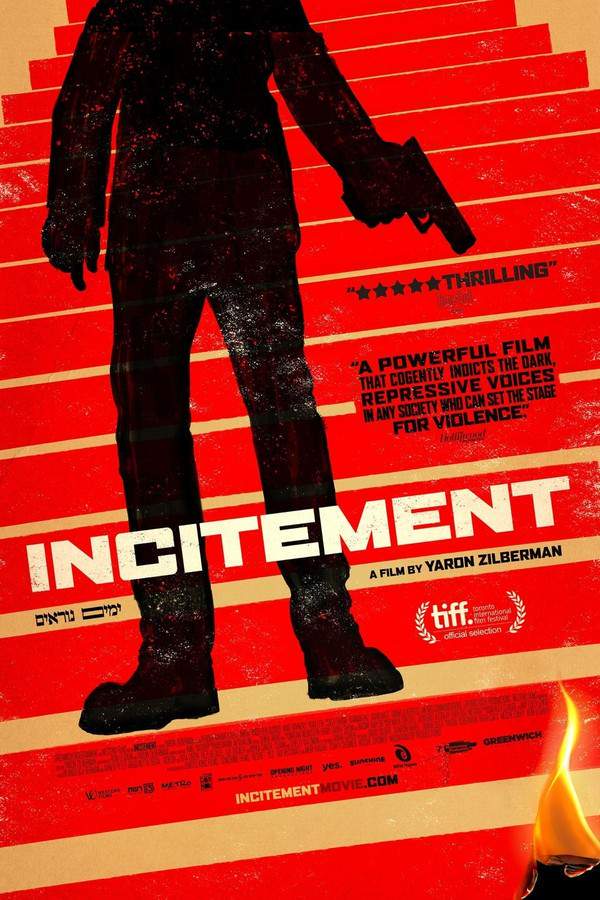
Incitement (2020) movie poster

Timeline

Incitement (2020) Timeline Explained – Every Event in Order

Release, runtime and language
2020 · 123 min · Hebrew
Echo score 66
Directed by
Yaron Zilberman
Starring
Dolev Ohana, Amitay Yaish Ben Ousilio, Anat Ravnitzki, Daniella Kertesz, Eldad Ben Tora, Gur Ya'ari
Budget
$80K

In the lead-up to the historic Oslo Accords, a young man named Yigal Amir becomes radicalized, rejecting moderate politics and embracing violent extremism. Fueled by feelings of rejection and isolation, he establishes a clandestine militia targeting Palestinians. Amir’s increasingly distorted worldview leads him to believe that the only way to safeguard Jewish dominance is to assassinate Israeli Prime Minister Yitzhak Rabin, setting in motion a dangerous and irreversible path.

On this page (4)
  1. 1 Where to watch
  2. 2 Events in order (13)
  3. 3 Movie threads
  4. 4 Every angle

Where to watch

Where to Watch Incitement (2020)

Where can you watch Incitement? Stream, rent or buy it in the US, including on Hoopla, Kanopy and Plex: current JustWatch availability with up-to-date prices.

Streaming availability powered by JustWatch

13 events in order · contains spoilers

Incitement Timeline: Events in Chronological Order

Every key event of Incitement (2020) in order, scene by scene, with when and where it takes place. Use it to untangle flashbacks, time jumps and parallel storylines, to refresh your memory before the sequel or to find the exact scene you are thinking of.

  1. Amir's Funeral Attendance

    Yigal Amir attends the night funeral of Baruch Goldstein in Kiryat Arba. He views Goldstein as a martyr who executed God's will, solidifying Amir's extremist beliefs.

    Where
    Kiryat Arba
  2. Signing of the Oslo Accords

    The Oslo Accords are signed in 1993, representing a breakthrough in Israeli-Palestinian relations. This event leads to heightened tensions and violence in regions such as Hebron and Kiryat Arba.

    When
    1993
  3. Increased Violence

    Following the Oslo Accords, terrorist attacks erupt in both Hebron and Kiryat Arba. The violence leaves numerous casualties, fueling anger and political divisions among Israeli citizens.

    Where
    Hebron, Kiryat Arba
  4. Rabin Confronted as a Traitor

    Right-wing opposition leaders, including prominent figures like Ariel Sharon and Benjamin Netanyahu, label Yitzhak Rabin as a 'traitor.' This public vilification intensifies the hostility towards Rabin and the peace process.

  5. Rabbis Debate Rabin's Status

    Certain rabbis engage in heated debates regarding whether Rabin should be considered a rodef, someone perceived as a persecutor. While they stop short of openly advocating his assassination, their veiled threats resonate with many extremists.

  6. Amir Seeks Religious Justification

    Yigal Amir visits various rabbis in search of religious sanction for his plan to assassinate Rabin. His consultations reflect the broader ideological struggle within Israeli society and Amir's radicalization.

  7. Organizing Tours for Students

    Amir, a student at Bar-Ilan University, organizes free weekend tours to Israeli settlements. This initiative not only showcases his commitment to the nationalist agenda but also influences his peers towards similar ideologies.

    Where
    Bar-Ilan University
  8. Amir's Familial Dynamics

    Amir's father, portrayed as a sympathetic character, attempts to instill humanistic values in his son. Despite his efforts, Amir remains steadfast in his radical beliefs, highlighting the generational and ideological divide.

  9. Amir's Romantic Interests

    Amir pursues Nava, an Ashkenazi student from the settlement of Psagot. Their relationship ultimately reveals the cultural tensions and biases within Israeli society, particularly concerning Yemeni Jews.

    Where
    Psagot
  10. Nava's Rejection

    After rejecting Amir's advances, Nava marries his best friend, further alienating Amir. While this rejection affects him deeply, it is not the primary motivation behind his decision to become an assassin.

  11. Amir's Militia Plans

    Even prior to his romantic setbacks, Amir plans to form a militia aimed at countering Palestinian forces. His strategy reflects a blend of political zeal and deep-seated racism, pushing him closer to violence.

  12. Brother's Dangerous Suggestion

    Amir's plumber brother proposes using water pressure to launch explosives towards Rabin's apartment. This suggestion highlights the extreme measures Amir is willing to consider in pursuit of his goals.

  13. Final Decision to Assassinate

    Ultimately, Amir decides on the most straightforward and terrifying method: he resolves to assassinate Yitzhak Rabin directly. This event marks a significant and tragic turning point in Israeli history.

Last updated: September 18, 2026 at 08:59

Was this helpful?

Movie threads

More Movies Like Incitement, by Mood & Story

Curated lists built around what makes Incitement tick: the same mood, the same kind of story or the same emotional payoff. Each list explains why these movies belong together.

Movies about radicalization and ideological descent like Incitement

Stories that trace how ordinary people construct rationalizations for unthinkable violence. If you were gripped by Incitement's unflinching look at how Yigal Amir justified assassination, these movies like Incitement explore similar characters whose ordinary lives spiral toward extremism. Expect politically charged dramas and character studies that trace ideological corruption step by step, perfect for viewers seeking morally complex thrillers about the road to violence.

  • foreboding
  • chilling
  • methodical
  • disturbing
  • oppressive
  • unsettling
  • Tone: dark, foreboding, chilling
  • Pacing: slow burn, methodical
Why these movies?

The story pattern: Films in this thread typically follow a recognizable but troubled individual whose worldview begins to fracture under personal grievances, political pressure, or social isolation. As they seek validation from ideologues, mentors, or fringe communities, their moral framework slowly warps until violence becomes not just acceptable but necessary in their mind. The narrative structure is usually linear but psychological, peeling back layers of rationalization. The climax is rarely a surprise — it is an inevitability the audience has been dreading since early on, and the ending almost always refuses any redemptive arc.

Why they belong together: These films share a commitment to inhabiting the interior life of an extremist or morally compromised character rather than treating them as monsters or one-dimensional villains. They lean on slow pacing to allow ideology and resentment to seep in, complex political or social context to ground the descent, and bleak endings that refuse easy redemption. The shared emotional experience is intellectual discomfort — the slow recognition that ordinary human psychology can produce horrifying acts.


Slow burn political thrillers with bleak inevitability like Incitement

Films where dread comes from knowing exactly where the story is heading. If you appreciated Incitement's slow, methodical build toward an assassination you knew was coming, these movies like Incitement deliver similar slow burn dread. Expect atmospheric political thrillers and historical dramas where pacing is deliberate, tension is oppressive, and endings refuse any comfort — ideal for viewers who want intellectually and emotionally demanding cinema.

  • oppressive
  • foreboding
  • somber
  • methodical
  • unsettling
  • weighted
  • Tone: dark, oppressive, somber
  • Pacing: slow burn, deliberate
Why these movies?

The story pattern: Stories in this thread tend to begin with the end already implicit — an event the audience knows is coming, a fate the characters are hurtling toward. The films spend their runtime not on surprise but on the texture of inevitability: the political maneuvering, the personal grievances, the cultural climate, the quiet moments before rupture. Pacing is intentionally slow so that every scene feels loaded with consequence. The tone is consistently heavy, often dark, with bleak endings that rarely offer catharsis. The viewing experience is closer to bearing witness than being entertained.

Why they belong together: These films share a commitment to using slow pacing as a tool of emotional accumulation rather than as a description of plot density. They pair high intensity with heavy emotional weight, often within politically charged or morally complex settings. Where most thrillers chase adrenaline, these films pursue an almost documentary-like gravity, letting historical or psychological context dominate over spectacle. The result is a distinctive viewing experience that is intellectually rigorous, emotionally draining, and impossible to shake.

Every angle

Incitement (2020) Explained: Plot, Timeline & Characters

Everything about Incitement in one place: what happens in the plot summary, the timeline in chronological order, the characters and meaning and a spoiler-free summary. What's After the Movie adds the cast, box office and post-credit scenes.

Coming soon on iOS and Android

The Plot Explained Movie Summary App

Plot summaries, endings explained and timelines on your phone. Catch up on any movie in minutes, save your favorites and never miss a twist again.

Be the first to know when we launch. Your email stays private, always.

Learn more about the app