Plot Explained Spoilers guaranteed!
Plot Explained

Browse by genre

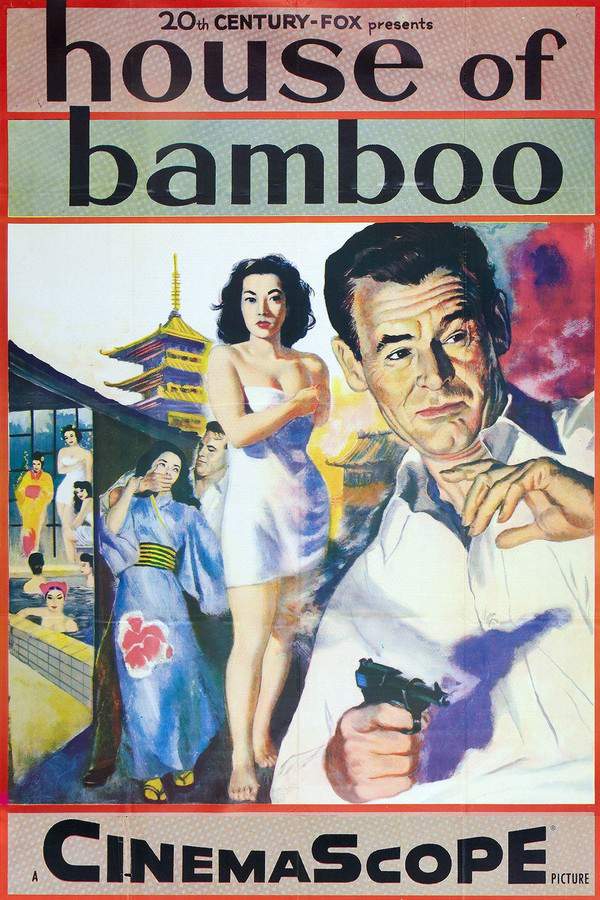
House of Bamboo (1955) (2011) movie poster

Plot Summary

House of Bamboo (1955) (2011) Plot Summary Explained

Release, runtime and language
2011 · 102 min · English
Loading streaming availability…
Directed by
Samuel Fuller
Starring
Robert Ryan, Robert Stack

In 1950s Tokyo, a U.S. Army agent goes undercover to investigate a dangerous gang led by the former soldier Sandy Dawson. He infiltrates their organization, gaining their trust while attempting to expose their crimes. The agent finds himself caught in a complex situation, entangled in a forbidden romance with Mariko, the wife of a deceased gang member. The story unfolds against a backdrop of corruption, betrayal, and escalating violence.

On this page (5)
  1. 1 Where to watch
  2. 2 What happens: full plot
  3. 3 Plot questions answered
  4. 4 Movie threads
  5. 5 Every angle
Loading streaming availability…

Full plot summary · contains spoilers

What Happens in House of Bamboo (1955): Full Plot Summary

The whole story of House of Bamboo (1955) (2011) explained, from the opening scene to the final frame: every key event, every twist and what it all adds up to. Read it as a quick recap before the sequel, to check a scene you missed, or to finally understand what really happened.

In 1954, a meticulously guarded military train, loaded with armaments, smoke bombs, and firearms, was audaciously robbed by a crafty band of thieves. This brazen heist unfolded before the watchful gazes of American soldiers and Japanese police, culminating in the tragic loss of a U.S. Army sergeant's life. Fast-forward five weeks to a Tokyo hospital, where the infamous thief, Webber, breathes his last, having been betrayed by one of his own during a failed robbery that left a cloud of smoke bombs in its wake. The deadly P38 pistol that snuffed out Webber's life was the very same weapon that took the sergeant's life aboard the train.

As both U.S. Army investigators and Japanese police dug into the case, they unearthed a mysterious letter amongst Webber's belongings, directed to an American named Eddie Spanier, eager to be reunited with his friend after serving time in a U.S. prison. Although Webber chose not to implicate his fellow gang members, he did disclose his secret marriage to a Japanese woman, Mariko Nagoya, whose identity remained concealed from both military and law enforcement eyes.

Three weeks later, Eddie touched down in Tokyo, re-establishing his connection with Mariko by way of a photograph capturing happier moments shared with Webber. As Mariko recounted the heart-wrenching story behind her husband's death, she revealed that Webber had entangled her in a web of secrecy regarding their marriage, never disclosing his life of crime, fearing that seeking assistance from authorities would endanger her.

Soon, Eddie’s arrival caught the attention of Tokyo’s criminal underbelly, as he attempted to peddle “protection” services to a pachinko parlour manager. However, his efforts led to a brutal beating at the hands of American toughs, led by the fearsome Sandy Dawson, who was fascinated by Eddie's audacity and invited him to join his gang of disillusioned ex-servicemen.

As Eddie infiltrated the ranks of this gang, he maintained stealthy communication with U.S. and Japanese authorities, working undercover to piece together the puzzle of Webber's unexpected demise. To further establish his cover, Eddie proposed that Mariko act as his "kimono girl," a role she reluctantly accepted in the hope that it would help her uncover the reality of her husband's murder.

In the throes of this treacherous environment, Sandy began to begrudgingly trust Eddie, even going so far as to save his life during a botched robbery—a move that defied the gang's unspoken codes. As Eddie navigated these perilous waters, he found himself torn between his allegiance to Mariko and his commitment to revealing the truth behind Webber's death.

With the truth inching closer to the surface, Eddie unveiled his true identity as U.S. Army Sergeant Edward Kenner, embedding himself within Sandy's gang under the guise of an undercover operative. Mariko remained devoted, pledging her support for Eddie's investigation. However, their covert mission faced jeopardy when Charlie—a loyal accomplice of Sandy—spotted Mariko discussing the gang's upcoming heist with a high-ranking American army officer. Alarmed by this discovery, Charlie alerted Sandy, leading him to call off the job and reorganize his crew. Meanwhile, a mysterious informant named Ceram warned Sandy that the police were closing in and that Eddie was, in fact, a military infiltration.

Seizing upon this information, Sandy devised a deadly trap for Eddie, orchestrating a staged robbery intended to end in Eddie's execution. Tasked with executing the plan, Charlie accidentally became a victim as he struggled to keep Eddie upright, only to be gunned down by the police. In the ensuing chaos, Sandy found himself pursued by law enforcement and a recovering Eddie, culminating in a thrilling rooftop clash at an amusement park. Ultimately, Eddie emerged triumphant, eliminating Sandy in a whirlwind of gunfire. As the dust settled, Eddie was united with Mariko, bringing a poignant closure to this harrowing chapter in their lives.
Last updated: November 17, 2024 at 20:13

Was this helpful?

Plot questions answered

House of Bamboo (1955) Plot Explained: Your Questions Answered

The questions people ask most about House of Bamboo (1955) (2011): what happens in the confusing scenes, why the characters do what they do, the twists, hidden details and what the ending means. Each answer contains spoilers.

Q1

Why was Webber killed after the train robbery?

Webber was betrayed and killed by one of his own gang members during a failed robbery attempt. The murder weapon was a P38 pistol, the same gun used to kill the U.S. Army sergeant during the original train heist, creating a direct connection between the two crimes.

Foreshadowing: The summary hints that internal betrayal led to his downfall, as Webber chose not to name his fellow gang members even as he died.

  • webber death
  • p38 pistol
  • train robbery
  • gang betrayal
Q2

Why does Eddie Spanier come to Tokyo?

Eddie comes to Tokyo after receiving a letter from Webber, who was eager to reunite with his friend after serving time in a U.S. prison. The letter also mentioned Webber's secret marriage to a Japanese woman named Mariko Nagoya.

  • eddie spanier
  • tokyo arrival
  • webber letter
  • mariko nagoya
Q3

Why does Sandy Dawson let Eddie join his gang?

Sandy is intrigued by Eddie's audacity after witnessing him get brutally beaten by American toughs yet still attempting to sell protection services. This boldness impresses Sandy, who runs a gang of disillusioned ex-servicemen, and he extends an invitation for Eddie to join.

  • sandy dawson
  • eddie infiltrates
  • ex-servicemen gang
  • protection racket
Q4

Why does Sandy save Eddie during the botched robbery?

During a failed robbery, Sandy defies the gang's unspoken codes by saving Eddie's life. This act marks a turning point in their relationship, generating begrudging trust between them despite Sandy's typical ruthlessness.

Foreshadowing: Earlier scenes establish Sandy's brutal nature, making this act of loyalty unexpected and significant.

  • sandy saves eddie
  • robbery
  • trust building
  • character development
Q5

Why does Charlie tell Sandy about Mariko talking to an officer?

Charlie spots Mariko discussing the gang's upcoming heist with a high-ranking American army officer. Alarmed by this discovery, Charlie immediately alerts Sandy, who responds by calling off the job and reorganizing his crew to prevent exposure.

  • charlie discovers mariko
  • heist exposed
  • sandy notified
  • gang security
Q6

Why does Sandy set a deadly trap for Eddie?

The informant Ceram warns Sandy that police are closing in and that Eddie is actually a military infiltration agent. Using this knowledge, Sandy orchestrates a staged robbery designed to execute Eddie, turning the planned heist into a lethal trap.

Foreshadowing: Ceram's warning provides the catalyst for Sandy's final betrayal, reversing the trust he had built with Eddie.

  • ceram informant
  • sandy trap
  • eddie exposed
  • staged robbery
Q7

Why does Charlie die during the staged robbery?

Charlie is tasked with executing the trap but accidentally becomes a victim while struggling to keep Eddie upright during the chaos. He is gunned down by police in the confusion, dying inadvertently while trying to carry out Sandy's plan.

  • charlie death
  • police shooting
  • staged robbery
  • accidental victim
Q8

How does Eddie defeat Sandy on the amusement park rooftop?

After the failed trap, Sandy flees to an amusement park rooftop with law enforcement and a recovering Eddie in pursuit. In the climactic confrontation, Eddie prevails in a gunfire exchange, killing Sandy and surviving the showdown.

Foreshadowing: The rooftop setting was established earlier as a location connected to the gang's activities.

  • rooftop fight
  • sandy defeated
  • amusement park
  • climax
Q9

Why does the P38 pistol connect Webber's death to the train heist?

The P38 pistol that killed Webber was the exact same weapon used to murder the U.S. Army sergeant during the military train robbery. This detail links the two crimes and reveals the weapon's journey through the criminal underworld.

Foreshadowing: The opening train heist establishes the sergeant's murder as a pivotal event.

  • p38 pistol
  • weapon evidence
  • sergeant murder
  • crime connection
Q10

Why does Mariko keep her marriage to Webber hidden?

Webber never revealed his criminal life to Mariko, deliberately keeping her unaware of his involvement in the train robbery and other crimes. He feared that seeking help from authorities would endanger her, so he maintained the secrecy that ultimately left her vulnerable and uninformed.

  • mariko secret marriage
  • webber hidden life
  • protection
  • truth concealed

Movie threads

More Movies Like House of Bamboo (1955), by Mood & Story

Curated lists built around what makes House of Bamboo (1955) tick: the same mood, the same kind of story or the same emotional payoff. Each list explains why these movies belong together.

Undercover crime thrillers like House of Bamboo (1955)

An agent infiltrates a criminal underworld, risking everything in a web of deceit. For viewers who enjoyed the high-stakes tension of House of Bamboo, this thread gathers movies about deep-cover agents infiltrating dangerous organizations. Discover similar stories of betrayal, moral conflict, and the psychological toll of living a lie, where the hero's survival hinges on their ability to maintain a fragile deception.

  • tense
  • paranoid
  • dangerous
  • suspenseful
  • deceptive
  • high-stakes
  • Tone: tense, dangerous, morally ambiguous
  • Pacing: steady, methodical build-up
Why these movies?

The story pattern: The narrative follows an agent as they assume a false identity to gain the trust of a powerful criminal syndicate. The plot is driven by escalating risks, close calls with discovery, and the internal conflict of forming bonds with the very people they must betray. The climax typically involves a violent confrontation where the protagonist's cover is finally blown.

Why they belong together: Movies in this thread are united by the specific tension of an undercover operation. They share a mood of sustained paranoia, a high-intensity tone, and a plot structure built on deception and the inevitable, explosive unmasking.

Gritty foreign crime dramas with a noir feel like House of Bamboo (1955)

A morally conflicted protagonist navigates a corrupt and gritty foreign landscape. If you liked the post-war Tokyo setting and grim atmosphere of House of Bamboo, this thread features movies that blend crime narratives with a strong sense of place. Explore similar neo-noir stories set in corrupt foreign underworlds, where outsiders become entangled in local conflicts and forbidden relationships.

  • grimy
  • melancholic
  • atmospheric
  • corrupt
  • alienation
  • anxious
  • Tone: tense, melancholic, bleak
  • Pacing: steady, atmospheric
Why these movies?

The story pattern: The narrative follows an outsider, often a soldier, detective, or fugitive, who enters a foreign cityscape riddled with crime. They become embroiled in a central conflict that forces them to challenge the local power structure. A fraught romance with a local often provides personal stakes, complicating their mission and highlighting their isolation. The resolution is typically bittersweet, involving significant loss amidst a hard-won victory.

Why they belong together: These movies are grouped by their shared atmosphere and world-building. The combination of a tense, heavy crime plot with a specific, evocative foreign setting creates a unique vibe of melancholy, alienation, and grimy realism that defines the thread.

Every angle

House of Bamboo (1955) (2011) Explained: Plot, Timeline & Characters

Everything about House of Bamboo (1955) in one place: what happens in the plot summary, the timeline in chronological order, the characters and meaning and a spoiler-free summary. What's After the Movie adds the cast, box office and post-credit scenes.

Coming soon on iOS and Android

The Plot Explained Movie Summary App

Plot summaries, endings explained and timelines on your phone. Catch up on any movie in minutes, save your favorites and never miss a twist again.

Be the first to know when we launch. Your email stays private, always.

Learn more about the app