Year: 1974
Runtime: 96 mins
Language: English
Director: Larry Yust
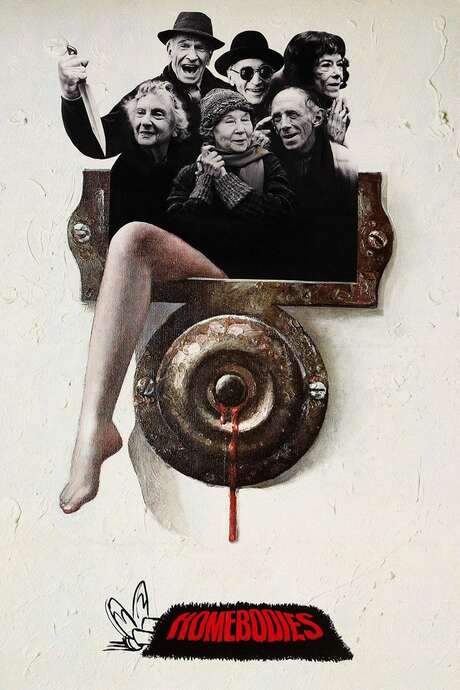
When a tranquil group of pensioners learns their homes are slated for demolition to make way for a new block of flats, they band together to resist. Their quiet protest quickly turns violent, escalating into a brutal campaign of murder that targets both the developers and the construction workers.
Warning: spoilers below!
Haven’t seen Homebodies yet? This summary contains major spoilers. Bookmark the page, watch the movie, and come back for the full breakdown. If you're ready, scroll on and relive the story!
Read the complete plot breakdown of Homebodies (1974), including all key story events, major twists, and the ending explained in detail. Discover what really happened—and what it all means.
Elderly pensioner Mattie Spencer, [Paula Trueman], watches from her Cincinnati apartment as modern redevelopment sweeps across the block, threatening eviction for tenants next door to make way for a gleaming skyscraper financed by the ambitious businessman Mr. Crawford, [Douglas Fowley]. Nearby, Emily Wilkins, [Frances Fuller], an agoraphobic whose father once owned several buildings in the neighborhood, speaks softly of the place’s memories to Mattie as the city’s progress presses in. Outside, tragedy interrupts the morning quiet when a construction worker plummets to his death, casting a pall over the quiet street and foreshadowing a darker course for the residents.
The looming eviction is enforced by Miss Pollack, [Linda Marsh], a social worker who delivers relocation notices with clinical efficiency. Tensions flare: Sandy, [William Hansen], a reserved writer who has put down roots in the building, resists leaving, while Mr. Blakely, [Peter Brocco], an elderly blind man, laments that adjusting to a new environment will be a moment-to-moment struggle. As the utilities in the building are shut off, residents improvise by lighting candles and even burning small flames inside to stay warm, heightening the sense of danger and dependence on an aging, fragile infrastructure.
The following morning, an explosion on the construction site kills three workers, and the foreman and his crew abandon the project in anger and fear. A regulator informs Crawford that the accident might have been deliberately caused, a possibility that casts a shadow over the entire redevelopment. Miss Pollack returns with police, and it seems most tenants have agreed to relocate, though Mattie and Emily have vanished. The Loomises, Mr. Blakely, and Mr. Sandy are relocated to retirement housing, while the building itself seems to tilt toward a fate of abandonment and memory.
Back at the building, Emily and Mattie unexpectedly ambush Miss Pollack, and Emily fatally stabs her. Mattie escapes in Miss Pollack’s car and disposes of the bloodied knife by dumping it into a passing garbage truck. The others’ relocation becomes a temporary quiet, but they soon return to the building, where Mattie reveals Miss Pollack’s corpse, a grim trophy of their defiance. They maneuver Miss Pollack’s wheelchair-bound body and shove it onto a passing train, a macabre act that signals the depths of their resolve.
With Miss Pollack out of the way, the group lures Crawford to the building. They incapacitate him and, when he offers to move them to a nicer building, they refuse and drive him to the skyscraper site, where he is buried alive in wet cement. As the work continues, Crawford’s foot protrudes, and Loomis, with stoic determination, hacks off the offending limb, keeping the severed foot as a grisly reminder of the price of oppression and greed.
Demolition roars around them, and Mrs. Loomis begins to feel the weight of guilt settling in. She contemplates reporting the murder to the police, but Mattie’s fevered conviction remains unshaken. In a brutal moment, Mattie strikes her with an urn containing Emily’s father’s ashes and then murders Mr. Sandy to silence him. Fearful for her safety, Emily flees to the skyscraper while Mattie gives chase, their pursuit culminating on a high scaffold. A security guard witnesses the confrontation and intervenes, and Mr. Loomis, Mr. Blakely, and Emily come to escort Mattie and Emily back to the building, trying to restore a fragile balance.
Mattie’s vow to keep killing anyone who stands in her way hardens the atmosphere into a testament of stubborn, unyielding violence. The trio—Loomis, Blakely, and Emily—launch a final inglorious bid to stop her, attempting to push her in front of a moving truck, but she narrowly escapes. She escapes into the park and attempts to vanish on a paddleboat, yet her pursuers close in on the water, and she is thought drowned in the lake. As the wrecking ball continues its merciless arc across the apartment block, Emily, Blakely, and Loomis depart the area, leaving the fate of their former neighbor unresolved. In a bleak alleyway, they encounter another elderly couple facing eviction, a reminder that the cycle of displacement continues. Moments later, a vengeful Mattie appears in the alley, having survived the attempt on her life, leaving her ultimate fate shrouded in ambiguity as the neighborhood’s skyline redefines the lives within it.
Last Updated: October 07, 2025 at 10:01
Discover curated groups of movies connected by mood, themes, and story style. Browse collections built around emotion, atmosphere, and narrative focus to easily find films that match what you feel like watching right now.
Ordinary people pushed to extremes, with the horror made morbidly funny.If you liked the grim comedy and brutal violence of Homebodies, explore more movies where dark humor meets desperate acts. This thread features films about ordinary people cracking under pressure, with stories that use sardonic wit to offset their shocking brutality. Find similar tales of moral decay and violent rebellion.
The narrative typically starts with a relatable injustice or pressure point that pushes sympathetic but ordinary characters over the edge. Their initial resistance gradually escalates into premeditated, brutal acts, with the story using dark comedy to highlight the absurdity and horror of their transformation. The focus is on the ironic juxtaposition of mundane settings with extreme violence.
Movies are grouped here for their shared tone: a specific blend of high-intensity horror and cynical, dark comedy. They feature protagonists who are morally compromised yet strangely sympathetic, and they deliver a viewing experience that is simultaneously grim, tense, and morbidly amusing.
Stories where societal pressures crush characters, leading to a grim, unresolved end.For viewers who appreciated the social commentary and bleak ending of Homebodies, this thread collects movies that use horror to explore themes of injustice and moral decay. Discover similar stories about characters fighting back against oppressive systems, only to be consumed by the violence they unleash. Find films with heavy emotional weight and unresolved, cynical conclusions.
The narrative revolves around a clear social conflict that forces characters into a corner. Their rebellion, while initially justified, becomes increasingly violent and morally questionable. The story methodically shows their descent, culminating in an ending where the core social problem remains largely unchanged, leaving a sense of futility and heavy emotional impact.
These films are connected by their heavy thematic focus on social injustice, the complex moral journeys of their characters, and their consistently bleak, cynical outlook. They share a steady pacing that builds tension towards an emotionally heavy and unresolved conclusion, creating a powerful and thought-provoking vibe.
Don't stop at just watching — explore Homebodies in full detail. From the complete plot summary and scene-by-scene timeline to character breakdowns, thematic analysis, and a deep dive into the ending — every page helps you truly understand what Homebodies is all about. Plus, discover what's next after the movie.
Track the full timeline of Homebodies with every major event arranged chronologically. Perfect for decoding non-linear storytelling, flashbacks, or parallel narratives with a clear scene-by-scene breakdown.
Discover the characters, locations, and core themes that shape Homebodies. Get insights into symbolic elements, setting significance, and deeper narrative meaning — ideal for thematic analysis and movie breakdowns.
Get a quick, spoiler-free overview of Homebodies that covers the main plot points and key details without revealing any major twists or spoilers. Perfect for those who want to know what to expect before diving in.
Visit What's After the Movie to explore more about Homebodies: box office results, cast and crew info, production details, post-credit scenes, and external links — all in one place for movie fans and researchers.
Discover movies like Homebodies that share similar genres, themes, and storytelling elements. Whether you’re drawn to the atmosphere, character arcs, or plot structure, these curated recommendations will help you explore more films you’ll love.
Homebodies (1974) Scene-by-Scene Movie Timeline
Homebodies (1974) Movie Characters, Themes & Settings
Homebodies (1974) Spoiler-Free Summary & Key Flow
Movies Like Homebodies – Similar Titles You’ll Enjoy
Home (2009) Film Overview & Timeline
Housebound (2014) Ending Explained & Film Insights
The Home (2025) Story Summary & Characters
Funny Games (2007) Full Summary & Key Details
Housebound (2000) Complete Plot Breakdown
Home Sweet Home (1981) Full Movie Breakdown
Bloodbath at the House of Death (1984) Full Movie Breakdown
Boardinghouse (1982) Full Movie Breakdown
The Dead Come Home (1989) Story Summary & Characters
Home is My Home (1000) Spoiler-Packed Plot Recap
Homesdale (1971) Detailed Story Recap
The Old Dark House (1963) Complete Plot Breakdown
The Comedy of Terrors (1963) Movie Recap & Themes
House (1977) Full Summary & Key Details
The House of the Dead (1978) Spoiler-Packed Plot Recap