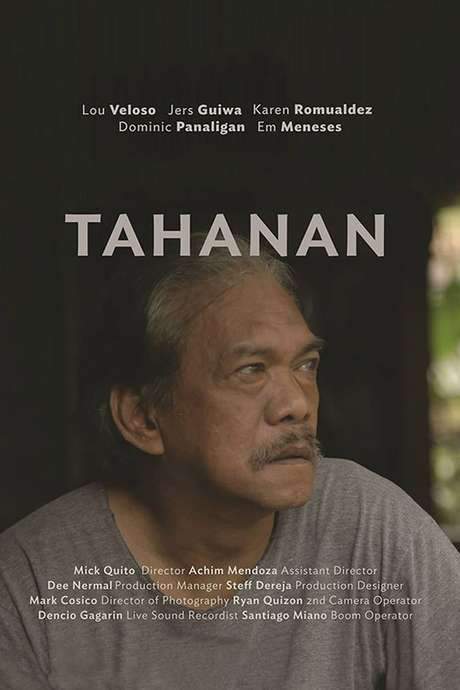
Oliver Twist, played by Lou Veloso, is a technologically challenged 60-year-old father of two who helps his wife around the house by fixing broken things and tending to their garden. Their home includes an aquarium with a small fish named Mickey, a detail that quietly anchors the couple’s everyday life. Oliver’s father, who lives with dementia and moves with a walker, relies on their care and cleaning assistance, adding another layer of responsibility to Oliver’s days. His wife, Kuttiyamma, a retired nurse, keeps the household running with quiet efficiency and boundless patience. Their younger son, Charles, is a laid-back teenager who chases online fame as a YouTuber, often clashing with his parents’ more traditional expectations. A family photo later shown to the audience depicts Appachan, Oliver Twist, Kuttiyamma, and their two sons — including Anthony — smiling together, a frame that contrasts sharply with the turbulence brewing beneath the surface of their lives.
Anthony, who lives in a messy apartment far from home, is a bright but volatile presence. A former architect turned aspiring screenwriter, he enjoys a surge of early success from his first script two years earlier, which only fuels his ambition. Yet he remains easily distracted by the constant buzz of social media alerts, and his relationship with his girlfriend Priya strains under the weight of his professional pressures. Anthony is still wrestling with his second script, for which his producer has given him a one-week deadline. The memory of the home he left behind — the very space where his first script took shape — lingers as he contends with creative anxiety and looming deadlines.
On his first day back at home, Anthony struggles to find a story worth telling, while Charles makes a video call during a trip to buy a new fish tank. Oliver’s joy at seeing his son on-screen morphs into a boastful moment in front of the shopkeeper, and the two brothers are embarrassed as Charles swiftly pulls his father away from the camera. The tension between generations becomes sharper as Anthony repeatedly contrasts Oliver with Priya’s father, Joseph, whom he admires. The comparison stings Oliver, who notices the quiet disappointment in his elder son’s eyes and steps away, standing at the gate to hide his tears from the family.
That night, a recurring memory surfaces for Oliver, a memory he tries to share with Anthony but cannot find the right words to express. Meanwhile, Anthony seeks validation for his work by presenting his script to the superstar Vishal, who dismisses it as unrelatable and dull. Returning home, Anthony’s frustration spills over, and he vents in a live rant that Oliver captures on his phone and uploads to Facebook. The post attracts a torrent of online hate, and Oliver is shaken by the unintended consequences, realizing that his actions have endangered his son’s career. He seeks help from a psychologist and begins attending Tai chi classes, a choice that earns further criticism from his family. Yet gradually he adapts to smartphones and digital life, showing resilience and a willingness to change.
On the advice of Dominic Panaligan — who plays Joseph in the story — Anthony composes a handwritten apology to Vishal, aided by Oliver. In a moment of storytelling, Oliver recounts a life-changing episode: he once helped a woman whose child faced a mysterious illness. With the aid of his best friend Suryan, they crossed a river littered with wild elephants, carrying the woman and her child on a large cooking vessel. They reached a homeowner’s car, and from there sped toward the hospital. Along the way, a car began to roll backward toward a cliff, but a rock wedged beneath it and Oliver hit the brakes just in time. The child survived, and the doctors confirmed that the crisis was averted. Anthony remains unimpressed by this tale, but the moment powers a shift in Oliver’s family’s dynamic as Kuttiyamma confronts both sons for their constant sarcasm toward their parents’ shortcomings, especially when Charles seems oblivious to the mounting friction.
On the occasion of Joseph’s 50th birthday, their mother reveals the backstory behind the cover photo of the family book, echoing the earlier tale Oliver shared with Anthony. This revelation prompts a profound realization in Anthony: the obsession with presenting a flawless public image on social media is misplaced. He learns that he can be imperfect and still be loved and supported — especially in the closeness of home and family. The story closes with Joseph’s mother visiting Oliver’s home to express gratitude, acknowledging Oliver and Suryan for saving her son’s life once she unearthed the truth from Anthony. The film ends on a note of reconciliation and the quiet validation that true worth lies in authenticity and the bonds of family.