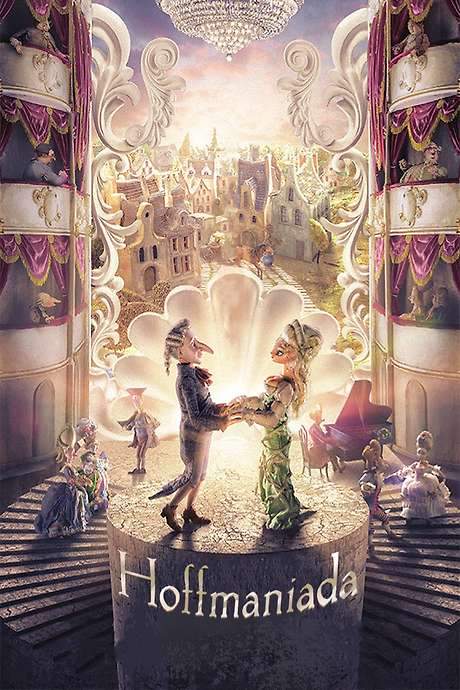
In this lyrical fantasy-drama, the protagonist Ernst Hoffmann, a young lawyer, musician, and writer, dwells between two intertwined dimensions: the orderly reality of a small town and the boundless, dream-filled world of his own novels and operas. By day he pores over legal papers in a quiet office and gives music lessons, while by night he crafts magical stories and operas, secretly hoping to see his own work, the opera Undine, brought to the grand stage. As Hoffmann delves deeper into his imagination, the line between dream and reality grows increasingly thin, and the worlds he creates begin to push back against the constraints of ordinary life.
Soon, the imagined worlds intrude with a vivid urgency. Hoffmann finds himself stepping inside the very adventures he wrote about, where underwater journeys, sword fights, and ballet-filled theater performances become real experiences rather than mere figments of his imagination. The film unfolds as a richly layered voyage in which the author’s creations come to life and invite him to live out the dramas he once only described on the page. This is not simply a escape into fantasy; it is a journey in which the author must confront the mysterious forces that shape his thoughts and his desires.
As the narrative progresses, Ernst Hoffmann encounters a troupe of fantastical and perilous figures drawn from his own stories. He becomes the titular character Anselm, a role that draws him into a romantic labyrinth spanning different moments in his life. In these encounters, he meets Olympia, a beautiful, yet ethereal presence who captivates him; Serpentine, a snake-girl who embodies a darker, more dangerous allure; and Veronica, a worldly and refined woman whose charm adds another layer to Hoffmann’s quest for love and meaning. The romance is not simple or straightforward; it is tempered and complicated by the magical forces at work around him, and by the shadowy figures who seek to control or disrupt his path to happiness.
Central to this otherworldly drama are the unsettling powers of Coppelius, a seasoned merchant and faker, and Paulman, a watchmaker whose creations blur the boundary between life and mechanism. These characters wield a sorcery that challenges Hoffmann’s intentions and tests his faith in his own imaginings. The figure of Sandman—the dreamy, elusive student who is obsessed with Olympia—adds another layer of longing and danger, illustrating how desire and illusion can intertwine with artistry and ambition.
Into Hoffmann’s orbit also come the wise Lindhorst, a royal archivist exiled from Atlantis who becomes a patron and mentor to the writer and his literary persona. Lindhorst’s presence lends a sense of ancient mystery to the tale, hinting at larger scales of existence and history beyond the small-town settings. The relationship between reality and fantasy intensifies as these guides, antagonists, and muses collide, shaping Hoffmann’s choices and his sense of self.
The film’s dreamlogic intensifies when transformations and magical clashes disrupt Hoffmann’s efforts to pursue love. A striking turn of events sees a figure—resembling Lindhorst—take the form of a Fire-Salamander, an embodiment of the uncanny forces arrayed against Hoffmann’s plans to court Serpentina. This surreal shift underscores the peril and wonder at the heart of Hoffmann’s odyssey: to navigate desire, art, and fate when the very fabric of reality is pliant, responsive, and sometimes hostile. As rival plots take shape and the dangers grow more pronounced, Hoffmann must confront threats that arise not only from external forces but from the depths of his own imagination.
Throughout the story, love and magic become inextricably linked. The melodrama of Hoffmann’s personal desires intersects with the fantastical machinery of the worlds he has created, producing a tapestry in which romance is tempered by risk, beauty, and wonder. The narrative does not shy away from peril, yet it moves toward a hopeful, harmonious resolution in which the strands of love, art, and fantasy are woven together. By the end, the enchantment that has braided Hoffmann’s life with the fates of Olympia, Serpentina, and Veronica is resolved in a way that feels both earned and uplifting, leaving behind a sense of wonder and a recognition that art can momentarily reshape the boundaries of reality.
The film features a notable ensemble of performers who bring these vivid characters to life: Anvar Libabov, Aleksey Petrenko, Vyacheslav Polunin, Natalya Fisson, Pavel Lyubimtsev, Vladimir Koshevoy, Aleksandr Shirvindt, and Anna Artamonova. Their performances anchor the dreamlike spectacle in human emotion, lending weight to Hoffmann’s fragile, dazzling journey and grounding the story in a shared human longing for beauty, meaning, and connection.
The result is a story that ambitiously blends romance, fantasy, and theatrical spectacle. It invites the audience to linger on the edges of dream and waking life, to feel the pull of legendary figures and conjured realms, and to witness how imagination can illuminate the deepest corners of the human heart. It remains, at its core, a meditation on how a single creative mind negotiates love, ambition, and the seductive lure of worlds that may be too magical to exist, yet are real enough to change a life.