Plot Explained Spoilers guaranteed!
Plot Explained

Browse by genre

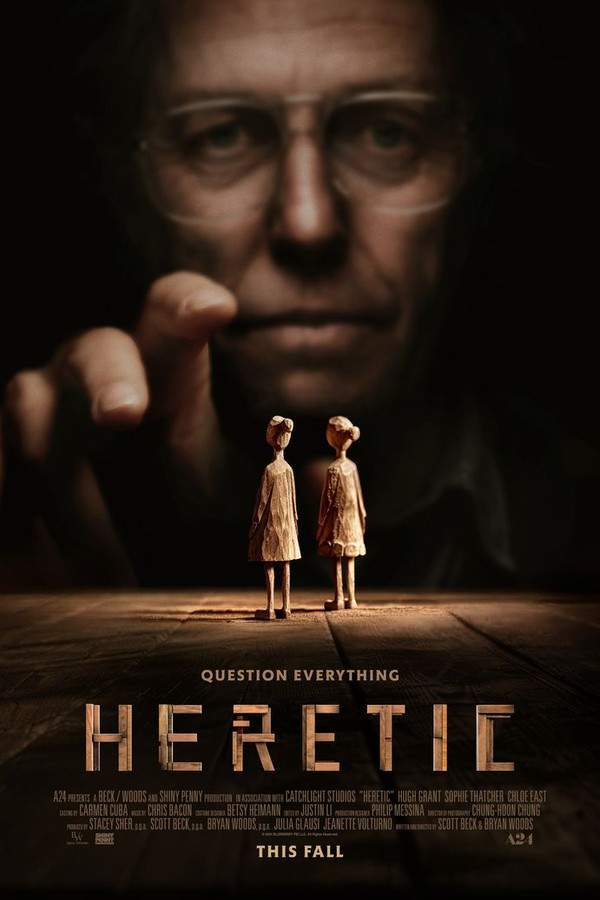
Heretic (2024) movie poster

Timeline

Heretic (2024) Timeline Explained – Every Event in Order

Release, runtime and language
2024 · 1 h 50 m · English
Echo score 76
Directed by
Bryan Woods, Scott Beck
Starring
Sophie Thatcher, Topher Grace, Hugh Grant, Chloe East, Anesha Bailey, Carolyn Adair
Budget
$10M

Two young missionaries find themselves in a dangerous situation when they encounter the sinister Mr. Reed (Hugh Grant). He lures them into a perilous game of cat-and-mouse, forcing them to confront the limits of their faith.

On this page (5)
  1. 1 Events in order (15)
  2. 2 Timeline questions answered
  3. 3 Movie threads
  4. 4 Movies like Heretic
  5. 5 Every angle

15 events in order · contains spoilers

Heretic Timeline: Events in Chronological Order

Every key event of Heretic (2024) in order, scene by scene, with when and where it takes place. Use it to untangle flashbacks, time jumps and parallel storylines, to refresh your memory before the sequel or to find the exact scene you are thinking of.

  1. Discussion on Pornography

    The film opens with two Mormon missionaries, Sister Barnes and Sister Paxton, engaging in a conversation about pornography. Paxton shares her feelings of guilt after watching a video, expressing concern for the actress involved.

  2. Prank at the Park

    While walking around town to spread their message, the missionaries encounter a group of teenage girls. The group plays a mean prank on Paxton by pulling down her skirt to see if she’s wearing 'magic underwear', highlighting the mockery they often face.

  3. Visit to Mr. Reed

    Seeking refuge from the rain, the missionaries arrive at the home of Mr. Reed, an Englishman. Initially hesitant, they enter his home when he mentions that his wife is inside, which is essential for their entry.

    Where
    Mr. Reed's House
  4. Conversations with Reed

    Inside, Mr. Reed engages the sisters in deep discussions about religion, including his own studies of Mormonism. Tension arises when he makes sensitive comments about Sister Barnes’s deceased father, foreshadowing the unsettling events to come.

    Where
    Mr. Reed's House
  5. The Locked Door

    Feeling increasingly uncomfortable, the sisters attempt to leave but discover the front door is locked. Without mobile signal, they attempt to escape through the back, only to find Reed waiting with an extensive library.

    Where
    Back of Mr. Reed's House
  6. The Two Doors

    Reed presents them with two doors labeled 'belief' and 'disbelief'. He challenges their faith, suggesting their choice will determine their fate, before they ultimately choose the 'belief' door, believing it to be a way out.

    Where
    Mr. Reed's House
  7. Down the Dungeon

    The missionaries are led down a dark staircase into an underground dungeon. With dread setting in, they realize that there may be no way out and their earlier choice may have dire consequences.

    Where
    Dungeon
  8. The Prophet's Arrival

    A decrepit old woman, labeled the 'Prophet', appears in the dungeon holding a messy blueberry pie. Reed announces that the pie has been poisoned, and he claims they are about to witness a miracle involving the Prophet.

    Where
    Dungeon
  9. First Attempt at Rescue

    Elder Kennedy notices Sister Barnes and Sister Paxton’s absence and begins searching for them. Despite their urgent pleas for help, Kennedy leaves before finding them, increasing the tension and urgency of their situation.

  10. Barnes's Revelation

    As the supposed miracle unfolds, Reed gloatingly explains the nature of the 'resurrection'. In a shocking turn, Barnes reveals her own near-death experience, challenging Reed on his claims of miracles.

    Where
    Dungeon
  11. Tragic Turn of Events

    In a brutal moment, Reed slashes Barnes's throat, proclaiming she will resurrect. The horror escalates as he attempts to prove his claims about her existence, introducing a sinister twist to their entrapment.

    Where
    Dungeon
  12. Paxton's Discovery

    Paxton realizes the second Prophet was merely an actress following Reed's directives. She descends into the trap door leading to a hidden truth about the control Reed exerts over others, fueling her resolve to fight back.

    Where
    Dungeon
  13. Fight for Survival

    As tensions peak, Paxton stabs Reed with a hidden letter opener, but he retaliates by stabbing her. In this brutal showdown, they confront the reality of their dire situation and the twisted belief Reed held.

    Where
    Dungeon
  14. Final Sacrifice

    In a climactic moment of desperation, Sister Barnes reappears to save Paxton but collapses into her arms. Their bond is solidified in this moment of sacrifice, representing hope amidst despair.

    Where
    Dungeon
  15. Escape into the Morning Light

    Finally, Paxton finds a window and escapes as dawn breaks. As she watches a butterfly land on her hand, she recalls her desire to return as one in the next life, embracing a new beginning against all odds.

Last updated: November 25, 2024 at 19:24

Was this helpful?

Timeline questions answered

Heretic Timeline Explained: Your Questions Answered

When does it happen, and why in that order? The questions people ask about the chronology of Heretic (2024): time jumps, flashbacks, cause and effect between scenes and the correct order of events, each answered with spoilers.

Q1

Why did Mr. Reed lock the missionaries inside his house?

Mr. Reed locked the missionaries inside because he wanted to force them to participate in his religious experiment. He specifically waited for them to enter by mentioning his wife was home, which was a requirement for the missionaries to enter a stranger's house. Once inside, he revealed his true intention: to test their faith through his twisted theological game.

Foreshadowing: Earlier, Reed enthusiastically engaged them in religious discussion and showed his extensive study of Mormonism, hinting at his obsession.

  • mr reed
  • locked door
  • missionaries trapped
  • why locked inside
Q2

What was the metal pin Sister Barnes had in her neck?

The metal pin was a contraceptive device (IUD), not a microchip as Reed claimed. Reed attempted to use it as proof that Barnes was not human but rather a fabricated being. In reality, Barnes had received the IUD years earlier during her medical history, and it had nothing to do with her identity or existence.

Foreshadowing: Barnes had mentioned her traumatic medical history with an e.coli infection that left her clinically dead, establishing her as a real person with medical history.

  • metal pin
  • iud
  • contraceptive
  • barnes neck
  • microchip
Q3

Was the Prophet woman in the dungeon real?

No, the Prophet was not the original woman. The first Prophet had genuinely died, and Reed replaced her with a second woman who simply memorized a script to perform the fake resurrection. This was part of Reed's elaborate scheme to convince the missionaries of his twisted version of a miracle.

Foreshadowing: Reed announced the pie was poisoned before the 'miracle' began, suggesting the entire event was staged.

  • prophet
  • resurrection
  • fake miracle
  • dungeon woman
  • real or fake
Q4

Why did Reed slash Barnes's throat?

Reed slashed Barnes's throat to prove his theory that she would resurrect, similar to the Prophet's fake resurrection. He believed that if she came back, it would validate his argument that she was not a real person but rather a programmed being. He expected her to 'return' just as the Prophet supposedly did.

Foreshadowing: Reed had been building toward this moment throughout the dungeon scene, insisting they would witness a miracle and testing whether the missionaries' faith could withstand his demonstration.

  • reed kills barnes
  • throat slash
  • why killed
  • resurrection proof
Q5

Why did Sister Barnes come back after being killed?

Barnes came back because she had previously experienced a near-death situation herself. She revealed that she survived an e.coli infection that left her clinically dead for four minutes. This experience mirrored the fake resurrection Reed was demonstrating, meaning she understood the difference between actual death and theatrical performance. She was never truly dead when Reed slashed her throat, she recovered enough to save Paxton.

Foreshadowing: Barnes's earlier confession about her father's death from ALS and her own near-death experience with e.coli foreshadowed her ability to survive the attack.

  • barnes survives
  • e.coli
  • near death experience
  • comes back
  • alive
Q6

What was the point of the two doors labeled 'belief' and 'disbelief'?

The two doors were part of Reed's theological game to test the missionaries' faith. He presented it as a philosophical choice, but both doors led to the same dungeon where he would stage his 'miracle.' Reed used this setup to illustrate his argument that all religions are flawed variations of a single original belief system, forcing the missionaries to literally choose whether to maintain or abandon their faith.

Foreshadowing: Reed's earlier lecture about Monopoly's origins and religions being variations of one original belief set up his desire to control this binary choice.

  • belief door
  • disbelief door
  • choice
  • reeds game
  • two doors meaning
Q7

Why did Elder Kennedy leave without finding the missionaries?

Elder Kennedy left because he did not hear the missionaries' desperate attempts to get his attention. While they shouted and tried to create a fire with matches to signal him, Kennedy was already departing from the property. Despite their urgent efforts, he left before discovering they were trapped inside Reed's house.

Foreshadowing: Earlier, the missionaries had noticed their phones had no signal, cutting off their ability to call for help electronically.

  • elder kennedy
  • leaves
  • why didn't help
  • missed rescue
  • searching
Q8

What were the women locked in cages in the basement?

The caged women were Reed's victims, women he had captured and held captive in his basement. This revealed that Reed's entire conceptualization of religion was merely a facade for his control over others. These women were the real extent of his twisted 'religion,' showing his pattern of manipulating and imprisoning people under the guise of spiritual experimentation.

Foreshadowing: Reed's obsessive study of religion and his desire to create his own 'one true religion' hinted at his willingness to control others.

  • caged women
  • basement
  • captives
  • reed's victims
  • trapped women
Q9

What did the butterfly symbolize at the end of the movie?

The butterfly represented Paxton's earlier wish to return as something beautiful like a butterfly if she died. When the butterfly briefly landed on her hand as she escaped, it seemed to fulfill her wish, but then it flew away, leaving the ending ambiguous about whether it was a sign of hope, a symbol of her friend's sacrifice, or simply nature. This bittersweet moment reflected her traumatic journey and uncertain future.

Foreshadowing: Earlier in the film, Paxton expressed her belief that she would return as a butterfly if she died, creating this symbolic callback.

  • butterfly
  • ending
  • symbol
  • paxton
  • meaning of butterfly
Q10

Why was Mr. Reed so obsessed with religion?

Reed was obsessed with religion because he wanted to prove that all religions, including Mormonism, are flawed iterations of a single original belief system. He studied Mormonism extensively, owned a copy of the Book of Mormon, and used the Monopoly game as a metaphor to argue that all religions are variations created by people, just like how Parker Brothers changed The Landlord's Game. His ultimate goal was to break the missionaries' faith by demonstrating what he saw as the artificial nature of religious belief.

Foreshadowing: Reed's library of religious books and his passionate debate about religious origins established his deep obsession from the start.

  • reed religion obsession
  • why study mormonism
  • religious debate
  • all religions flawed
Q11

Why did Mr. Reed bring out the Monopoly game?

Reed used the Monopoly game to illustrate his theory that all religions are variations of one original belief, just as Monopoly evolved from The Landlord's Game. He contrasted 'The Air That I Breathe' by The Hollies with 'Creep' by Radiohead to show how one creation can be reimagined into something different. By presenting this argument, Reed attempted to deconstruct the missionaries' faith by arguing their religion was simply a reworked version of earlier beliefs.

Foreshadowing: This moment occurred after the missionaries chose the 'belief' door but before they descended into the dungeon, serving as Reed's philosophical setup.

  • monopoly game
  • landlords game
  • reeds argument
  • religion comparison
  • why monopoly

Movie threads

More Movies Like Heretic, by Mood & Story

Curated lists built around what makes Heretic tick: the same mood, the same kind of story or the same emotional payoff. Each list explains why these movies belong together.

Claustrophobic Survival Horror Movies Like Heretic

Stories where characters are trapped and stalked by a cunning antagonist. If the tense, trapped feeling of Heretic captivated you, explore these other movies like it. This collection features similar thrillers and horror stories where characters are confined and forced into a deadly cat-and-mouse game for survival, perfect for fans of high-stakes suspense.

  • claustrophobic
  • tense
  • suspenseful
  • trapped
  • hunted
  • desperate
  • Tone: dark, tense
  • Pacing: variable, escalating
Why these movies?

The story pattern: The narrative typically involves characters being isolated and confined in a limited space, where they must outthink and outmaneuver a persistent and often intelligent threat. The plot revolves around escalating tension, close calls, and a desperate fight for survival against overwhelming odds.

Why they belong together: Movies are grouped here for their shared atmosphere of confinement and imminent danger. They feature a consistent high level of tension, a dark tone, and a focus on the psychological and physical ordeal of being trapped and pursued.


Movies About Psychological Faith Crises Like Heretic

Narratives where core beliefs are violently tested by manipulation and terror. For viewers who appreciated the theological debate and faith crisis in Heretic, this list spotlights similar movies. Discover other psychological horror and thriller films that delve into themes of religious doubt, manipulation, and the brutal testing of belief systems.

  • psychological
  • disturbing
  • unsettling
  • thought-provoking
  • tense
  • oppressive
  • Tone: dark, psychological
  • Pacing: steady, dialogue-driven
Why these movies?

The story pattern: These narratives often pit a believer or idealist against a cunning foe who weaponizes their own beliefs against them. The journey involves psychological torment, deep doubt, and a struggle to maintain one's core identity in the face of horrific evidence or sophisticated arguments designed to break the spirit.

Why they belong together: These films are connected by their central theme of a psychological assault on faith. They share a heavy emotional weight, explore disturbing themes of manipulation, and feature a tone that is dark and intellectually challenging, focusing on the protagonist's internal collapse.

If you liked this

Movies Like Heretic

Similar movies to Heretic: the same genre, themes or kind of story. Each one comes with its own plot summary, timeline and ending explained.

Browse all movie summaries

Every angle

Heretic (2024) Explained: Plot, Ending, Timeline & Characters

Everything about Heretic in one place: what happens in the plot summary, the timeline in chronological order, the characters and meaning, the ending explained and a spoiler-free summary. What's After the Movie adds the cast, box office and post-credit scenes.

Coming soon on iOS and Android

The Plot Explained Movie Summary App

Plot summaries, endings explained and timelines on your phone. Catch up on any movie in minutes, save your favorites and never miss a twist again.

Be the first to know when we launch. Your email stays private, always.

Learn more about the app