Plot Explained Spoilers guaranteed!
Plot Explained

Browse by genre

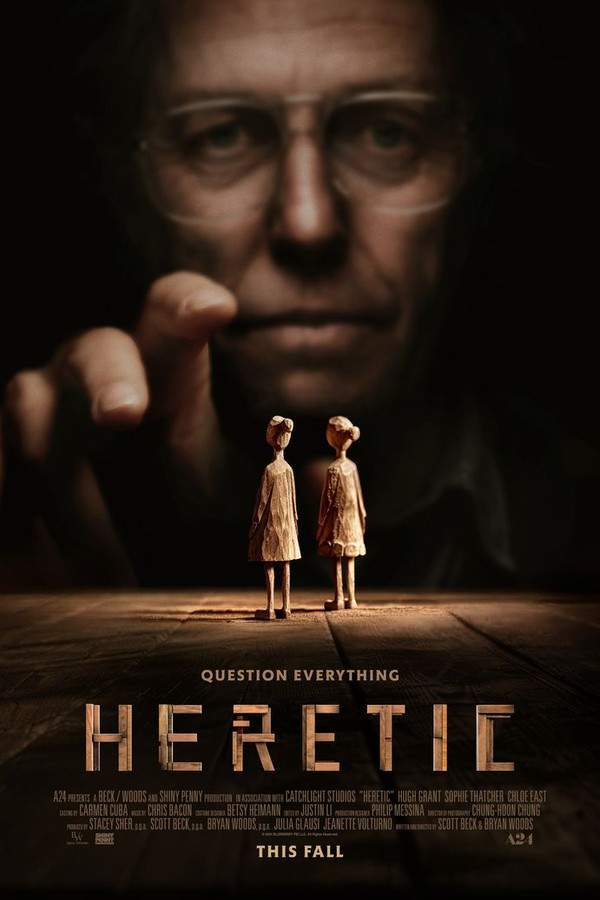
Heretic (2024) movie poster

Plot Summary

Heretic (2024) Plot Summary & Ending Explained

Release, runtime and language
2024 · 1 h 50 m · English
Echo score 76
Directed by
Bryan Woods, Scott Beck
Starring
Sophie Thatcher, Topher Grace, Hugh Grant, Chloe East, Anesha Bailey, Carolyn Adair
Budget
$10M

Two young missionaries find themselves in a dangerous situation when they encounter the sinister Mr. Reed (Hugh Grant). He lures them into a perilous game of cat-and-mouse, forcing them to confront the limits of their faith.

On this page (6)
  1. 1 What happens: full plot
  2. 2 Plot questions answered
  3. 3 How it ends
  4. 4 Movie threads
  5. 5 Movies like Heretic
  6. 6 Every angle

Full plot summary · contains spoilers

What Happens in Heretic: Full Plot Summary

The whole story of Heretic (2024) explained, from the opening scene to the final frame: every key event, every twist and what it all adds up to. Read it as a quick recap before the sequel, to check a scene you missed, or to finally understand what really happened.

The film begins with two Mormon missionaries, Sister Barnes and Sister Paxton, engaging in a rather unconventional debate about pornography. Their discussion arises when Paxton admits to feeling a twinge of sympathy for an actress featured in a video she watched. With their mission to convert others to their faith, the duo sets out into the local community, eager to spread their beliefs. However, on their way, they encounter a trio of teenage girls who cruelly embarrass Paxton by yanking down her skirt to see if she indeed has “magic underwear.” This incident adds to Paxton's concerns about the ridicule their religion faces, yet Barnes appears unfazed.

As the rain begins to pour heavily, they find refuge at the home of an Englishman named Mr. Reed. Eager to engage, he invites them inside and reassures them that his wife is home – which is crucial for their entry. He mentions that his wife is occupied baking a blueberry pie, a detail that further piques their interest. Once settled, Reed engages them in conversation about various topics including religion, sharing his passionate study of Mormonism and proudly displaying his copy of the Book of Mormon.

Their dialogue takes a serious turn as Barnes reveals the tragic death of her father from ALS, and they adamantly steer clear of discussing Taco Bell. Tensions rise when Reed makes an unsettling remark about her father and the essence of their faith, prompting him to exit the room. Alone, Barnes notices a candle on the table, the source of the delicious blueberry aroma that initially welcomed them.

Feeling increasingly uneasy, the women attempt to leave discreetly but discover that the front door has been locked and their phones are without signal. As they cautiously navigate toward the back of the house, they stumble into Reed's study, where he houses an extensive collection of books. Despite their attempts to politely exit, Reed presents them with a choice between two doors, labeled “belief” and “disbelief.” He then surprises them by pulling out an original version of the Monopoly game instead of something more sinister.

Reed uses this moment to lecture the missionaries about the game's origins with The Landlord’s Game and draws parallels with the song “The Air That I Breathe” by The Hollies, contrasting it with “Creep” by Radiohead, a song he assumes they are well-acquainted with. He positions his argument that all religions are flawed iterations of a single original belief, challenging their own convictions. With resolve, Barnes defends her faith, prompting both women to pass through the doorway marked “belief.”

This seemingly simple choice leads them into an underground dungeon, where an alarming situation unfolds. Reed's voice pierces through the darkness, explaining that they are about to witness a miracle. Just then, an old woman, referred to as the “Prophet” (Elle Young), enters, brandishing a disheveled blueberry pie. Reed chillingly declares that the pie has been poisoned, and that the Prophet will soon be resurrected.

Meanwhile, Elder Kennedy becomes concerned after realizing that Barnes and Paxton have not checked back in after hours. He ventures out to inquire about their whereabouts at homes they intended to visit. When he arrives at Reed’s house, the missionaries try desperately to get his attention by shouting and even attempting to ignite a fire with matches, but Kennedy departs before they can signal him.

Back in the dungeon, the ladies watch as the Prophet seemingly returns from the dead, ominously muttering about the afterlife. Reed descends into the dungeon, boasting about the “miracle,” and offers a chilling proposal: he will sacrifice one of them, only to resurrect her afterward. However, Barnes stands firm, asserting that she understands the truth of the situation. She reveals her traumatic history with an e. coli infection that left her clinically dead, drawing parallels with the Prophet’s description of the afterlife. In a shocking turn of events, Reed violently slashes her throat, claiming she would come back.

Moments later, Reed inspects Barnes’ body and discovers a metal pin, claiming it to be a microchip, asserting that Barnes was never real – a concept that shakes Paxton's reality. Yet Paxton counters Reed, identifying the pin as a contraceptive device, revealing that the initial Prophet had truly perished, leaving only a substitute following Reed's orders. The second woman had simply memorized a script while they endeavored to attract Kennedy’s attention.

Determined, Paxton ventures into the trap door where the dead woman lies, granted entry by Reed who is intent on showcasing his twisted version of the “one true religion.” In a harrowing discovery, Paxton finds dozens of women contained in cages – realizing that Reed's conceptualization of religion is merely a facade for control over others. In a moment of defiance, she stabs Reed in the throat with a concealed letter opener her friend had given her for safety. As Paxton makes a desperate bid for freedom, Reed retaliates and stabs her in the abdomen, and while they both bleed profusely, he bizarrely suggests they pray for their fates.

Paxton gleefully retorts, expressing her belief that prayers are in vain and often serve only as gestures of goodwill. As she begins to pray, Reed, weakened and crawling towards her, prepares for one final strike. However, out of nowhere, he is abruptly struck by a plank of wood studded with nails, dealt by the recovering Barnes, who collapses in Paxton's embrace before fading away.

Finally, as daylight breaks and the storm dissipates, Paxton finds a window and escapes. In a moment of transcendence, a butterfly rests on her hand, fulfilling her earlier wish to return as one in the event of her death. But as she gazes away for merely a heartbeat, the butterfly vanishes, leaving her to reckon with the tumultuous events that transpired.
Last updated: November 25, 2024 at 19:24

Was this helpful?

Plot questions answered

Heretic Plot Explained: Your Questions Answered

The questions people ask most about Heretic (2024): what happens in the confusing scenes, why the characters do what they do, the twists, hidden details and what the ending means. Each answer contains spoilers.

Q1

Why did Mr. Reed lock the missionaries inside his house?

Mr. Reed locked the missionaries inside because he wanted to force them to participate in his religious experiment. He specifically waited for them to enter by mentioning his wife was home, which was a requirement for the missionaries to enter a stranger's house. Once inside, he revealed his true intention: to test their faith through his twisted theological game.

Foreshadowing: Earlier, Reed enthusiastically engaged them in religious discussion and showed his extensive study of Mormonism, hinting at his obsession.

  • mr reed
  • locked door
  • missionaries trapped
  • why locked inside
Q2

What was the metal pin Sister Barnes had in her neck?

The metal pin was a contraceptive device (IUD), not a microchip as Reed claimed. Reed attempted to use it as proof that Barnes was not human but rather a fabricated being. In reality, Barnes had received the IUD years earlier during her medical history, and it had nothing to do with her identity or existence.

Foreshadowing: Barnes had mentioned her traumatic medical history with an e.coli infection that left her clinically dead, establishing her as a real person with medical history.

  • metal pin
  • iud
  • contraceptive
  • barnes neck
  • microchip
Q3

Was the Prophet woman in the dungeon real?

No, the Prophet was not the original woman. The first Prophet had genuinely died, and Reed replaced her with a second woman who simply memorized a script to perform the fake resurrection. This was part of Reed's elaborate scheme to convince the missionaries of his twisted version of a miracle.

Foreshadowing: Reed announced the pie was poisoned before the 'miracle' began, suggesting the entire event was staged.

  • prophet
  • resurrection
  • fake miracle
  • dungeon woman
  • real or fake
Q4

Why did Reed slash Barnes's throat?

Reed slashed Barnes's throat to prove his theory that she would resurrect, similar to the Prophet's fake resurrection. He believed that if she came back, it would validate his argument that she was not a real person but rather a programmed being. He expected her to 'return' just as the Prophet supposedly did.

Foreshadowing: Reed had been building toward this moment throughout the dungeon scene, insisting they would witness a miracle and testing whether the missionaries' faith could withstand his demonstration.

  • reed kills barnes
  • throat slash
  • why killed
  • resurrection proof
Q5

Why did Sister Barnes come back after being killed?

Barnes came back because she had previously experienced a near-death situation herself. She revealed that she survived an e.coli infection that left her clinically dead for four minutes. This experience mirrored the fake resurrection Reed was demonstrating, meaning she understood the difference between actual death and theatrical performance. She was never truly dead when Reed slashed her throat, she recovered enough to save Paxton.

Foreshadowing: Barnes's earlier confession about her father's death from ALS and her own near-death experience with e.coli foreshadowed her ability to survive the attack.

  • barnes survives
  • e.coli
  • near death experience
  • comes back
  • alive
Q6

What was the point of the two doors labeled 'belief' and 'disbelief'?

The two doors were part of Reed's theological game to test the missionaries' faith. He presented it as a philosophical choice, but both doors led to the same dungeon where he would stage his 'miracle.' Reed used this setup to illustrate his argument that all religions are flawed variations of a single original belief system, forcing the missionaries to literally choose whether to maintain or abandon their faith.

Foreshadowing: Reed's earlier lecture about Monopoly's origins and religions being variations of one original belief set up his desire to control this binary choice.

  • belief door
  • disbelief door
  • choice
  • reeds game
  • two doors meaning
Q7

Why did Elder Kennedy leave without finding the missionaries?

Elder Kennedy left because he did not hear the missionaries' desperate attempts to get his attention. While they shouted and tried to create a fire with matches to signal him, Kennedy was already departing from the property. Despite their urgent efforts, he left before discovering they were trapped inside Reed's house.

Foreshadowing: Earlier, the missionaries had noticed their phones had no signal, cutting off their ability to call for help electronically.

  • elder kennedy
  • leaves
  • why didn't help
  • missed rescue
  • searching
Q8

What were the women locked in cages in the basement?

The caged women were Reed's victims, women he had captured and held captive in his basement. This revealed that Reed's entire conceptualization of religion was merely a facade for his control over others. These women were the real extent of his twisted 'religion,' showing his pattern of manipulating and imprisoning people under the guise of spiritual experimentation.

Foreshadowing: Reed's obsessive study of religion and his desire to create his own 'one true religion' hinted at his willingness to control others.

  • caged women
  • basement
  • captives
  • reed's victims
  • trapped women
Q9

What did the butterfly symbolize at the end of the movie?

The butterfly represented Paxton's earlier wish to return as something beautiful like a butterfly if she died. When the butterfly briefly landed on her hand as she escaped, it seemed to fulfill her wish, but then it flew away, leaving the ending ambiguous about whether it was a sign of hope, a symbol of her friend's sacrifice, or simply nature. This bittersweet moment reflected her traumatic journey and uncertain future.

Foreshadowing: Earlier in the film, Paxton expressed her belief that she would return as a butterfly if she died, creating this symbolic callback.

  • butterfly
  • ending
  • symbol
  • paxton
  • meaning of butterfly
Q10

Why was Mr. Reed so obsessed with religion?

Reed was obsessed with religion because he wanted to prove that all religions, including Mormonism, are flawed iterations of a single original belief system. He studied Mormonism extensively, owned a copy of the Book of Mormon, and used the Monopoly game as a metaphor to argue that all religions are variations created by people, just like how Parker Brothers changed The Landlord's Game. His ultimate goal was to break the missionaries' faith by demonstrating what he saw as the artificial nature of religious belief.

Foreshadowing: Reed's library of religious books and his passionate debate about religious origins established his deep obsession from the start.

  • reed religion obsession
  • why study mormonism
  • religious debate
  • all religions flawed
Q11

Why did Mr. Reed bring out the Monopoly game?

Reed used the Monopoly game to illustrate his theory that all religions are variations of one original belief, just as Monopoly evolved from The Landlord's Game. He contrasted 'The Air That I Breathe' by The Hollies with 'Creep' by Radiohead to show how one creation can be reimagined into something different. By presenting this argument, Reed attempted to deconstruct the missionaries' faith by arguing their religion was simply a reworked version of earlier beliefs.

Foreshadowing: This moment occurred after the missionaries chose the 'belief' door but before they descended into the dungeon, serving as Reed's philosophical setup.

  • monopoly game
  • landlords game
  • reeds argument
  • religion comparison
  • why monopoly

Ending explained

What Happens at the End of Heretic?

How Heretic (2024) ends, in short: the final scene, the last twist and what it means for the characters. The full ending explained, with every spoiler, lives on its own page.

Read the full ending explained

Heretic’s ending is left intentionally ambiguous, focusing on the profound themes of faith, control, and the possibility of divine intervention. After a harrowing confrontation, Sister Paxton fights for her survival against Mr. Reed, who seeks to manipulate her faith and turn her into another victim of his twisted game. As Reed taunts her about the futility of prayer against his demonic plans, Paxton prays not for divine power, but to find solace in the faith that human connection and belief can bring comfort. Miraculously, her prayer seems to activate a fleeting moment of salvation when Sister Barnes, who was believed to be dead after her throat was slit, suddenly revives and kills Reed, saving Paxton. Whether this resurrection was supernatural or just a coincidence remains unclear, leaving the story open to interpretation. It could symbolize that faith and hope sometimes transcend logic, or suggest that moments of spiritual power exist beyond human understanding.

In the final scene, after escaping the house by uncovering a hidden route, Sister Paxton walks into the snowy landscape and a butterfly gently lands on her hand. This image is rich with symbolism. Paxton had previously mentioned that she believed in a kind of afterlife where she would transform into a butterfly and reunite with loved ones. The butterfly’s brief appearance could be a sign that her faith in this idea is real—possibly her friend Sister Barnes in a spiritual form—or simply a comforting coincidence. The butterfly's sudden disappearance leaves it open to multiple interpretations: perhaps it represents her own spiritual awakening or a near-death experience, or it symbolically signifies that she will carry the memory of Barnes and her faith with her forever. Overall, the ending emphasizes the enduring power of belief, the mystery of what lies beyond death, and the idea that faith might sometimes offer salvation in unexpected ways.

Heretic ending explained in full

Movie threads

More Movies Like Heretic, by Mood & Story

Curated lists built around what makes Heretic tick: the same mood, the same kind of story or the same emotional payoff. Each list explains why these movies belong together.

Claustrophobic Survival Horror Movies Like Heretic

Stories where characters are trapped and stalked by a cunning antagonist. If the tense, trapped feeling of Heretic captivated you, explore these other movies like it. This collection features similar thrillers and horror stories where characters are confined and forced into a deadly cat-and-mouse game for survival, perfect for fans of high-stakes suspense.

  • claustrophobic
  • tense
  • suspenseful
  • trapped
  • hunted
  • desperate
  • Tone: dark, tense
  • Pacing: variable, escalating
Why these movies?

The story pattern: The narrative typically involves characters being isolated and confined in a limited space, where they must outthink and outmaneuver a persistent and often intelligent threat. The plot revolves around escalating tension, close calls, and a desperate fight for survival against overwhelming odds.

Why they belong together: Movies are grouped here for their shared atmosphere of confinement and imminent danger. They feature a consistent high level of tension, a dark tone, and a focus on the psychological and physical ordeal of being trapped and pursued.

Movies About Psychological Faith Crises Like Heretic

Narratives where core beliefs are violently tested by manipulation and terror. For viewers who appreciated the theological debate and faith crisis in Heretic, this list spotlights similar movies. Discover other psychological horror and thriller films that delve into themes of religious doubt, manipulation, and the brutal testing of belief systems.

  • psychological
  • disturbing
  • unsettling
  • thought-provoking
  • tense
  • oppressive
  • Tone: dark, psychological
  • Pacing: steady, dialogue-driven
Why these movies?

The story pattern: These narratives often pit a believer or idealist against a cunning foe who weaponizes their own beliefs against them. The journey involves psychological torment, deep doubt, and a struggle to maintain one's core identity in the face of horrific evidence or sophisticated arguments designed to break the spirit.

Why they belong together: These films are connected by their central theme of a psychological assault on faith. They share a heavy emotional weight, explore disturbing themes of manipulation, and feature a tone that is dark and intellectually challenging, focusing on the protagonist's internal collapse.

If you liked this

Movies Like Heretic

Similar movies to Heretic: the same genre, themes or kind of story. Each one comes with its own plot summary, timeline and ending explained.

Browse all movie summaries

Every angle

Heretic (2024) Explained: Plot, Ending, Timeline & Characters

Everything about Heretic in one place: what happens in the plot summary, the timeline in chronological order, the characters and meaning, the ending explained and a spoiler-free summary. What's After the Movie adds the cast, box office and post-credit scenes.

Coming soon on iOS and Android

The Plot Explained Movie Summary App

Plot summaries, endings explained and timelines on your phone. Catch up on any movie in minutes, save your favorites and never miss a twist again.

Be the first to know when we launch. Your email stays private, always.

Learn more about the app