Plot Explained Spoilers guaranteed!
Plot Explained

Browse by genre

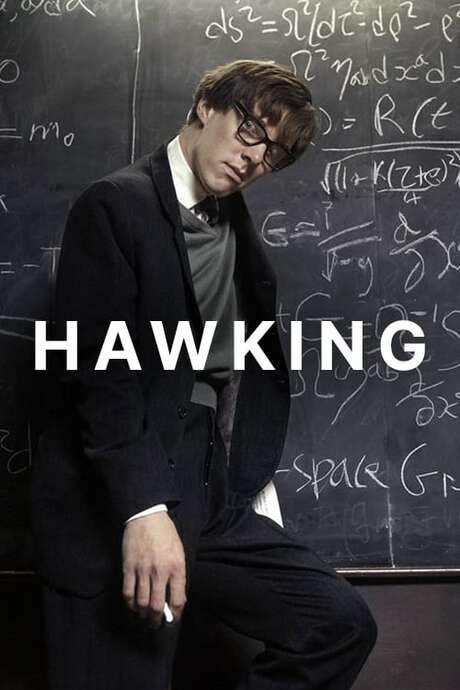
Hawking (2004) movie poster

Timeline

Hawking (2004) Timeline Explained – Every Event in Order

Release, runtime and language
2004 · 90 mins · English
Loading streaming availability…
Directed by
Philip Martin
Starring
Benedict Cumberbatch, Matthew Marsh, Christian Rubeck, Peter Firth, John Sessions, Alice Eve

In 1963, a young Stephen Hawking celebrates his 21st birthday surrounded by friends, including the captivating Jane Wilde. Their mutual fascination with stars and the cosmos quickly turns into a strong attraction. Suddenly, Stephen collapses, unable to stand, foreshadowing the health challenges that will shape his extraordinary life and scientific legacy.

On this page (5)
  1. 1 Where to watch
  2. 2 Events in order (14)
  3. 3 Timeline questions answered
  4. 4 Movie threads
  5. 5 Every angle
Loading streaming availability…

14 events in order · contains spoilers

Hawking Timeline: Events in Chronological Order

Every key event of Hawking (2004) in order, scene by scene, with when and where it takes place. Use it to untangle flashbacks, time jumps and parallel storylines, to refresh your memory before the sequel or to find the exact scene you are thinking of.

  1. Hawking meets Jane Wilde at his 21st birthday party

    At Stephen Hawking's 21st birthday party, he meets Jane Wilde and there is an immediate attraction. They connect over conversations about stars and the universe. Jane soon realises something is wrong when he suddenly cannot stand up.

  2. Diagnosis of motor neurone disease

    A stay in hospital reveals that Stephen Hawking has motor neurone disease. Doctors provide a distressing prognosis, suggesting he might not live beyond two years. The news anchors his future to a long, difficult fight.

    Where
    Hospital
  3. Return to Cambridge and PhD struggle

    Back in Cambridge, the new term starts but Stephen cannot find a subject for his PhD and drifts away from his supervisor, Dennis Sciama. He sinks into depression as his condition worsens and his academic life stalls. Friends and colleagues remain engaged with their own work, leaving Stephen feeling isolated.

    Where
    Cambridge
  4. Jane's support sustains him

    Jane's visits and faith in his abilities help Stephen hold on during the toughest days. He leans on their relationship as a source of hope and purpose. This support begins to pull him back from the edge of withdrawal.

    Where
    Cambridge
  5. Hoyle paper confrontation

    Hawking gets an early glimpse of a paper by Fred Hoyle to be presented at a Royal Society lecture. He works through the calculations, spots a mistake, and publicly confronts Hoyle after the talk. The clash sparks interest in his own independent research.

    Where
    Royal Society lecture
  6. Penrose introduces topology

    Around the same time, Roger Penrose introduces Hawking to topology, a way of thinking about the universe through shapes rather than equations. The new approach gives Stephen a practical method to cope with writing and to frame his ideas.

    Where
    Cambridge
  7. Penrose and the singularity concept

    Penrose explains how the collapse of dying stars suggests singularities at their cores, a concept that excites Stephen's imagination about the origins of the universe. He begins to see a path toward a cosmology that could include a beginning.

    Where
    Cambridge
  8. Thinking backwards: the Big Bang idea

    Stephen asks what would happen if Penrose's math were applied backwards to the universe as a whole. The answer hints that nothingness could explode into something, implying the universe could have originated with a Big Bang.

    Where
    Cambridge
  9. PhD breakthrough and renewed focus

    With renewed energy, Hawking dives into his research and produces a PhD that combines Penrose's theorems with cosmological questions. The results are brilliant and have profound implications for cosmology.

    Where
    Cambridge
  10. Marriage proposal and commitment to survival

    Despite his deteriorating health, Stephen commits to Jane, asking her to marry him. Their engagement becomes a source of resolve and a personal victory in his fight to survive.

  11. Two-year milestone and impact

    Two years after the initial diagnosis, Hawking is still alive and has helped spark a major scientific breakthrough that reshapes how people view the universe. He demonstrates that ambition and intellect can persist beyond a grim prognosis.

    When
    1965
    Where
    Cambridge
  12. Penzias and Wilson and the evidence for the Big Bang

    Unbeknownst to Hawking, two American scientists, Arno Penzias and Robert Wilson, are interviewed in Stockholm in 1978 on the eve of receiving the Nobel Prize. They recount how they discovered a faint signal from space that would become evidence for the Big Bang.

    When
    1978
    Where
    Stockholm
  13. Cosmic microwave background discovered

    They describe scanning the skies from a radio telescope in the hills above New Jersey, where they detected the leftover heat of the first explosion. This signal would later be recognized as physical proof of the Big Bang.

    When
    1964
    Where
    New Jersey hills
  14. Legacy: Big Bang confirmed

    By the film's end, the cosmological consensus is that the universe started with a Big Bang, marking a fundamental shift in how humanity understands space and time.

    When
    present day

Last updated: October 09, 2025 at 15:15

Was this helpful?

Timeline questions answered

Hawking Timeline Explained: Your Questions Answered

When does it happen, and why in that order? The questions people ask about the chronology of Hawking (2004): time jumps, flashbacks, cause and effect between scenes and the correct order of events, each answered with spoilers.

Q1

Why did Stephen Hawking collapse at his 21st birthday party?

Stephen collapsed because he was experiencing the first symptoms of motor neurone disease, a degenerative condition that affects nerve cells controlling voluntary muscles. What began as difficulty standing gradually progressed to complete immobility. This sudden collapse at a moment of joy foreshadowed the devastating diagnosis he would receive shortly after.

Foreshadowing: Earlier scenes show Stephen's fascination with the stars and universe, hinting at the brilliant mind that would later transform cosmology.

  • motor neurone disease
  • als
  • symptoms
  • diagnosis
  • collapse
Q2

What did doctors tell Stephen Hawking about his life expectancy?

Doctors diagnosed Stephen with motor neurone disease and gave him a grim prognosis: they expected him to survive no more than two years. This devastating news came when he was just 21 years old and at the beginning of his scientific career at Cambridge. The prediction eventually proved wrong, as Stephen lived for another 55 years.

Foreshadowing: The sudden collapse at his birthday party planted the seed of his health struggles.

  • motor neurone disease
  • prognosis
  • life expectancy
  • two years
Q3

Why did Stephen Hawking withdraw from his studies after his diagnosis?

After receiving his diagnosis, Stephen withdrew from his PhD work and isolated himself from his supervisor Dennis Sciama and fellow students. The progression of his disease made it increasingly difficult to keep up with academic demands, and he sank into deep depression. He felt his life was ending before it had truly begun, and the steady hands of his peers highlighted his own declining physical abilities.

Foreshadowing: His earlier passion for cosmology and ambition to make a scientific breakthrough seemed extinguished.

  • depression
  • isolation
  • PhD
  • Cambridge
  • Dennis Sciama
Q4

What was the conflict between Stephen Hawking and Fred Hoyle about?

Stephen Hawking studied a paper by Fred Hoyle, a prominent proponent of the Steady State theory, and discovered a mathematical error in it. He confronted Hoyle publicly after a Royal Society lecture, challenging his work. This confrontation gave Stephen a much-needed confidence boost and redirected his research toward questioning whether the universe truly had no beginning, which became foundational to his Big Bang theory.

Foreshadowing: The Steady State theory dominated academic discussions early in the film, setting up the intellectual battle that would follow.

  • Fred Hoyle
  • Steady State theory
  • error
  • confrontation
  • Royal Society
Q5

How did Roger Penrose influence Stephen Hawking's Big Bang theory?

Roger Penrose introduced Stephen to topology, a way of studying shapes and spaces without relying on complex equations. This approach was particularly valuable as Hawking's physical condition made writing increasingly difficult. More importantly, Penrose demonstrated that collapsing stars form singularities, points of infinite density at their cores. Hawking realized this mathematical framework could be applied in reverse to trace the universe backward in time, suggesting it had a beginning.

Foreshadowing: The film shows Penrose discussing star collapse and singularities, planting the mathematical seed for Hawking's breakthrough.

  • Roger Penrose
  • topology
  • singularity
  • Big Bang
  • mathematics
Q6

What is a singularity and how does it relate to the Big Bang?

A singularity is a point where matter becomes infinitely dense, such as at the center of a black hole. Penrose showed mathematically that when massive stars collapse, they must form singularities. Hawking asked what would happen if this logic were applied to the entire universe going backward in time. The answer was revolutionary: if you trace the universe's expansion backward, everything converges to a single point of infinite density, an initial explosion from which everything began, now known as the Big Bang.

Foreshadowing: Penrose's explanation of dying stars and their collapsed cores directly parallels the film's parallel narrative about cosmic origins.

  • singularity
  • black hole
  • collapse
  • Big Bang
  • origin of universe
Q7

What was Stephen Hawking's PhD thesis about?

Stephen Hawking's PhD thesis applied Penrose's singularity theorems to the universe as a whole. He demonstrated mathematically that if general relativity is correct and matter collapses gravitationally, the universe must have begun as a singularity, a point of infinite density from which space and time expanded. This provided theoretical support for the Big Bang theory and challenged the prevailing Steady State model, fundamentally changing our understanding of cosmic origins.

Foreshadowing: His earlier confrontation with Hoyle and depression gave way to this breakthrough as he found renewed purpose.

  • PhD thesis
  • singularity
  • Big Bang
  • cosmology
  • Cambridge
Q8

What did Arno Penzias and Robert Wilson discover?

In 1964, Arno Penzias and Robert Wilson were working with a radio telescope in New Jersey when they detected a faint, pervasive signal coming from every direction in space. This mysterious noise turned out to be the leftover heat from the universe's initial explosion, the cosmic microwave background radiation. This discovery provided the first concrete physical evidence supporting the Big Bang theory, earning them the Nobel Prize in 1978.

Foreshadowing: The film intercuts their discovery with Hawking's theoretical work, showing how theory and observation converged.

  • Arno Penzias
  • Robert Wilson
  • cosmic microwave background
  • Nobel Prize
  • evidence
Q9

Why did Stephen Hawking propose to Jane Wilde despite his illness?

Stephen proposed to Jane because their relationship had become his primary source of hope and purpose during his darkest period. Jane's unwavering faith in his abilities and her visits during his depression helped pull him back from isolation. His proposal represented a defiant commitment to living and building a future, despite doctors predicting he had only two years left. Their engagement gave him a personal reason to fight his illness.

Foreshadowing: Jane's support began when she first visited him after his diagnosis, sustaining him through his depression.

  • marriage
  • Jane Wilde
  • proposal
  • love
  • hope
  • defiance
Q10

How did Stephen Hawking beat the two-year prognosis?

Stephen Hawking lived for 55 years after his diagnosis, far exceeding the two-year prognosis doctors gave him in 1963. His survival became remarkable not just for its duration but for what he accomplished during those years, revolutionary scientific discoveries, academic recognition, and a full family life. His stubborn will to survive and refusal to accept his predicted fate transformed what should have been a tragic ending into a story of defiance and legacy.

Foreshadowing: The film shows his determination to survive as both a personal and intellectual battle.

  • prognosis
  • survival
  • two years
  • legacy
  • defiance
  • longevity
Q11

What was the Steady State theory and why did it lose to the Big Bang?

The Steady State theory proposed that the universe has no beginning or end, it simply exists infinitely, with new matter continuously created to fill gaps left by expanding galaxies. Fred Hoyle was this theory's most prominent advocate. Hawking's mathematical work demonstrated that if general relativity holds, the universe must have had a beginning. When Penzias and Wilson discovered the cosmic microwave background radiation in 1964, it provided physical proof that contradicted Steady State predictions, leading to the Big Bang becoming the accepted model.

Foreshadowing: Hoyle's televised defense of Steady State establishes the prevailing orthodoxy that Hawking would challenge.

  • Steady State theory
  • Fred Hoyle
  • Big Bang
  • cosmology
  • universe origin

Movie threads

More Movies Like Hawking, by Mood & Story

Curated lists built around what makes Hawking tick: the same mood, the same kind of story or the same emotional payoff. Each list explains why these movies belong together.

Brilliant Minds Facing Adversity Movies like Hawking

Stories of exceptional minds facing profound personal challenges with unwavering determination. Find movies like Hawking, featuring brilliant protagonists whose personal struggles with illness or other immense challenges define their extraordinary journeys. These stories of intellectual resilience and personal triumph offer a similar mix of heavy emotional weight, hopeful tone, and inspiring character arcs.

  • intellectual
  • resilient
  • melancholic
  • inspiring
  • intimate
  • triumphant
  • Tone: hopeful, resilient, melancholic
  • Pacing: steady, patient, character-driven
Why these movies?

The story pattern: These narratives typically follow a genius or highly skilled individual on the cusp of a major breakthrough. Their path is dramatically complicated by a sudden, devastating personal hurdle—such as a terminal diagnosis or a psychological crisis. The story then intertwines their professional persistence with their personal fight for endurance, often hinging on the support of a key relationship, and culminating in a legacy that transcends their suffering.

Why they belong together: Movies in this thread are united by their focus on the intersection of extreme intellect and extreme human vulnerability. They share a tone that is fundamentally hopeful despite heavy emotional stakes, a steady pacing that respects the patient nature of both struggle and discovery, and a core theme of legacy built through defiance.

Intimate Biographical Dramas similar to Hawking

Grand personal journeys told through the quiet, steady lens of daily life and relationships. Discover films similar to Hawking that blend a grand biographical scope with an intimate, relationship-focused narrative. If you liked the steady pacing and the balance of scientific discovery with personal partnership in Hawking, you'll find more emotionally heavy, hopeful stories here.

  • intimate
  • inspiring
  • resilient
  • melancholic
  • triumphant
  • thoughtful
  • Tone: hopeful, intimate, weighty
  • Pacing: steady, deliberate, patient
Why these movies?

The story pattern: These stories often cover a significant portion of a person's life, using key relationships as the narrative anchor. The plot avoids frantic action in favor of a steady, deliberate pace that mirrors the long, patient process of enduring hardship or making a discovery. The central conflict is internal and relational, with the 'epic' quality emerging from the emotional weight and historical significance of the journey, rather than from external events.

Why they belong together: These movies are grouped by their unique narrative structure and mood: they possess the emotional weight and significance of an epic story but are delivered with the pacing and focus of an intimate drama. They consistently balance a heavy central theme (like illness or historical struggle) with a hopeful, humanistic tone, creating a deeply resonant viewing experience.

Every angle

Hawking (2004) Explained: Plot, Timeline & Characters

Everything about Hawking in one place: what happens in the plot summary, the timeline in chronological order, the characters and meaning and a spoiler-free summary. What's After the Movie adds the cast, box office and post-credit scenes.

Coming soon on iOS and Android

The Plot Explained Movie Summary App

Plot summaries, endings explained and timelines on your phone. Catch up on any movie in minutes, save your favorites and never miss a twist again.

Be the first to know when we launch. Your email stays private, always.

Learn more about the app