Plot Explained Spoilers guaranteed!
Plot Explained

Browse by genre

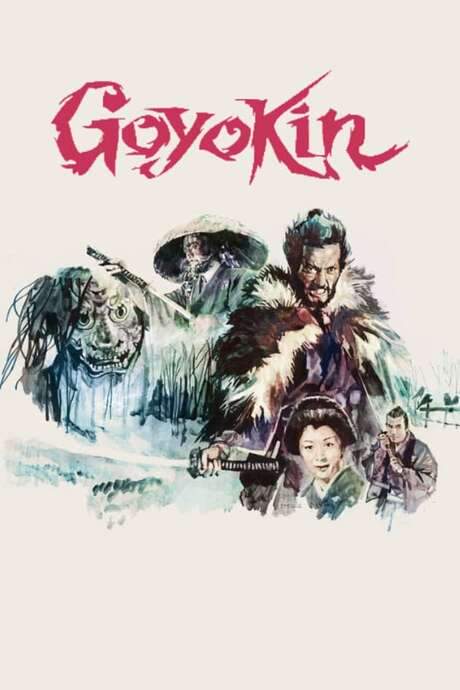
Goyokin (1969) movie poster

Characters & Themes

Goyokin (1969) Characters, Setting & Themes Explained

Release, runtime and language
1969 · 124 mins · Japanese
Loading streaming availability…
Directed by
Hideo Gosha
Starring
Tatsuya Nakadai, Yôko Tsukasa, Eijirô Tôno, Hisashi Igawa, Eitarô Ozawa, Susumu Kurobe

A guilt-haunted samurai warrior attempts to stop a massacre taking place.

On this page (8)
  1. 1 Where to watch
  2. 2 Characters explained (6)
  3. 3 Where & when it takes place
  4. 4 Themes & meaning (4)
  5. 5 Character & meaning questions
  6. 6 Movie threads
  7. 7 Movies like Goyokin
  8. 8 Every angle
Loading streaming availability…

6 main characters · contains spoilers

Goyokin Characters Explained: Who Is Who

The main characters of Goyokin (1969), heroes and villains: what drives them, how they change over the course of the story and what each of them reveals about the film's bigger ideas.

  • Magobei Wakizaka (Tatsuya Nakadai)

    A principled samurai who refuses to let Rokugo escape punishment. He embodies a quiet, moral resilience, choosing to return to Sabai and confront his former master even at great personal risk. Magobei's steady code drives the group and ultimately leads to the saving of the villagers.

    • 🗡️ Samurai
    • 🧭 Honor
    • 🧩 Moral dilemma
  • Rokugo Tatewaki (Tetsuro Tamba)

    A calculating former master who uses his position to plunder wealth and crush dissent. His plan to move a bonfire to lure ships shows a ruthless willingness to sacrifice others for profit. Rokugo remains Magobei's primary antagonist until the final confrontation.

    • 🗡️ Power
    • 🧭 Ruthless
    • 🧩 Mastermind
  • Oriha (Ruriko Asaoka)

    A survivor who has endured Rokugo's brutality and joins Magobei's quest. She embodies resilience and compassion, helping to guide the group and ensuring that the price of violence is not forgotten by the living. Oriha's presence offers emotional grounding amid the action.

    • 🌸 Survivor
    • 💫 Compassion
  • Rokuzo (Ben Hiura)

    Oriha's brother who becomes a partner in the journey to Sabai. He brings a pragmatic, loyal perspective and a desire to see the right outcome for his sister and the villagers. Rokuzo's involvement helps balance the group with a grounded, humane viewpoint.

    • 👣 Heir to resilience
    • 🧭 Loyalty
  • Samon Fujimaki (Kinnosuke Nakamura)

    A ronin hired to kill Magobei who reveals his own alignment shifts due to his status as a Shogun spy. His evolving loyalties add complexity to the mission and emphasize that trust is earned, not assumed. Samon becomes a crucial ally in the final plan.

    • 🗡️ Ronin
    • 🧭 Loyalties
  • Kunai (Isao Natsuyagi)

    A retainer of Rokugo who orchestrates the initial hit on Magobei. He is a foil to Magobei's honor, representing the dangers of ruthless ambition within the ruling class. Kunai's role accelerates the timeline toward the climactic confrontation.

    • 🗡️ Assassin
    • 🧭 Ambition

Last updated: October 04, 2025 at 15:43

Was this helpful?

Setting

Where and When Does Goyokin Take Place?

The setting of Goyokin (1969): the year and time period, the places and locations, and how they shape the characters, the mood and the tension of the story.

Time period

Edo period

The events unfold under the Tokugawa shogunate, a rigid feudal system that controls society and trade. Samurai codes, loyalty, and state power shape every decision, from the initial theft to the final confrontation in the snow.

Location

Sado Island, Sabai, Edo

A remote island in the Sea of Japan houses a rich gold mine that powers the Tokugawa regime. The story also pivots through Edo, the shogunate's capital, where Magobei hides and makes difficult choices. The rural village of Sabai is the scene of sacrifice and treachery that drives the plot.

  • 🏝️ Island setting
  • 🏯 Feudal Japan
  • 🌊 Maritime

Last updated: October 04, 2025 at 15:43

Was this helpful?

4 major themes

Goyokin Meaning: Themes & Message Explained

What is Goyokin (1969) really about? The emotional, social and philosophical themes the film keeps returning to, its symbolism and the message beneath the surface.

  • Honor & Duty

    Magobei's commitment to justice pits personal loyalty against the orders of his former master. The film explores how a samurai's code can compel him to risk life and reputation to protect the vulnerable.

  • Justice & Corruption

    Rokugo's plan to steal wealth and manipulate the bonfire warning reveals how power can corrupt leadership. The protagonists struggle to expose wrongdoing and save the innocent, even at great personal cost.

  • Solidarity

    Magobei, Samon, Oriha, and Rokuzo form an unlikely alliance to thwart the master’s schemes. Their cooperation demonstrates that shared humanity can overcome political intrigue and violence.

  • Nature & Fate

    The snow-clad finale underscores the harsh, indifferent environment in which the characters fight. Nature acts as a stark counterpoint to human schemes, deciding who survives and who pays the price.

Last updated: October 04, 2025 at 15:43

Was this helpful?

Character & theme questions

Goyokin Characters & Meaning: Your Questions Answered

The questions people ask about Goyokin (1969): who the characters really are, their relationships, what the symbols mean, where it takes place and what the movie is really about. Each answer contains spoilers.

Q1

Where is Goyokin set?

The film takes place across three main locations: Sado Island, a remote island in the Sea of Japan that houses a rich gold mine powering the Tokugawa regime; Sabai, a rural village that becomes the scene of sacrifice and treachery; and Edo, the shogunate's capital where key characters make difficult choices.

  • sado island
  • sabai
  • edo
  • setting
  • japan
  • sea of japan
Q2

When does the story take place?

Goyokin is set during the Edo period under the Tokugawa shogunate, a rigid feudal system that controls society and trade. Samurai codes, loyalty, and state power shape every decision throughout the film, from the initial theft to the final confrontation in the snow.

  • edo period
  • tokugawa shogunate
  • feudal japan
  • time period
  • historical
Q3

What role does the gold mine play in the story?

The gold mine on Sado Island is central to the conflict, it powers the Tokugawa regime and attracts greedy officials who manipulate its wealth. The mine's wealth becomes the catalyst for corruption and the planned massacre that Magobei seeks to prevent.

  • gold mine
  • sado island
  • wealth
  • tokugawa regime
  • corruption
Q4

What are the main themes of Goyokin?

The film explores several interconnected themes: Honor & Duty, as Magobei's commitment to justice pits personal loyalty against his former master's orders; Justice & Corruption, examining how power can corrupt leadership; Solidarity, showing how unlikely allies unite against tyranny; and Nature & Fate, with the harsh winter setting acting as an indifferent force that decides who survives.

  • honor
  • duty
  • justice
  • corruption
  • solidarity
  • nature
  • fate
  • themes
Q5

How does the film explore honor and duty?

Magobei's commitment to justice forces him to confront his former master Rokugo, risking his life and reputation to protect the vulnerable. The film shows how a samurai's code can compel righteous action even against authority, creating deep personal conflict between loyalty and moral duty.

  • honor
  • duty
  • samurai code
  • magobei
  • loyalty
  • moral dilemma
Q6

How does Goyokin portray corruption?

Rokugo's scheme to steal wealth and manipulate the bonfire warning system demonstrates how power corrupts leadership. His willingness to sacrifice innocent villagers for profit represents the moral rot within the Tokugawa system, contrasting with the protagonists who risk everything to expose wrongdoing.

  • corruption
  • power
  • rokugo
  • greed
  • injustice
  • leadership
Q7

Who is Magobei Wakizaka?

Magobei Wakizaka (played by Tatsuya Nakadai) is a principled samurai who refuses to let Rokugo escape punishment. Driven by a quiet moral resilience, he returns to Sabai to confront his former master despite great personal risk. His steady code guides the group and leads to saving the villagers, though at significant personal cost.

  • magobei wakizaka
  • tatsuya nakadai
  • protagonist
  • samurai
  • honor
Q8

Who is Rokugo Tatewaki?

Rokugo Tatewaki (played by Tetsuro Tamba) is the film's primary antagonist, a calculating former master who plunders wealth and crushes dissent. His plan to move a bonfire to lure ships demonstrates ruthless willingness to sacrifice others for profit. He remains Magobei's adversary until the final confrontation in the snow.

  • rokugo tatewaki
  • tetsuro tamba
  • antagonist
  • villain
  • corruption
Q9

Who is Oriha in the film?

Oriha (played by Ruriko Asaoka) is a survivor who has endured Rokugo's brutality and joins Magobei's quest for justice. She embodies resilience and compassion, guiding the group and ensuring the price of violence is remembered. Her presence provides emotional grounding amid the film's action and moral complexity.

  • oriha
  • ruriko asaoka
  • survivor
  • resilience
  • compassion
Q10

Who is Samon Fujimaki?

Samon Fujimaki (played by Kinnosuke Nakamura) is a ronin hired to kill Magobei who later reveals he is a Shogun spy. His evolving loyalties add complexity to the mission, showing that trust must be earned rather than assumed. Samon becomes a crucial ally in the final plan against Rokugo.

  • samon fujimaki
  • kinnosuke nakamura
  • ronin
  • spy
  • shogun
  • loyalty shift
Q11

What is the significance of the snow in the ending?

The snow-clad finale underscores the harsh, indifferent environment in which the characters fight. Nature acts as a stark counterpoint to human schemes, deciding who survives and who pays the price. The winter setting amplifies the film's themes of fate and the heavy personal cost of justice.

  • snow
  • nature
  • fate
  • ending
  • winter
  • finale
  • environment
Q12

How do the characters form an alliance in Goyokin?

Magobei, Samon, Oriha, and Rokuzo form an unlikely alliance to thwart Rokugo's schemes. Their cooperation demonstrates that shared humanity can overcome political intrigue and violence. Each character brings different skills and perspectives, Magobei's honor, Samon's hidden authority, Oriha's emotional depth, and Rokuzo's grounded loyalty.

  • alliance
  • teamwork
  • solidarity
  • magobei
  • samon
  • oriha
  • rokuzo
Q13

What is the emotional tone of Goyokin?

The film carries a predominantly tense tone driven by suspense and the protagonist's internal guilt. This is punctuated by a melancholic undercurrent throughout. The emotional weight centers on themes of betrayal, mass murder, and a man's struggle for redemption, culminating in a bittersweet ending where Magobei achieves victory but remains wounded and alone.

  • emotional tone
  • tension
  • melancholy
  • guilt
  • redemption
  • bittersweet
  • atmosphere

Movie threads

More Movies Like Goyokin, by Mood & Story

Curated lists built around what makes Goyokin tick: the same mood, the same kind of story or the same emotional payoff. Each list explains why these movies belong together.

Samurai Redemption Stories like Goyokin

Honorable warriors confront their past sins in a quest for personal salvation. For viewers seeking movies like Goyokin, this collection focuses on samurai dramas and historical action films where a guilt-ridden protagonist seeks atonement. These stories share a heavy emotional weight, tense atmosphere, and a focus on honor, betrayal, and the bittersweet cost of redemption.

  • guilt-ridden
  • honorable
  • melancholic
  • atmospheric
  • grim
  • redemptive
  • Tone: tense, melancholic, honorable
  • Pacing: steady, deliberate
Why these movies?

The story pattern: The narrative follows a protagonist who is morally compromised by a past transgression. Driven by a deep sense of guilt and a personal code, they embark on a path that pits them against former allies or a corrupt system, culminating in a climactic confrontation that serves as both punishment and absolution.

Why they belong together: These movies are grouped by their central character archetype—the flawed warrior seeking redemption—and the shared emotional journey of confronting past sins. They consistently deliver a somber, honorable, and tense mood, with a pacing that builds steadily towards a morally complex and emotionally resonant climax.

Atmospheric and Grim Action Dramas like Goyokin

Suspenseful stories where the environment is a character, amplifying tension and isolation. If you liked the tense, snowy atmosphere of Goyokin, this list features movies with a similar vibe where the setting enhances the suspense. These films are characterized by a grim and melancholic mood, a steady pace that builds tension, and stories of survival and moral conflict set against harsh backdrops.

  • atmospheric
  • tense
  • suspenseful
  • grim
  • melancholic
  • snowy
  • Tone: tense, grim, atmospheric
  • Pacing: steady, suspenseful
Why these movies?

The story pattern: Stories in this thread use their setting to create a pervasive mood of isolation and impending doom. The plot unfolds with a steady, often deliberate pace, allowing the atmosphere to build suspense. Characters are frequently isolated or outnumbered, fighting for survival or a moral cause against a backdrop that is as much an antagonist as the human foes.

Why they belong together: These films are united by their masterful use of atmosphere and setting to define the viewing experience. They share a palpable sense of place that contributes directly to the tone—be it tension, melancholy, or grim determination—creating a cohesive and immersive vibe that is central to their appeal.

If you liked this

Movies Like Goyokin

Similar movies to Goyokin: the same genre, themes or kind of story. Each one comes with its own plot summary, timeline and ending explained.

Browse all movie summaries

Every angle

Goyokin (1969) Explained: Plot, Timeline & Characters

Everything about Goyokin in one place: what happens in the plot summary, the timeline in chronological order, the characters and meaning and a spoiler-free summary. What's After the Movie adds the cast, box office and post-credit scenes.

Coming soon on iOS and Android

The Plot Explained Movie Summary App

Plot summaries, endings explained and timelines on your phone. Catch up on any movie in minutes, save your favorites and never miss a twist again.

Be the first to know when we launch. Your email stays private, always.

Learn more about the app