Plot Explained Spoilers guaranteed!
Plot Explained

Browse by genre

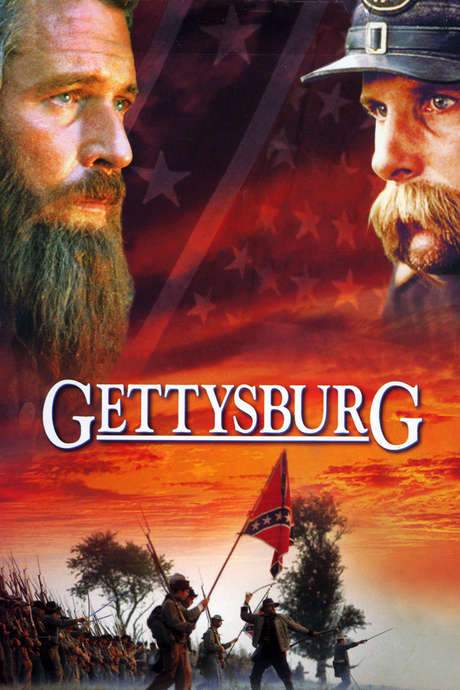
Gettysburg (1993) movie poster

Timeline

Gettysburg (1993) Timeline Explained – Every Event in Order

Release, runtime and language
1993 · 254 mins · English
Loading streaming availability…
Directed by
Ronald F. Maxwell
Starring
Martin Sheen, Stephen Lang, Mark Moses, Tom Berenger, Kevin Conway, George Lazenby

Same land, same god, different dreams. In the summer of 1863 General Robert E. Lee leads the Confederate Army of Northern Virginia into Gettysburg, Pennsylvania, aiming for Washington, D.C. Union General George G. Meade positions the Potomac army defensively, setting the stage for the decisive Battle of Gettysburg, a turning point in the Civil War.

On this page (7)
  1. 1 Where to watch
  2. 2 Events in order (15)
  3. 3 Timeline questions answered
  4. 4 The book behind the movie
  5. 5 Movie threads
  6. 6 Movies like Gettysburg
  7. 7 Every angle
Loading streaming availability…

15 events in order · contains spoilers

Gettysburg Timeline: Events in Chronological Order

Every key event of Gettysburg (1993) in order, scene by scene, with when and where it takes place. Use it to untangle flashbacks, time jumps and parallel storylines, to refresh your memory before the sequel or to find the exact scene you are thinking of.

  1. Confederate invasion crosses into the North

    From a narrated map, the Confederate Army of Northern Virginia crosses the Potomac River and invades the North in June 1863, marching through Maryland into Pennsylvania. Lee aims to strike the Union on favorable ground while the army maneuvers toward Gettysburg. The maneuvering signals the coming clash between the two sides.

    When
    June 1863
    Where
    Potomac River / Maryland
  2. Harrison reports Union movement to Longstreet

    On June 30, Confederate spy Henry Thomas Harrison informs Lt. Gen. James Longstreet that the Union Army of the Potomac is moving; Hooker has been replaced by Meade. Longstreet relays the information to Lee, who is wary of relying on a cavalry report. Lee orders concentration near Gettysburg despite doubts.

    When
    June 30, 1863
    Where
    Union encampments near Union Mills, Maryland
  3. Lee concentrates near Gettysburg

    Lee orders the army to concentrate near the town of Gettysburg after weighing the earlier reports. He wants to draw the Union into battle on ground of his choosing. The plan sets the stage for the climactic engagement in Pennsylvania.

    When
    June 30 – July 1, 1863
    Where
    Gettysburg, Pennsylvania
  4. Buford holds the ground at Gettysburg

    Brig. Gen. John Buford's cavalry discerns the approaching Confederates and decides to stand on favorable terrain rather than retreat. He sends for reinforcements from Reynolds's I Corps. The Union army slows the Confederate advance, buying time for defenses.

    When
    July 1, 1863
    Where
    Gettysburg
  5. Reynolds killed; Union retreats to Cemetery Ridge

    Reynolds arrives to reinforce Buford but is killed by a Confederate sharpshooter. The Union army is pushed back from Gettysburg to Cemetery Ridge as Lee's forces press forward. Ewell is ordered to take the Union positions 'if practicable' but hesitates.

    When
    July 1, 1863
    Where
    Gettysburg, Cemetery Ridge
  6. Stuart arrives; Lee reprimands him

    That evening, Confederate cavalry chief J. E. B. Stuart finally arrives at headquarters, prompting Lee to reprimand him for being out of contact. Longstreet's second division also arrives; Pickett's division comes later. The command confusion underscores the mounting pressures on the Confederate side.

    When
    Evening of July 1, 1863
    Where
    Seminary Ridge / Confederate headquarters
  7. Little Round Top defended by Vincent and Chamberlain

    On July 2, Col. Strong Vincent's brigade deploys to Little Round Top, placing the 20th Maine at the end of the line. Chamberlain persuades the remaining 2nd Maine soldiers to fight, reinforcing the line at the crucial flank. The Union defense secures a vital position on the battlefield.

    When
    July 2, 1863
    Where
    Little Round Top, Gettysburg
  8. Longstreet orders Hood to attack at Little Round Top; Hood wounded

    Lee orders Longstreet to deploy two divisions to attack Little Round Top. Hood's assault is launched despite protests, and Hood is wounded at Devil's Den. The Union defense holds the high ground for now.

    When
    July 2, 1863
    Where
    Little Round Top / Devil's Den
  9. Chamberlain's bayonet charge secures the flank

    As ammunition runs low on the Union side, Chamberlain orders a dramatic bayonet charge and a right-wheel drive down the slope. The attack sustains the Union flank and repels the Confederate onslaught.

    When
    July 2, 1863
    Where
    Little Round Top, Gettysburg
  10. Day Two ends with Confederate repositioning

    Stuart's late arrival and Pickett's divisions moving into position mark the end of a tense second day. Lee reprimands Stuart for the delay while Longstreet's forces prepare for the next phase.

    When
    July 2, 1863
    Where
    Seminary Ridge / Gettysburg
  11. Three-division assault planned for Cemetery Ridge

    On July 3, Lee orders a coordinated assault with Pickett, Trimble, and Pettigrew against the Union center at Cemetery Ridge. Longstreet expresses doubts that the attack will succeed, given the well-fortified Union defense behind a stone wall.

    When
    July 3, 1863
    Where
    Cemetery Ridge
  12. Alexander's artillery fails to clear Union guns

    General Porter Alexander commands artillery to silence the Union guns on the ridge but struggles to make an impact. Despite heavy fire, Confederate artillery cannot break the line, hampering the planned assault.

    When
    July 3, 1863
    Where
    Cemetery Ridge
  13. Armistead crosses the wall; Armistead wounded and captured

    One of Pickett's brigades, commanded by Lewis Armistead, crosses the Union stone wall but Armistead is wounded and captured. The Union troops respond fiercely, and the Confederate assault loses momentum under mounting casualties.

    When
    July 3, 1863
    Where
    Cemetery Ridge
  14. Lee orders withdrawal after the failed assault

    Witnessing the heavy losses, Lee withdraws his forces in retreat that evening. The fighting at Gettysburg ends with the Union holding the ridge and the Confederates retreating to the south.

    When
    July 3–4, 1863
    Where
    Gettysburg
  15. Conclusion: fates of major figures

    The film closes by showing the fates of the major generals and leaders involved in the battle, reflecting on the enormous costs and consequences of the clash. The narrative ties together the strategic and personal arcs that defined the three-day struggle.

    When
    After July 3, 1863
    Where
    Gettysburg

Last updated: October 09, 2025 at 12:31

Was this helpful?

Timeline questions answered

Gettysburg Timeline Explained: Your Questions Answered

When does it happen, and why in that order? The questions people ask about the chronology of Gettysburg (1993): time jumps, flashbacks, cause and effect between scenes and the correct order of events, each answered with spoilers.

Q1

Why did Robert E. Lee decide to invade the North in 1863 despite the risks?

Lee believed that invading Pennsylvania would shift the war out of Virginia, supply his army from Northern resources, and potentially force Lincoln to negotiate peace by threatening Washington. He also hoped to lure the Union army into battle on ground of his choosing, leveraging the Confederate home-field advantage even on Northern soil.

Foreshadowing: The film opens with Lee trusting 'the land and timing to shape their fate,' showing his belief in terrain as a strategic asset.

  • robert e lee
  • confederate invasion
  • pennsylvania
  • strategic gamble
  • gettysburg campaign
Q2

Why was J.E.B. Stuart's absence problematic for Lee at Gettysburg?

Stuart, the Confederate cavalry commander, rode around the Union army to gather intelligence but lost contact with Lee for critical days. This left Lee without accurate information about the Union army's position and movements, forcing him to make decisions based on incomplete intelligence and leading to the Confederate army arriving at Gettysburg piecemeal rather than as a unified force.

Foreshadowing: Lee relies on a spy (Harrison) rather than his cavalry commander, showing the fragility of his information network from the start.

  • jeb stuart
  • cavalry
  • intelligence
  • confederate army
  • lee orders
Q3

How did General Reynolds' death affect the first day of battle?

Reynolds was killed by a Confederate sharpshooter shortly after arriving to reinforce Buford's cavalry. His death created a leadership vacuum at a critical moment, and Union forces were pushed back from Gettysburg to Cemetery Ridge. The Union still managed to establish a defensive line, but losing Reynolds early removed a key commander from the first day's coordination.

  • john f reynolds
  • killed
  • sharpshooter
  • union command
  • first day battle
Q4

Why did Lee order Ewell to take Cemetery Hill 'if practicable' instead of insisting?

Lee gave Ewell discretionary orders ('if practicable') because he was not physically present at the scene and trusted Ewell to judge the tactical situation. Ewell hesitated, deciding not to press the assault despite having an opportunity to take the high ground. This decision allowed the Union to consolidate their defensive position on Cemetery Ridge, which became crucial for the rest of the battle.

  • edward ewell
  • cemetery hill
  • lee orders
  • high ground
  • tactical decision
Q5

How did Chamberlain convince the 2nd Maine soldiers to fight?

  • josiah chamberlain
  • 2nd maine
  • moral leadership
  • recruitment
  • 20th maine
Q6

Why was Little Round Top so critical to the Union defense?

Little Round Top was the southern anchor of the Union line. If Confederates seized it, they could enfilade the entire Union position and potentially force a retreat. Strong Vincent placed the 20th Maine at the extreme left of the line, knowing the flank was exposed. Holding this ground prevented the Confederates from turning the Union position and allowed the Union army to maintain its defensive posture.

  • little round top
  • 20th maine
  • strong vincent
  • flank defense
  • union line
Q7

Why did Longstreet object to the attack plans at Little Round Top?

Longstreet recognized that attacking uphill against a defended position with the high ground held by the Union would be extremely costly. He voiced protests, particularly regarding General Hood's division being ordered to assault the rocky terrain of Devil's Den. Despite his objections, Lee pressed forward with the attack, resulting in heavy Confederate casualties and ultimately failing to dislodge the Union forces.

  • james longstreet
  • little round top
  • hood protest
  • tactical criticism
  • confederate attack
Q8

Why did Chamberlain order a bayonet charge when the 20th Maine was running low on ammunition?

With ammunition nearly exhausted and the Confederate attackers closing in, Chamberlain recognized that falling back would expose the entire Union flank to collapse. He ordered a bayonet charge, a right-wheel movement down the slope, that caught the Confederates by surprise. The aggressive action swept the enemy back and saved the flank, described in the film as 'sweeping like a door closing.'

  • chamberlain bayonet charge
  • ammunition
  • 20th maine
  • flank attack
  • defense
Q9

Why did Lee order Pickett's Charge despite Longstreet's objections?

Lee believed the Union center was vulnerable after previous day's fighting and that a concentrated assault could break the Union line. Longstreet warned that crossing a mile of open ground against a fortified position behind a stone wall would be devastating. Lee overruled him, committing three divisions (Pickett's, Trimble's, and Pettigrew's) in what became the most infamous assault of the battle.

  • picketts charge
  • lee orders
  • longstreet objection
  • cemetery ridge
  • assault failure
Q10

Why didn't Confederate artillery silence the Union guns before Pickett's Charge?

General Porter Alexander commanded Confederate artillery to neutralize Union guns on Cemetery Ridge, but the artillery could not achieve sufficient impact. Union return fire was effective, and despite heavy exchange, the Confederate artillery failed to suppress the Union defenses. This left Pickett's attacking infantry exposed to devastating fire without adequate suppression of Union positions.

  • porter alexander
  • artillery
  • cemetery ridge
  • union guns
  • preparation
Q11

What happened when Armistead's brigade crossed the Union stone wall?

Lewis Armistead's brigade achieved the farthest penetration of Pickett's Charge, actually crossing the Union stone wall at the center of the line. However, without support and with Armistead himself wounded and captured, the breakthrough could not be maintained. Union forces counterattacked, and the Confederate assault collapsed with devastating casualties.

  • lewis armistead
  • stone wall
  • breakthrough
  • capture
  • wounding
Q12

Why did Lee order a withdrawal after Pickett's Charge failed?

With Pickett's division shattered, Trimble's and Pettigrew's divisions decimated, and the Union line intact, Lee recognized the assault had failed catastrophically. He ordered the army to retreat under darkness to avoid total destruction. The Confederate army withdrew on July 3-4, marking the end of their northern campaign and a turning point in the war.

  • lee withdrawal
  • retreat
  • confederate defeat
  • july 4
  • campaign ends

Movie threads

More Movies Like Gettysburg, by Mood & Story

Curated lists built around what makes Gettysburg tick: the same mood, the same kind of story or the same emotional payoff. Each list explains why these movies belong together.

Epic War Dramas with Strategic Focus like Gettysburg

Immense historical battles where the fate of nations hangs on tense command decisions. If you liked the intricate strategy and human drama of Gettysburg, explore more movies like it. This thread features similar epic historical films that focus on leadership, pivotal battles, and the heavy cost of conflict, offering a blend of tactical tension and profound emotional weight.

  • epic
  • tense
  • somber
  • grim
  • heroic
  • reflective
  • Tone: tense, somber, grim
  • Pacing: variable, shifting from methodical to chaotic
Why these movies?

The story pattern: Narratives in this thread often weave together multiple perspectives, from top commanders grappling with hubris and doubt to frontline soldiers facing the brutal reality of combat. The story builds through tense planning and positioning, culminating in large-scale, devastating battle sequences that serve as a turning point, leaving a bittersweet or heavy conclusion.

Why they belong together: Movies are grouped here for their shared focus on the strategic dimension of war, their epic scale, and their somber, reflective tone. They all deliver a high-intensity experience rooted in historical authenticity, where the drama comes from command stakes as much as battlefield action.

Movies About Leadership and Command like Gettysburg

Intense dramas where leaders face impossible choices with immense consequences. For viewers who appreciated the command-level drama in Gettysburg, this thread collects films with similar stories of leadership under pressure. Discover movies like Gettysburg that explore the weight of strategic decisions, moral courage, and the personal toll on those in charge during historical turning points.

  • tense
  • heavy
  • psychological
  • command
  • dilemma
  • strategic
  • Tone: tense, heavy, reflective
  • Pacing: variable, with deliberate build-up
Why these movies?

The story pattern: The core journey follows a leader or group of leaders facing a high-stakes situation. The plot is driven by critical decision-making, often involving strategic gambles and ethical dilemmas. Tension builds from the consequences of these choices, leading to a climax that validates or condemns their judgment, resulting in a reflective and often bittersweet ending.

Why they belong together: These films are united by their central focus on the psychology of command. They share a tense, heavy tone and explore themes of hubris, pragmatism, and moral responsibility, creating a compelling character study set against a backdrop of immense pressure.

If you liked this

Movies Like Gettysburg

Similar movies to Gettysburg: the same genre, themes or kind of story. Each one comes with its own plot summary, timeline and ending explained.

Browse all movie summaries

Every angle

Gettysburg (1993) Explained: Plot, Timeline & Characters

Everything about Gettysburg in one place: what happens in the plot summary, the timeline in chronological order, the characters and meaning and a spoiler-free summary. What's After the Movie adds the cast, box office and post-credit scenes.

Coming soon on iOS and Android

The Plot Explained Movie Summary App

Plot summaries, endings explained and timelines on your phone. Catch up on any movie in minutes, save your favorites and never miss a twist again.

Be the first to know when we launch. Your email stays private, always.

Learn more about the app