

















Plot Explained Spoilers guaranteed!
Plot Explained

Browse by genre

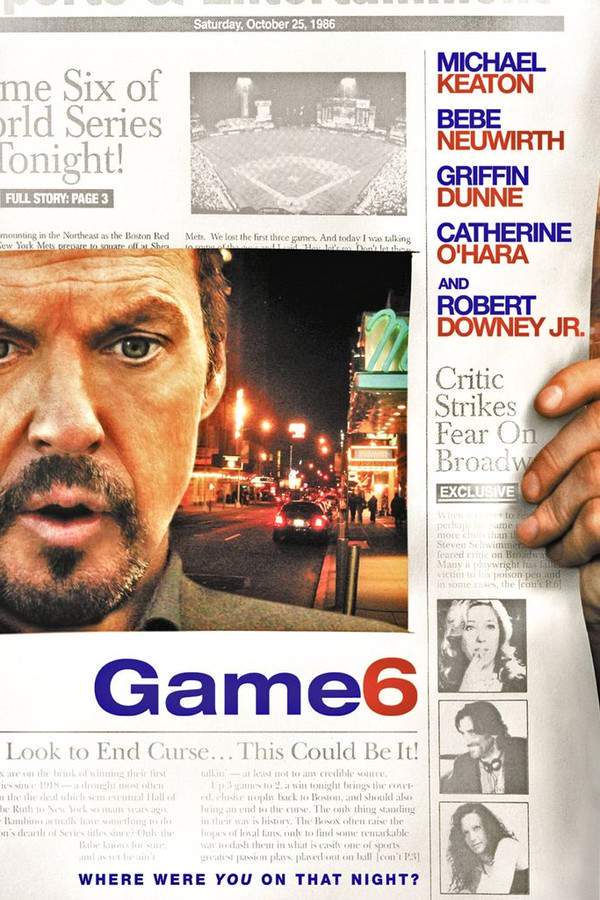
Game 6 (2006) movie poster

Plot Summary

Game 6 (2006) Plot Summary Explained

Release, runtime and language
2006 · 87 min · English
JustWatch #20,734 6
Directed by
Michael Hoffman
Starring
Robert Downey Jr., Michael Keaton, Griffin Dunne

In 1986, playwright Nicky Rogan faces a crisis when a harsh review from critic Steven Schwimmer appears imminent. His personal anxieties are heightened as he watches the Boston Red Sox compete for the World Series championship. The pressure of the looming critique intertwines with the team’s struggle, blurring the lines between Nicky's professional and personal life as he confronts his deepest insecurities.

On this page (6)
  1. 1 Where to watch
  2. 2 What happens: full plot
  3. 3 Plot questions answered
  4. 4 Movie threads
  5. 5 Movies like Game 6
  6. 6 Every angle

Where to watch

Where to Watch Game 6 (2006)

Where can you watch Game 6? Stream, rent or buy it in the US, including on Amazon Prime Video, fuboTV and Fawesome: current JustWatch availability with up-to-date prices.

Streaming availability powered by JustWatch

Full plot summary · contains spoilers

What Happens in Game 6: Full Plot Summary

The whole story of Game 6 (2006) explained, from the opening scene to the final frame: every key event, every twist and what it all adds up to. Read it as a quick recap before the sequel, to check a scene you missed, or to finally understand what really happened.

Nicky Rogan, a successful playwright known for his multiple successful works, finds himself in turmoil on the opening night of his latest play. With everyone around him, including his friends, convinced that this will be his best production yet, doubts and fears begin to creep in. These insecurities are fueled by a rival playwright whose previous work was severely panned by the local newspaper's strident drama critic, Steven Schwimmer. As the hour approaches, Nicky's anxiety escalates to a terrifying resolve—he intends to eliminate the critic, convinced that his play will suffer the same fate.

Instead of being at the theater, Nicky opts for a local bar, finding unexpected company in a friendly cab driver and her grandson. Earlier that evening, she amusingly mistook him for a small-time gangster, a mistake he does not bother to correct. As they share the night, they fixate on the pivotal Game 6 of the 1986 World Series, where the Boston Red Sox, Nicky's beloved team, are on the brink of clinching the championship against the New York Mets. Throughout the game, even as the Sox lead, Nicky wrestles with a deep-seated fear of loss, one he knows all too well as a dedicated fan.

When the infamous moment arrives—the catastrophic errors leading to the heartbreaking loss for the Sox—Nicky reaches his breaking point. Fueled by rage and disappointment, he abandons his companions and heads out on a mission to confront his would-be nemesis. In a twist of fate, Nicky discovers not only the critic but also witnesses him in an intimate moment with his own daughter. In a chaotic storm of emotions, Nicky pulls out his weapon, only to find unexpected camaraderie with Steven Schwimmer as they share in the misery of the Sox's defeat. Ultimately, they find solace in each other, huddled together in the critic's apartment as they endure a seemingly endless rerun of the devastating Bill Buckner error, forever entwined by the night’s events.

Last updated: November 08, 2024 at 03:47

Was this helpful?

Plot questions answered

Game 6 Plot Explained: Your Questions Answered

The questions people ask most about Game 6 (2006): what happens in the confusing scenes, why the characters do what they do, the twists, hidden details and what the ending means. Each answer contains spoilers.

Q1

Why does Nicky Rogan want to kill the drama critic?

Nicky plans to eliminate critic Steven Schwimmer because he believes the review will destroy his new play, just as his rival playwright's work was severely panned. His mounting anxiety and insecurities convince him that preventing the review is the only way to avoid professional humiliation. The plan represents the extreme endpoint of his fear of public failure and artistic rejection.

Foreshadowing: Earlier, Nicky's rival playwright is mentioned as having his work trashed by the same critic, showing Nicky the devastating impact of a negative review.

  • nicky rogan
  • steven schwimmer
  • critic
  • murder plot
  • anxiety
  • playwright
Q2

Why does Nicky skip his play's opening night?

Nicky abandons his own opening night because his anxiety reaches an unbearable level. Instead of facing the possibility of artistic failure at the theater, he flees to a local bar seeking escape from the mounting pressure. This impulsive decision sets the entire film's events in motion.

Foreshadowing: Friends and supporters believe the play will be his best work, but Nicky's internal doubts contradict their confidence, foreshadowing his inability to face the premiere.

  • nicky rogan
  • opening night
  • bar
  • anxiety
  • play
  • escape
Q3

What does Nicky discover at the critic's apartment?

When Nicky confronts the critic, he unexpectedly finds Steven Schwimmer in an intimate moment with his own daughter. This shocking discovery creates a chaotic emotional漩涡 that completely derails Nicky's original violent intentions, forcing him to process betrayal on multiple levels.

Foreshadowing: The narrative builds tension toward this confrontation as Nicky storms out after the Red Sox loss, driven by rage and a need for revenge.

  • steven schwimmer
  • daughter
  • discovery
  • confrontation
  • apartment
Q4

Why does Nicky bond with the critic after the baseball game?

Nicky and Steven Schwimmer find unexpected camaraderie because they share the same devastating experience, the Red Sox's heartbreaking loss in Game 6 of the 1986 World Series. Their mutual misery over the baseball defeat creates an immediate human connection that transcends Nicky's planned violence. They literally huddle together watching the Bill Buckner error replay.

Foreshadowing: Throughout the evening, Nicky's emotional state tracks with the game's tension, and his rage peaks exactly when the Sox lose, linking his personal despair to the team's defeat.

  • steven schwimmer
  • red sox
  • game 6
  • 1986 world series
  • bond
  • misery
Q5

What is the Bill Buckner error and why does it matter in the film?

The Bill Buckner error refers to the infamous moment in Game 6 when Red Sox first baseman Bill Buckner let a ground ball slip through his legs, allowing the winning runs to score and handing the championship to the New York Mets. In the film, this moment represents Nicky's ultimate breaking point, the catastrophic, devastating loss that mirrors his fear of failure. The repeated replay of the error becomes a symbol of how failure defines both sports and art.

Foreshadowing: As the game progresses, Nicky's fear of loss intensifies even while the Sox lead, foreshadowing the catastrophic collapse that mirrors his own professional anxieties.

  • bill buckner
  • error
  • red sox
  • mets
  • game 6
  • 1986
  • world series
Q6

What is the purpose of the cab driver and grandson in the story?

The cab driver and her grandson provide Nicky with human connection and temporary escape from his anxieties. The cab driver amusingly mistakes Nicky for a small-time gangster, which he doesn't correct, giving him a brief moment of levity and a different identity. Their presence grounds the story in everyday humanity and makes Nicky's subsequent abandonment of them more impactful.

Foreshadowing: The mistaken identity subplot adds whimsical humor early on, but Nicky leaves them abruptly after the game ends, showing how consumed he is by his darker intentions.

  • cab driver
  • grandson
  • mistaken identity
  • bar
  • connection
Q7

How does the Red Sox loss connect to Nicky's personal fear of failure?

The Red Sox's devastating loss directly parallels Nicky's deepest fear of failure. As a lifelong Red Sox fan, he knows intimately the agony of coming close to victory only to lose dramatically. When the game collapses, it triggers his emotional breakdown because it confirms his belief that loss is inevitable, the same defeat he fears will happen with his play. The baseball game becomes a mirror for his artistic anxieties.

Foreshadowing: Even while the Sox lead, Nicky wrestles with fear of loss, showing his inability to enjoy success while anticipating failure.

  • red sox
  • failure
  • fear
  • loss
  • parallel
  • anxiety
  • art
Q8

Why doesn't Nicky hurt the critic after finding him with his daughter?

Nicky doesn't commit violence because discovering the critic with his daughter creates a complex emotional situation that disrupts his rage. Rather than executing his plan, Nicky finds himself in an unexpected moment of shared humanity. The devastation of the Red Sox loss also leaves both men broken, and they bond over mutual misery instead of conflict.

Foreshadowing: Nicky's weapon is drawn during the chaotic confrontation, but the emotional complexity of what he discovers prevents him from following through.

  • violence
  • critic
  • daughter
  • weapon
  • restraint
  • emotional shift
Q9

What is the relationship between Nicky's daughter and the critic?

Nicky discovers that his own daughter is in an intimate relationship with Steven Schwimmer, the drama critic he planned to kill. This revelation adds a profound layer of betrayal and complexity to the confrontation, as Nicky not only faces his professional nemesis but also a deeply personal family betrayal.

Foreshadowing: The film establishes Nicky's personal vulnerabilities, but this relationship is revealed only at the confrontation moment.

  • daughter
  • steven schwimmer
  • relationship
  • betrayal
  • family
Q10

What does Nicky learn by the end of the movie?

Through the shared misery of watching the Red Sox loss repeatedly, Nicky comes to terms with his fears about failure. He realizes that defeat, whether in sports or art, is a part of human experience. The night forces him to reconsider his anxieties about public perception and criticism, leading to a new perspective on life and artistic vulnerability.

Foreshadowing: The replay of the Bill Buckner error循环 becomes a ritual of processing loss, allowing Nicky to move from rage to acceptance.

  • acceptance
  • failure
  • reflection
  • criticism
  • perspective
  • end
Q11

Why is Nicky so obsessed with Game 6 of the 1986 World Series?

Nicky is obsessed with Game 6 because he is a die-hard Boston Red Sox fan, and the game represents everything he fears, coming tantalizingly close to victory only to lose at the last moment. His emotional investment in the game mirrors his professional anxieties about his play's opening night, making the baseball outcome a proxy for his own potential failure.

Foreshadowing: Nicky declares the game pivotal and stays glued to it, with his emotional state swinging wildly with each play.

  • game 6
  • world series
  • red sox
  • mets
  • obsession
  • fan

Movie threads

More Movies Like Game 6, by Mood & Story

Curated lists built around what makes Game 6 tick: the same mood, the same kind of story or the same emotional payoff. Each list explains why these movies belong together.

Movies with a High-Stakes Night Like Game 6

Stories where a single impending event unravels a character's entire world. If you liked the tense atmosphere of Game 6, this thread features movies where a character's fate hinges on a single, impending event over one dramatic night. Find similar stories of professional anxiety, personal collapse, and the desperate measures taken before a life-altering review or result.

  • anxious
  • unraveling
  • cathartic
  • high-stakes
  • claustrophobic
  • melancholic
  • Tone: tense, anxious, cathartic
  • Pacing: variable, building to a climax
Why these movies?

The story pattern: Narratives in this thread are tightly focused on a short time frame, often a single day or night, leading up to a momentous event like a critical review, a verdict, or a final performance. The protagonist's anxieties, fears, and past failures are amplified by the ticking clock, leading to a cathartic, often bittersweet, confrontation with their own insecurities.

Why they belong together: Movies are grouped here by their shared structure of building immense tension around a singular, looming event. They feature protagonists on the brink, whose personal crises are intensified by the compressed timeline, resulting in a heavy, anxious, and psychologically probing viewing experience.

Movies Where Personal Drama Mirrors a Big Event Like Game 6

Stories where a private crisis mirrors a grand, public event. For viewers who enjoyed how Game 6 wove a playwright's crisis with the Red Sox World Series, this thread collects movies where a character's personal collapse or redemption is set against a major public spectacle. Discover similar stories that use parallel narratives to explore themes of fate and shared experience.

  • shared despair
  • melancholic
  • cathartic
  • symbolic
  • anxious
  • unlikely connection
  • Tone: bittersweet, melancholic, tense
  • Pacing: variable, intercutting
Why these movies?

The story pattern: These narratives operate on two levels: a deeply personal character arc and a significant public event that runs concurrently. The outcomes of each thread comment on and reflect the other, often using the public event as a metaphor for the character's internal state. The ending is frequently bittersweet, finding meaning or connection not in victory, but in shared experience.

Why they belong together: These films are connected by their unique structure, which creates meaning through juxtaposition. The emotional resonance comes from seeing a private anxiety reflected in a public arena, blending the heaviness of personal drama with the collective emotion of a major event, resulting in a complex and cathartic experience.

If you liked this

Movies Like Game 6

Similar movies to Game 6: the same genre, themes or kind of story. Each one comes with its own plot summary, timeline and ending explained.

Browse all movie summaries

Every angle

Game 6 (2006) Explained: Plot, Timeline & Characters

Everything about Game 6 in one place: what happens in the plot summary, the timeline in chronological order, the characters and meaning and a spoiler-free summary. What's After the Movie adds the cast, box office and post-credit scenes.

Coming soon on iOS and Android

The Plot Explained Movie Summary App

Plot summaries, endings explained and timelines on your phone. Catch up on any movie in minutes, save your favorites and never miss a twist again.

Be the first to know when we launch. Your email stays private, always.

Learn more about the app