













Plot Explained Spoilers guaranteed!
Plot Explained

Browse by genre

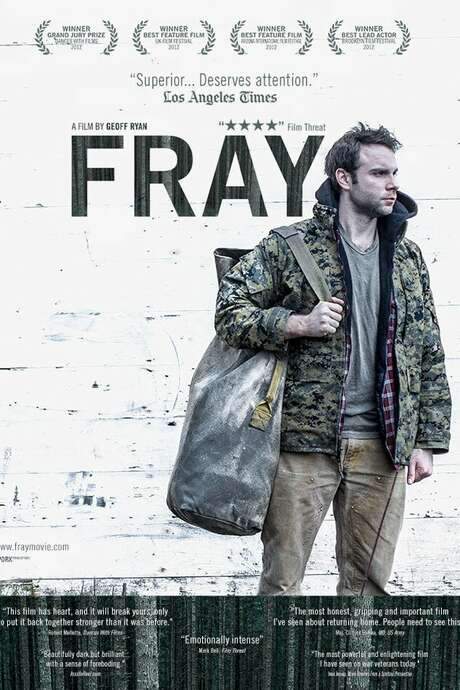
Fray (2012) movie poster

Timeline

Fray (2012) Timeline Explained – Every Event in Order

Release, runtime and language
2012 · 95 mins · English
JustWatch #25,081 2
Directed by
Geoff Ryan
Starring
Catherine Johnson, Evan Honer, Marisa Costa, Wes Harris, Drew Hicks, Bryan Kaplan

A young Marine veteran is facing a new battle back home while struggling through a shattered economy and burdened by the physical and emotional scars of war.

On this page (5)
  1. 1 Where to watch
  2. 2 Events in order (12)
  3. 3 Timeline questions answered
  4. 4 Movie threads
  5. 5 Every angle

Where to watch

Where to Watch Fray (2012)

Where can you watch Fray? Stream, rent or buy it in the US, including on Amazon Prime Video, Hoopla and JustWatch TV: current JustWatch availability with up-to-date prices.

Streaming availability powered by JustWatch

12 events in order · contains spoilers

Fray Timeline: Events in Chronological Order

Every key event of Fray (2012) in order, scene by scene, with when and where it takes place. Use it to untangle flashbacks, time jumps and parallel storylines, to refresh your memory before the sequel or to find the exact scene you are thinking of.

  1. Return home after five tours

    Justin, a United States Marine, returns home after five tours in Iraq and Afghanistan. He struggles to readjust to civilian life while working at a lumber mill and tending to his injured leg. He enrolls in classes at a nearby community college to build a life beyond his military service.

    Where
    Home
  2. Work and injury management at the lumber mill

    Back home, he handles cleanup work at a lumber mill and often checks his injured leg, a constant reminder of his combat past. The routine is steady but unsatisfying, highlighting his unsettled state. He begins to consider a future outside the military.

    Where
    Lumber mill
  3. Enrollment in community college

    He begins attending classes at a community college, seeking a path forward beyond combat. The academic setting offers a glimpse of normalcy, but adjusting to civilian studies remains challenging.

    Where
    Community college
  4. Romance with instructor begins

    A romance develops with a young instructor named Costa. The relationship gives him a sense of connection and hope, though it also tests his capacity for commitment.

  5. Struggles with commitment

    Justin finds commitment difficult; his past experiences make him wary of deep emotional ties. This struggle complicates the budding romance and disrupts efforts to settle into civilian life.

  6. Paul offers help but is met with hesitation

    Paul, his boss at the mill and a fellow veteran, offers help and guidance. Justin has trouble accepting assistance, unsure how to rely on others.

    Where
    Lumber mill
  7. Financial stress and late rent

    Spotty work hours in a tough economy leave him short on money and perpetually late with rent. Financial pressure compounds his stress and sense of instability. He worries about losing his housing.

  8. Anxiety triggers and woodland retreat

    The sounds of neighbors and daily life trigger anxiety, making him lash out or retreat to quiet places. He often escapes into the woods to find a measure of calm away from the demands of work and rent.

    Where
    Neighborhood / woods
  9. News of fallen buddies

    News arrives that some of his buddies overseas have died in battle. The loss deepens his sense of isolation and heightens his desire to disappear.

  10. Woods as a retreat after bad news

    The retreat into the woods after the news signals growing detachment from civilian life. He uses the isolation as a coping mechanism, away from work, class, and relationships.

    Where
    Woods
  11. Cheri and Paul's ongoing support

    Cheri, the instructor, and Paul persist in reaching out, offering support and patience. Their ongoing attempts reflect the film's theme of care and the challenge of reintegration.

  12. Continued effort to build a life beyond service

    Justin's ongoing effort to build a life beyond service sees him juggling school, work, and relationships while grappling with the trauma of combat. The story follows his slow, imperfect steps toward stability, connection, and self-understanding.

Last updated: February 24, 2026 at 14:09

Was this helpful?

Timeline questions answered

Fray Timeline Explained: Your Questions Answered

When does it happen, and why in that order? The questions people ask about the chronology of Fray (2012): time jumps, flashbacks, cause and effect between scenes and the correct order of events, each answered with spoilers.

Q1

Why does Justin have trouble accepting help from Paul?

Justin struggles to accept help because his military training emphasized self-reliance and independence. After experiencing trauma and loss in combat, he has difficulty trusting others and fears appearing vulnerable. Paul, as a fellow veteran, recognizes this pattern but Justin's emotional walls remain difficult to break through.

Foreshadowing: Paul's veteran status is established early, suggesting he understands Justin's reluctance in ways civilians cannot.

  • justin
  • paul
  • veteran help
  • PTSD
  • trust issues
  • military culture
Q2

Why does Justin keep retreating to the woods?

The woods provide Justin a sense of calm that mimics the isolation he experienced during combat deployments. The quiet and emptiness offer control and safety away from the overwhelming stimuli of civilian life. This retreat becomes his primary coping mechanism for managing PTSD and anxiety.

Foreshadowing: Early scenes show Justin escaping to quiet places when daily life becomes too demanding.

  • woods
  • retreat
  • PTSD coping
  • anxiety
  • isolation
  • nature
Q3

Why does Justin struggle with commitment to Cheri?

Justin's combat experiences have left him emotionally guarded and fearful of forming deep connections. The trauma of losing comrades makes the idea of vulnerability terrifying, as he's already experienced profound loss. His past makes him wary of letting anyone close enough to be hurt or to leave.

Foreshadowing: His difficulty with commitment is hinted at when the romance first develops, showing hesitation and uncertainty.

  • justin
  • cheri
  • commitment
  • trauma
  • emotional guard
  • relationship struggle
Q4

Why does Justin yell at sounds from his neighbors?

Justin experiences hypervigilance, a common PTSD symptom where unexpected sounds trigger a fight-or-flight response. Noises that would be normal in civilian life, voices, doors, music, activate his combat-trained survival instincts. This causes him to react aggressively or retreat rather than simply ignore the sounds.

Foreshadowing: The film establishes early that Justin is sensitive to everyday noises, setting up this pattern of anxiety.

  • PTSD
  • hypervigilance
  • anxiety
  • neighbor sounds
  • triggers
  • combat trauma
Q5

Why does news of his fallen buddies affect Justin so deeply?

When Justin learns his friends have died overseas, it triggers survivor's guilt and intensifies his existing PTSD. The loss reinforces his sense of isolation and makes him want to disappear further into the woods. This news represents the reality that the war continues without him, while he's stuck trying to function in a civilian world he no longer understands.

Foreshadowing: The film establishes his connection to his fellow Marines early, making this news emotionally devastating.

  • buddies
  • death
  • survivor guilt
  • PTSD
  • overseas
  • military loss
Q6

What is the significance of Justin's injured leg?

Justin's injured leg serves as a constant physical reminder of his combat past. It represents the visible wounds of war that he must manage while trying to rebuild a civilian life. The injury also limits his employment options, contributing to his financial struggles and sense of being trapped between his military identity and civilian future.

Foreshadowing: He is shown checking his leg early in the film, establishing it as an ongoing issue.

  • injured leg
  • combat injury
  • physical scars
  • lumber mill
  • pain
Q7

Why is Justin always late with his rent?

Justin faces financial instability due to spotty work hours at the lumber mill amid a difficult economy. His inconsistent schedule makes it hard to earn enough to cover basic expenses, and his military skills don't translate easily to civilian work. This financial pressure adds to his stress and threatens his housing security, further destabilizing his already fragile civilian life.

Foreshadowing: The timeline establishes his work hours as unreliable from the beginning.

  • rent
  • financial stress
  • economy
  • lumber mill
  • job
  • money struggles
Q8

Why do Cheri and Paul keep trying to help Justin despite his resistance?

Cheri and Paul recognize that Justin's resistance comes from genuine struggle rather than unwillingness. Cheri sees potential for connection and growth in him, while Paul, as a veteran himself, understands the unique challenges of reintegration. Their persistence reflects the film's theme that recovery requires patient support, even when progress seems slow.

Foreshadowing: Both characters are established as supportive figures who reach out consistently throughout the story.

  • cheri
  • paul
  • support
  • patience
  • reintegration
  • hope
Q9

Does the ending suggest Justin will be okay?

The ending remains deliberately ambiguous, showing Justin still struggling but with Cheri and Paul continuing to offer support. There is no neat resolution, his battle with PTSD and civilian readjustment continues. However, the persistence of these relationships provides a foundation of hope, suggesting that connection, though difficult for Justin, may be his path forward.

Foreshadowing: The ongoing nature of Cheri and Paul's efforts throughout the film sets up this ambiguous but not entirely pessimistic conclusion.

  • ending
  • hope
  • recovery
  • connection
  • ambiguity
  • moving forward

Movie threads

More Movies Like Fray, by Mood & Story

Curated lists built around what makes Fray tick: the same mood, the same kind of story or the same emotional payoff. Each list explains why these movies belong together.

War trauma recovery stories like Fray

Heavy character studies about rebuilding shattered lives. If you liked the emotional weight and veteran's journey in Fray, these movies explore similar themes of trauma, readjustment, and the quiet struggle to rebuild after life-altering experiences. Find more films about military homecoming and emotional healing.

  • melancholic
  • isolated
  • reflective
  • heavy
  • somber
  • quiet tension
  • Tone: melancholic, introspective, heavy
  • Pacing: slow, deliberate, character-driven
Why these movies?

The story pattern: Stories typically follow a linear progression from trauma event to reintegration struggle, focusing on daily challenges and emotional hurdles rather than dramatic plot twists. Characters are often isolated figures navigating a world that doesn't understand their pain, with relationships and mundane activities becoming significant tests of recovery.

Why they belong together: Movies grouped here share a focus on internal emotional journeys rather than external plot. They maintain a consistently melancholic tone, prioritize character reflection over narrative complexity, and deal with themes of isolation and rebuilding after profound damage.

Quiet mental health dramas like Fray

Understated films about internal psychological struggles. For viewers who appreciated the introspective tone and mental health focus in Fray, these movies offer similar quiet character studies about psychological wounds, isolation, and the process of emotional healing. Find more films about internal struggles and recovery journeys.

  • introspective
  • somber
  • quiet
  • isolated
  • reflective
  • psychological
  • Tone: somber, reflective, psychologically heavy
  • Pacing: slow, observational
Why these movies?

The story pattern: These narratives typically center on a single protagonist's internal journey, with external events serving mainly as triggers for emotional development. The plot is often minimal, replaced by observational moments that reveal character psychology and emotional state. Relationships may offer potential healing but don't resolve the core trauma.

Why they belong together: This grouping focuses on films with straightforward narratives that prioritize emotional authenticity over plot complexity. They share a melancholic tone, slow pacing that allows for reflection, and a focus on characters processing trauma without neat resolutions.

Every angle

Fray (2012) Explained: Plot, Timeline & Characters

Everything about Fray in one place: what happens in the plot summary, the timeline in chronological order, the characters and meaning and a spoiler-free summary. What's After the Movie adds the cast, box office and post-credit scenes.

Coming soon on iOS and Android

The Plot Explained Movie Summary App

Plot summaries, endings explained and timelines on your phone. Catch up on any movie in minutes, save your favorites and never miss a twist again.

Be the first to know when we launch. Your email stays private, always.

Learn more about the app