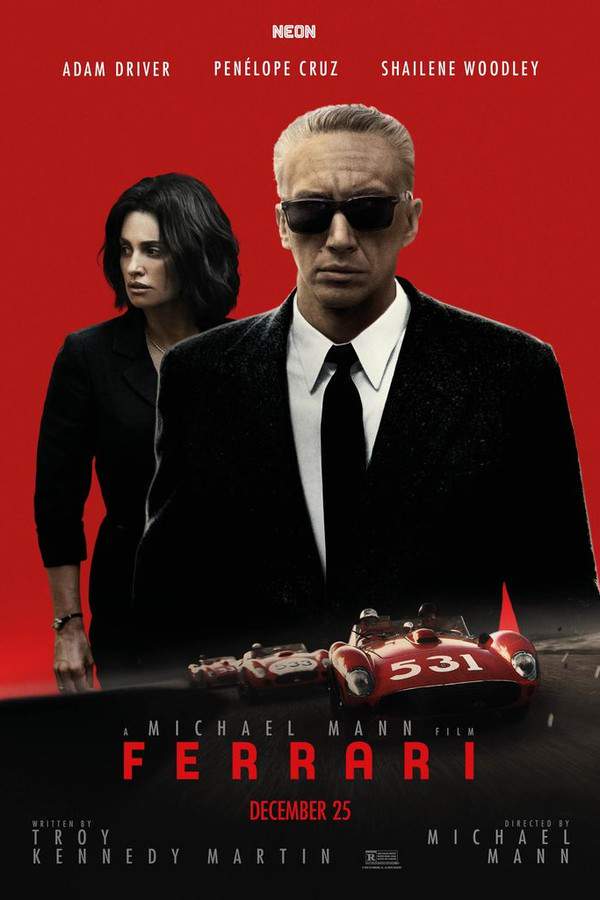
In 1957, Enzo Ferrari faces financial ruin as his racing company struggles. Personal turmoil and past regrets add to the pressure as he battles to save his family's future. He makes a daring decision, risking everything on a pivotal race that could offer a chance at redemption.
Warning: spoilers below!
Haven’t seen Ferrari yet? This summary contains major spoilers. Bookmark the page, watch the movie, and come back for the full breakdown. If you're ready, scroll on and relive the story!
Read the complete plot breakdown of Ferrari (2023), including all key story events, major twists, and the ending explained in detail. Discover what really happened—and what it all means.
In the aftermath of World War II, Enzo Ferrari and his wife Laura (played by Penélope Cruz) established their automobile company, Auto Construzioni Ferrari, which took shape in 1947. Fast forward to the sweltering summer of 1957, the tenacious Italian entrepreneur Enzo Ferrari (portrayed by Adam Driver) finds himself entrenched in both personal and professional turmoil while preparing his racing team for the Mille Miglia—a grueling open-road endurance race stretching a thousand miles. The couple grapples with the unbearable grief of their only son, Dino, who tragically passed away a year earlier, deepening the rift between them.
While Laura remains unaware of her husband’s infidelities, Enzo’s mistress, Lina Lardi (played by Shailene Woodley), is pressuring him to bestow the Ferrari name upon their illegitimate son, Piero (portrayed by Giuseppe Festinese), as his confirmation approaches.
In a bid to bolster the upcoming racing season, Enzo seeks to hire accomplished Maserati driver Jean Behra (depicted by Derek Hill). However, his visit to Lina delays his arrival at the train station where he fails to meet Behra, who has plans to challenge the world record held by Eugenio Castellotti (played by Marino Franchitti), one of Ferrari’s own drivers. The emotional burden weighs heavily on Enzo, who emotionally connects with his late son Dino during heartfelt visits to his grave, confessing, “Laura is not the woman I fell in love with anymore.”
Amidst this turmoil, Enzo’s mother, Adalgisa (portrayed by Daniela Piperno), echoes her own grief, lamenting the loss of her son Alfredo during the war and reflecting on a perceived injustice in losing the wrong child. Tension escalates when Behra successfully breaks Ferrari’s speed record, leading to a catastrophic turn when Eugenio suffers a tragic accident on the track, leaving behind his fiancé Cecilia Manzini (played by Valentina Bellè).
As the media begins to point fingers at Enzo for a troubling driver safety record, he finds himself at odds with Laura, who traditionally oversees the company’s finances. In a turn of events, Laura halts the paycheck for Eugenio, yet Enzo insists she provide Cecilia with funds to secure her future. Simultaneously, desperate to keep the business afloat amidst crippling financial losses, Enzo’s accountant, Giacomo Cuoghi (portrayed by Giuseppe Bonifati), advises him to secure a financial partner to elevate production to a staggering 400 cars annually, a goal that hinges on their success at the Mille Miglia.
As Ferrari secures Alfonso De Portago for the race team, he cautions the driver to keep personal distractions away from the track, emphasizing the importance of maintaining focus. The stakes rise as other notable drivers, including Carlo Chiti (played by Michele Savoia) and entries from Peter Collins, Piero Taruffi, and Wolfgang Von Trips hit the tracks.
Caught in a precarious situation, Enzo faces mounting pressure to merge with another company to sustain operations. However, Laura holds half of Ferrari’s shares, necessitating that Enzo persuades her to relinquish control. In a tense showdown, Laura’s conditions threaten to bankrupt the business, yet their intertwined lives push them toward an unavoidable confrontation.
As the iconic Mille Miglia race commences in Brescia, Enzo finds himself pitted against Adolfo Orsi (Domenico Fortunato) and amid fierce competition with Maserati. With the race on the line, Ferrari pushes his team to elevate their performance, ultimately leading to tragic consequences when Alfonso De Portago’s reckless decision during the race results in a catastrophic crash, claiming the lives of numerous onlookers and leaving an indelible mark on the racing community.
In the wake of the accident and relentless media scrutiny, Laura takes drastic action. She cashes in a check, using the funds as bribe money for journalists while strategically maneuvering to sign over full rights to the company, stipulating that Enzo must delay granting Piero the Ferrari name until after her passing.
The legacy of Ferrari weathers the storm, with Piero emerging as a vital figure within the company as Enzo finds solace in his bond with Lina, as well as in the memories of his son. Ultimately, Laura passes away in 1978, leaving the infamous legacy of Ferrari in the capable hands of Piero, who navigates the intricate landscape of the automotive world as Vice Chairman.
Last Updated: October 24, 2024 at 09:02
Still wondering what the ending of Ferrari (2023) really means? Here’s a spoiler-heavy breakdown of the final scene, major twists, and the deeper themes that shape the film’s conclusion.
Ferrari’s ending reveals a mix of personal sacrifice, unresolved loyalties, and the ongoing legacy of Enzo Ferrari. Throughout the film, we see Enzo struggling to save his racing team and family business, torn between his relentless ambition and the crumbling state of his personal life. The climax builds around the tragic Mille Miglia race, where driver Alfonso de Portago’s reckless decision to push his car without proper pit stops results in a catastrophic accident that claims lives, including innocent spectators. This tragedy casts a dark shadow over Enzo’s success, leading to legal charges and public scrutiny. However, the charges against him are eventually dropped, as it is determined that the accident was caused by a roadside reflector, not negligence.
At the same time, the film explores the fractured relationship between Enzo and his wife Laura. She discovers that Enzo has been hiding a secret family in Castelvetro, including a son, Piero, with a woman named Lina Lardi. This revelation devastates Laura, especially given the grief over their late son Dino, and intensifies their personal rift. Yet, Laura’s final act of love and sacrifice is to loan Enzo the money she received from selling her shares—a gesture meant to support his troubled company and career. She requests that, as a condition, Enzo never give Piero the Ferrari surname, a symbolic protection of Dino’s memory and her own grief.
In the end, even amidst familial pain and public scandal, Enzo maintains his connection to his new family, still involved with Lina and Piero. The movie closes on a touching scene of Enzo with a young Piero, hinting at future hope. After Laura’s death, Enzo revives his bond with his son Piero, who eventually becomes Vice Chairman of Ferrari. The film’s conclusion reflects the complex interplay of love, ambition, identity, and legacy, leaving viewers with a poignant look at how personal and professional lives intertwine in the shadow of greatness.}
Last Updated: June 25, 2025 at 09:01
Discover curated groups of movies connected by mood, themes, and story style. Browse collections built around emotion, atmosphere, and narrative focus to easily find films that match what you feel like watching right now.
Biographical dramas where immense professional stakes collide with private turmoil.If you were captivated by the tense convergence of business peril and personal crisis in Ferrari, explore these movies. This collection features intense biographical and dramatic stories about iconic figures pushed to the brink, where the fate of a legacy hinges on a single, high-risk decision.
Narratives in this thread follow a central figure, often based on a real person, as they grapple with a professional catastrophe—financial ruin, a failing company, a pivotal event—that is inextricably linked to their personal failings, such as infidelity, grief, or a fractured family. The story builds steadily towards a climactic moment that will determine their future.
These movies are grouped by their heavy emotional weight and tense tone, stemming from the protagonist's dual crises. They share a steady pacing that methodically builds pressure, a high intensity viewing experience, and a focus on the moral and emotional cost of ambition.
Stories where hard-won success is permanently stained by profound loss.For viewers who appreciated the complicated, tragic victory at the end of Ferrari, this thread gathers movies with similarly bittersweet conclusions. These stories feature climactic successes that are deeply shadowed by loss, moral compromise, or tragedy, creating a powerful and lingering emotional resonance.
The narrative arc moves towards a clear, high-stakes objective. The protagonist achieves this goal, but the victory is hollow or compromised. The ending is not purely happy or sad; it's a mix of professional accomplishment and profound personal cost, often involving death, sacrifice, or irreversible damage to relationships.
Movies in this thread share a specific emotional structure: a heavy, tense journey culminating in a bittersweet ending. They are united by their exploration of the price of ambition and the melancholy that can underpin great achievements, offering a realistic and emotionally complex viewing experience.
Don't stop at just watching — explore Ferrari in full detail. From the complete plot summary and scene-by-scene timeline to character breakdowns, thematic analysis, and a deep dive into the ending — every page helps you truly understand what Ferrari is all about. Plus, discover what's next after the movie.
Track the full timeline of Ferrari with every major event arranged chronologically. Perfect for decoding non-linear storytelling, flashbacks, or parallel narratives with a clear scene-by-scene breakdown.
Discover the characters, locations, and core themes that shape Ferrari. Get insights into symbolic elements, setting significance, and deeper narrative meaning — ideal for thematic analysis and movie breakdowns.
What really happened at the end of Ferrari? This detailed ending explained page breaks down final scenes, hidden clues, and alternate interpretations with expert analysis and viewer theories.
Get a quick, spoiler-free overview of Ferrari that covers the main plot points and key details without revealing any major twists or spoilers. Perfect for those who want to know what to expect before diving in.
Visit What's After the Movie to explore more about Ferrari: box office results, cast and crew info, production details, post-credit scenes, and external links — all in one place for movie fans and researchers.
Discover movies like Ferrari that share similar genres, themes, and storytelling elements. Whether you’re drawn to the atmosphere, character arcs, or plot structure, these curated recommendations will help you explore more films you’ll love.
Ferrari (2023) Scene-by-Scene Movie Timeline
Ferrari (2023) Movie Characters, Themes & Settings
Ferrari (2023) Ending Explained & Theories
Ferrari (2023) Spoiler-Free Summary & Key Flow
Movies Like Ferrari – Similar Titles You’ll Enjoy
Senna (2011) Complete Plot Breakdown
Grand Prix (1966) Plot Summary & Ending Explained
Racer and the Jailbird (2018) Film Overview & Timeline
The Racer (2020) Ending Explained & Film Insights
Lamborghini: The Man Behind the Legend (2022) Full Movie Breakdown
Le Mans (1971) Full Movie Breakdown
The Young Racers (1963) Plot Summary & Ending Explained
Driven (2001) Detailed Story Recap
The Racers (1955) Film Overview & Timeline
Race for Glory: Audi vs. Lancia (2024) Plot Summary & Ending Explained
F1: The Movie (2025) Ending Explained & Film Insights
Born to Race (1988) Ending Explained & Film Insights
Le Mans, Shortcut to Hell (1970) Full Movie Breakdown
Senna (1000) Spoiler-Packed Plot Recap
F1 (2025) Plot Summary & Ending Explained